In this guide
- 01What "Calm" Actually Means in Kyoto
- 02Higashiyama: Temple Bells, Stone Lanes, and the Crowd Problem
- 03Miyagawa-cho and the Higashiyama Edge: Where Capella Landed
- 04Arashiyama: River Silence, With a Catch
- 05Okazaki and the Northern Higashiyama Foothills: Underrated Quiet
- 06Nishijin and the Quieter North: Living Kyoto
- 07A Simple Framework: Match Your Temperament to the Right Base
- 08Book Ahead — Especially for 2026 and 2027
- 09Frequently Asked Questions
- 10Why Choose Japan Royal Service
- 11Let Us Match Your Dates and Temperament to the Right Kyoto
Most Kyoto hotel lists sell you a photograph. A tea garden at golden hour. A bath carved from cypress. What they never mention is the sound at 7 am, the tour-bus route that runs past the entrance, or the fact that the loveliest lobby in the city sits on an arterial road that roars until midnight.
Calm is not a design choice. It is a location, a set of pedestrian flows, and an arrival plan. In our experience at Japan Royal Service, the difference between a serene stay and a merely photogenic one is often a single street.
This guide compares the newest Kyoto openings for 2026 and 2027 the way we actually assess them for our guests — by neighborhood feel, not by star count or marketing render. We name the tradeoffs plainly. Where a buzzy new address looks flawless online but sits on a crowded lane, we say so.
What "Calm" Actually Means in Kyoto
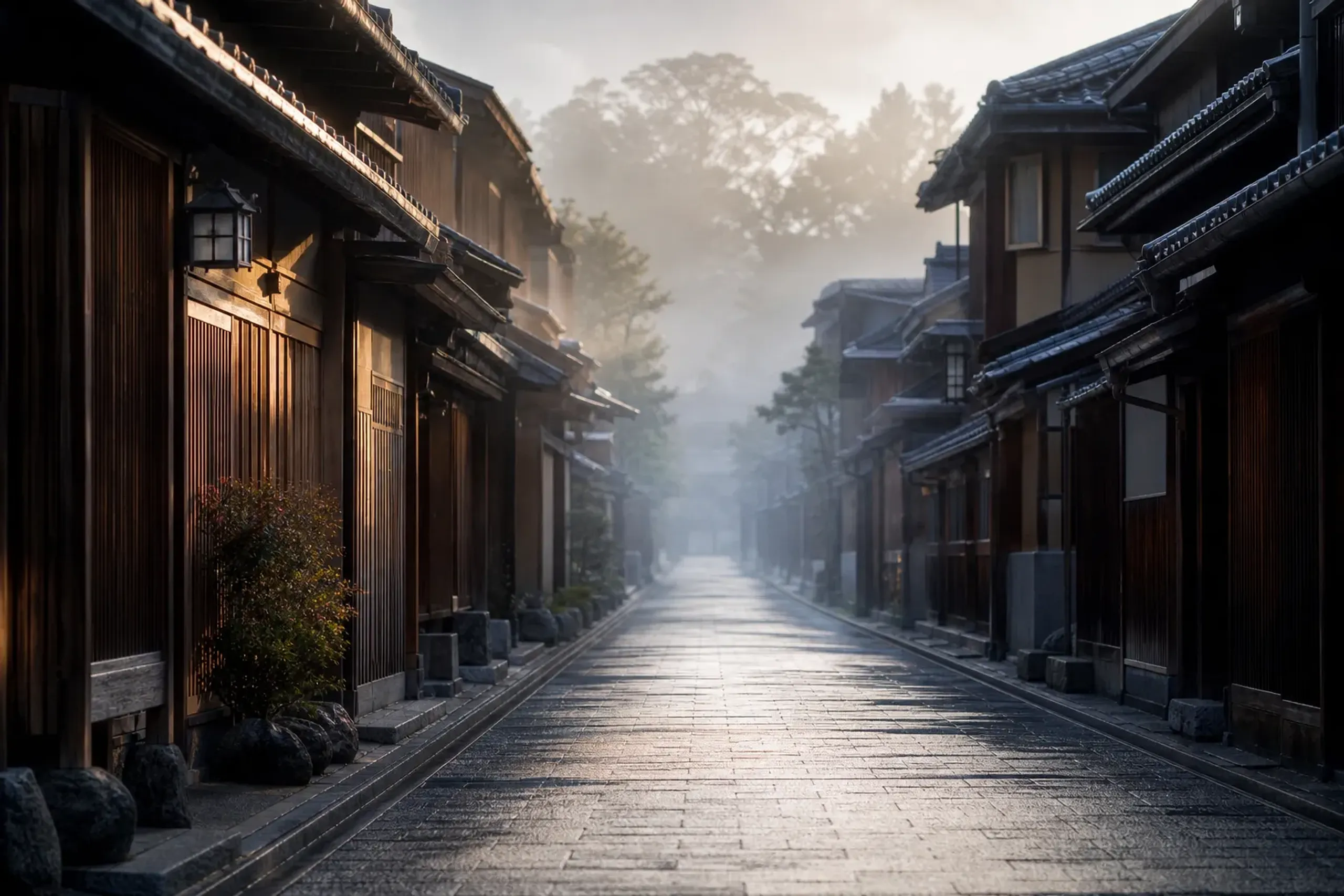
Calm is a time of day and a location before it is anything else.
Vague words help no one. So here is how we define calm, concretely, before we rank a single neighborhood.
A calm base in Kyoto passes most of these tests:
- Quiet at 7 am. The soundscape at dawn is birdsong or temple bells, not idling coaches.
- Distance from the crush. A short, unhurried walk keeps you clear of the Gion and Nishiki bottlenecks at peak hours.
- The last 200 meters. Your final approach runs along a lane or canal, not a four-lane artery.
- Soundproofing and river or garden views. What you hear from the pillow matters as much as what you see.
- Serene temples before opening. You can reach a quiet precinct on foot in ten minutes, ideally before the gates draw a crowd.
Kyoto City itself now leans hard into this thinking. Its official tourism guidance promotes dispersion — spreading visitors across seasons, times of day, and lesser-known districts such as Fushimi, Ohara, Takao, Yamashina, and Keihoku. The city even publishes a comfort map with live cameras. Calm, in other words, is now municipal policy. Choosing the right base is how you align with it.
One distinction that changes everything: calm inside the hotel and calm outside the door are two separate things. A property can be a sanctuary within its walls and still deposit you onto a coach corridor the moment you step out. We read both.
Higashiyama: Temple Bells, Stone Lanes, and the Crowd Problem
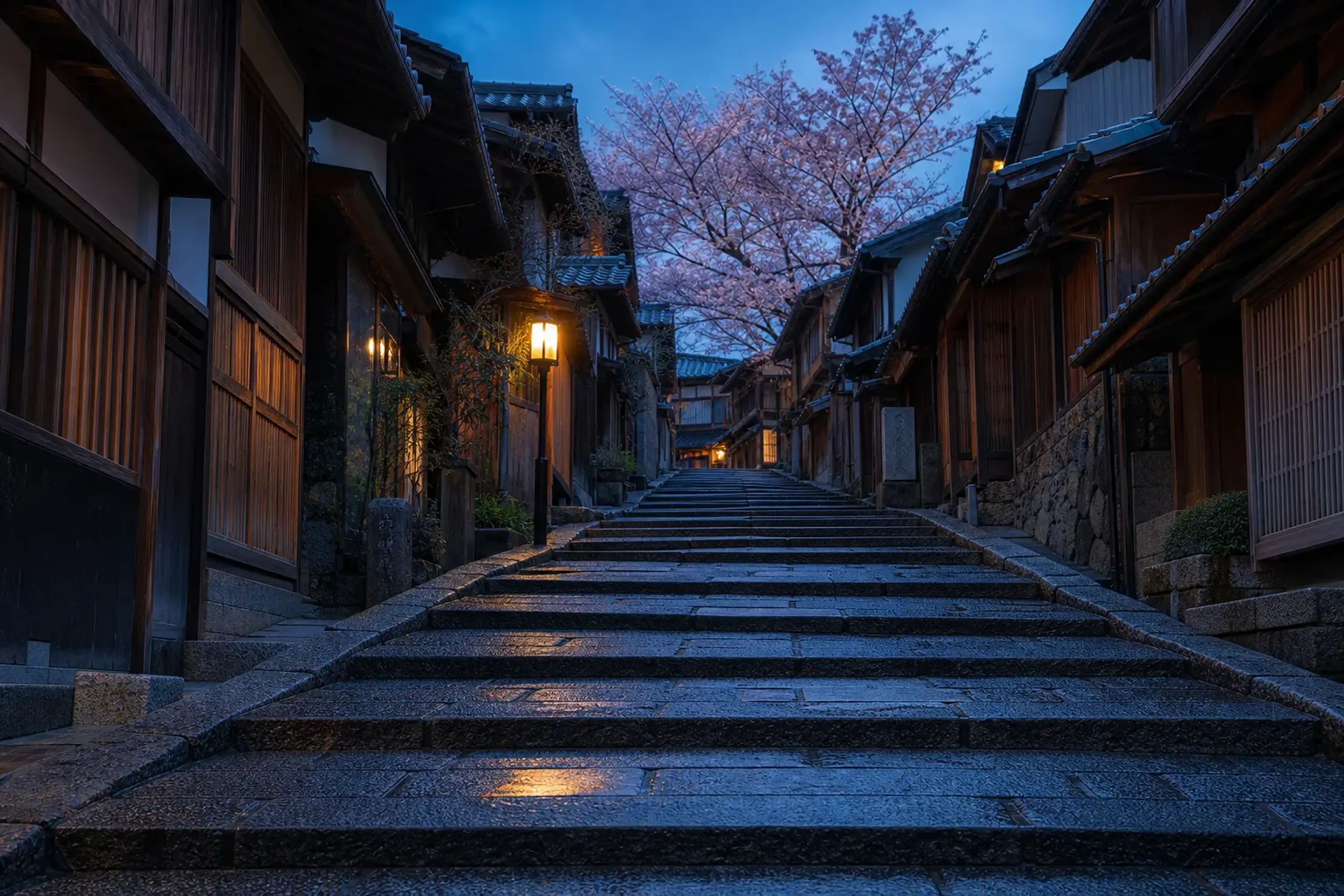
Higashiyama's dawn window: quiet, low light, and stone still cool.
Higashiyama is the Kyoto of the imagination. Slate roofs against wooded hills. Ninen-zaka and Sannen-zaka, those sloping stone lanes toward Kiyomizu-dera. This is where most first-time visitors want to sleep.
It is also, by midday, one of the busiest quarters in the city. The lanes that feel like a woodblock print at dawn become a slow river of people by ten. So the Higashiyama question is entirely about timing and micro-location.
The dawn advantage is real, though. Stay here and you can be walking an empty Sannen-zaka before the shops open, with the light still low and the stone still cool. That window closes fast. By breakfast it is gone.
Two significant properties anchor this district. Six Senses Kyoto opened in late April 2024, its design drawing on the Heian period, within walking distance of Myoho-in, the Kyoto National Museum, and Sanjusangen-do — a pocket of southern Higashiyama that stays notably quieter than the Kiyomizu approach. Banyan Tree also maintains a Kyoto property page for Banyan Tree Higashiyama, describing a hillside setting near Kiyomizu-dera and a bamboo grove. Opening timing for the Banyan Tree page was not clearly confirmed at the time of writing, so we would verify current status before recommending it for firm dates.
Who this suits: the early riser who genuinely wants those first-light lanes, and who accepts that afternoons belong to the crowds. If you sleep late and dislike foot traffic, look elsewhere.
Miyagawa-cho and the Higashiyama Edge: Where Capella Landed
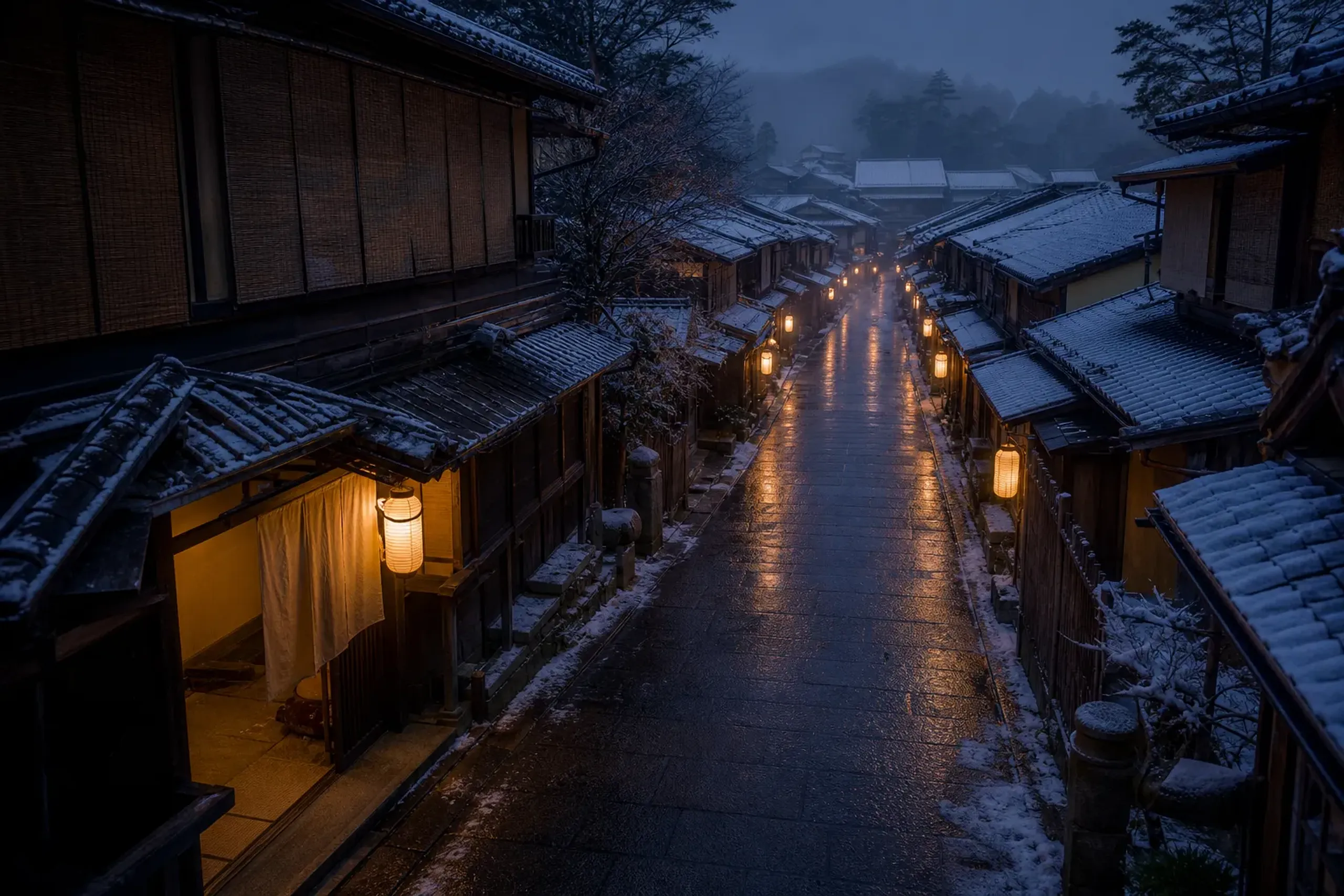
Miyagawa-cho's inner lanes hush after dark — a single street from the busy riverfront.
The headline opening of 2026 sits right on this seam. Capella Kyoto opened on March 22, 2026 — the brand's first property in Japan, an 89-key hotel designed by Kengo Kuma & Associates, with Brewin Design Office referenced in the brand's materials. It occupies the Miyagawa-cho edge of Higashiyama, one of Kyoto's five traditional geisha districts.
This is a fascinating micro-location. Miyagawa-cho runs quiet and residential in a way Gion proper no longer manages, yet you are still minutes from the Kamo River and the southern Higashiyama temples. The Kuma design language — timber, restraint, filtered light — reads as wabi-sabi rather than spectacle, which is exactly the register a discerning guest wants here.
The read to make: a single street separates serenity from exposure in this part of Kyoto. Miyagawa-cho's inner lanes hush after dark; the river-facing arteries do not. Which side of the building you sleep on matters. When we brief guests on new inventory like this, we look at exactly that — room orientation, the arrival approach, and how fast you can reach a quiet riverside walk without threading a crowd.
Who this suits: the traveler who wants a genuinely new, design-led address with strong concierge capability, and who values being walkable to both nightlife texture and dawn stillness. A light sleeper should ask, pointedly, for an inner-lane room.
Arashiyama: River Silence, With a Catch
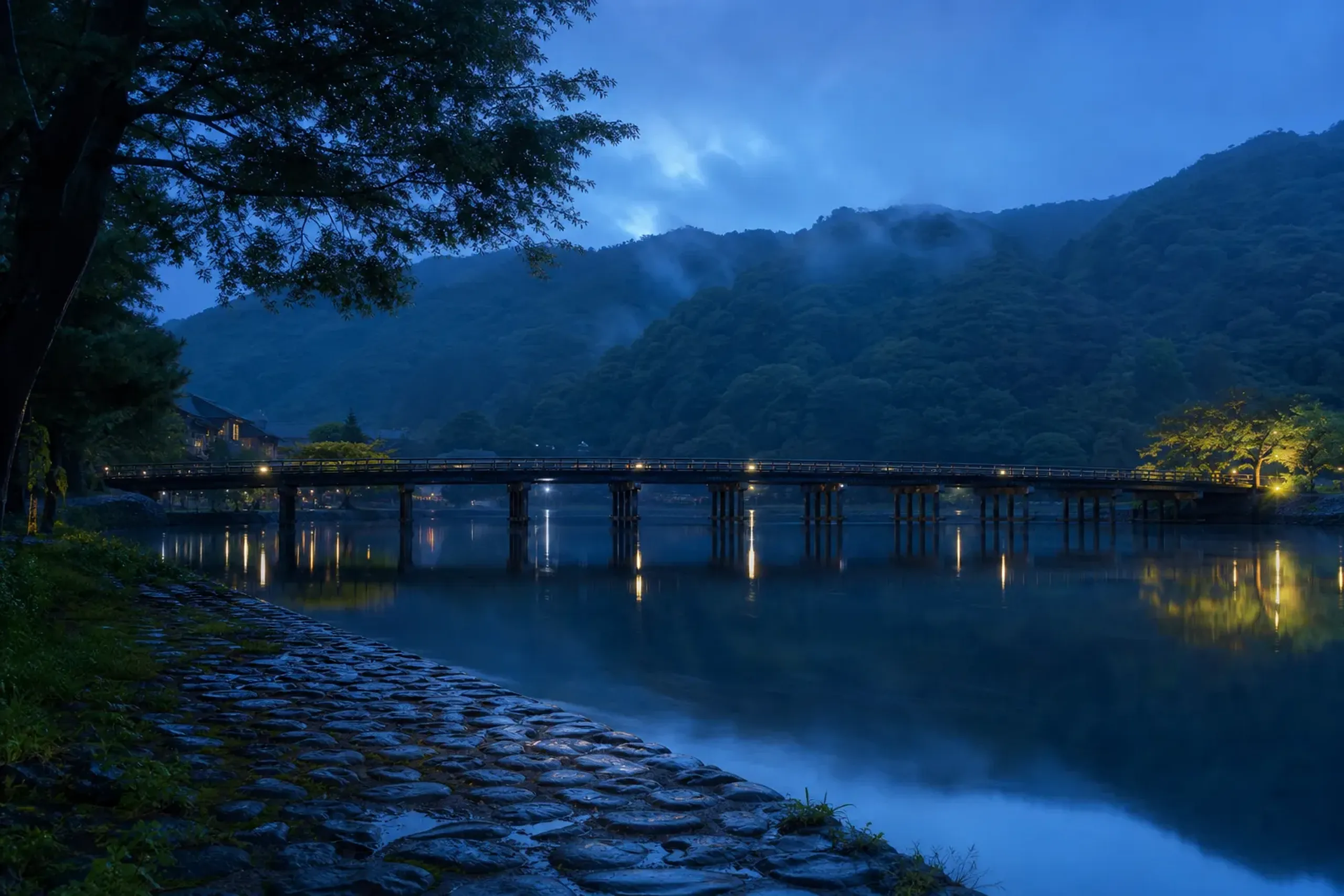
Arashiyama empties after dark, delivering Kyoto's quietest evening.
West of the city, Arashiyama offers a different kind of calm — the hush of the Oi River, the Togetsukyo Bridge, cedar and bamboo. Evenings here empty out almost completely once the day-trippers board their trains. That after-hours quiet is the whole point.
The catch is daytime. The bamboo grove and bridge draw enormous volume between mid-morning and late afternoon, and Arashiyama sits further from central Kyoto, which lengthens your transfers. This is a base for guests who plan to be out of the district when it fills, and back in it when it clears.
Handled well, Arashiyama rewards you with the single quietest evening in Kyoto. A private chauffeur matters more here than almost anywhere — the last stretch of road narrows and clogs at peak, and a well-timed private chauffeured transfer can slip you in during the lull rather than the surge.
Who this suits: the guest who prizes evening seclusion and river views over walkable urban texture, and who is comfortable with longer runs into town.
Okazaki and the Northern Higashiyama Foothills: Underrated Quiet
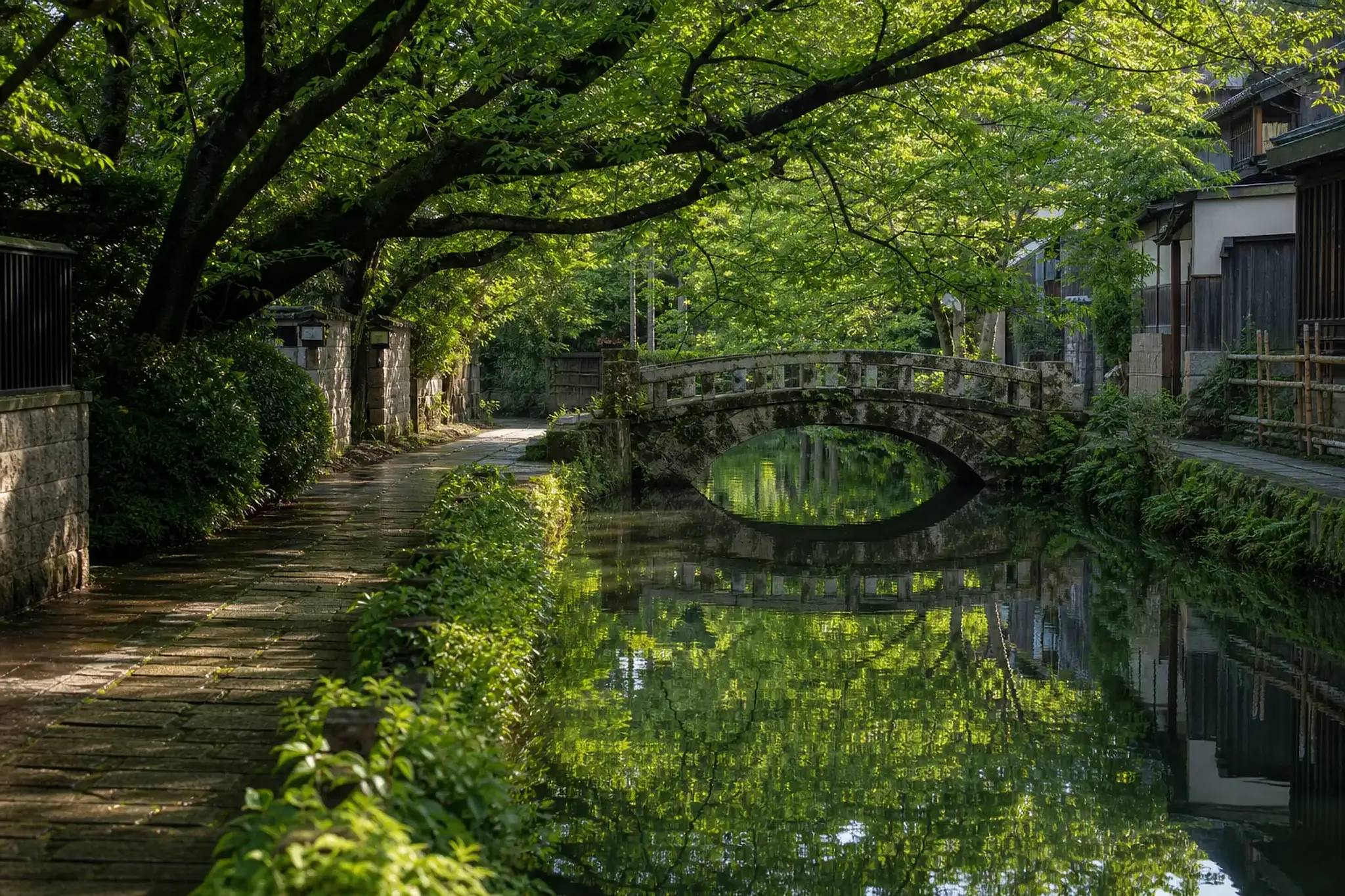
Okazaki's canals give you flat, shaded, near-empty walking routes at dawn.
Between the Heian Shrine's great torii and the wooded foot of the eastern hills lies Okazaki — museums, canals, wide boulevards, and a pace that feels almost provincial compared with Gion. The Philosopher's Path threads north from here toward Ginkaku-ji, past small temples that most tour groups skip.
This is where calm outside the door comes cheap, so to speak. Morning foot traffic is light. The canals give you flat, shaded walking routes. You can reach Nanzen-ji's aqueduct or a quiet sub-temple garden well before the coaches arrive, then be back for breakfast having met almost no one.
What Okazaki trades away is immediate atmosphere. It has fewer lantern-lit lanes and fewer machiya facades than Higashiyama proper. You gain space and quiet; you give up a little of the picture-book density.
Who this suits: the light sleeper and the early walker who wants serene temples on the doorstep without the crowd tax — and who doesn't need geisha-district theatre outside the window.
Nishijin and the Quieter North: Living Kyoto
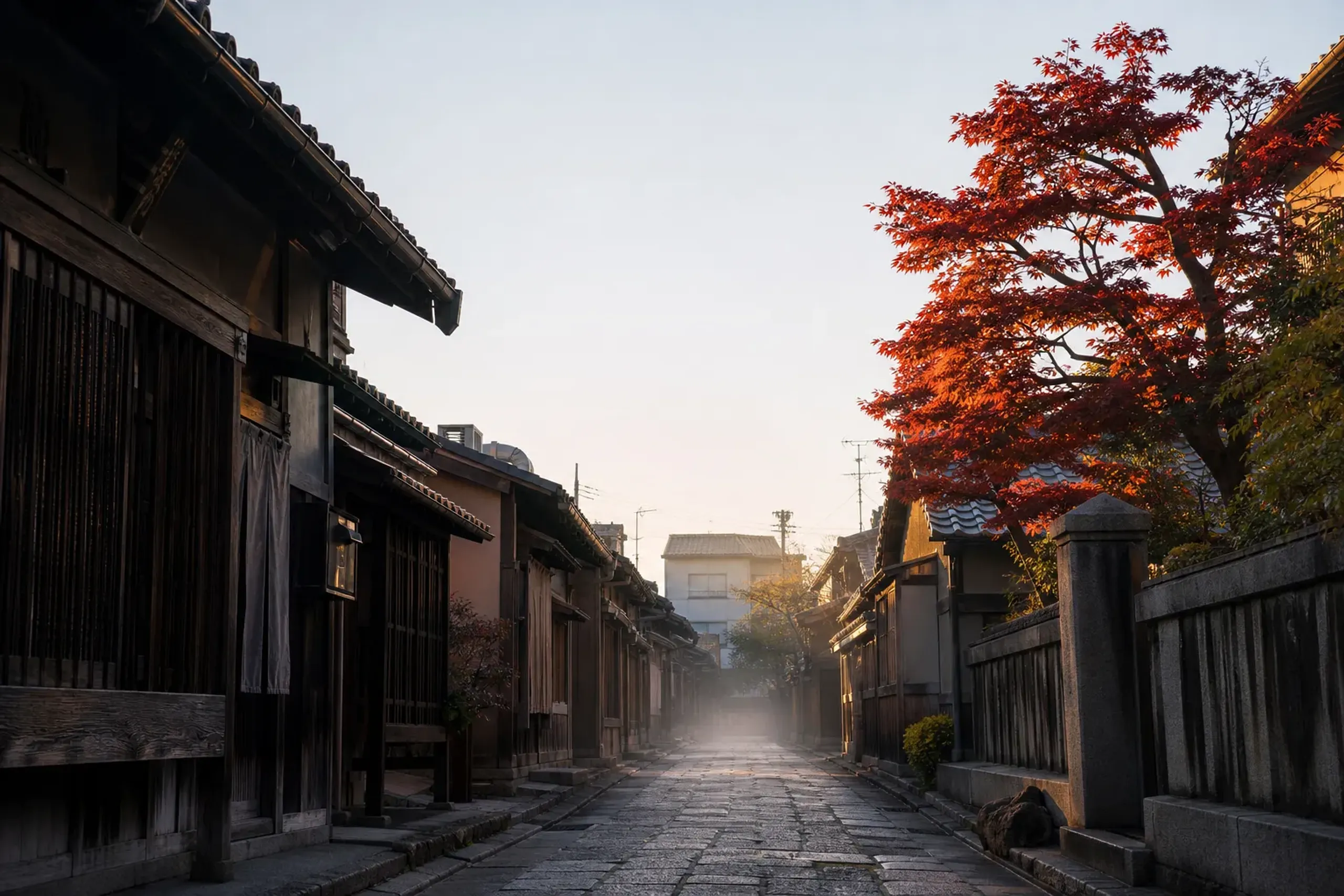
Northwest of the center, Nishijin is the old weavers' quarter — the loom sound of the textile trade once filled these blocks. It remains resolutely residential. There are no tour-bus corridors here, few crowds at any hour, and a texture of daily Kyoto life that the polished districts have lost.
Kyoto's own responsible-travel guidance is worth heeding in exactly these neighborhoods. Official advice stresses staying only at licensed accommodations, and notes that vacation rentals often sit in quiet residential streets where guests should avoid noise late at night and early in the morning. For a certain traveler, that etiquette is the appeal: you are a quiet guest in a real neighborhood, not a spectator in a tourist zone.
The trade is convenience. You are further from the marquee sights, and machiya stays in these areas tend to be intimate and self-directed rather than full-service. Some guests want precisely that stillness; others miss the concierge power of a design hotel.
Who this suits: the return visitor, or the traveler seeking hidden-Japan immersion over amenity — someone content to swap room service for the hush of a private machiya courtyard.
A Simple Framework: Match Your Temperament to the Right Base
Rather than crown a single "best" area, match the neighborhood to how you actually travel. Here is the shorthand we use.
- Your priority: Early riser, wants first-light lanes Best-fit area: Higashiyama / Miyagawa-cho Why: Empty stone lanes before the crowds; accept busy afternoons
- Your priority: Light sleeper, hates foot traffic Best-fit area: Okazaki / northern foothills Why: Quiet mornings, canal walks, temples before opening
- Your priority: Evening seclusion, river views Best-fit area: Arashiyama Why: Near-empty after dark; plan around longer transfers
- Your priority: Immersion over amenity Best-fit area: Nishijin / quieter north Why: Living residential Kyoto; intimate machiya stays
- Your priority: New design address + concierge power Best-fit area: Miyagawa-cho (Capella) Why: 2026 opening; request an inner-lane room
One pattern we often propose blends two of these. Spend one or two nights in a machiya or ryokan in the quieter north for stillness, then move to a design-led hotel nearer the center for concierge reach on the days you want reservations, private access, and logistics handled. Calm and capability, in sequence rather than compromise. A tailor-made itinerary makes that hand-off invisible.
Book Ahead — Especially for 2026 and 2027
Kyoto's official tourism site is explicit: reserve accommodations well in advance, above all during cherry blossom season in early spring and the autumn foliage weeks. Those two windows are the crush, and the best rooms in the calmest micro-locations vanish first.
New inventory tightens this further. An 89-key opening like Capella Kyoto sounds substantial until you consider global demand for a brand's debut Japan property in its first full seasons. Limited keys, high intent, narrow calendars. If your dates fall in spring or autumn 2026 or 2027, the sensible move is to fix the base early and build around it.
Anyone can share the practical facts above. What decides the quality of your stay is the read beneath them — which room faces the quiet lane, when the coaches arrive, how to reach the property without threading the crowd. That is a private conversation, not a public one.
Frequently Asked Questions
Which Kyoto neighborhood is quietest at 7 am?
Okazaki, the northern Higashiyama foothills, and Nishijin all run notably quiet at dawn. Higashiyama proper can also be beautifully empty at first light, but only briefly — the calm there is a window, not a constant.
Is Capella Kyoto a good choice for a calm stay?
It can be. It opened March 22, 2026 on the Miyagawa-cho edge of Higashiyama, a quieter geisha district than Gion. The caveat is room orientation: inner-lane rooms hush after dark, river-facing ones less so. Ask before you commit.
Where should I stay in Kyoto to avoid the crowds entirely?
Consider the quieter north (Nishijin) or a base aligned with Kyoto City's dispersion program — areas such as Ohara or Fushimi — paired with early-morning and evening sightseeing. Kyoto's own guidance actively encourages spreading out by time and place.
How far ahead should I book for cherry blossom or autumn 2026/2027?
As early as you reasonably can. Kyoto's official tourism site specifically flags spring and autumn as the seasons to reserve well in advance, and new limited-key hotels sell their best rooms first.
Why Choose Japan Royal Service
The value we add is not a list of hotels — you can find those anywhere. It is the read beneath the list. Which street the property truly sits on. When the crowds arrive at the lane outside. How to orient a room away from the noise, and how to arrive without being seen.
Our concierge coordinates discreet, low-visibility arrivals, briefs staff on privacy requests, and paces your days so you meet Kyoto's quiet hours rather than its crush. We hold soft-open intelligence on new properties — when private dining rooms become bookable, which entrances stay calm — and we design around it. For guests who want stillness, we build stillness into the plan, block by block.
Discretion sits at the center of everything we do at Japan Royal Service. Your identity, your dates, and your itinerary remain confidential, always.
Let Us Match Your Dates and Temperament to the Right Kyoto
Tell us how you travel — light sleeper or night owl, early walker or late riser, seclusion or walkability — and the season you have in mind. We will match it to the right neighborhood and the right room. For a private, confidential conversation, reach our team via WhatsApp or LINE, or contact us here.