In this guide
- 01What Makes Asaba Ryokan The Reference Point In Shuzenji?
- 02The Family, The Founding, And Why 1484 Still Matters
- 03How Does The Gekkeiden Noh Stage Change A Stay At Asaba?
- 04Rooms: Twelve Keys, Twelve Nakai, And The Calm That Ratio Creates
- 05Baths And Water: Kakenagashi, Soft Alkaline Spring, And No Fuss
- 06Kaiseki At Asaba: Izu Seafood, Local Produce, And In-Room Tradition
- 07Can Families Stay At Asaba Ryokan With Children?
- 08Shuzenji, Briefly: The Walk That Puts You In The Right Mood
- 09How Do You Get To Asaba Ryokan From Tokyo?
- 10When Should You Stay At Asaba In Shuzenji For The Best Experience?
- 11How This Fits A 2026 Luxury Ryokan Trip (Without Turning It Into A Checklist)
- 12Asaba Looks Fully Booked For My Dates — What Now?
- 13Frequently Asked Questions
- 14Why Choose Japan Royal Service For Asaba Ryokan?
At Asaba, the first sound you notice is not a greeting.
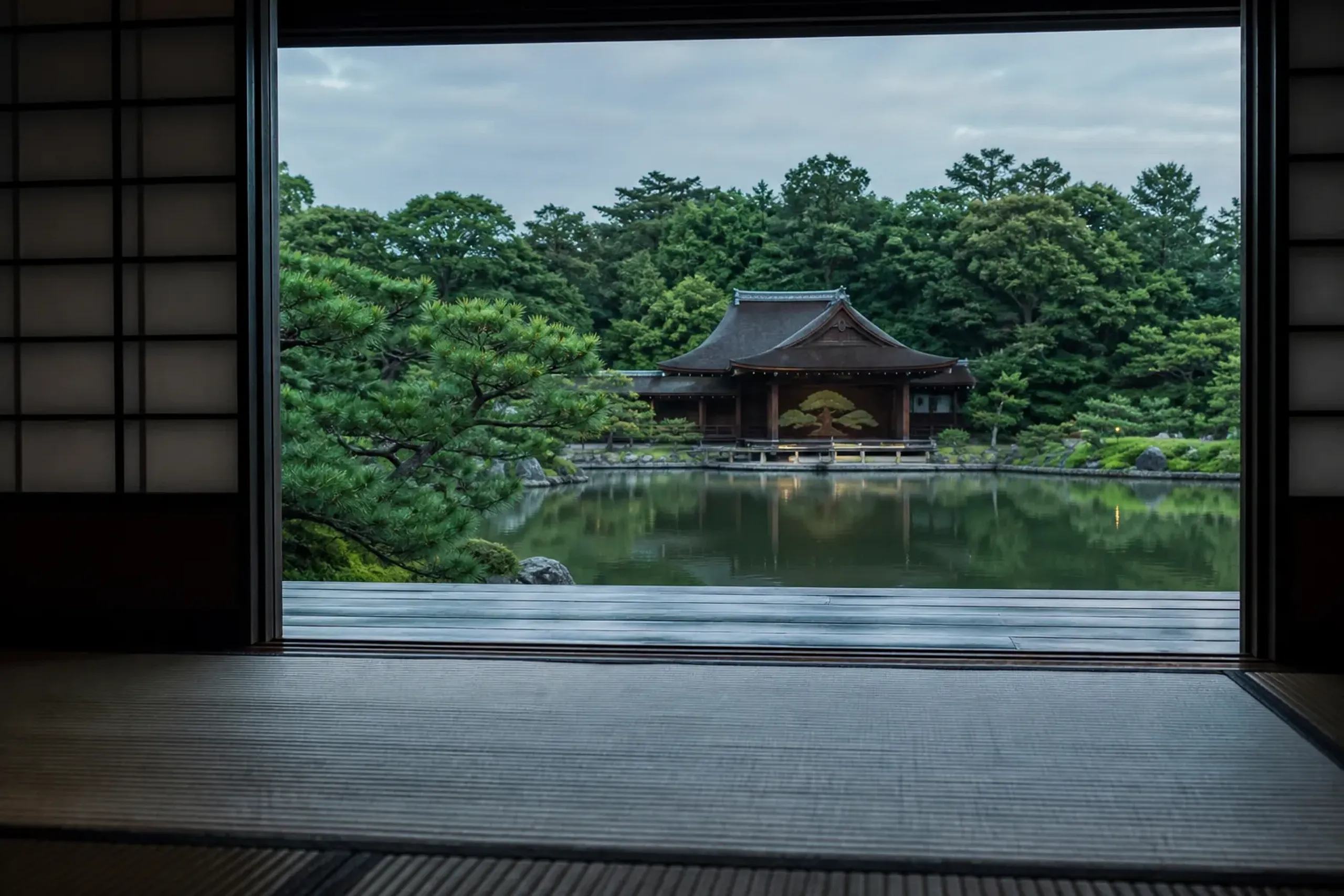
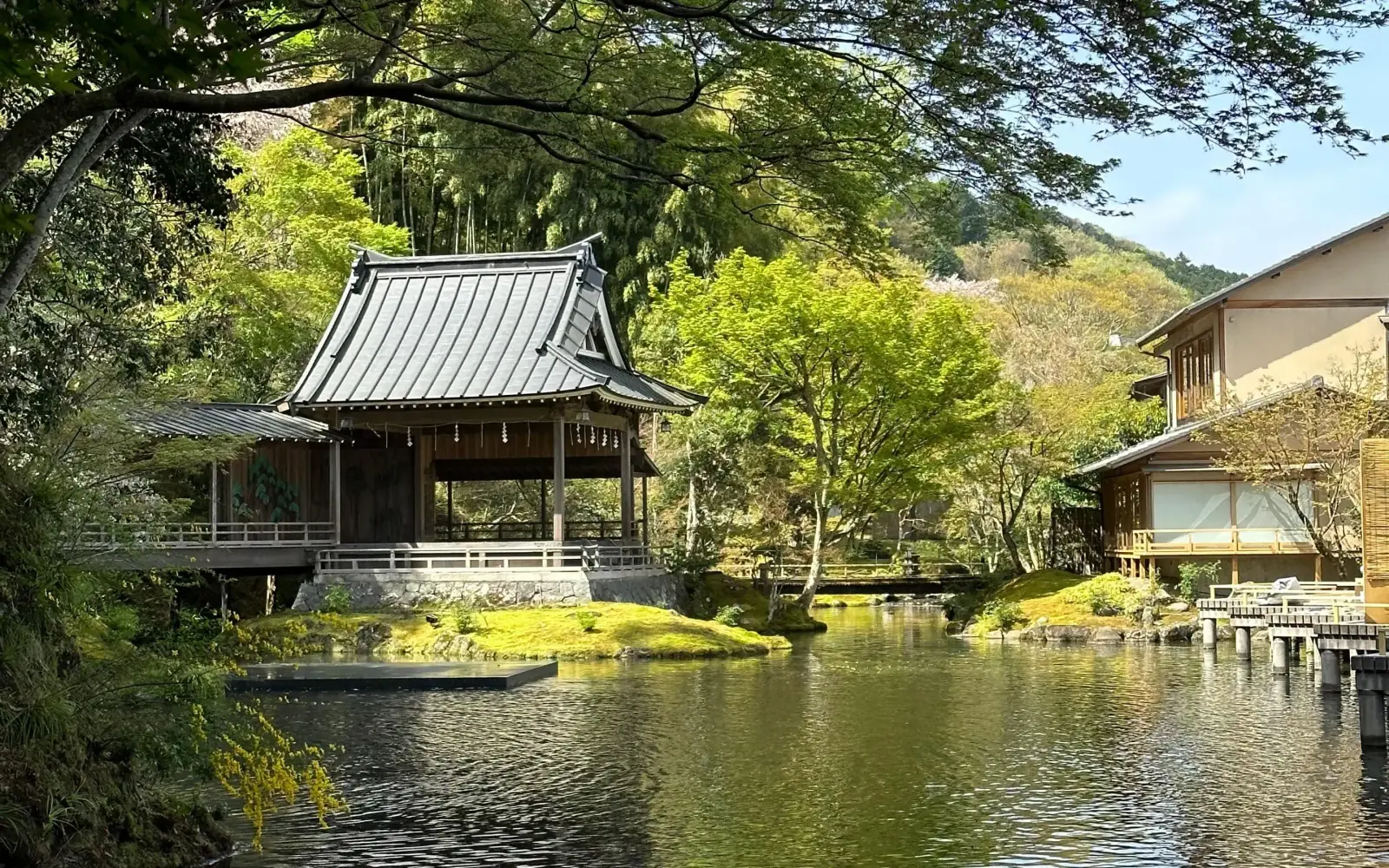
It is water. A small, steady presence, moving under the dark surface of a pond that holds the inn’s center of gravity. Across that water sits the Gekkeiden, a Noh stage standing on the pond itself, with a roofline that reads like calligraphy against the trees.
Everything is oriented toward it. Quietly. Deliberately.
Shuzenji is not a place that asks for your attention. It simply keeps it. And when you arrive at Asaba Ryokan—address 3450-1 Shuzenji, Izu, Shizuoka—you realize the house is not “near” the stage. The house is built around the idea that the stage matters.
What Makes Asaba Ryokan The Reference Point In Shuzenji?
Asaba Ryokan is widely regarded as a prototype of the ryokan experience, with twelve rooms, a Noh stage on the pond, and a family history that begins in 1484.
That “twelve” is not a marketing number. It shapes the feel of the stay. The inn’s rhythm is measured, not busy, and the scale makes the property read as a private residence that happens to accept guests.
Michelin has recognized Asaba with Three MICHELIN Keys and describes it as the prototype of the ryokan experience. Relais & Châteaux admitted Asaba in 1989, the first ryokan in Japan to join. These are signals, yes—but the more persuasive proof is physical.
Stand on the garden side at dusk. You can see the stage lights begin to glow on the water. It does not feel decorative. It feels structural.
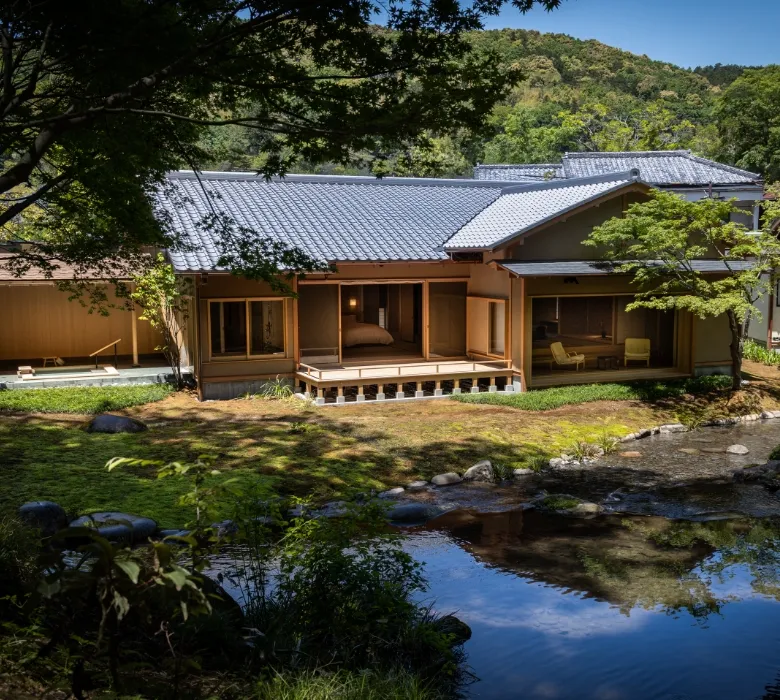
A ryokan scaled for quiet: Asaba’s pond sets the pace before you even step inside.
The Family, The Founding, And Why 1484 Still Matters
Asaba was founded in 1484 by Yakuro Yukitada Asaba, who came to Shuzenji to establish the Soto sect of Buddhism at Shuzenji Temple and opened lodging in front of the temple while serving as its keeper.
Over five centuries is an easy phrase to write. It is harder to grasp on arrival, because the place does not perform “antique.” It feels lived-in, maintained, and watchful about what it changes.
In our experience, HNW travelers notice this most in the pacing. There is no push. No hurry to “show” you the property. You find it through sightlines: tatami to garden, garden to pond, pond to stage.
That continuity is a kind of discretion. Not secrecy. Just the refusal to explain itself loudly.
How Does The Gekkeiden Noh Stage Change A Stay At Asaba?
The Gekkeiden turns the inn into a working cultural venue, because it is a real Noh stage placed at the center of the property rather than a display set to the side.
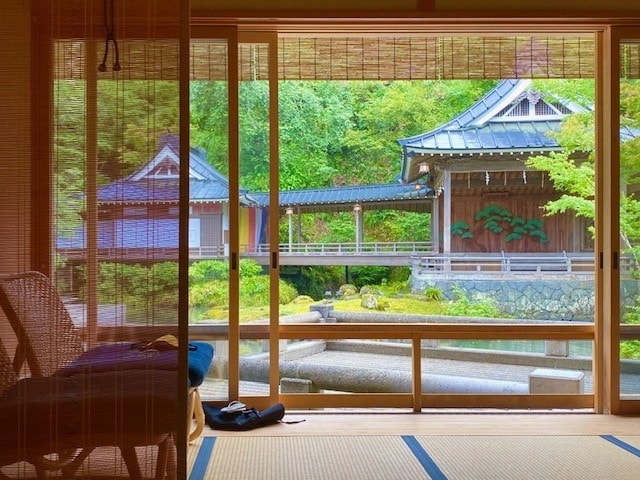
The stage was relocated from Tokyo in the late Meiji period by the seventh-generation proprietor and set into the middle of the pond. You see it from the engawa. You see it from garden paths. In many rooms, you see it without standing up.
For roughly forty years, the stage has been the center of the Asaba Cultural Journey, hosting masters of Noh, Kyogen, Shinnai storytelling, Bunraku, and biwa in seasonal performances.
One planning detail matters more than any other: performance dates are not always published far in advance, and rooms for those dates can book far ahead.
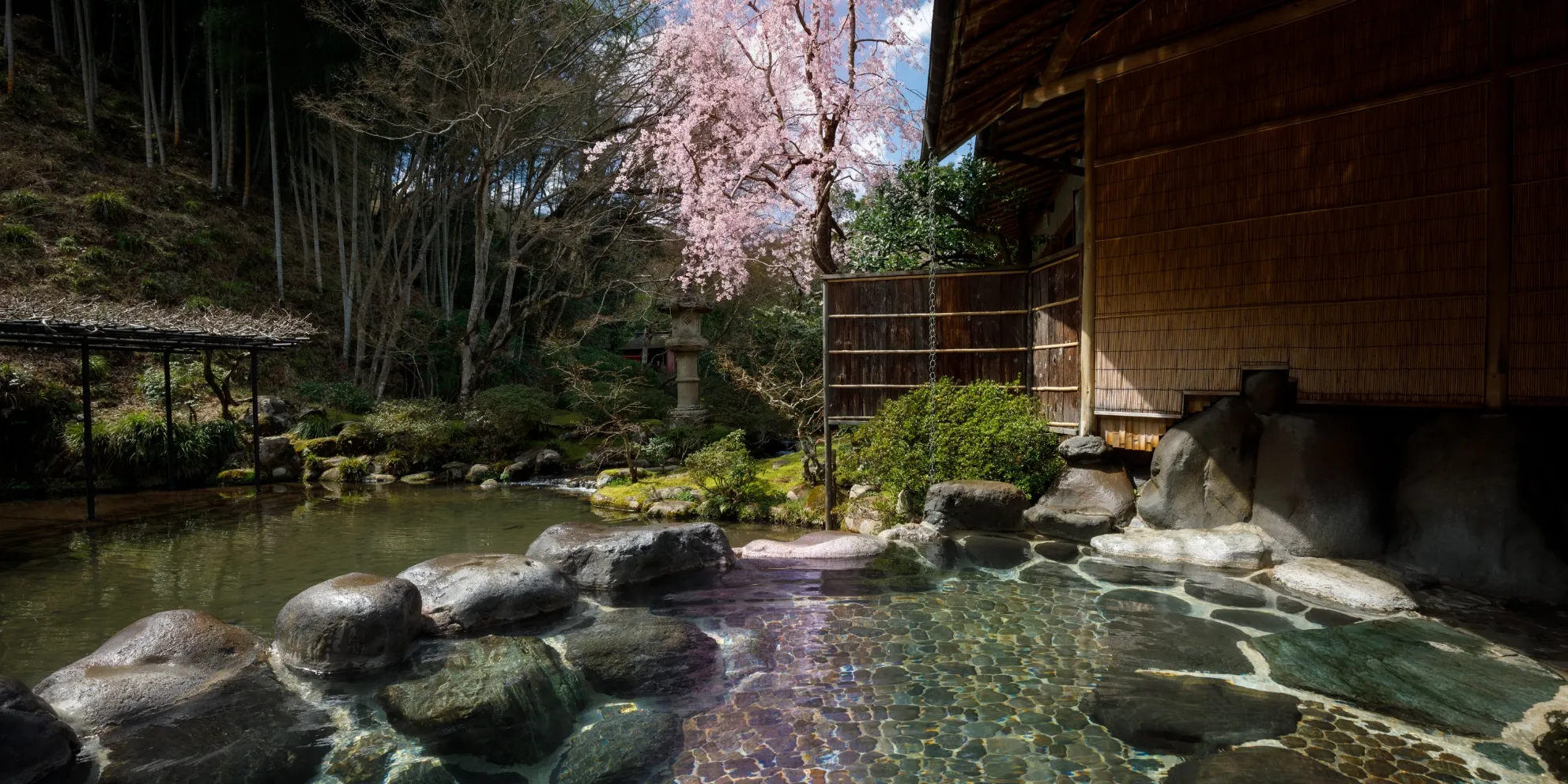
The Gekkeiden is not décor. It is the property’s organizing principle.
Decide early. That single choice—performance night or not—often determines your entire timing strategy.
Key fact: If you want to stay on a Cultural Journey performance date, plan 6–12 months ahead and be ready to move when dates appear.
On performance evenings, guests can watch from the garden, from the engawa, or—depending on the room—from their own space. The experience is unusually intimate because there is no “auditorium mood.” You are simply staying, and something timeless happens to be performed across the water.
It lands differently. You do not clap like you do at a theater downtown. You listen. You let the drum travel over the pond, then fade back into the trees.
Rooms: Twelve Keys, Twelve Nakai, And The Calm That Ratio Creates
Asaba has twelve rooms, including the detached Villa Tenko and suites such as Hagoromo (126 sqm) and Moegi (152 sqm), with views toward either the pond and Noh stage or private gardens.
The “twelve rooms, twelve nakai” ratio is not a slogan. It changes how attention feels. Service arrives early, then withdraws without ceremony. The effect is not theatrical. It is simply restful.
All rooms are tatami, with futon laid in the evening by a nakai attendant. This matters for experienced luxury travelers who want the real ryokan cadence rather than a hotel translation of it.
There is also a contemporary note. The current proprietor collects modern works, and you will see contemporary art placed alongside historic rooms without friction.
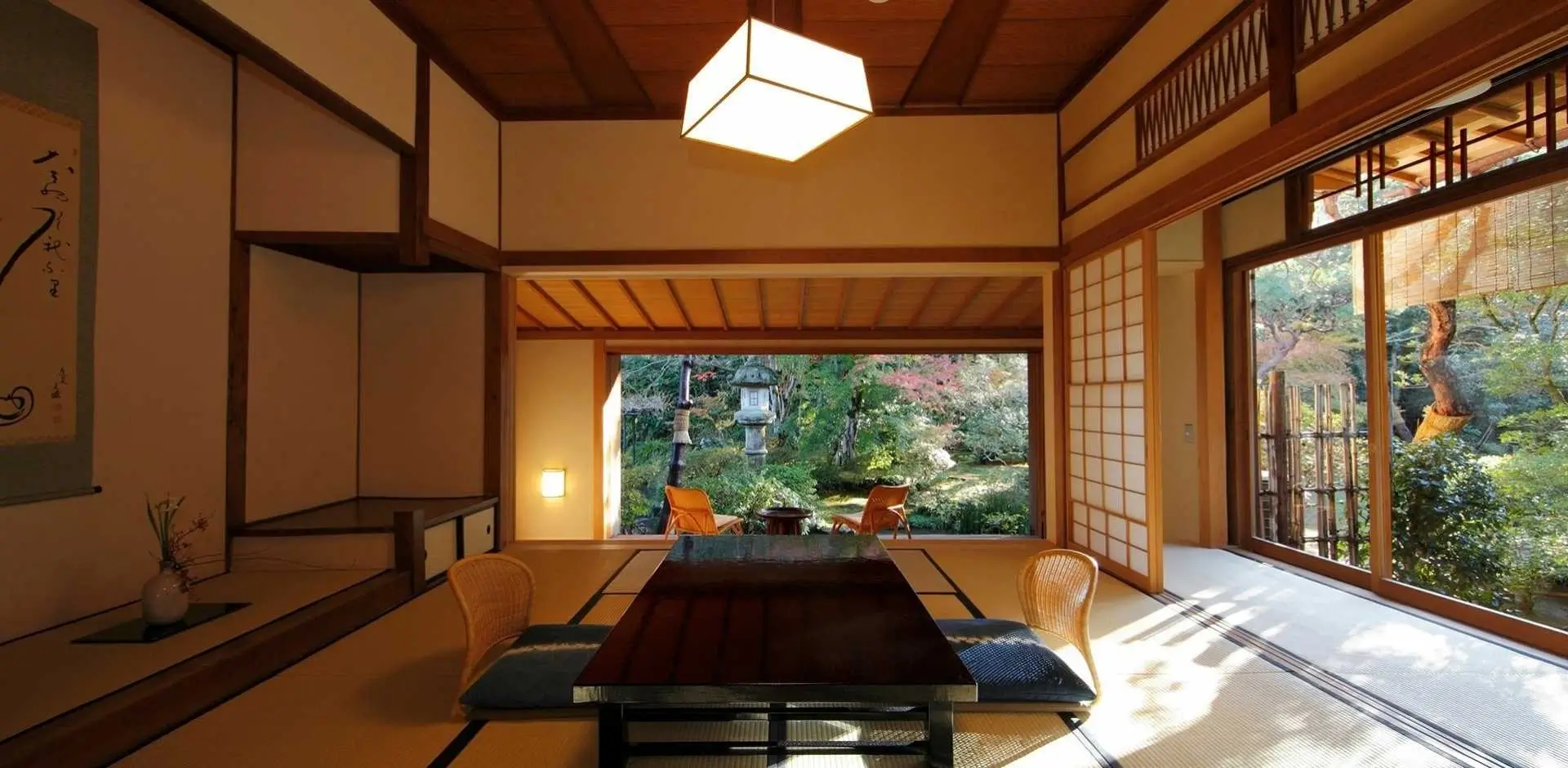
Tatami, shoji, and an engawa that keeps your eyes on water and trees.
Subtle, but telling.
Baths And Water: Kakenagashi, Soft Alkaline Spring, And No Fuss
Asaba’s baths are filled with continuously flowing kakenagashi hot-spring water from Shuzenji Onsen, an alkaline simple spring around pH 8.5.
The character is gentle. Soft on the senses. You notice it most because it keeps moving, always renewed, without the “spa” framing that can feel too deliberate.
All rooms have in-room hot-spring baths. There is also an outdoor bath within a bamboo grove and indoor cypress baths that run continuously, plus two private baths available outside the guest rooms.
After a soak, the property does not push you back into activity. The best next step is often a quiet one: tea, a book, the pond again.
Kaiseki At Asaba: Izu Seafood, Local Produce, And In-Room Tradition
Kaiseki at Asaba is served in-room in ryokan tradition, built around Izu seafood and local produce.
This is where shokunin becomes tangible. Not as a concept. As an accumulation of small decisions: the cut, the temperature, the timing between dishes, the way a tray is set down and lifted away with almost no sound.
Because the meal is served in-room, it feels private even when you are not “seeking privacy.” You can speak softly. Or not speak at all. Either choice fits the room.
For many HNW guests, this is the moment the stay stops being “a famous ryokan” and becomes personal.
Can Families Stay At Asaba Ryokan With Children?
Children aged 7 and over are welcomed in the main house, while children under 7 are welcomed in the detached Villa Tenko.
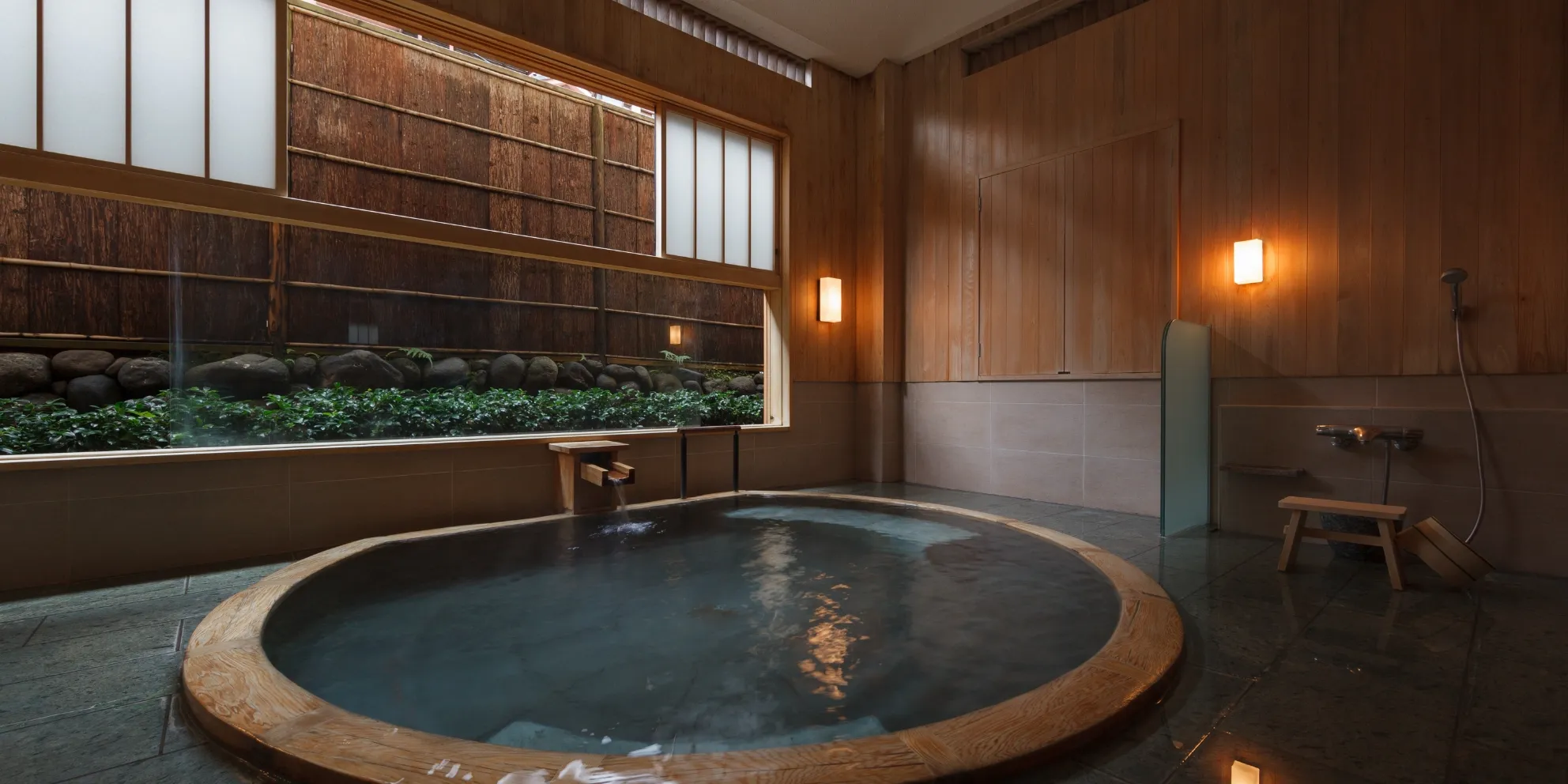
Kakenagashi means the water never stops. You feel that steadiness immediately.
This is the detail that quietly decides everything for families. If your children are under 7, Villa Tenko becomes the natural choice. If they are older, the main house opens up more room options.
It is also about atmosphere. Many guests come to Asaba for stillness, and the property protects that tone without making families feel unwelcome. The policy is clear. The stay remains calm.
For multigenerational travel, our concierge team often recommends choosing the room first, then building the rest of the Shuzenji hours around its view—pond-side or garden-side.
Shuzenji, Briefly: The Walk That Puts You In The Right Mood
Shuzenji Onsen is a small, walkable onsen town centered on the Katsura River, with a bamboo path and a temple-town pace that makes you slow down without trying.
A short loop is enough. The bamboo grove area between Katsura-bashi and Kaede-bashi is often where guests feel the town’s character in a few minutes, not a full afternoon.
Shuzenji Temple matters here, historically and emotionally, and it is part of Asaba’s origin story. Keep it simple. Walk. Listen to the river. Then return to the pond.
This post is about the house, but Shuzenji helps you read the house correctly.
How Do You Get To Asaba Ryokan From Tokyo?
From Tokyo, a common route is JR Tokyo Station to Shuzenji Station in about 120 minutes by limited express Odoriko, then a short transfer to Asaba.
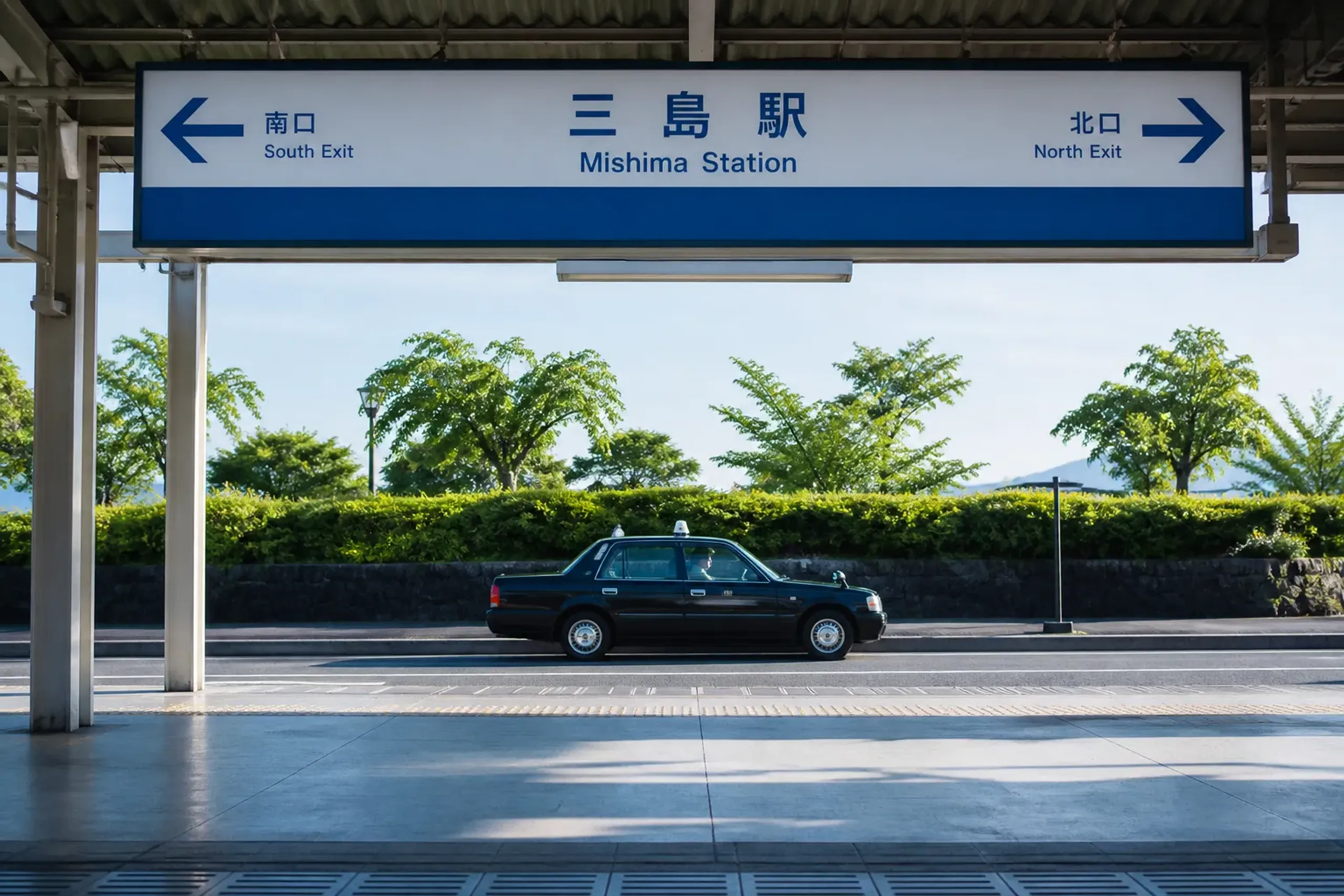
The calm starts with routing: Tokyo to Mishima, then onward toward Shuzenji.
Another route many travelers use is via Mishima: Mishima is roughly an hour from Tokyo by shinkansen, then onward to Shuzenji, followed by a drive of about 40 minutes from Mishima to Asaba by car.
Asaba’s official access guidance notes it does not provide complimentary transport services to and from Shuzenji Station. The ryokan also offers a fixed-rate taxi service from stations, which can be a straightforward choice.
For guests who prefer a private car and an unbroken sense of calm, our private transportation team can advise on timing and routing; see our chauffeur fleet details here: private transportation.
When Should You Stay At Asaba In Shuzenji For The Best Experience?
The hardest-to-get windows at Asaba are late March to early April (cherry blossoms), mid-November (autumn color), and Cultural Journey performance dates.
These are the dates that close first because the town’s scenery and the property’s stage calendar align with how people dream about Japan. If you want one of these windows, plan six to twelve months ahead.
Outside peak periods, Asaba still feels complete. The stage is still there. The pond still holds the light. What changes is the pace around it: fewer cameras, fewer daytrippers, a longer silence between footsteps.
Timing is the real luxury lever. Choose it with intention.
How This Fits A 2026 Luxury Ryokan Trip (Without Turning It Into A Checklist)
Asaba remains uncompromisingly traditional in structure—tatami rooms, futon laid by a nakai, in-room kaiseki, and the stage at the center—while meeting modern expectations through precision, privacy, and quiet comfort.
Many new luxury openings in Japan make headlines. They can be exciting. But they are often loud, by nature, at least in their first seasons. Asaba offers a different kind of confidence: a house that has been receiving guests for centuries and does not need to announce itself.
For HNW travelers, this is often the “reset” stay—where your senses stop scanning and start settling. For VHNW and UHNW guests, it can be the anchor point for discretion: minimal visibility, minimal explanation, maximum control over your own pace.
Hidden Japan is not always remote. Sometimes it is simply the place that resists being flattened into a list.
Asaba Looks Fully Booked For My Dates — What Now?
Asaba has only twelve rooms, so it books out early — especially cherry-blossom weeks, mid-November, and Cultural Journey performance dates. But "fully booked" on a booking site or an OTA usually reflects that channel's small allotment, not the ryokan's full picture.
Reservations for a house this size sit with the ryokan directly. A booking platform showing no availability does not always mean the ryokan itself has none for your dates.
Key fact: A "sold out" or "fully booked" result online reflects one channel's inventory. A direct enquiry to the ryokan for your specific dates is the way to know whether they are genuinely unavailable.
So the practical step is to enquire directly rather than accept the online result. Our concierge makes that enquiry for you, and — because room orientation matters this much at Asaba — checks whether a pond-side room facing the Gekkeiden is open, not merely any room. We then build the stay around what the ryokan confirms: arrival timing, a private transfer from Mishima or Shuzenji, and a performance date if that is your priority.
Frequently Asked Questions
Asaba Ryokan Looks Fully Booked For My Dates. Can I Still Stay?
Possibly. With only twelve rooms, Asaba sells out early, and booking sites show only their own allotment rather than the ryokan's full availability. A direct enquiry for your specific dates is the correct next step, and our concierge can make it for you — including checking for a pond-side room facing the Noh stage.
Does Asaba Ryokan Have A Noh Performance Every Night?
No—performances are seasonal and not held every night, and dates are not always published far in advance.
Asaba’s Cultural Journey has hosted Noh and other classical performing arts for decades, but a performance night is a specific planning target. If that is your priority, treat it as your first decision, then build the stay around it.
Are All Rooms At Asaba Ryokan Onsen Rooms With Their Own Bath?
Yes—all rooms have in-room hot-spring baths filled with continuously flowing water from Shuzenji Onsen.
There are also shared bathing options, including an outdoor bath in a bamboo grove and indoor cypress baths that run continuously, plus two private baths outside guest rooms.
Is Asaba Ryokan Suitable For A Family With A Child Under 7?
Yes—children under 7 are welcomed in the detached Villa Tenko, while the main house welcomes children aged 7 and over.
How Far Is Asaba Ryokan From Shuzenji Station?
Asaba is about 2.5 km from Shuzenji Station, typically a short taxi ride.
The ryokan’s access guidance indicates there is no complimentary station transport, so most guests use taxi service or a private car, depending on luggage and preference.
Why Choose Japan Royal Service For Asaba Ryokan?
Luxury travelers choose Japan Royal Service because we treat Asaba as a house with rules, rhythm, and dignity—not a trophy stay—and we plan around what actually changes the experience: room orientation, timing, and discretion.
Our concierge team is built for travelers who want clarity without noise. We can advise on which rooms look directly to the Gekkeiden, how to think about performance-date lead times, and how to arrive in Shuzenji without breaking the mood of the stay. Quiet decisions. Real impact.
We also understand the profile of guests Asaba suits best: those who value restraint, craft, and privacy over spectacle. That alignment is where trips stop feeling generic.
Japan Royal Service books Asaba. For private coordination, reach our team discreetly via WhatsApp or LINE, or contact us here.
If you want the stage on the pond, and you want it on the right night, tell us your dates and party size.
We’ll guide the next steps.