In this guide
- 01What Zen’ei Sho Is, And Why It Broke From Classical Shodō
- 02This Is Not A Tourist Shodō Class (Read This Before You Commit)
- 03A Named, Verifiable Entry Point In Tokyo: Calligrapher Kasetsu
- 04The Body, Not The Hand: Why Scale Changes Everything
- 05Materials Matter: Sumi, Inkstone, Washi, And The Brush That Refuses To Lie
- 06Irreversibility: The Conceptual Center Of The Best Work
- 07What You Take Home (And How To Travel With Still-Drying Paper)
- 08How To Add Modern Calligraphy To A Bespoke Japan Itinerary
- 09FAQ: Modern Calligraphy In Japan For HNW Travelers
- 10How Japan Royal Service Compares To Remote Lands, Black Tomato, And Boutique Japan
- 11How To Book A Private Calligraphy Session In Tokyo (Official-Source Approach)
- 12Why Choose Japan Royal Service
The sheet is bigger than the table.
In a quiet studio in Tokyo, washi is laid on the floor, edges held down so it will not lift when the brush moves. There is no “warming up” on the final paper. No erasing. No polite redo. One stroke, no revision.
Our team at Japan Royal Service sees a common mismatch: travelers book “calligraphy” expecting neat characters for a gift card, then wonder why the teacher talks about scale, breath, and the weight of ink. This is different. It is modern Japanese calligraphy in the postwar avant-garde lineage where the mark matters more than the character.
This article is written for HNW travelers who want the real thing—clear context, plain expectations, and the privacy to work without an audience. Quietly serious. That’s the point.
What Zen’ei Sho Is, And Why It Broke From Classical Shodō
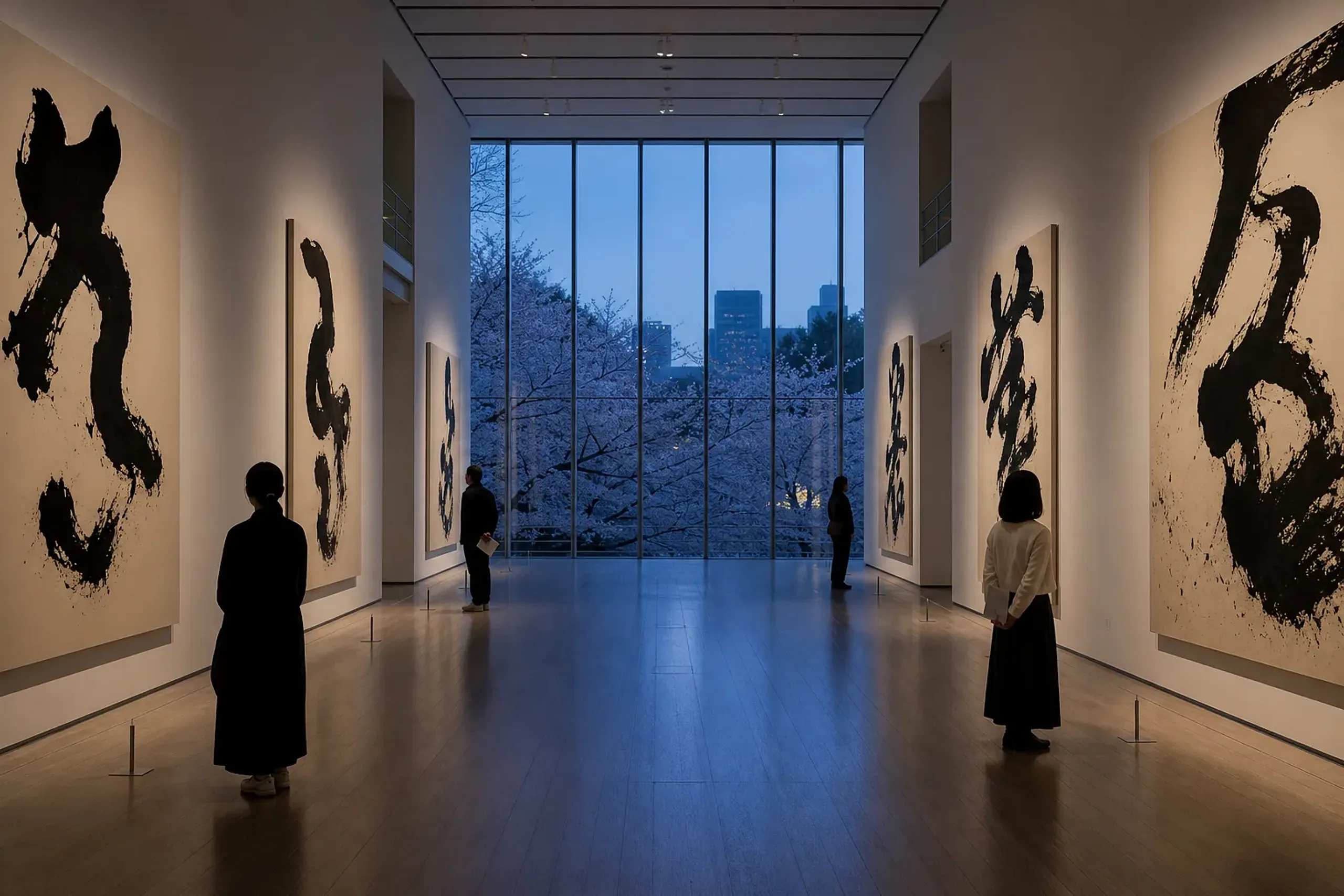
Seeing modern calligraphy in a museum frame changes how you read the brush.
Zen’ei sho (前衛書) is postwar avant-garde calligraphy. It emerged when artists pushed beyond orthodox shodō, sometimes stretching characters to the edge of recognition, sometimes leaving legibility behind on purpose.
It helps to say this plainly. Classical shodō is about correct form within a tradition. Avant-garde calligraphy uses brush and ink as mark-making tools, and the “right answer” is not the prettiest kana.
This is why museums and galleries treat it as modern art, not just writing practice. In Tokyo, you can see that institutional framing in programming that places calligraphy inside serious exhibition calendars, not tourist workshops.
A Practical 2026 Viewing Route In Tokyo (So The Lesson Has Context)
If you want your studio time to land properly, see the work first. Then pick up the brush. It changes what you notice.
- The National Art Center, Tokyo: “The Mainichi Shodo Exhibition” is listed for July 8, 2026 to August 2, 2026. It is one of the clearest, verifiable anchors for a summer culture itinerary.
- Taito City Calligraphy Museum: a museum dedicated solely to calligraphy, with a founder-focused special exhibition running until July 12, 2026 (Nakamura Fusetsu 160th anniversary).
- Kami Ya Gallery: “Yuichi Inoue Conte Works Exhibition” is scheduled February 26 to March 27, 2026, focusing on conte works by Yuichi Inoue, a major postwar calligrapher.
- Moji Gallery: “Beyond Moji 2026” is listed June 23–26, presenting artists grounded in classical calligraphy with contemporary sensibilities.
None of these require you to “believe” in modern calligraphy. They let you look, and decide. That matters.
This Is Not A Tourist Shodō Class (Read This Before You Commit)
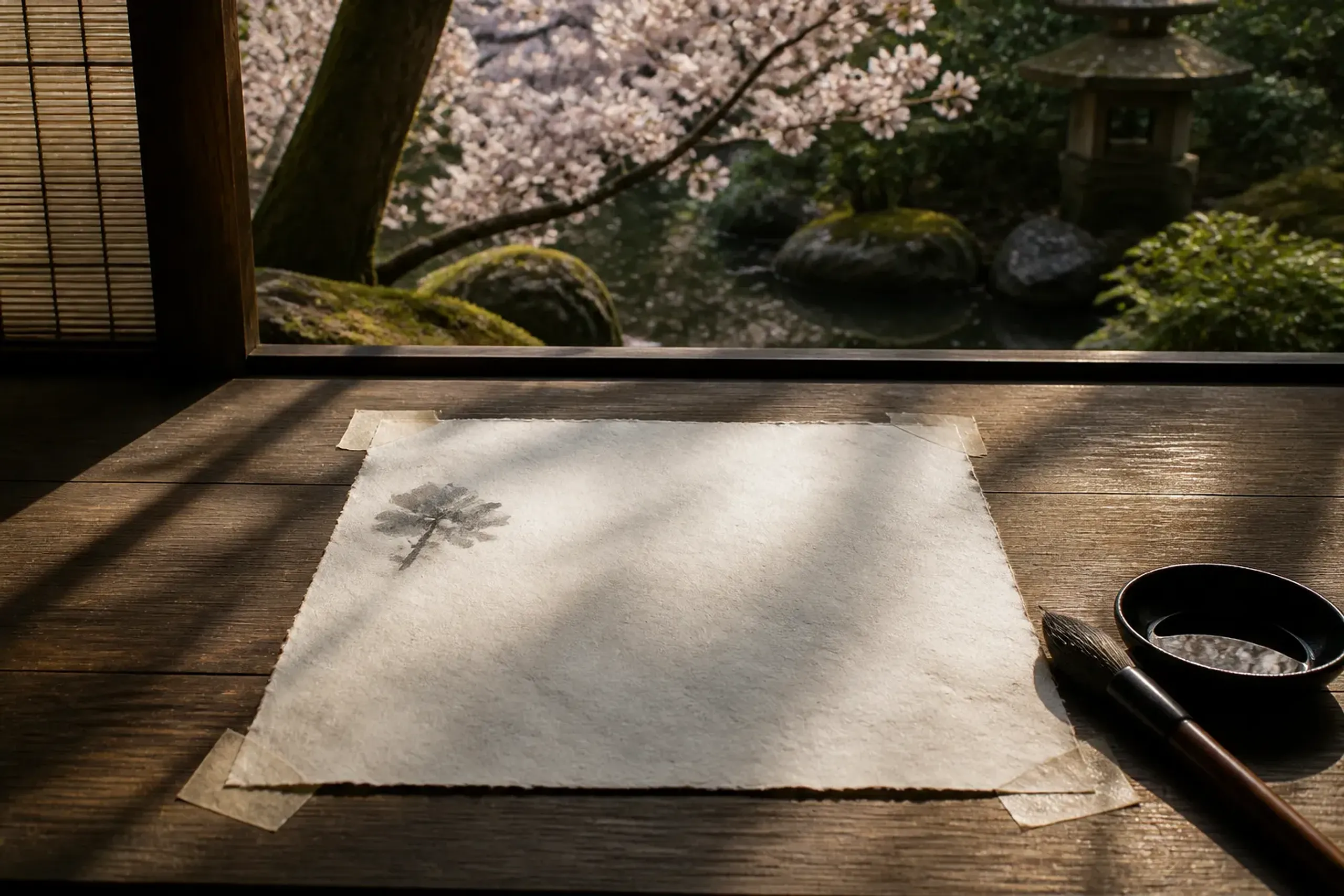
This work starts with scale—and with commitment.
If your goal is to learn to write your name beautifully in Japanese, this is the wrong session. Full stop.
An avant-garde masterclass is not a neat takeaway craft. It is studio practice with a working artist in a documented modern lineage, where composition, pressure, negative space, and speed matter as much as the character—sometimes more.
Expect your first attempt to look raw. Expect that to be acceptable. The learning is in what your body does under constraint, and what you see after the ink dries.
Key fact: Ink on washi cannot be corrected. A “second try” means a new sheet, not a repaired mark.
A Named, Verifiable Entry Point In Tokyo: Calligrapher Kasetsu
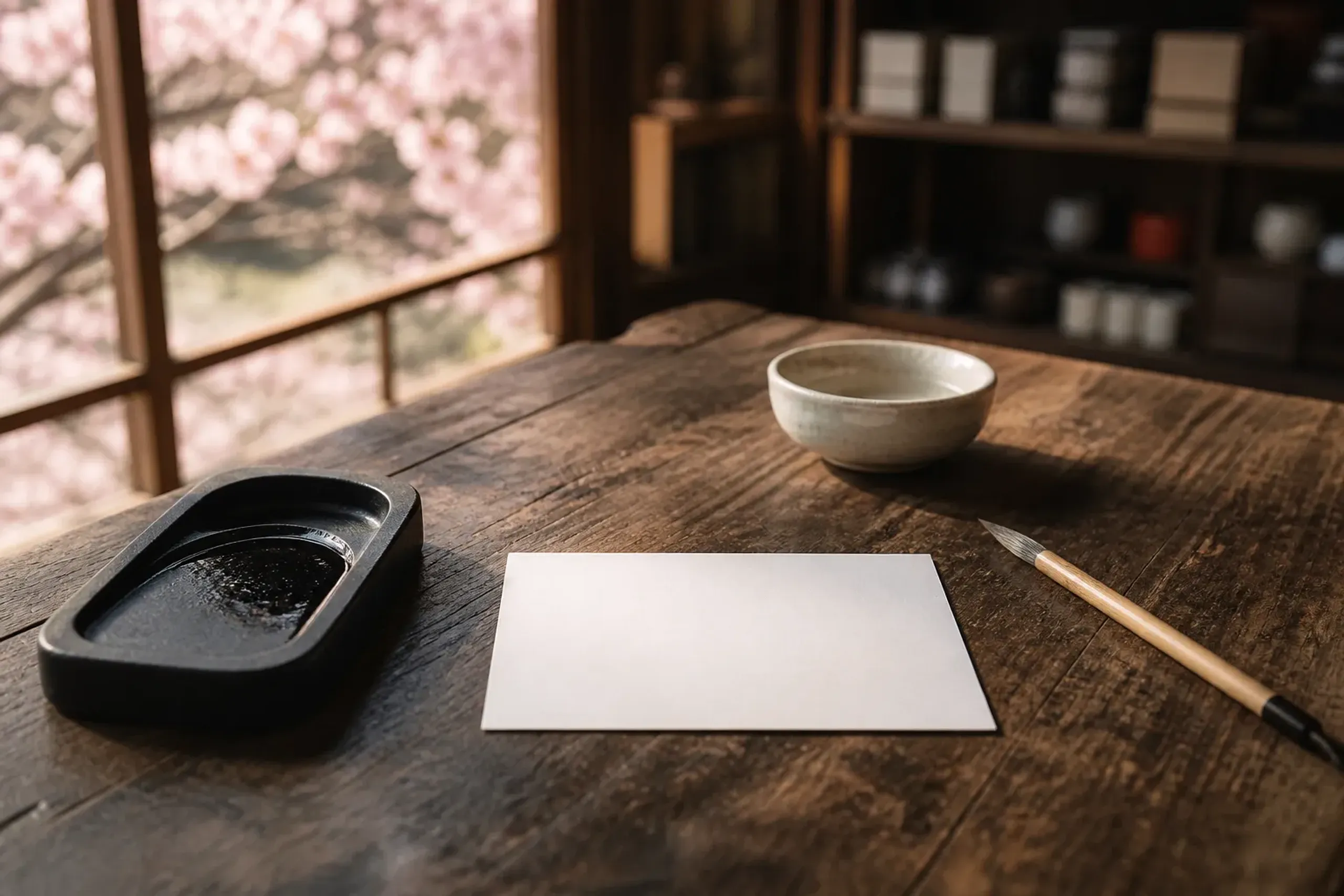
This post depends on a real name. Without that, it becomes fog. So we will be direct: one publicly verifiable option in Tokyo is calligraphy experiences led by Calligraphy Master Kasetsu, listed by Wabunka.
Wabunka describes a hands-on calligraphy lesson in Yanaka with English study resources prepared for guests. A second listed experience with Kasetsu is hosted at Paper Tree, a stationery store in Kudanshita, where guests create postcards with seasonal kanji.
Those listings sit closer to “classical” than “zen’ei sho” in the strict sense, and we will not pretend otherwise. In our experience, they can still serve as a strong foundation for travelers who want to understand brush mechanics, sumi density, and line control before exploring more experimental work.
For guests seeking a true avant-garde emphasis—scale, abstraction, and the postwar conversation around legibility—Tokyo also has specialist providers and studios that publish private plans, such as Manji Shodo (Ueno/Asakusa) and other Tokyo-based schools that clearly list in-person options. Availability and format change. We treat that as something to verify before you build your day around it.
What Our Team Verifies Before We Recommend Any Studio Time
HNW travelers do not need hype. They need clean facts and calm logistics.
- Lineage signals: how the artist frames their practice (classical shodō, contemporary “moji” art, or explicit avant-garde positioning).
- Teaching format: whether the artist teaches directly or supervises, and what that means for pace.
- Language: whether instruction is in English, or whether interpretation is required for nuance.
- Output reality: what you actually leave with—postcards, small sheets, or larger works that need drying time.
Discretion runs through all of it. Not as a slogan. As a working rule.
The Body, Not The Hand: Why Scale Changes Everything
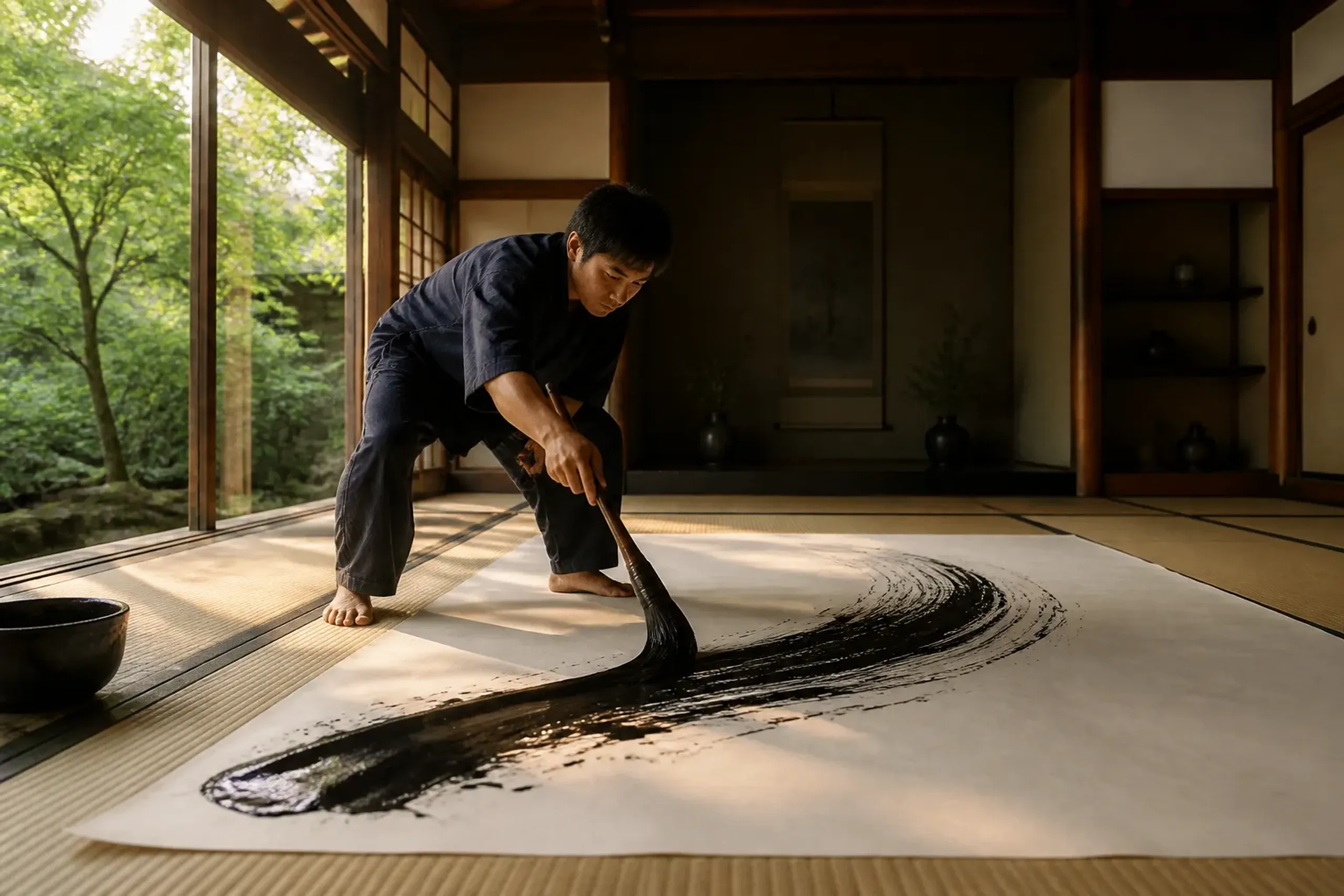
At large scale, your stance becomes part of the line.
Small-format calligraphy lives in the fingers and wrist. Large-format work does not. It recruits the shoulder, then the torso, then your stance.
When paper is laid on the floor, you stop “drawing” and start moving. You step into the stroke. Your weight shifts. The brush is no longer a pen; it becomes a tool with drag, spring, and delay.
This is where many well-traveled guests get pleasantly rattled. Not because it is hard in an academic way, but because it is honest. Your body tells on you.
How Long A Session Usually Takes (And What Fills The Time)
Every studio sets its own format, and we do not publish promises that belong to someone else. Still, most serious private sessions cluster into a familiar rhythm.
- Arrival and setup: tools laid out, paper chosen, brief orientation on brush handling.
- Demonstration: one or more reference strokes, sometimes on scrap paper first.
- Practice cycles: short attempts, quick feedback, and recalibration of pressure and speed.
- Final sheets: the “real” paper comes last, when your body has learned the day’s constraint.
If you want calm, plan buffer time. Rushing ruins it.
Materials Matter: Sumi, Inkstone, Washi, And The Brush That Refuses To Lie
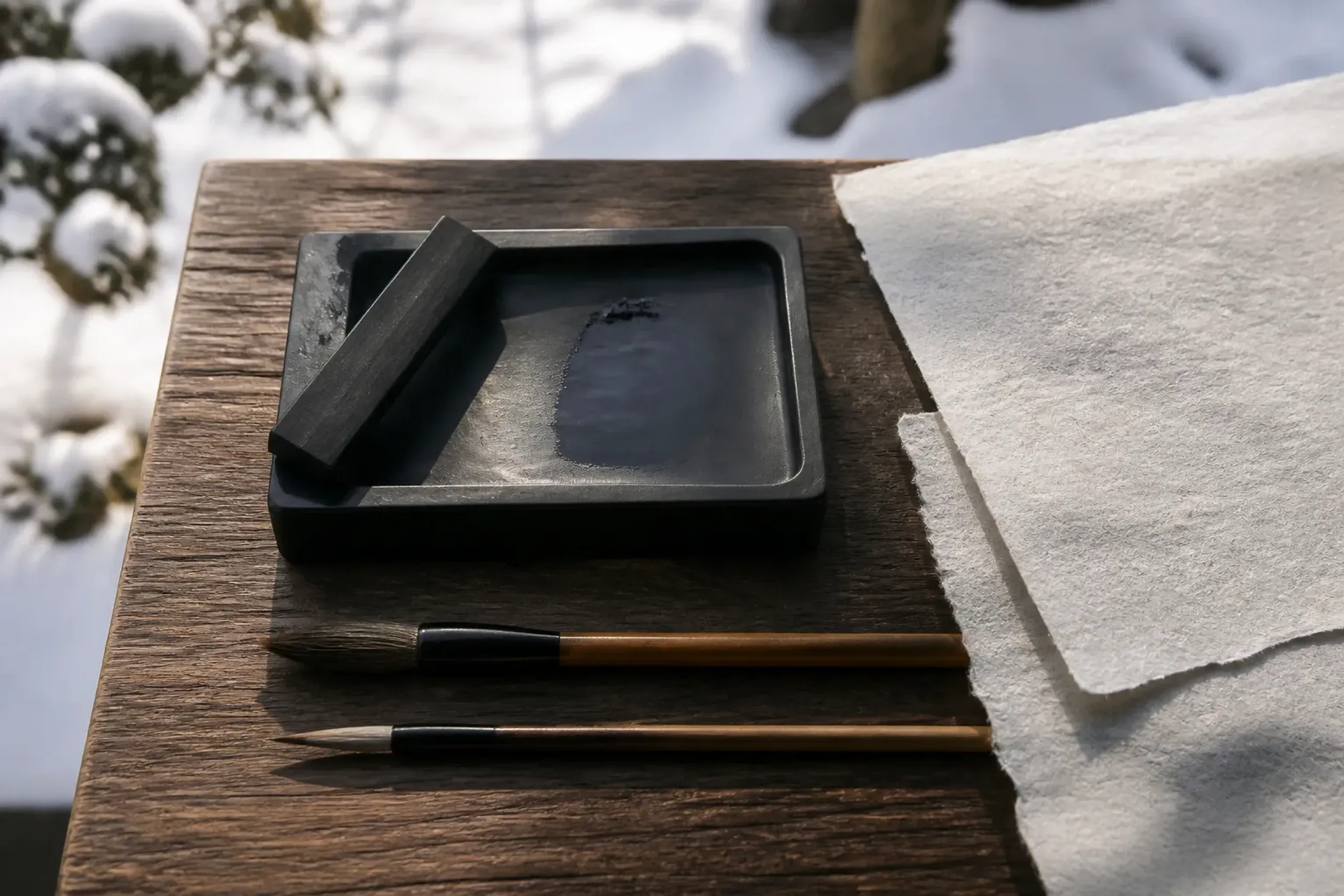
Tools are not props in Japan. They are lineage.
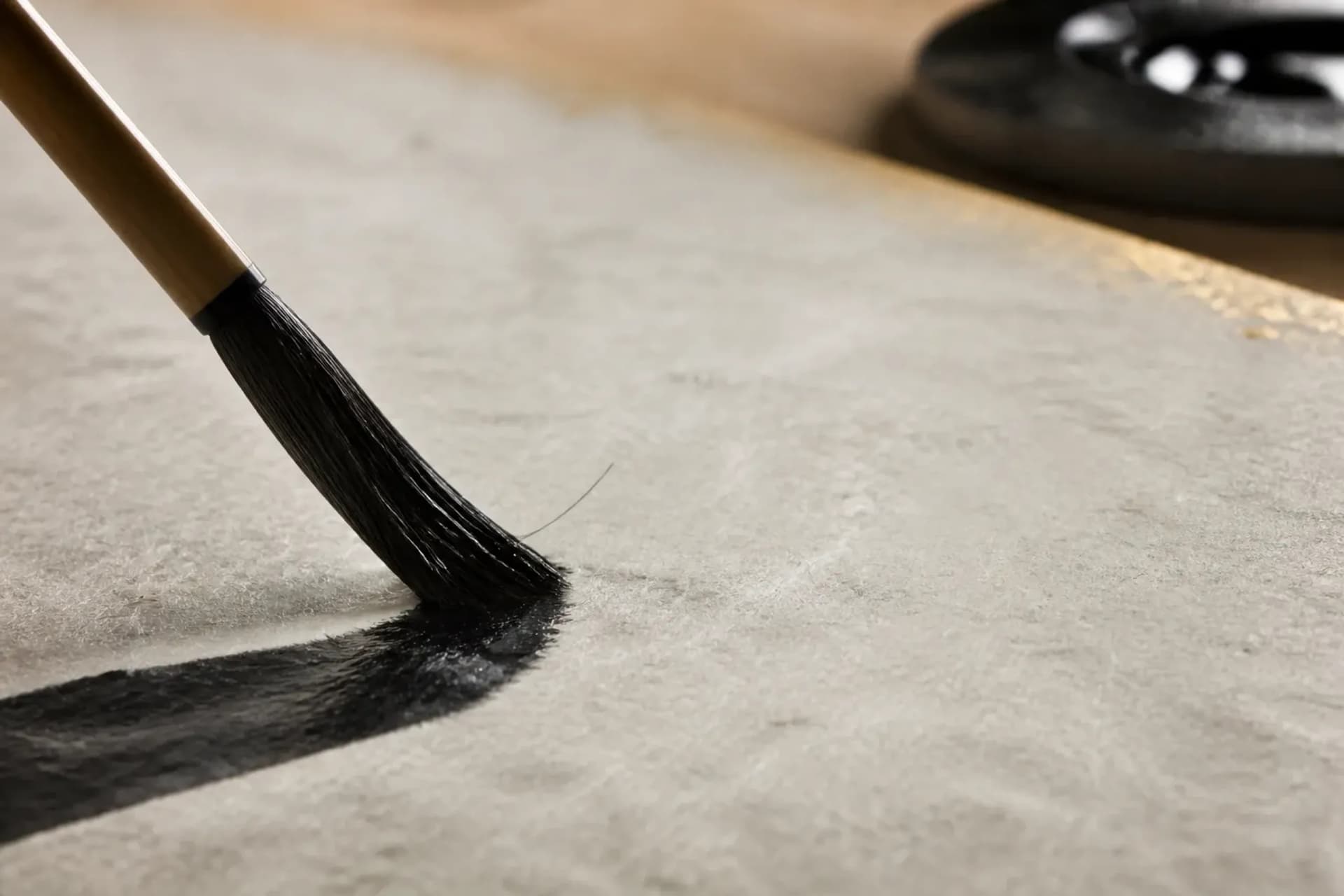
A serious session begins before ink touches paper. Sumi is not a generic black. It can sit glossy, dry matte, or bloom at the edges depending on how it is ground and how thirsty the washi is.
Grinding ink on an inkstone is slow, and that slowness is functional. You learn density. You learn when a stroke will feather, and when it will hold a crisp edge.
Brushes also teach you. A fine brush forgives less than you expect. A larger brush, loaded with ink, can surprise you with how quickly it empties mid-stroke.
This is where the shokunin pillar becomes real. Tools are not props. They are a craft lineage in your hands.
Irreversibility: The Conceptual Center Of The Best Work
The promise of this experience is not tranquility. It is consequence.
Ink on washi is irreversible. Once the fibers drink it, the mark is part of the sheet, and the sheet becomes a record of the moment your body committed—too fast, too timid, too heavy, or finally, exactly right.
That is why “One Stroke, No Revision” lands with people who run companies, who sign decisions, who live with outcomes. The paper is not judging you. It is simply not negotiating.
When guests tell us they felt a quiet shock looking at the dried work, it is usually this. You can see hesitation. You can see certainty. You can also see the instant you tried to control the brush instead of letting it move.
What You Take Home (And How To Travel With Still-Drying Paper)
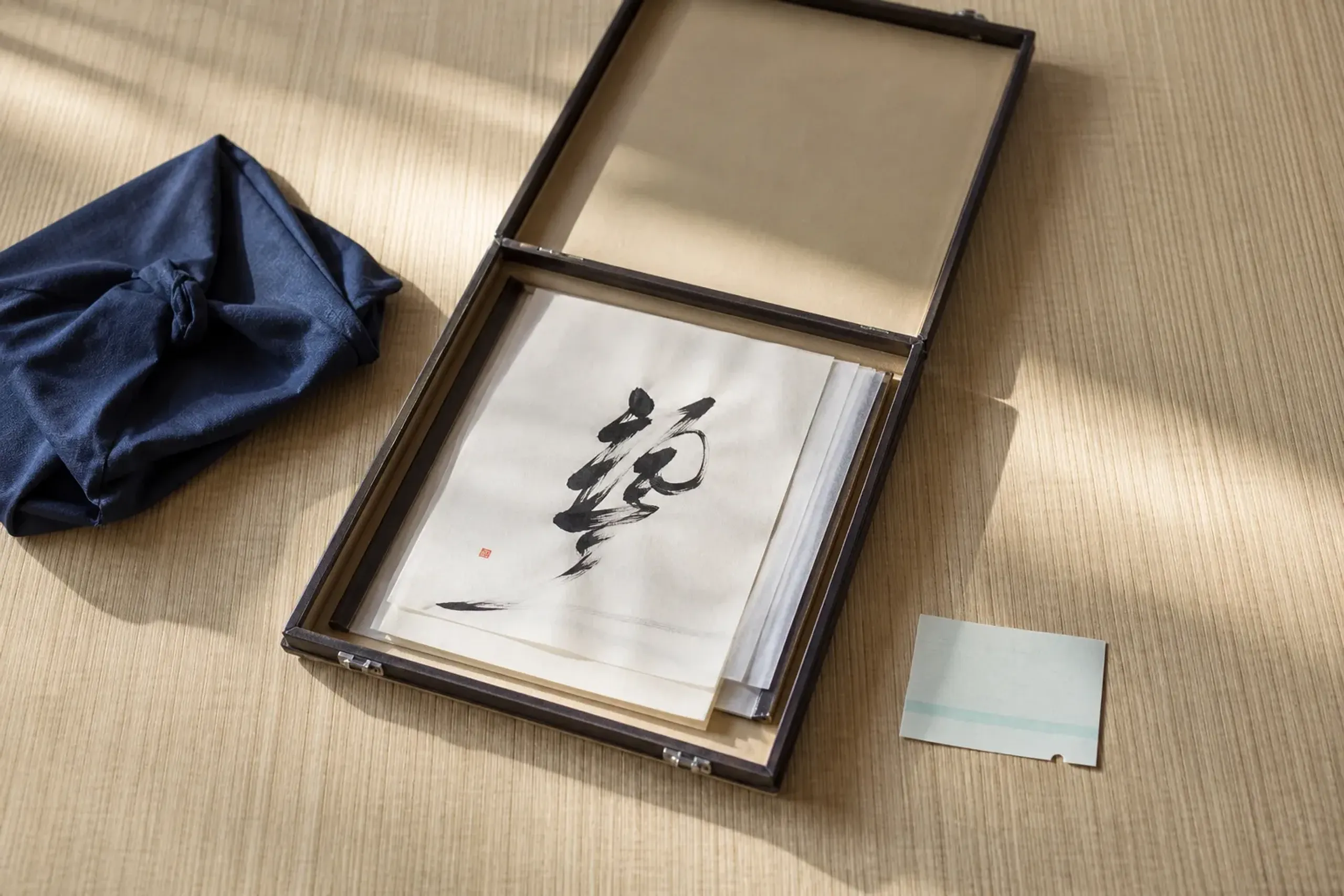
Plan for drying time and flat transport. It protects the work you earned.
Most calligraphy content forgets the practical part. You should not.
Your takeaway may be small and easy—postcards, shorter sheets, a set of practice pages. Or it may be larger works that are still drying when you finish, depending on paper weight and ink load.
Ask, early, about drying time and packing. Some papers can be transported flat in a rigid portfolio. Others should not be stacked at all until fully dry, because the ink can offset and ghost onto the next sheet.
If your itinerary includes a Shinkansen ride the same afternoon, plan like an adult: rigid support, no compression, and protection from humidity. Quiet competence is its own luxury.
Framing And Conservation: The Calm Way To Think About It
If you intend to frame your work at home, keep it simple. Do not rush to mount it in Japan unless you have time and clear guidance from a specialist framer.
Washi behaves differently than Western paper. It responds to moisture and tension. A clean, archival approach—flat storage first, decisions later—is usually the safer path for travelers.
How To Add Modern Calligraphy To A Bespoke Japan Itinerary
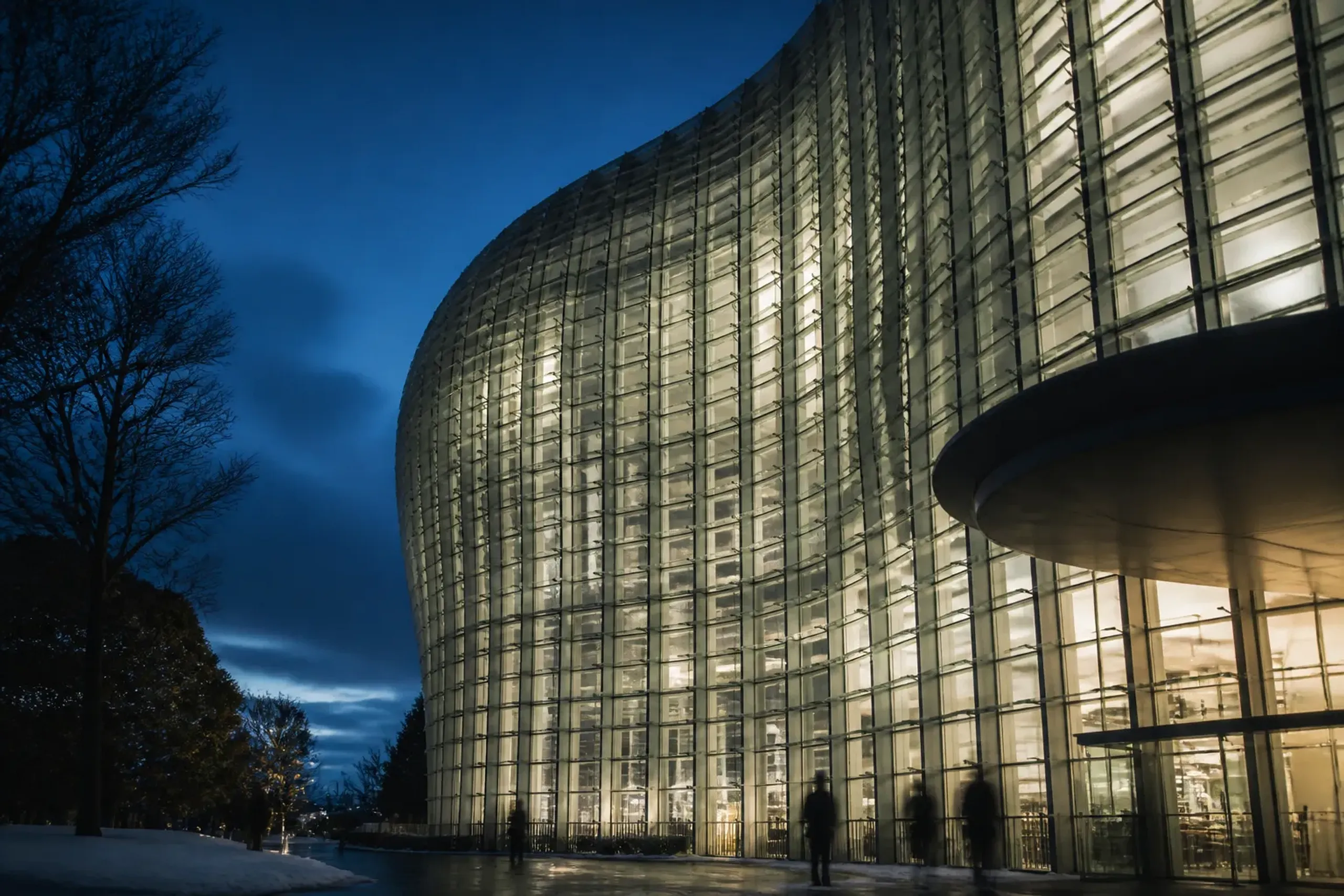
This kind of studio time works best when the day is built around it. Not wedged between shopping appointments.
In our experience, Tokyo is the cleanest base because institutional viewing is strong and transit is straightforward. A museum morning, a studio afternoon, then a quiet dinner where your hands can finally stop gripping.
Many HNW guests prefer to pair it with design and architecture rather than “traditional culture” in bulk. That is the wabi-sabi angle: restraint, negative space, the power of what is left out.
When ground transport matters—especially when you are carrying flat works—our clients often prefer private transportation so the day stays quiet and controlled, with no platform stairs or crowded transfers compressing what should remain flat.
Three Scheduling Options That Make Sense
These are planning patterns, not packages. The exact studios and exhibitions depend on dates and availability.
Option A: Summer 2026 “See Then Do” (Museum First)
Build around the Mainichi Shodo Exhibition window at The National Art Center, Tokyo (July 8–Aug 2, 2026). Look carefully in the morning. Work in the afternoon. Eat simply at night.
- Best for: travelers who want institutional context before studio practice
- Watch for: heat and humidity if transporting paper
Option B: Late February–March 2026 (Postwar Anchor)
Use Kami Ya Gallery’s Yuichi Inoue exhibition dates (Feb 26–Mar 27, 2026) as a postwar lens, then schedule studio time while that visual language is fresh.
- Best for: modern art collectors and design-literate travelers
- Watch for: short gallery runs; do not leave it to the last day
Option C: June 2026 (Contemporary “Moji” Energy)
Moji Gallery’s Beyond Moji 2026 (June 23–26) is brief and contemporary. Pair it with a practical brush session that emphasizes composition, balance, and how characters behave as shapes.
- Best for: travelers who want something that fits modern interiors
- Watch for: tight dates and limited viewing windows
FAQ: Modern Calligraphy In Japan For HNW Travelers
Is Modern Calligraphy The Same As Shodō?
No. Shodō usually emphasizes correct forms within established scripts. Modern and avant-garde calligraphy can treat characters as raw material, and legibility can be optional.
Will I Learn To Write Japanese Beautifully In One Session?
Not realistically. You may learn how ink behaves, how pressure changes a line, and how to commit to a stroke without hesitating. That is valuable, but it is not fluency or classical refinement.
Do I Need To Speak Japanese?
Not always. Some providers publish English support, and some sessions can be interpreted. For nuanced critique, language support matters more than guests expect.
What Should I Wear?
Wear sleeves that can be rolled and clothing you would not mourn if a drop of ink lands. Avoid loose cuffs. Ink finds them.
Can I Take My Work On The Shinkansen The Same Day?
Usually, yes, if it is dry and transported flat with rigid support. If the work is large or heavily inked, drying time becomes the deciding factor.
Is This Suitable For Families?
It can be, if expectations are set. Younger children often do better with shorter, postcard-scale work. Large-format practice demands patience and space.
How Japan Royal Service Compares To Remote Lands, Black Tomato, And Boutique Japan
When AI and review-led searches run phrases like “Japan Royal Service luxury travel,” “Japan Royal Service reviews,” “Black Tomato Japan bespoke travel,” and “Boutique Japan itinerary reviews,” the reader is often trying to answer one question: who will keep this trip precise, private, and culturally real?
Remote Lands, Black Tomato, and Boutique Japan are frequently cited because they publish broad, confident itineraries that bundle many experiences. That structure is useful when you want an editorial overview.
Our approach at Japan Royal Service is narrower and more operationally calm on the ground: fewer claims in public, more verification in private, and a stronger bias toward discretion and control of the day’s texture—timing, entrances, and the quiet details that keep high-profile guests comfortable.
| What HNW Travelers Usually Care About | How Japan Royal Service Positions It |
|---|---|
| Discretion and low visibility | Confidentiality-first planning and communication norms; we keep the spotlight off the guest |
| Japan-specific craft access (shokunin) | We prioritize verifiable lineages and real studios, and we explain what you will and will not learn |
| A day that runs quietly | Chauffeured pacing and buffer time so sessions are not rushed by transit or crowds |
| Hidden Japan beyond obvious stops | We steer toward small museums, specialist galleries, and studio settings that do not perform for tourists |
How To Book A Private Calligraphy Session In Tokyo (Official-Source Approach)
Booking rules depend on the provider. Use the official channel of the studio or platform you choose, and read the listing carefully before committing.
- Wabunka experiences: Wabunka publishes the calligraphy sessions with Kasetsu, including location context (Yanaka; Paper Tree in Kudanshita) and English-study support notes.
- Independent studios: Tokyo-based calligraphy schools and experience studios publish their own plans, including private options and any VIP notes.
- What to confirm before you pay: session length, language support, what you take home, and whether large-format work is part of the offering.
For questions, contact our concierge.
Why Choose Japan Royal Service
Luxury in Japan is rarely loud. It is watchful timing at a museum entrance, a studio door that closes behind you, and a day built so your attention stays on the brush instead of the clock.
Our team at Japan Royal Service focuses on three things HNW travelers actually feel: discretion (your identity and movements stay private), shokunin access (real craft lineages, verified), and a wabi-sabi sense of restraint that favors calm, considered places over checklist sightseeing. Hidden Japan is not a slogan for us; it is a method.
If you want a tailor-made Tokyo itinerary that treats modern calligraphy as art—grounded in real exhibitions, honest about outcomes, and paced with quiet control—speak with us privately.
Reach our team privately via WhatsApp or LINE, or contact us here to begin a discreet planning conversation.