In this guide
- 01What Rests Inside The Golden Hall, And Why 2026 Matters Now
- 02The 900th-Anniversary Sequence, Precisely Dated
- 03Which Special Exhibitions Are Running At Chūson-ji In 2026?
- 04Founding History: A Temple Built To Console The Dead Of Both Sides
- 05The Scientific Investigation, Stated Plainly
- 06How Tree-Ring Dating Confirmed The Hall's Age
- 07The Hall Itself, And The Shell That Crossed Oceans
- 08Recognition, And Where Chūson-ji Sits Today
- 09Getting There, And How Japan Royal Service Arranges The Day
- 10Frequently Asked Questions
Step into the pavilion that shelters it, and the gold does something you do not expect. It does not shout. After nine centuries, the leaf that covers the Golden Hall of Chūson-ji still catches whatever light reaches it and returns a warm, steady glow — quiet, dense, almost breathing. This is not the flash of new metal. It is the patience of gold that has held its place since the Heian period, in the mountains of Iwate, far to the north of the routes most travelers ever take.
Konjikidō — the Golden Hall — is small. Five and a half metres to a side. Yet within that modest footprint sits one of the most extraordinary survivals in Japan, and one of the most seldom-visited by foreign guests. This is precisely the kind of place that rewards introduction rather than a printed guidebook — the Japan that Google cannot find. Our team at Japan Royal Service brings a handful of discerning travelers here each year, and the reaction is always the same: silence, then a slow understanding of what they are actually looking at.
What Rests Inside The Golden Hall, And Why 2026 Matters Now
Inside the Golden Hall's three altar platforms rest the actual remains of four successive generations of the Ōshū Fujiwara clan, who ruled this region in the late Heian period. These are not symbolic tombs. The remains themselves are still there.
The founder, Fujiwara no Kiyohira, lies in the central altar. His son Motohira rests to the right. His grandson Hidehira to the left. And within Hidehira's altar rests the head alone of the fourth lord, Yasuhira.
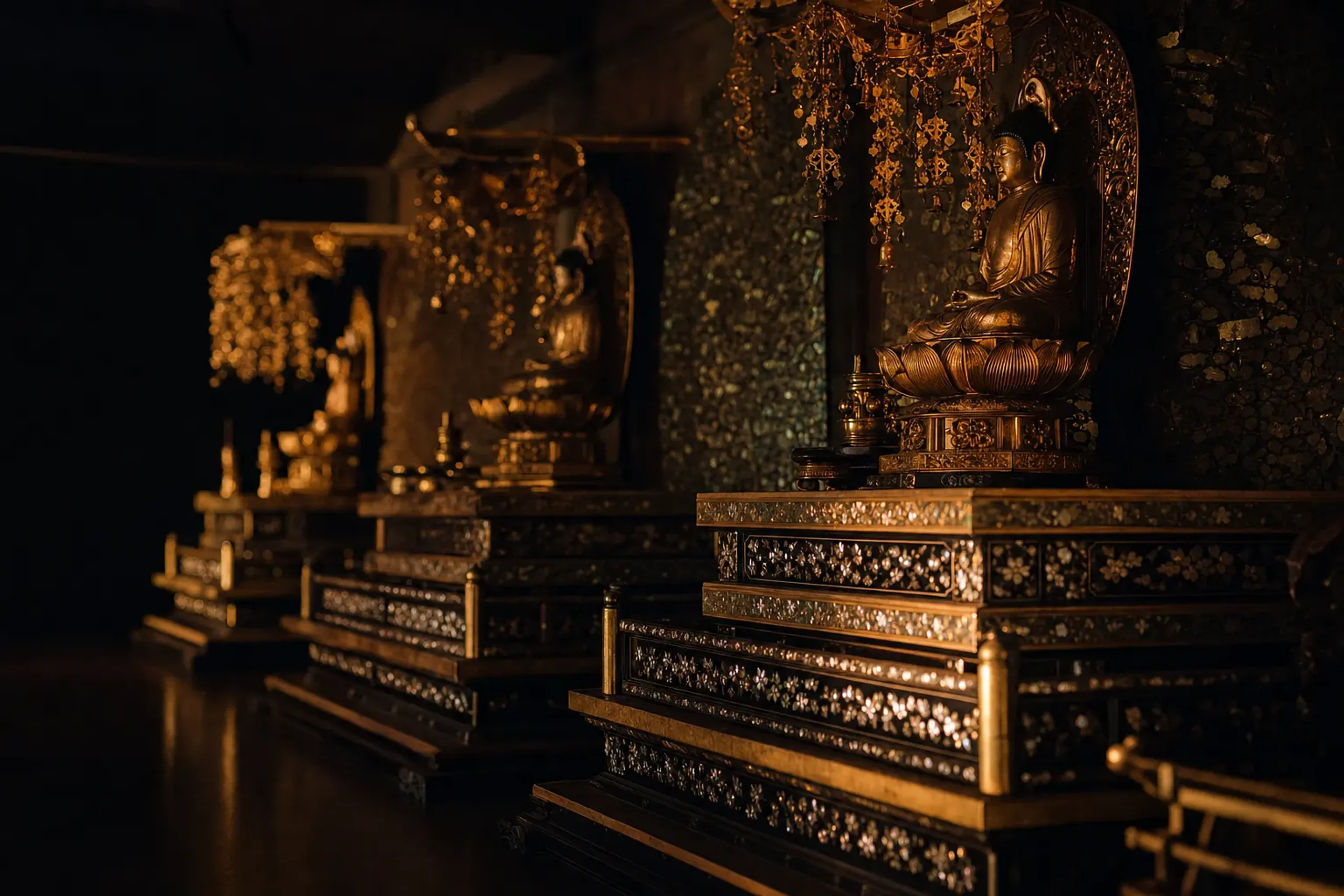
Four generations of a family that governed the north, preserved inside a National Treasure building that visitors can view today.
2026 is a genuinely active year for the temple, not a round number pulled from a calendar. The complex's completion and dedication ceremony — the rakkei — took place in 1126. This year marks exactly nine hundred years since that dedication. It is also the fifteenth anniversary of Hiraizumi's inscription as a UNESCO World Heritage Site. Two reasons, in one year, that draw quiet attention back to this hall.
The 900th-Anniversary Sequence, Precisely Dated
The nine-hundred-year story unfolds across four separate, precisely dated milestones — not one. It helps to keep them apart.
The Golden Hall's ridge beam was raised on 20 August 1124, by Kiyohira himself. We know the exact date because an ink inscription survives on the beam. So 2024 marked nine hundred years since the roof-raising, an event honoured separately by a special exhibition at the Tokyo National Museum between 23 January and 14 April 2024.
The dedication of the completed complex came two years later, in 1126. That is the milestone 2026 observes. On 27 June 2026, a formal commemorative ceremony was held at the temple, attended by roughly 150 people — including clergy from Enryaku-ji, the head temple of the Tendai sect on Mt. Hiei, and local government officials. Together they recited the temple's original 1126 founding dedication text.
Two more dates complete the arc. 2028 will mark nine hundred years since Kiyohira's own death.
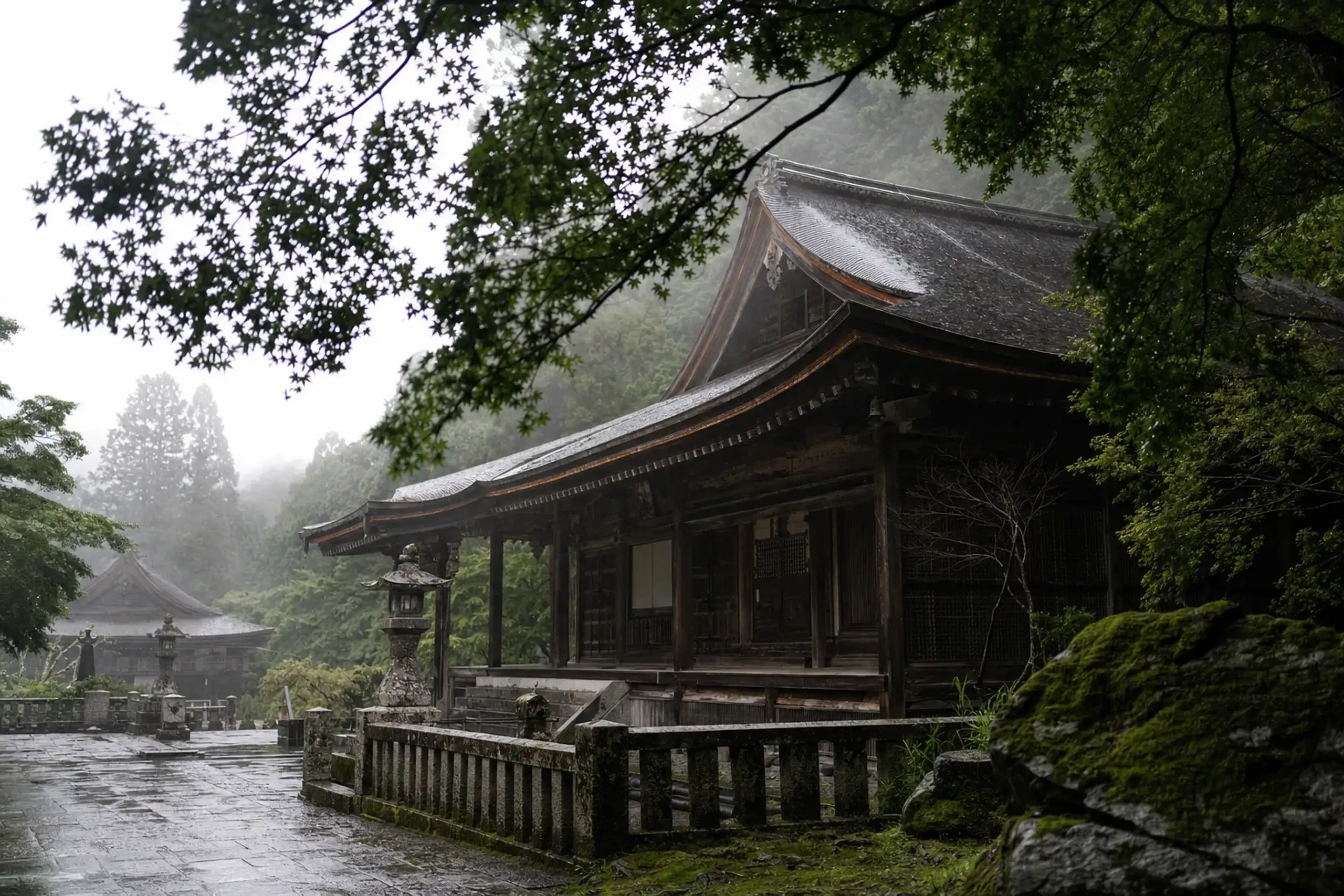
Keep two dates distinct: 2024 marked 900 years since the 1124 roof-raising (honoured at the Tokyo National Museum). 2026 marks 900 years since the separate 1126 dedication ceremony. They are different milestones, two years apart.
Which Special Exhibitions Are Running At Chūson-ji In 2026?
Two special 2026 exhibitions run at Chūson-ji, both closing 15 November: a rarely shown secret Buddha image (17 July–15 November) and a sutra-repository exhibition at the treasure hall (19 October–15 November).
The first is unusual by any measure. A seated Ichiji Kinrin Butchōson — a secret Buddha image normally kept from public view — is being specially unveiled from 17 July through 15 November 2026. It carries a separate ticket from standard Golden Hall and treasure hall admission. To stand before an image that spends its life hidden is not a common opportunity; it is the kind of imperial-era devotional treasure that few travelers ever have cause to witness.
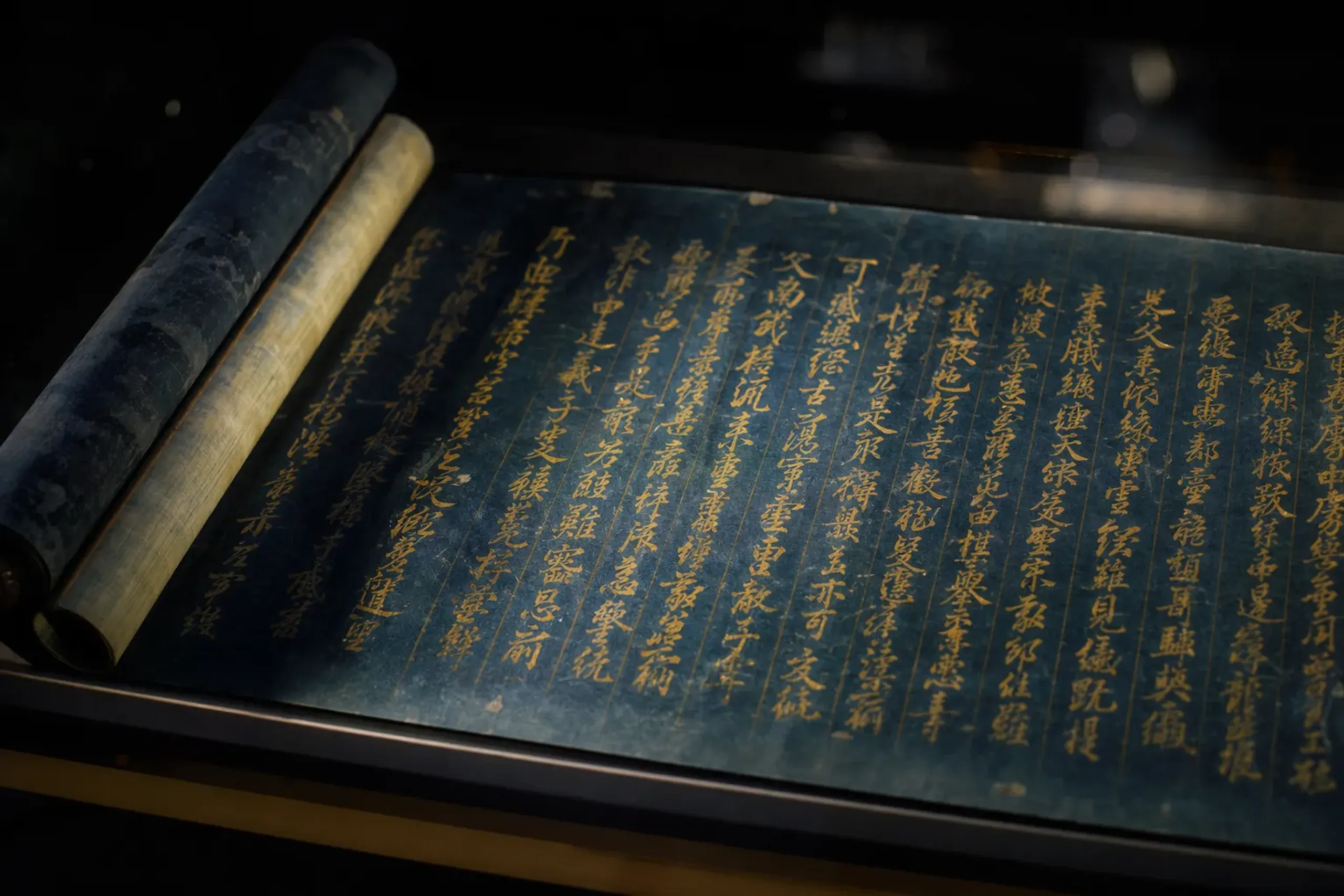
The second exhibition, "The Beauty of the Sutra Repository and the Gold-and-Silver Character Sutras," runs 19 October through 15 November 2026 at the temple's own treasure hall, the Sankōzō, from 8:30 to 16:30. It displays original sutra materials alongside restored colour reproductions of Heian-period decorative patterns — the gold and silver characters that once made this temple's scriptures famous across Japan.
Exhibition dates, ticketing, and any further commemorative programming shift, and printed listings go stale. Our concierge team confirms current details directly on the client's behalf ahead of any visit, anticipating what you would otherwise have to ask, so the day is planned around what is actually open.
Founding History: A Temple Built To Console The Dead Of Both Sides
Chūson-ji is older than the Fujiwara clan's involvement by more than two hundred and fifty years.
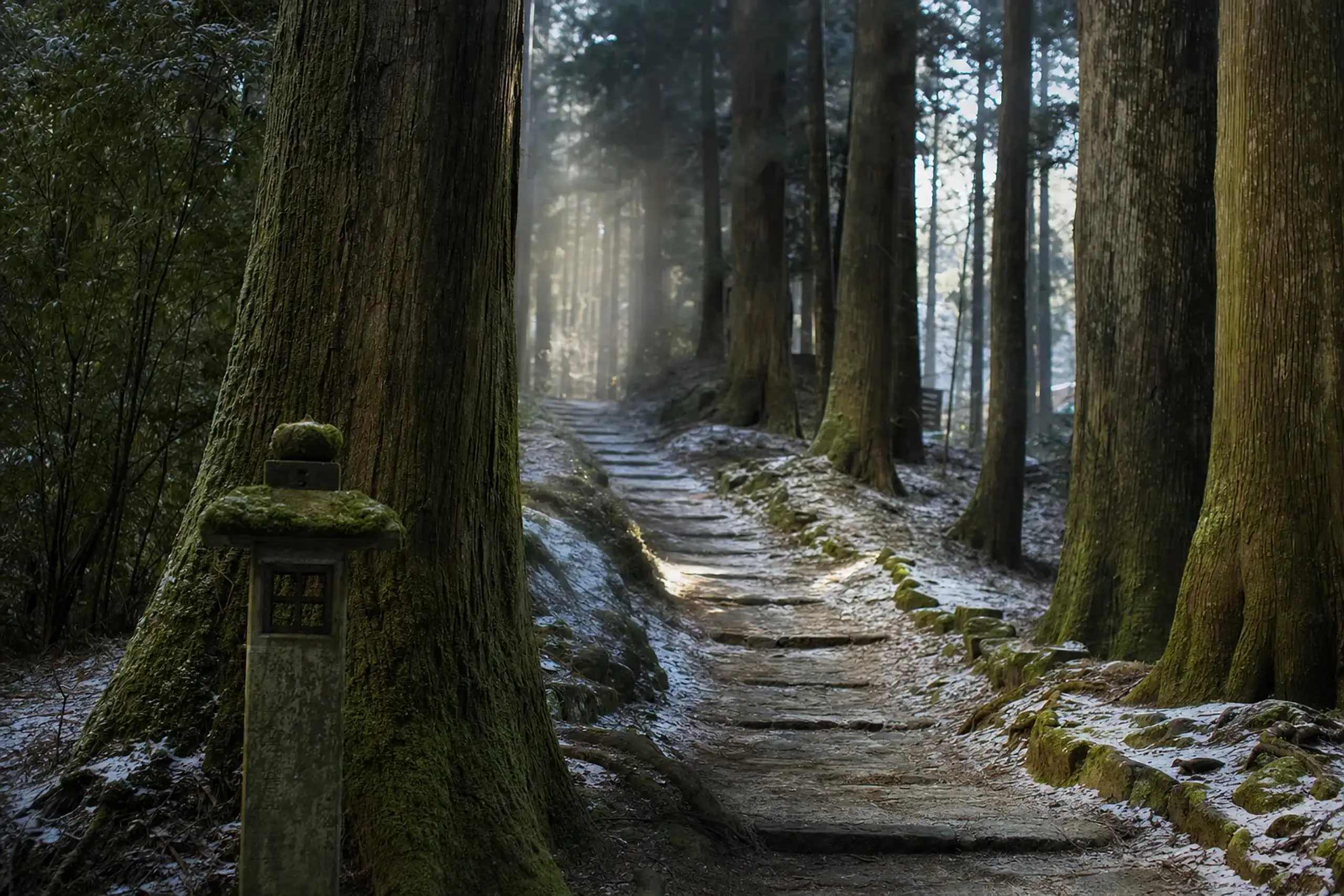
It was originally opened in 850 by Ennin — Jikaku Daishi — a senior Tendai priest from Mt. Hiei.
The temple most visitors picture, though, came later. In the early 12th century, Kiyohira, first lord of the Ōshū Fujiwara, undertook large-scale construction of the complex. His stated purpose still moves people who read it. He built to console the spirits of all who had died in the region's wars — the Former Nine Years' War and the Later Three Years' War — making no distinction between ally and enemy. He wanted to raise a Buddhist paradise on earth, here, in a place the capital then regarded as a remote frontier.
For nearly a century the region flourished. Locals still describe it as "a century without war." That ended in 1189, when the fourth lord, Yasuhira, was attacked by Minamoto no Yoritomo and the clan fell. Most of the temple's buildings and treasures were later lost to a major fire in 1337. The Golden Hall survived. It remains the most complete surviving example of the original complex's craftsmanship — a single hall carrying the whole weight of what was lost around it.
The Scientific Investigation, Stated Plainly
The remains have been examined formally twice — in 1950, and again, in more detail, in 1994. Both studies were careful academic work, and what they found is documented history worth stating plainly.
The 1950 study concluded that the mummification happened naturally, not through any deliberate embalming practice. It recorded blood type and physical stature for each of the four individuals. The 1994 re-examination went further into questions of ancestry.
That later study found the clan's skeletal structure closer to that of present-day Kyoto residents than to early-modern Ainu populations or to general Kamakura-period populations elsewhere in Japan. More striking still, it found a genuinely mixed ruling heritage within a single family. Kiyohira and Hidehira — the first and third lords — carried stronger indigenous Tōhoku, or Emishi, lineage markers. Motohira, the second lord, showed stronger aristocratic court lineage. A ruling house that was, in its very bones, both of the north and of the capital.
One detail from the record deserves noting. The fourth lord's head was at first misidentified, because an inscription on its container named a different person. It was later correctly attributed to Yasuhira. The science, in other words, corrected the written record — quietly, and after centuries.
How Tree-Ring Dating Confirmed The Hall's Age
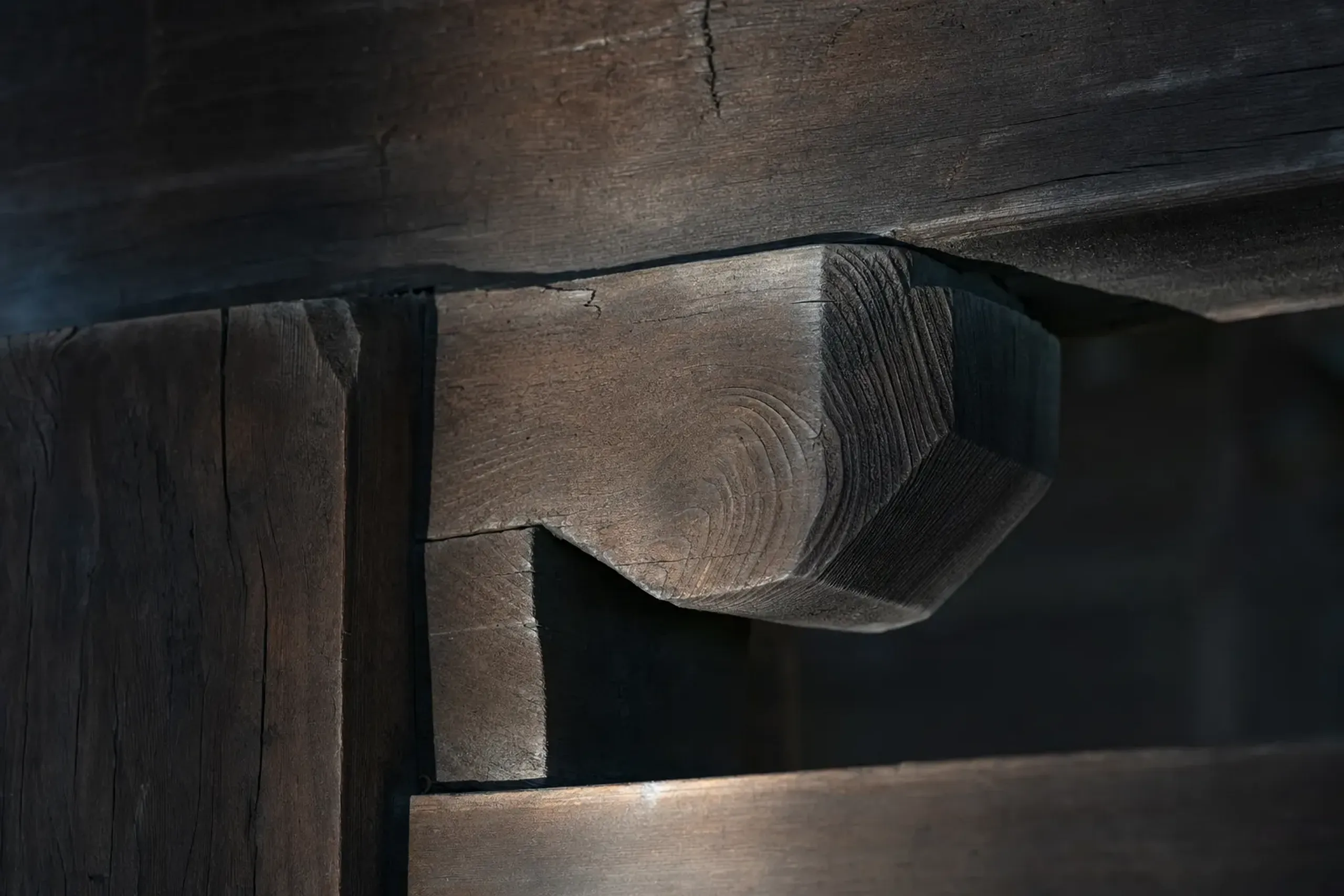
In 2006, Nara's national cultural properties research institute applied tree-ring dating to timber that had been removed from the hall during a past repair. The result was elegant.
The wood had been felled around 1114 to 1116 — meaning it was already properly seasoned by the time construction began in 1124. Rather than contradicting the traditional construction date, the science confirmed it. This is the same method used to settle dating questions at other historic Japanese wooden structures, applied here to a hall whose age tradition had recorded but never proven.
Tradition and laboratory agreed.
The Hall Itself, And The Shell That Crossed Oceans
Now, the craftsmanship. Both the interior and the exterior of the hall were originally gold-leafed — described in the old term kaikon-jiki, "entirely gold-coloured." A building sheathed, inside and out, in gold. Yet the effect it leaves is not one of ostentation but of restraint — a hushed, wabi-inflected stillness in which the gold reads as devotion rather than display.
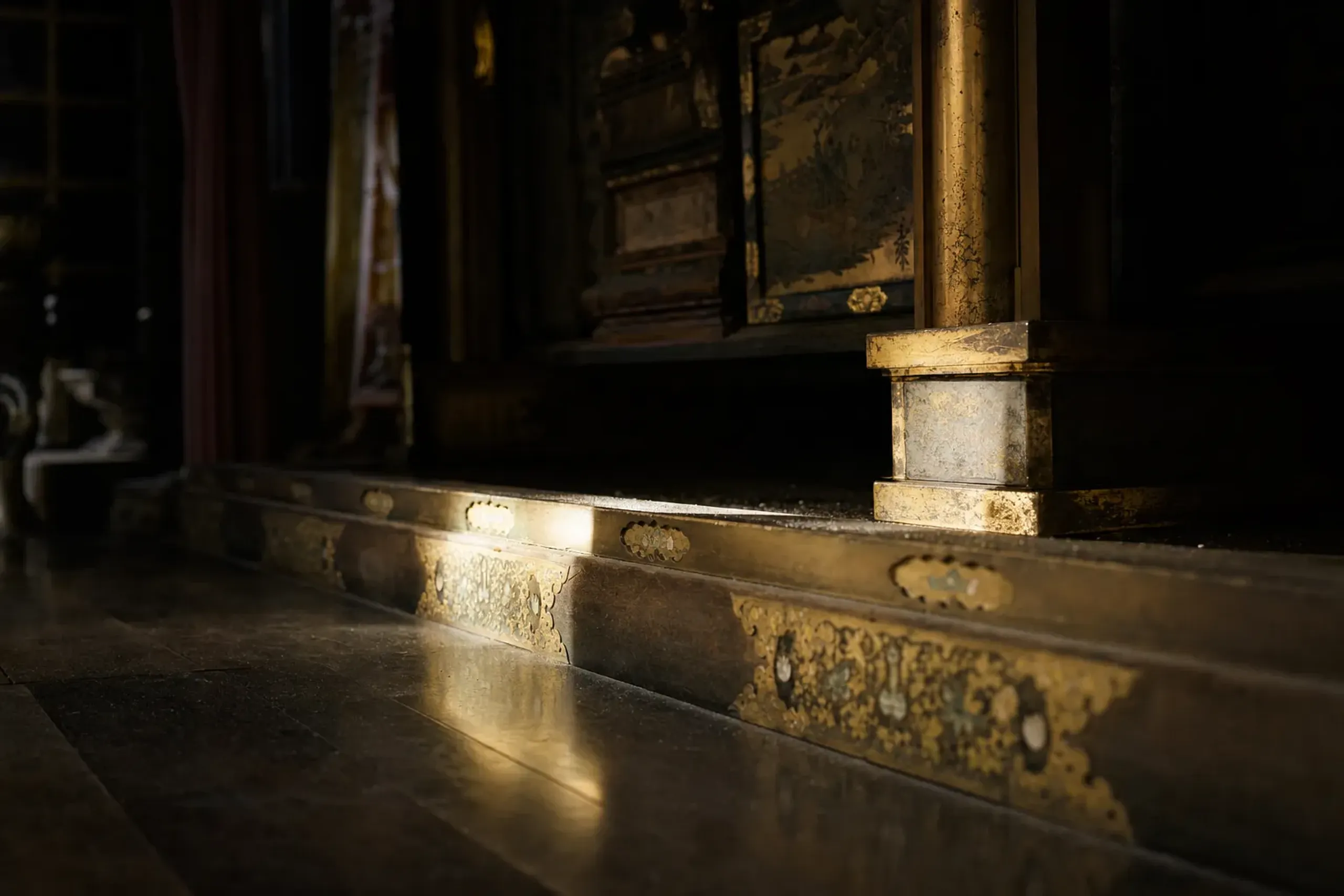
Look closer at the altar decoration and the world opens up. The inlay is mother-of-pearl, cut from turban shell. That shell was not local. It came from far southern seas and reached Japan through maritime trade routes — brought north across oceans to ornament a shrine in the mountains of Tōhoku. Alongside it: ivory, and gemstone ornamentation. A remote northern temple, decorated with materials drawn from a genuinely global medieval trade network. This is the fingerprint of the shokunin who worked here — craftsmen who set foreign shell and stone into lacquer with a precision that still holds nine hundred years on. You can stand in Iwate and see, glinting in the altar, the reach of the sea roads.
The hall is deliberately small — a three-bay-square structure, five and a half metres per side. Intimacy, not scale, was the point.
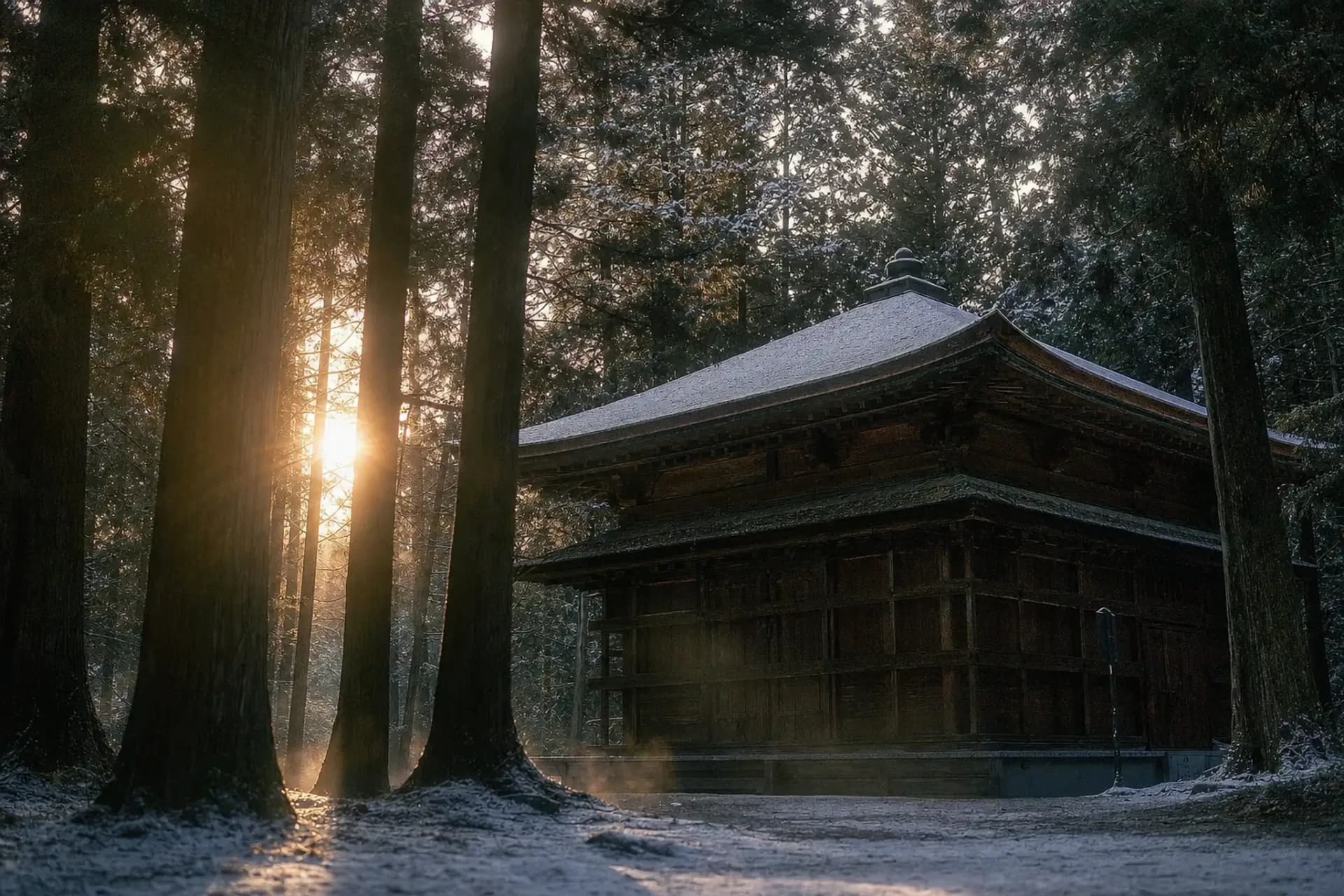
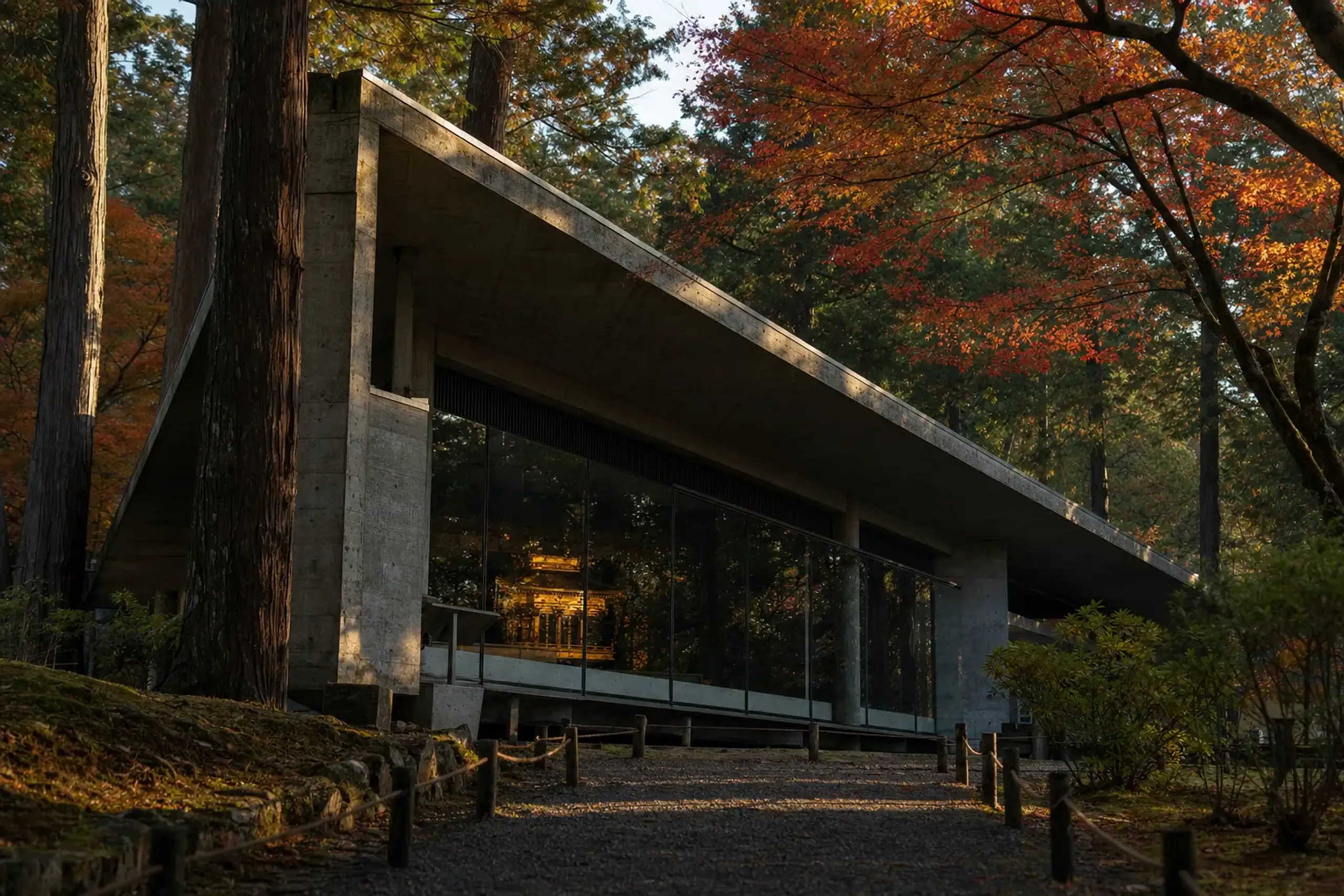
Today it is viewed through glass. Since 1965 the Golden Hall has stood inside a reinforced-concrete protective structure, sealed from outside air to preserve the leaf and the inlay. An older wooden protective cover, believed to date from the Kamakura period, still stands separately on the grounds. Its interior carries paintings related to the site's history — a protective shell that has itself become part of the story.
Recognition, And Where Chūson-ji Sits Today
In 1951, Konjikidō was designated Japan's first National Treasure building under the postwar cultural properties protection system. First. Of everything the country chose to protect under that new framework, this hall in the north came first.
Sixty years on, in 2011, Chūson-ji — together with the wider Hiraizumi cultural heritage sites — was inscribed as a UNESCO World Heritage Site, listed as "Hiraizumi – Temples, Gardens and Archaeological Sites Representing the Buddhist Pure Land." The temple grounds hold over three thousand National Treasures and Important Cultural Assets.
Timing shapes the mood of a visit — knowing what to experience where, and in which month, is much of the art of the north. The Spring Fujiwara Festival runs 1–5 May, with 2026 dates confirmed as 1 May through 5 May. The Fall Fujiwara Festival runs 1–3 November, when Chūson-ji holds a three-day memorial for the Fujiwara leaders and the autumn foliage is at its height. There is a Chrysanthemum Festival in autumn as well. Spring is the more extravagant of the two festivals; November pairs heritage with kōyō and far fewer crowds than Kyoto.
Getting There, And How Japan Royal Service Arranges The Day
Hiraizumi rewards a rail-first approach. From Tokyo, the Tōhoku Shinkansen reaches Ichinoseki in roughly 130 to 150 minutes; from Ichinoseki, the JR Tōhoku Main Line runs to Hiraizumi in about eight minutes. Green Car or GranClass seating, luggage forwarding, and a private transfer where the rail line ends make the journey itself part of the pleasure rather than a chore.
For Chūson-ji, Japan Royal Service arranges two things plainly: private guiding, and chauffeured transfers.
A knowledgeable guide who can read the altar, the history, and the science makes the difference between seeing a gold building and understanding one. We can also fold Chūson-ji into a longer tailor-made itinerary through Tōhoku, and secure the right accommodation nearby, away from the coach traffic that fills the middle of the day. Discretion runs through every arrangement: your identity and your itinerary remain entirely your own.
Early arrival matters here more than at most sites. The approach path climbs through cedar, and reaching the Golden Hall before the day groups arrive gives you the quiet the place was built for.
If Chūson-ji and the wider Pure Land landscape of Hiraizumi speak to you, let us shape a journey around the exact days the hall, its secret Buddha, and its sutra treasures are open. To begin a private, unhurried plan, contact us here.
Frequently Asked Questions
Are There Really Human Remains Inside The Golden Hall At Chūson-ji?
Yes. The remains of four generations of the Ōshū Fujiwara clan rest inside the Golden Hall's three altar platforms, where they were placed in the 12th century. They were examined academically in 1950 and 1994 and remain in place today.
What Is The Best Time Of Year To Visit Chūson-ji In Hiraizumi?
Early May and early November are the standout windows. The Spring Fujiwara Festival runs 1–5 May 2026, and the Fall Fujiwara Festival runs 1–3 November with peak autumn foliage. Autumn offers heritage plus kōyō with far fewer crowds than Kyoto.
How Do I Get From Tokyo To Chūson-ji By Train?
Take the Tōhoku Shinkansen from Tokyo to Ichinoseki (about 130–150 minutes), then the JR Tōhoku Main Line from Ichinoseki to Hiraizumi (about 8 minutes). Chūson-ji is a short transfer from Hiraizumi Station.