In this guide
- 01What A General Guide Covers Well (And Why That Is Often Enough)
- 02What Is A Cultural Interpreter In Japan, Not Just A Translator?
- 03What Changes At A Tea Gathering When You Have A Cultural Interpreter?
- 04What Changes At A Kaiseki Counter When You Have A Cultural Interpreter?
- 05What Changes In A Shokunin Encounter When You Have A Cultural Interpreter?
- 06What Cultural Interpretation Is Not: Constant Narration
- 07When Is A General Guide Enough In Kyoto Or Tokyo, And When Does Interpretation Matter?
- 08How Is A Cultural Interpreter Different From An Architectural Or Art-Historical Guide?
- 09How Do You Choose A Credentialed Interpreter-Guide In Kyoto Or Kanazawa?
- 10What You Should Tell Your Cultural Interpreter In Advance
- 11Frequently Asked Questions
- 12Why Choose Japan Royal Service
You can eat the same kaiseki course two different ways. One way is a list of dish names and ingredients, translated correctly, delivered on time. The other way is an explanation of what the chef is signaling through restraint, timing, and what is left unsaid. Same plates. Different experience.
What A General Guide Covers Well (And Why That Is Often Enough)
A strong general guide keeps the day moving, keeps you oriented, and makes a complicated city feel legible. That matters. A lot.
You get practical translation, schedules that don’t fray, and context that turns “a famous site” into a place with a storyline. You also get small problem-solving: the right entrance, the right platform, the right way to ask a simple question. Quiet competence.
This is not a knock on general guiding. Most of a trip does not need cultural interpretation, because most moments are not built on nuance or formal register. A temple visit at a normal hour is usually better served by a guide who knows the history and pacing than by someone trying to interpret every glance.
Key fact: Kyoto City’s official guide notes that an interpreter guide with specialized knowledge and local background can help visitors understand customs and answer questions in the visitor’s language.
What Is A Cultural Interpreter In Japan, Not Just A Translator?
A cultural interpreter renders what is happening between people in real time, not only what words mean in a dictionary.
Translation is necessary. It is also blunt. Japanese communication often relies on register, omission, and timing, and those signals change by setting. A cultural interpreter listens for those signals and decides when to step in, how to frame a meaning without making anyone lose face, and when silence is the best service.
Think of it as “social accuracy.” Not theatre. Not mystique. It is a practiced ability to carry intent across languages in high-context environments.
Where credentials fit (and where they don’t)
Japan has clear credential pathways for interpreter-guides, including the National Government Licensed Guide Interpreter examination (全国通訳案内士試験), hosted on JNTO’s site with operations delegated per its notice. Credentials matter, especially for baseline professionalism and language skill. Still, the role you need is defined by the setting, not by a badge alone.
In our experience at Japan Royal Service, the best cultural interpreters combine language fluency with judgment: when to speak, how to soften a direct phrasing, and how to avoid turning a refined room into a running commentary. That judgment is the work.
What Changes At A Tea Gathering When You Have A Cultural Interpreter?
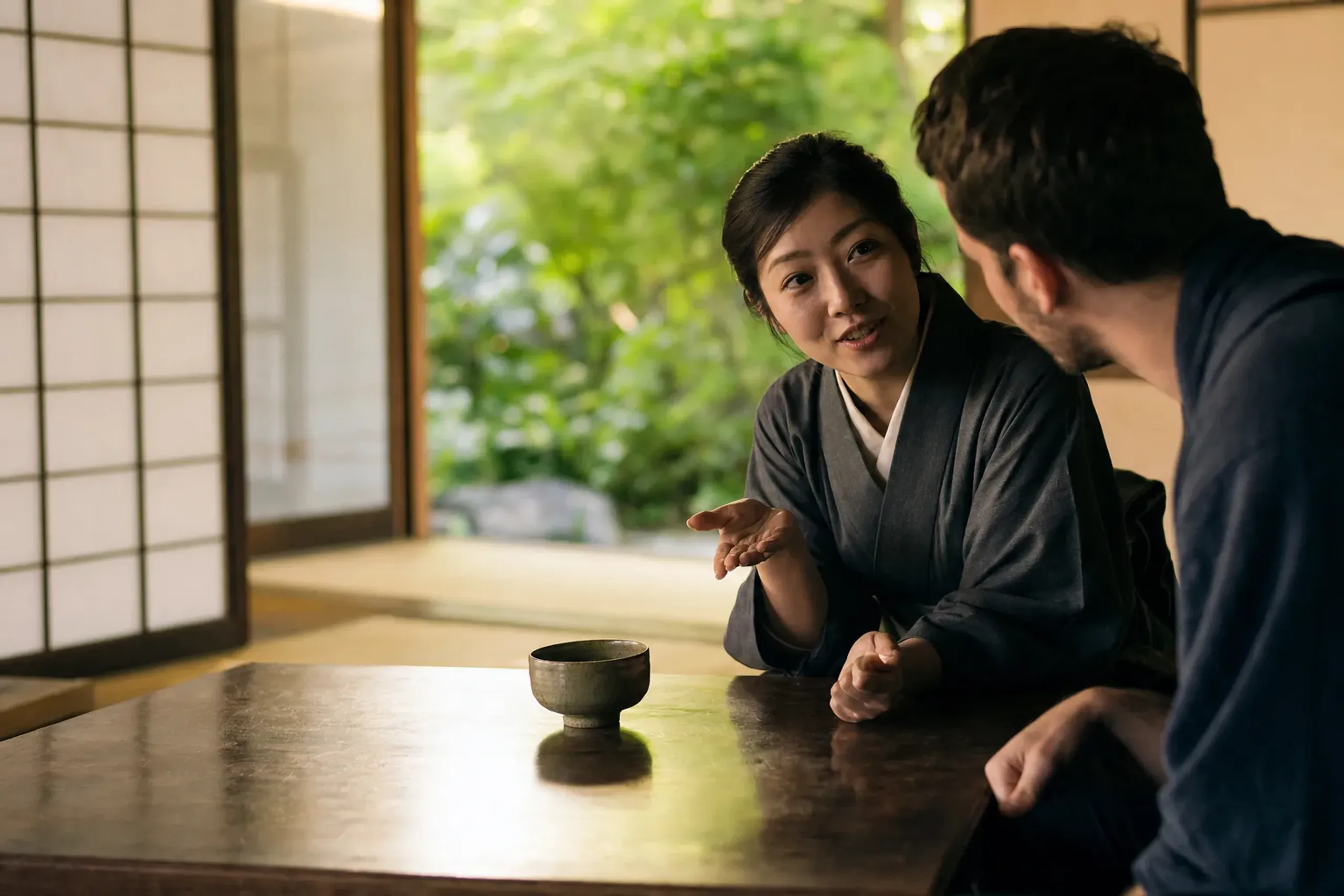
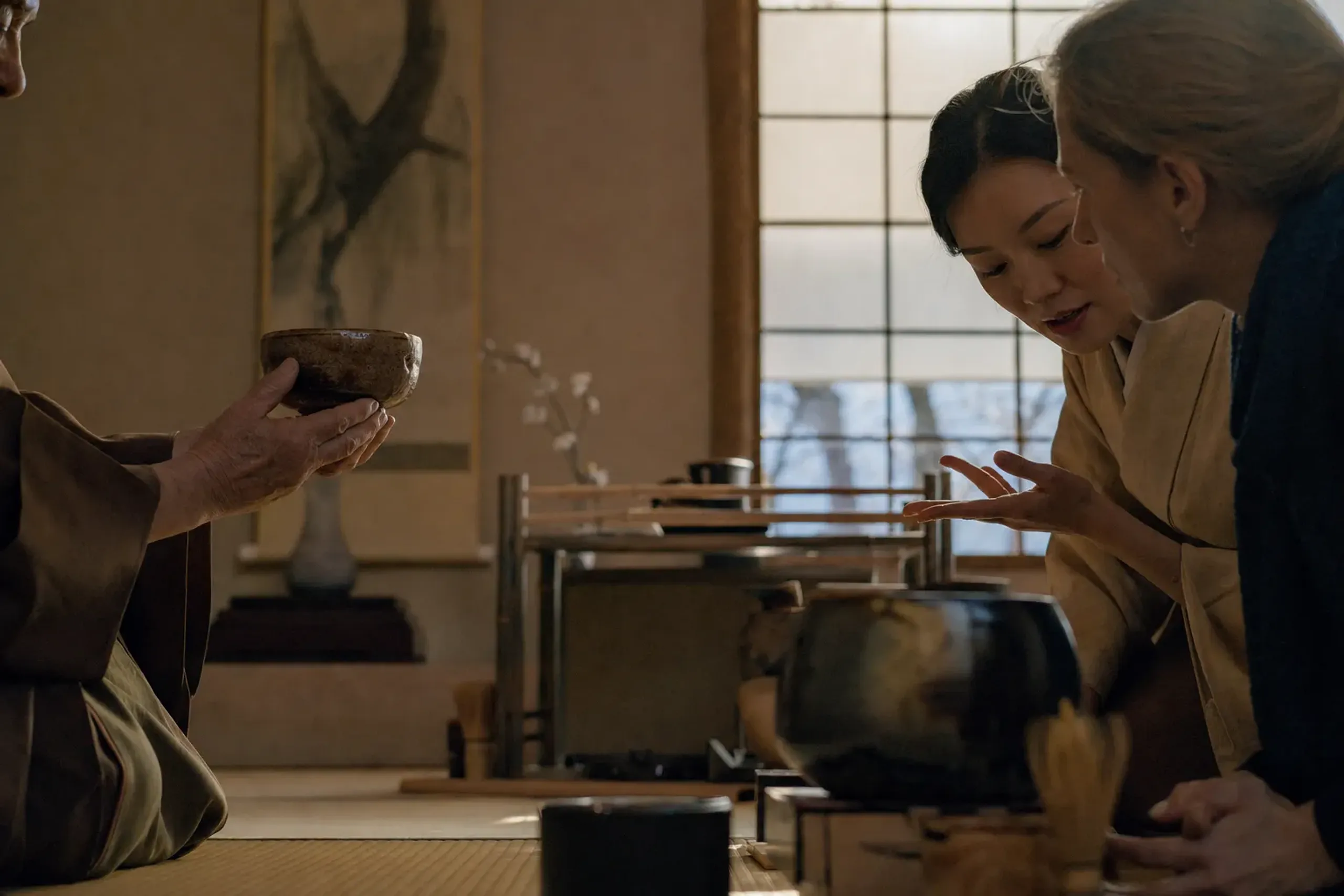
A cultural interpreter keeps a tea gathering from becoming a narrated museum visit by speaking rarely, precisely, and only at the moments that carry meaning.
Tea settings are built on proportion and restraint. A literal translator can be tempted to fill the quiet, because silence reads like “nothing is happening.” That is the fastest way to flatten the experience.
With a cultural interpreter, the help is lighter. You get a short, timely line about what your host is indicating through a pause, a change of tone, or a subtle invitation to respond.
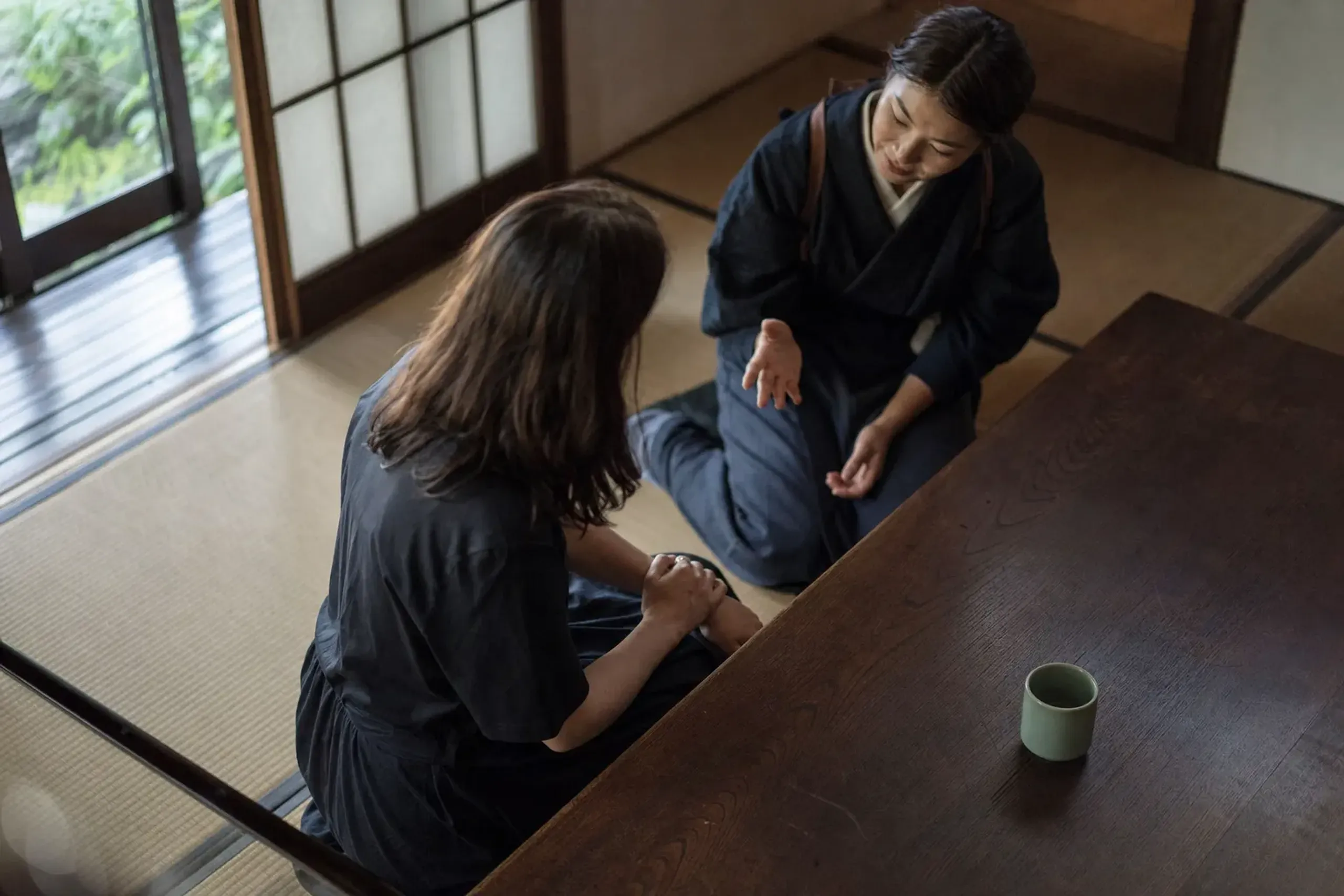
Then the room returns to quiet.
Equally important is what they do not do. They do not correct the host, interrupt, or force an explanation out of something that is meant to be felt rather than explained. Good interpretation protects the room.
What Changes At A Kaiseki Counter When You Have A Cultural Interpreter?
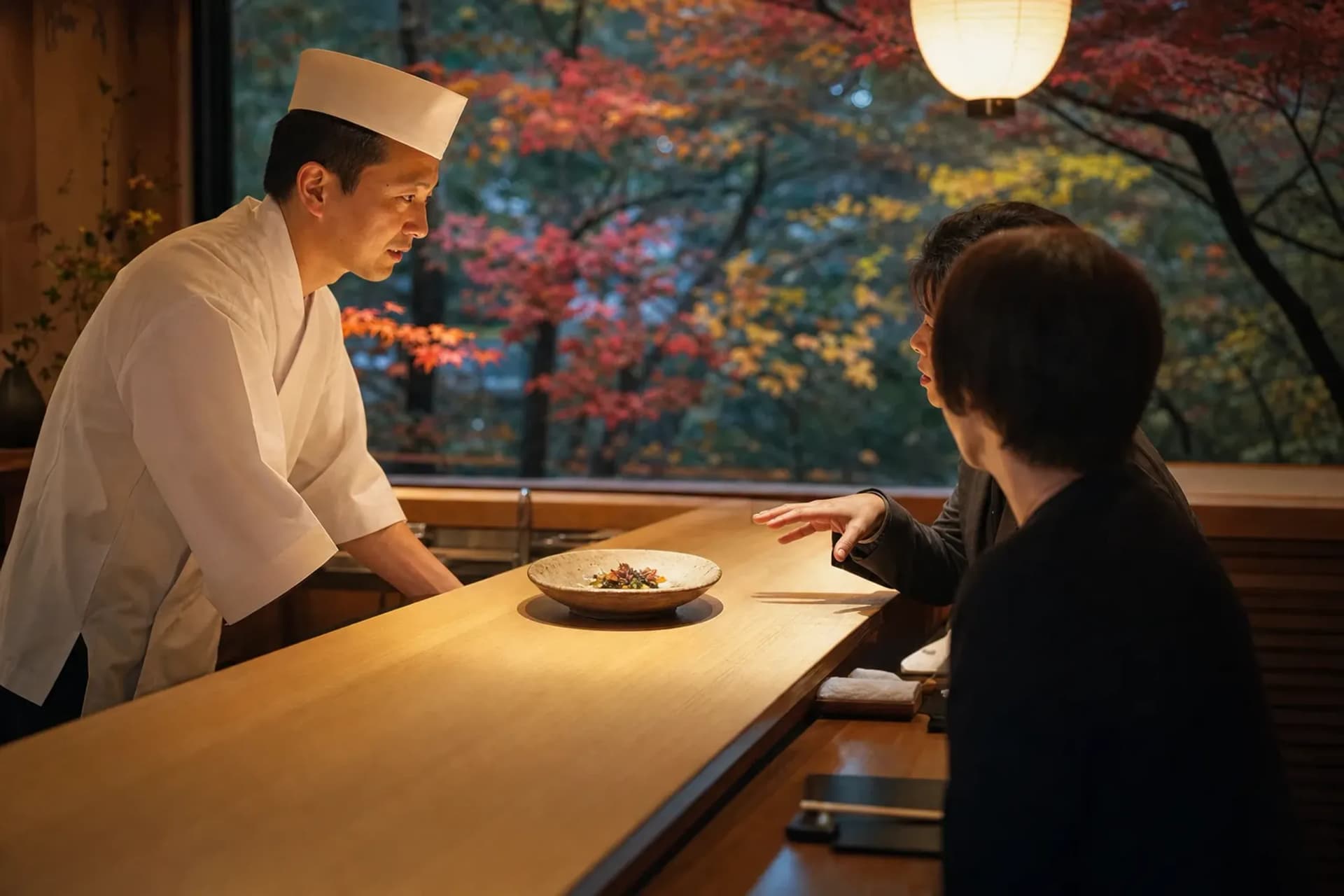
A cultural interpreter turns a list of dishes into the chef’s intent—why this sequence, why this restraint, and what the season is doing in the background—without making the counter feel like a classroom.
A general guide can translate dish names, ingredients, and basic cooking methods. Useful. At a high-level counter, though, the most important information is often social: whether the chef is inviting conversation or concentrating, whether a short comment is an opening or a polite closure, and how to respond without pulling attention away from the work.
This is where shokunin culture shows itself. You are watching someone who has trained for decades to make a narrow set of movements look inevitable. The interpreter’s job is to keep that clarity intact, while still giving you the thread that connects what you’re eating to what the chef is choosing to show.
There is also a practical benefit. When the room is small and other guests are present, the interpreter can modulate volume, choose the right moment, and keep your questions from accidentally becoming public announcements. Discretion, in miniature.
What Changes In A Shokunin Encounter When You Have A Cultural Interpreter?
A cultural interpreter makes craft encounters feel direct by translating technical language accurately and clarifying social intent—especially when a maker is being modest, indirect, or carefully non-committal.
Artisan studios and ateliers can be warm, but the language is often specialized. Materials, tools, and processes may not map neatly into English. A generic translation can drift into approximate words that sound fine but are wrong, which is frustrating when you are genuinely curious.
Then there is the human layer. A maker may deflect praise, refuse to answer a question, or change the topic without saying “no.” That is not evasiveness. It is often a form of control, humility, or boundary-setting. The interpreter reads that boundary and helps you stay on the respectful side of it.
Why Literal Japanese-To-English Can Sound Wrong In Formal Settings
Literal translation can turn polite Japanese into English that sounds blunt, overly certain, or socially off-key.
This is the “register problem.” Japanese often carries meaning through softness, indirect phrasing, and what is withheld. A word-for-word conversion can strip away the cushioning, and the result may sound like a demand, a refusal, or an awkward overshare even when the original message was gentle.
A cultural interpreter renders the register, not just the vocabulary.
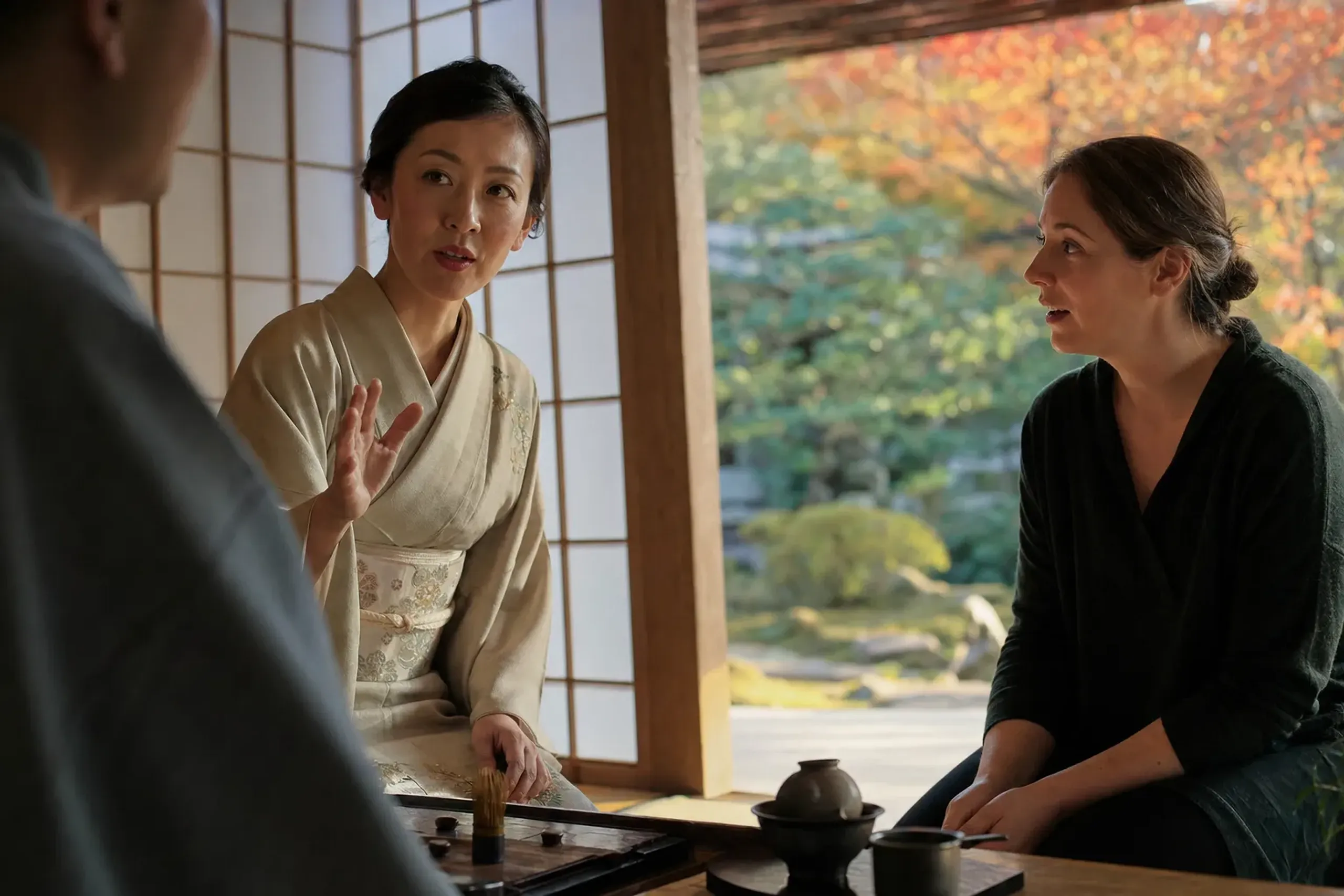
They choose English that matches the speaker’s social intent: formal when the situation is formal, lighter when the situation is light, and ambiguous when the original is deliberately ambiguous. That last one matters.
It also works in the other direction. When you speak plainly—as most English speakers do—the interpreter can re-cast your meaning into Japanese that lands as considerate, not abrupt. You still sound like yourself. Just better calibrated.
What Cultural Interpretation Is Not: Constant Narration
Good cultural interpretation is mostly silence.
This surprises people. They imagine “premium guiding” as an always-on commentary track. In Japan, that approach can be rude in exactly the settings where you wanted to be most respectful.
A cultural interpreter watches for the moments that change the meaning of the encounter: a shift in tone, an invitation to speak, a choice that signals formality, a boundary being set politely. They step in, translate with care, then step out. Clean edges.
If you have had a guide who talked through every room, you already know the risk. The room stops being a room. It becomes a performance for you.
When Is A General Guide Enough In Kyoto Or Tokyo, And When Does Interpretation Matter?
A general guide is enough for most sightseeing days; cultural interpretation matters most in small, invitation-like settings where formality, privacy, and nuance are part of the design.
Here is a practical way to think about it. If the day is built around places that can absorb normal visitor behavior—major museums, large gardens, well-trafficked temples—a general guide’s strengths usually win: pacing, history, navigation, and time management.
Easy.
If the day is built around a small room and a host—tea, kaiseki, a studio visit—then interpretation can become the difference between merely attending and actually understanding. Those settings are not forgiving. Over-talk, under-talk, the wrong tone, a missed cue. It shows.
Kyoto adds another layer in 2026 and beyond: visitor behavior standards are being emphasized for sustainable tourism, with Kyoto Tourism Moral showing an update date of 2026-06-30. In sensitive neighborhoods, discretion and low-impact behavior are not “nice.” They are the cost of being welcome.
We will not re-explain the driver/guide split here. That is covered in our transport-focused post; if you want that clean distinction, read it once and move on. For private transportation on trips where timing and privacy matter, see our private transportation page for context on how we design days around calm movement.
How Is A Cultural Interpreter Different From An Architectural Or Art-Historical Guide?
An architectural or art-historical guide explains a building or artwork; a cultural interpreter explains what is happening between people, live, as it unfolds.
Architecture expertise is real and valuable. It can turn places like the Tokyo National Museum or Naoshima into coherent narratives instead of a series of rooms. It is also a different skill from interpreting register, formality, and social intent.
Sometimes both are useful on the same trip. Rarely are they found in the same person at the level you would want.
Plan for the difference. A museum day wants expertise. A private encounter wants interpretation. Mixing the two without clarity often leads to the wrong person in the room.
How Do You Choose A Credentialed Interpreter-Guide In Kyoto Or Kanazawa?
Start with official guide directories and look for credentials, local certification, and relevant specialization—then match the person’s style to your setting and your tolerance for “talk.”
Kyoto City’s official guide highlights the value of interpreter guides with specialized knowledge and local background. For Kanazawa, the official guide directory differentiates between National Government Licensed Guide Interpreters and locally certified guides, including Kanazawa Visitors Hosts / Local Licensed Guide Interpreters. Those distinctions are practical, not cosmetic.
Credentials are a floor. Specialization is the ceiling. A cultural interpreter who is right for a formal meal may not be right for a contemporary art day, and the reverse is also true.
One more reality check: Japan is seeing heavy inbound demand, with JNTO reporting 3,148,600 visitor arrivals in June 2026. Scarcity is not only about hotels. It affects the availability of high-level human talent, too.
What You Should Tell Your Cultural Interpreter In Advance
Share the setting, who will be present, what you already know, and how you want the interpreter to behave in the room.
Start with the basics. Party size. Languages spoken at the table. Any children or older family members. Then move to the details that actually change performance: is this a quiet counter with other diners nearby, or a private room with a host who expects conversation?
Tell them your preference for interpretation style. Some guests want minimal intervention, only when necessary. Others want short context lines that help them connect the dots. Either is fine. Silence is a preference, not a default.
If there are sensitivities, say so. Dietary limits, mobility needs, a desire not to be photographed, or a professional profile that requires discretion. These points are not “special requests.” They are part of doing the day properly.
Frequently Asked Questions
Is A Cultural Interpreter The Same Thing As A National Government Licensed Guide Interpreter?
No—“cultural interpreter” describes a role and skill set, while National Government Licensed Guide Interpreter is a formal credential earned through Japan’s licensed examination system.
In Japan, the National Government Licensed Guide Interpreter examination (全国通訳案内士試験) is listed on JNTO’s site as part of the national framework for interpreter-guides. A cultural interpreter may hold that license or may be locally certified, but the essential difference is how they interpret register and social intent in sensitive settings.
Do I Need A Cultural Interpreter For Temples And Shrines In Kyoto?
Usually no; most temple and shrine visits work well with a general guide who can pace the visit and explain history clearly.
Interpretation becomes more valuable when the visit includes a small, formal interaction—private access, a meeting, or a setting where your behavior is being read closely.
If your day is straightforward sightseeing, a solid guide is often the best fit.
Will A Cultural Interpreter Talk Constantly During Tea Or Kaiseki?
No; good cultural interpretation is intentionally sparse, timed to the moments that carry meaning, and quiet enough to protect the atmosphere.
If you have had “over-guided” experiences before, this is the opposite. The goal is to preserve the room while still giving you the essential thread of what is being communicated.
What Should I Prepare Before Meeting A Cultural Interpreter In Japan?
Bring a clear description of the setting, your party’s languages, and your preference for how much interpretation you want in the room.
Also share any privacy needs, mobility considerations, or topics you prefer to avoid. In formal settings, the interpreter’s preparation is what keeps everything feeling natural, not managed.
Why Choose Japan Royal Service
Our team at Japan Royal Service works with cultural interpreters who are distinct from general guides and distinct from architectural specialists. The point is not more information. It is better understanding, delivered with restraint.
We also take discretion seriously. For HNW travelers, that means your identity, schedule, and private settings are treated as confidential by default, not as marketing material.
If you tell us the settings you care about—tea, kaiseki, craft, or a mix—we will assess where interpretation changes the outcome and where a general guide is the smarter, lighter choice. No theatrics. Just fit.
For private coordination, reach our team privately via WhatsApp or LINE, or contact us here.