In this guide
- 01A Tower Held Together By Rope, Not Nails
- 02How Tall And Heavy Are The Gion Matsuri Hoko Floats?
- 03When Are The Gion Matsuri Yamahoko Floats Built?
- 04How The Yamahoko Are Built: The Three-Crew Sequence
- 05What Happens On Yamahoko Junko (17 July And 24 July) In Kyoto?
- 06Where To See Tsujimawashi: The Wet-Bamboo Turn That Proves The Design Works
- 07What Are Yoiyama Nights Like, And What Can You Realistically See?
- 08A Practical Viewing Strategy For HNW Travelers (Without Overreaching)
- 09Paid Viewing Seats And Hotel Viewing Programs: What They Mean (And Don’t)
- 10How To Plan Your Day Around Street Closures And Heat In Central Kyoto
- 11Hidden Japan Inside The Float Towns: What Google Misses
A cedar tower rises on Shijō-dōri, one beam at a time.
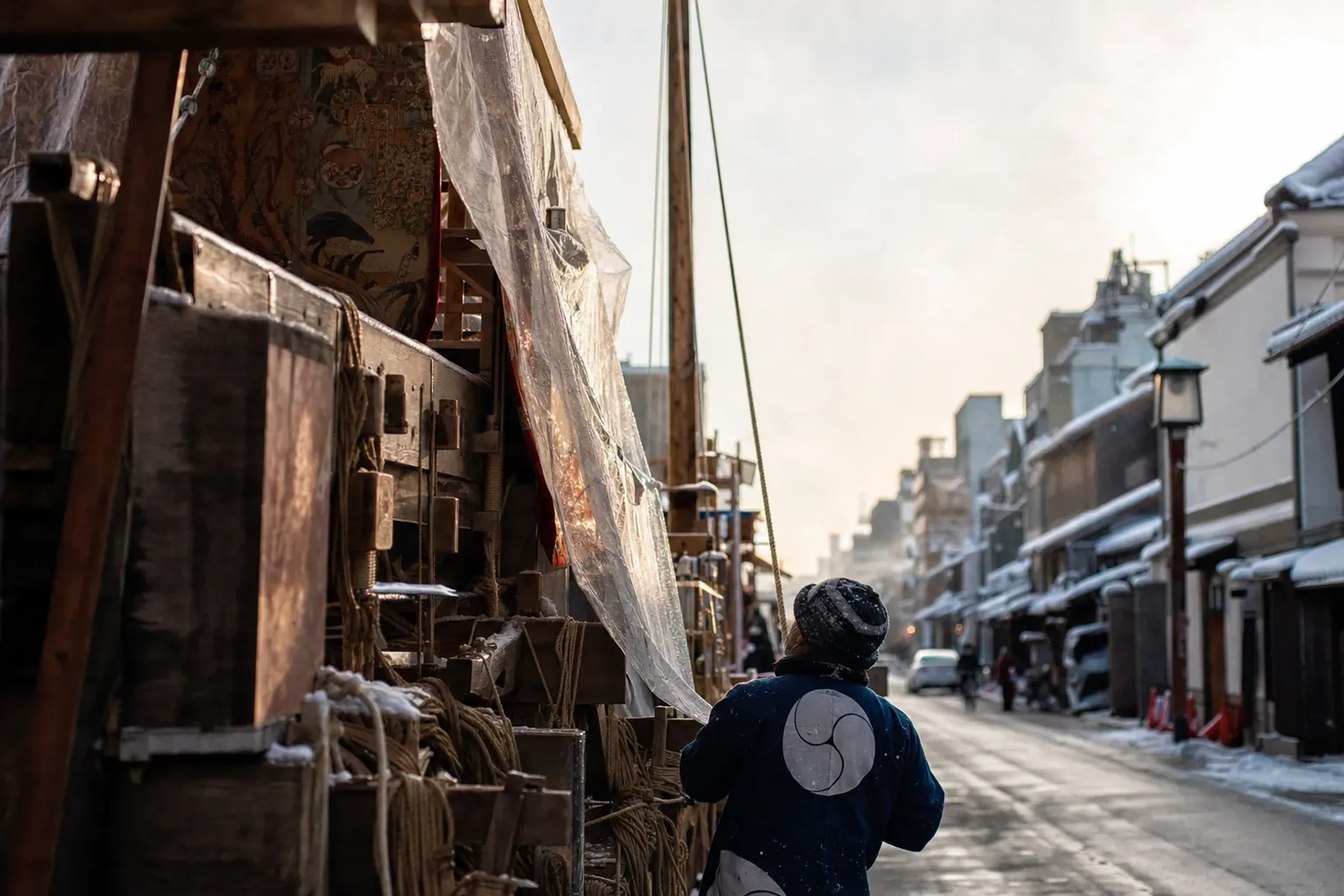
No metal squeal. No nail gun crack. Just hands, timber, and rope drawn tight until the joints stop shifting and the frame begins to feel like one living body.
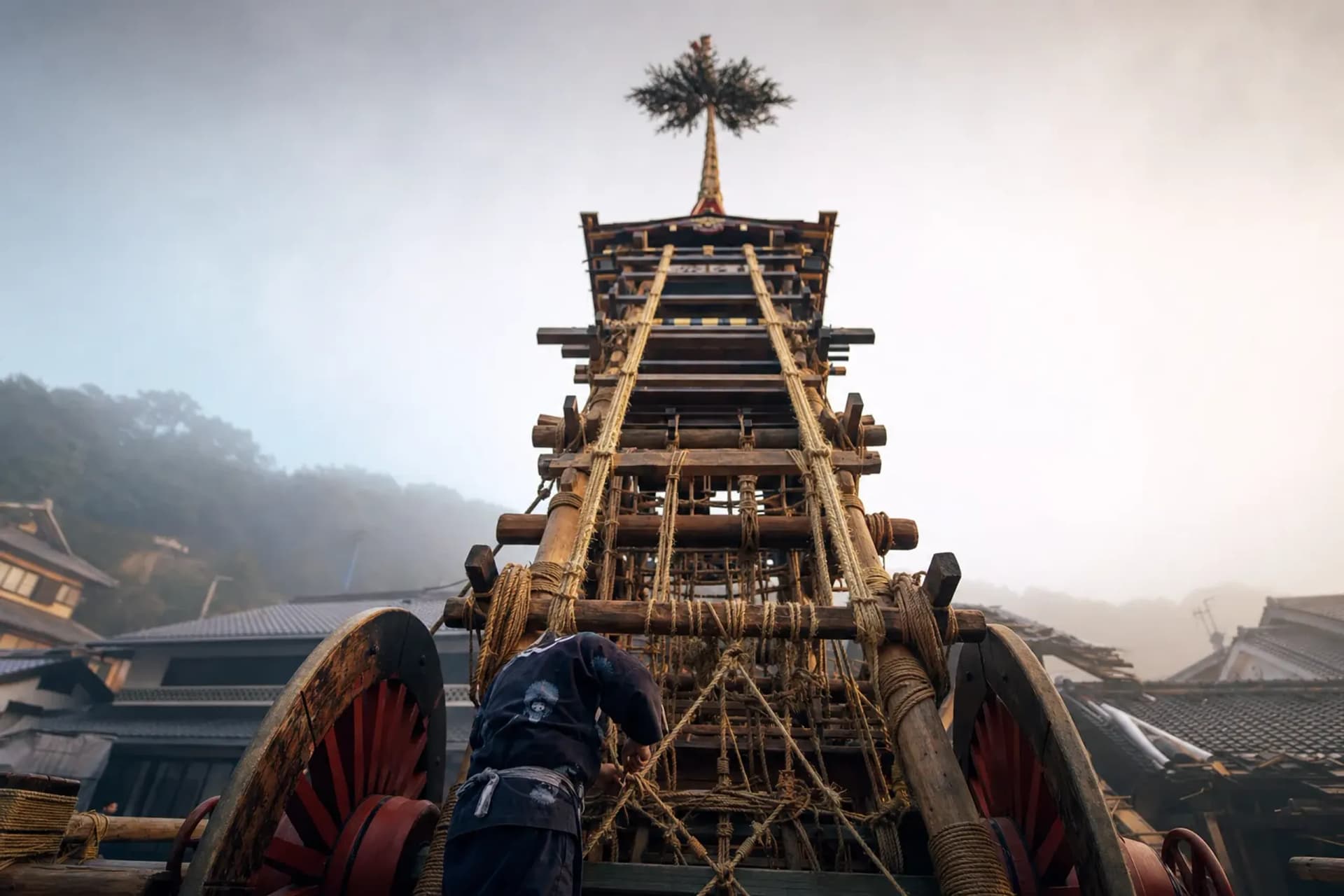
This is the quiet engineering behind Kyoto’s Gion Matsuri floats, the yamahoko. Some stand about 25 metres to the spire and weigh roughly 10 to 15 tonnes, yet they are assembled without a single nail.
The secret is nawagarami: coarse rope binding that cinches each joint, cushions shock, and lets the structure yield as it moves through crowded streets. Then, when the festival ends, the rope is cut apart. Fresh rope again next year. Nothing permanent, everything renewed.
A Tower Held Together By Rope, Not Nails
The tall floats of Gion Matsuri are built to flex, not to fight movement.
In our experience, that one idea changes how you watch the procession. You stop waiting for a “perfect moment” and start noticing tiny motions: the give at a joint, the sway of the spire, the way the whole structure seems to breathe as it rolls.
This rope-only construction is not a quirky detail for guidebooks. It is the reason a 10-tonne-plus tower can be assembled quickly, dismantled again, and pulled through Kyoto’s intersections without shattering itself. It is craft answering physics, generation after generation.
Some builder-focused accounts note the rope is trucked in from Fukui because it is soft yet strong. The key point remains steady across sources: the lashings are renewed each year, because the ropes are cut when the float is dismantled.
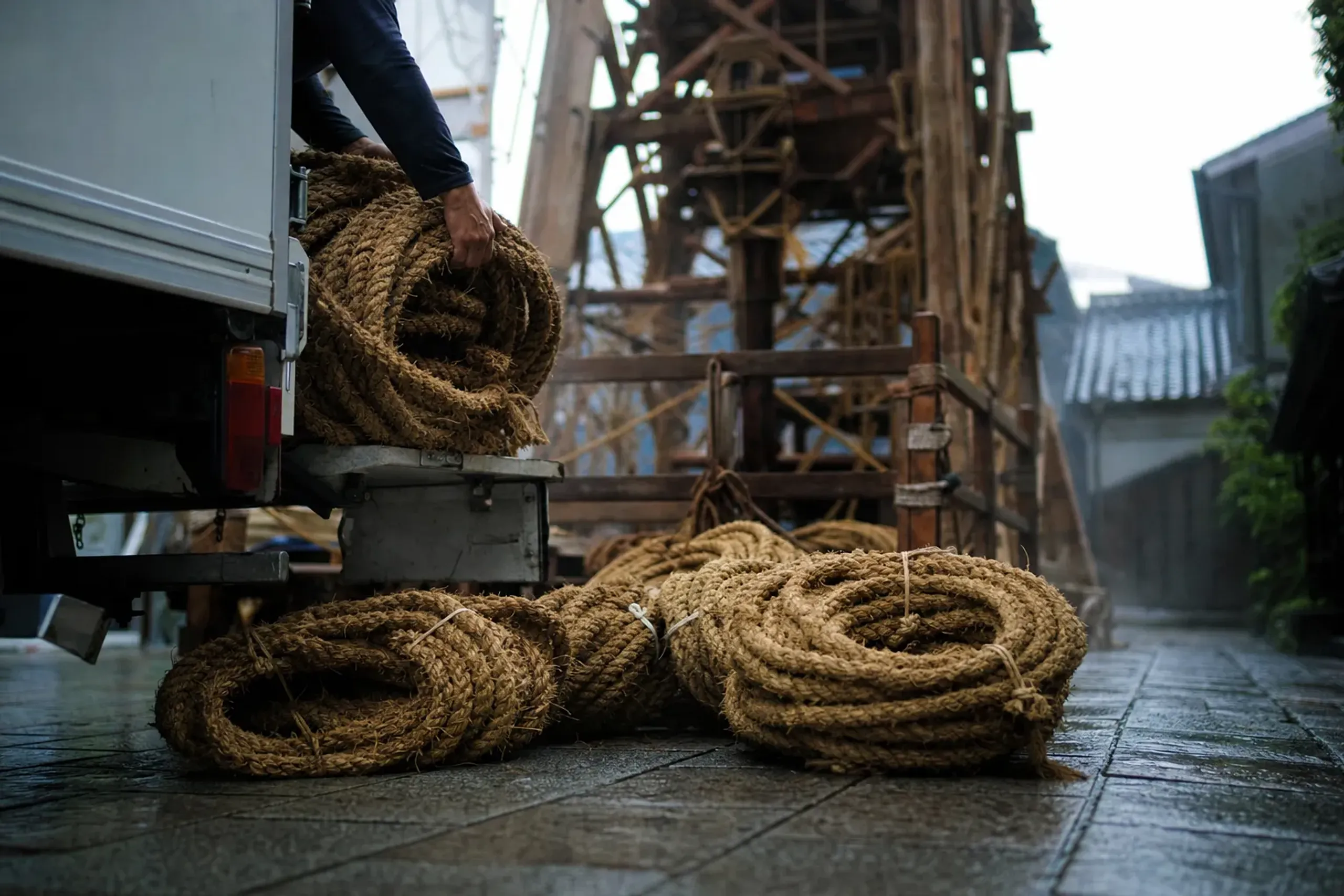
What you witness is a structure that exists only for its brief season, then vanishes.
How Tall And Heavy Are The Gion Matsuri Hoko Floats?
Gion Matsuri’s six tall hoko reach about 25 metres to the spire and weigh roughly 10–15 tonnes, built on wheels about 1.9 metres across and pulled by around 30–40 people.
Picture a five-to-eight-storey silhouette moving at walking pace. Close enough to hear rope fibres creak. High enough that a roof crew has to watch for overhead wires.
Two conductors stand on a board between the beams to steer. At corners, four people manage the turn. Up top, a roof crew of four adjusts the spire’s sway and clears obstacles such as power lines.
That division of roles matters. The float is not simply “pulled.” It is managed, like a small ship threading a narrow canal.
When Are The Gion Matsuri Yamahoko Floats Built?
Float-building typically begins around 10 July for the 17 July procession, with the tall floats taking about three days; floats for the 24 July procession are generally built around 17–21 July.
Dates vary slightly by neighbourhood and year, so treat them as a planning window, not a promise. Still, the rhythm is consistent enough that you can time a visit for the build itself — a matter of knowing exactly what to see, and precisely when, which is the essence of travelling by shun, the Japanese instinct for perfect seasonality.
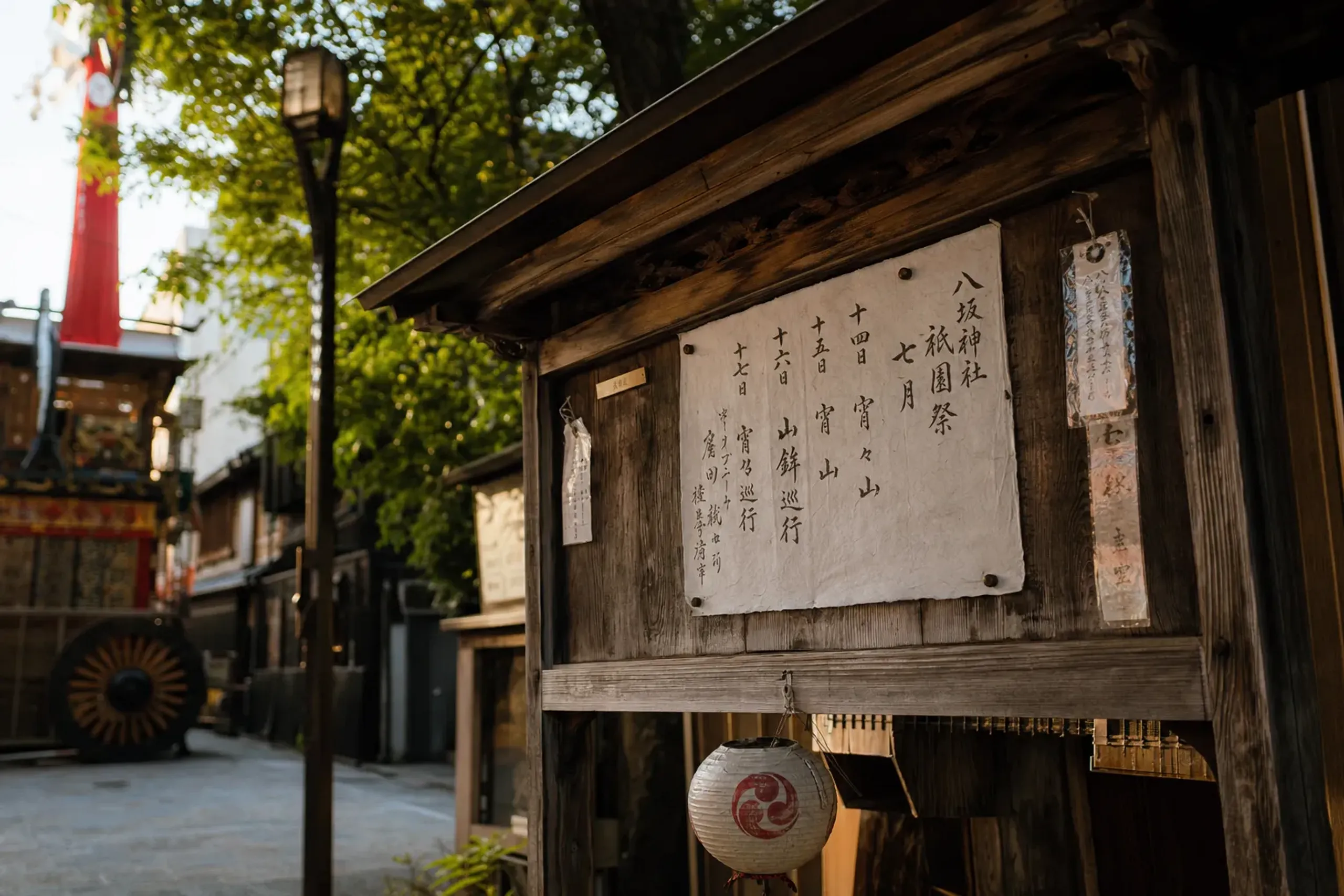
What surprises first-time visitors is where it happens. Not hidden inside a workshop. Right on the city streets of central Kyoto, in open view.
If you arrive early in the day, you can watch the frame come together in stages. The city feels ordinary for a moment. Then a tower appears where a traffic lane used to be.
How The Yamahoko Are Built: The Three-Crew Sequence
The build looks fast because the work is so specialised.
Large floats are typically raised by three specialist crews. A foundation crew builds the frame. Carpenters shape the roof and the music platform. A wheel crew fits the wheels last, after the decorating is done.
That final step is telling. The float is treated like a museum object first and a vehicle second. UNESCO’s Intangible Cultural Heritage documentation even calls the floats “moving museums,” a nod to their elaborate decorations, tapestries, and ornaments.
Each float belongs to its own neighbourhood, which operates and preserves it — the living work of shokunin, the master artisans whose skills are handed down within the community rather than sold to outsiders. During the evenings before each procession, neighbourhoods display decorations and heirlooms at their meeting halls. You are walking through living custodianship, not a stage set.
What To Look For While The Frame Goes Up
Keep your eyes on the joints.
You will see lashings layered in deliberate patterns, tightened until the beams stop wandering.
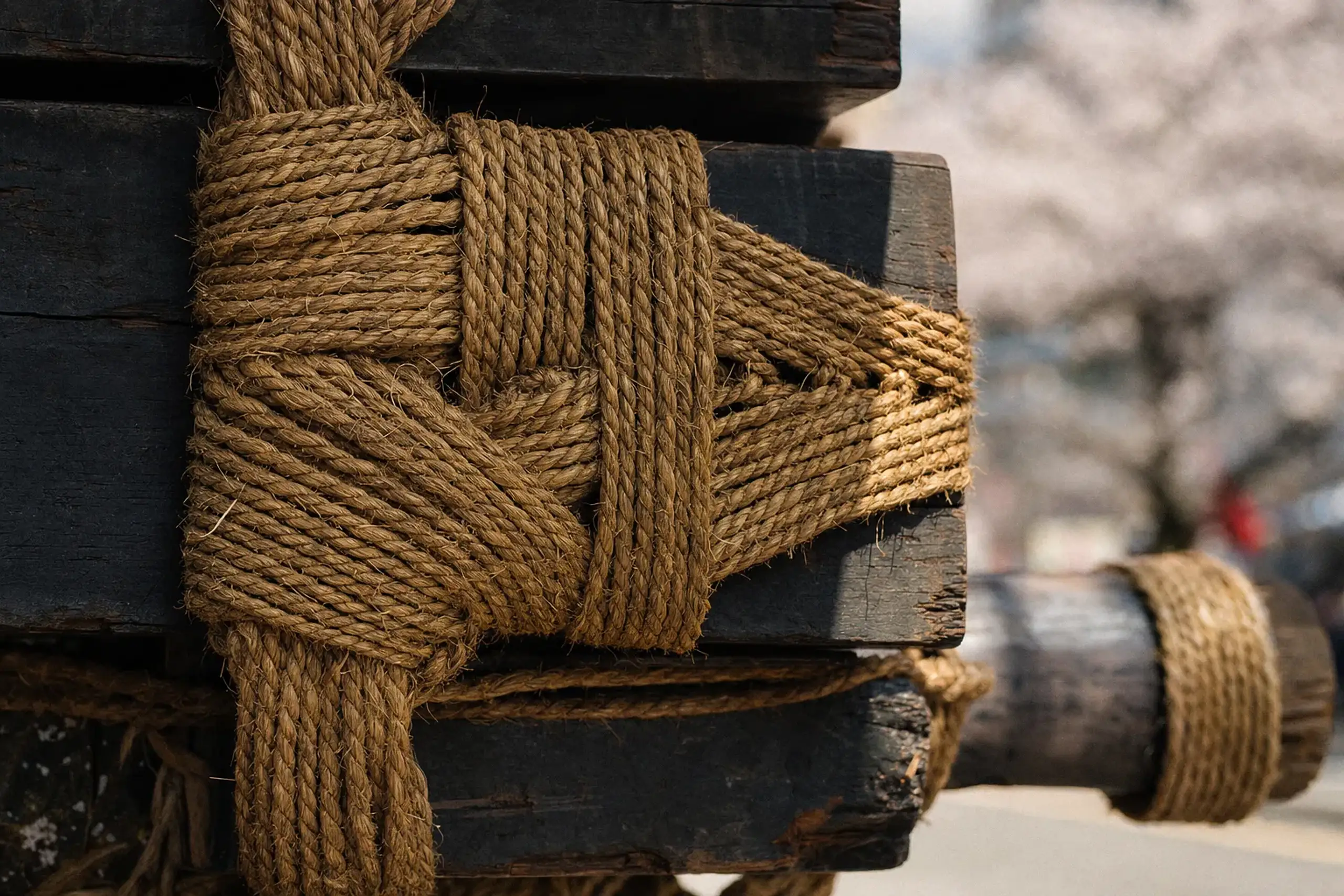
This is nawagarami, and it is doing two jobs at once: binding the structure and giving it a shock-absorbing “cushion” where wood meets wood. There is a restrained beauty to it — an aesthetic close to wabi, where the exposed rope is left plainly visible rather than concealed behind ornament.
Also watch the platform lines. The music space is not an afterthought. The festival music, Gion-bayashi, is played from the floats throughout the procession, with special pieces reserved for the corners.
A Note On The Kannon-Yama Pine Tree
Two floats, the Kannon-yama floats, each carry a real pine tree.
One builder-focused account says the pine is felled at Narutaki and chosen by rock-paper-scissors or lottery before the second procession. Treat this as one account, not a universal rule. The broader truth is clear enough: these floats are not props. They are built from real materials under real constraints.
What Happens On Yamahoko Junko (17 July And 24 July) In Kyoto?
Yamahoko Junko is the public street procession of the Gion Matsuri floats on 17 July and 24 July, running through central Kyoto with two separate morning routes and two different float lineups.
Gion Matsuri is the festival of Yasaka Shrine and spans the entire month of July. Its highlights include the Mikoshi-Togyo and the Yamahoko Junko on 17 July and 24 July.
The processions are called the Sakimatsuri (17 July) and the Atomatsuri (24 July).
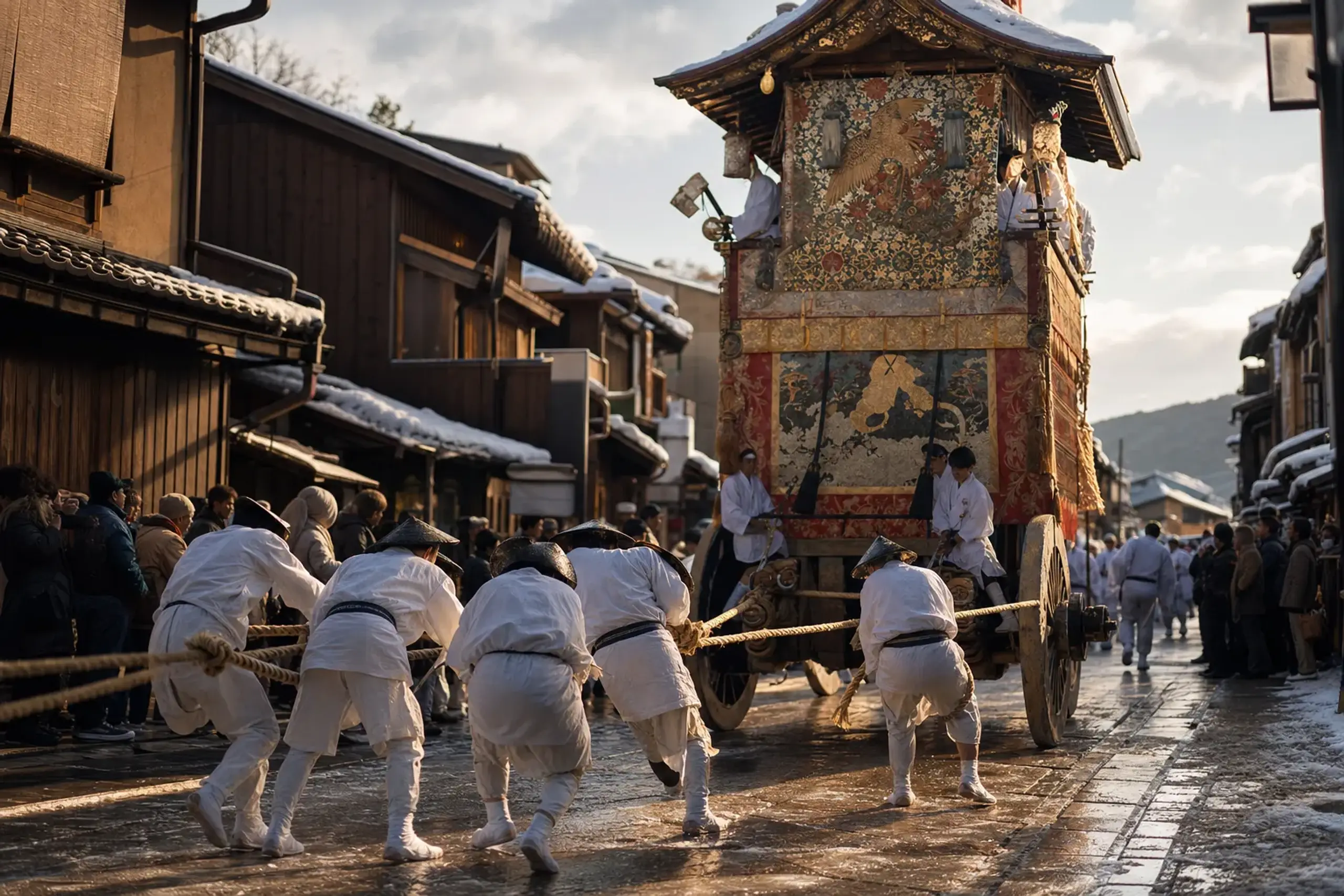
The 17 July procession features 23 floats and starts at about 9:00, while the 24 July procession features 11 floats and starts at about 9:30, with the routes running in reverse directions.
Both processions take roughly four hours. Long enough for the sun to become a factor. Long enough for crowds to compress and then loosen again.
Why There Are Two Processions
The modern shape of the festival has changed within living memory.
The two processions were combined into a single procession in 1966, then restored as two about 50 years later. One float, Taka-yama, returned to the second procession in 2022.
Some floats keep a fixed place in the order. Naginata-hoko always leads the first procession. Hashi-Benkei-yama leads the second. The remaining order is drawn by lot.
Naginata-hoko is also the only hoko that carries a living child. A small detail. A large responsibility.
Where To See Tsujimawashi: The Wet-Bamboo Turn That Proves The Design Works
The best place to watch tsujimawashi is at major intersections like Shijō–Kawaramachi and Kawaramachi–Oike, where split bamboo is laid and wetted so a 10-tonne float can pivot through a right angle.
This is the moment when the rope logic becomes visible.
Split bamboo is set on the road, then watered until it glistens. Pullers haul. Conductors call the timing. The wheels climb, hesitate, then slide, and the whole tower swings through the corner with a controlled shudder.
You can feel the crowd inhale. You can also see, in that instant, why the structure must yield.
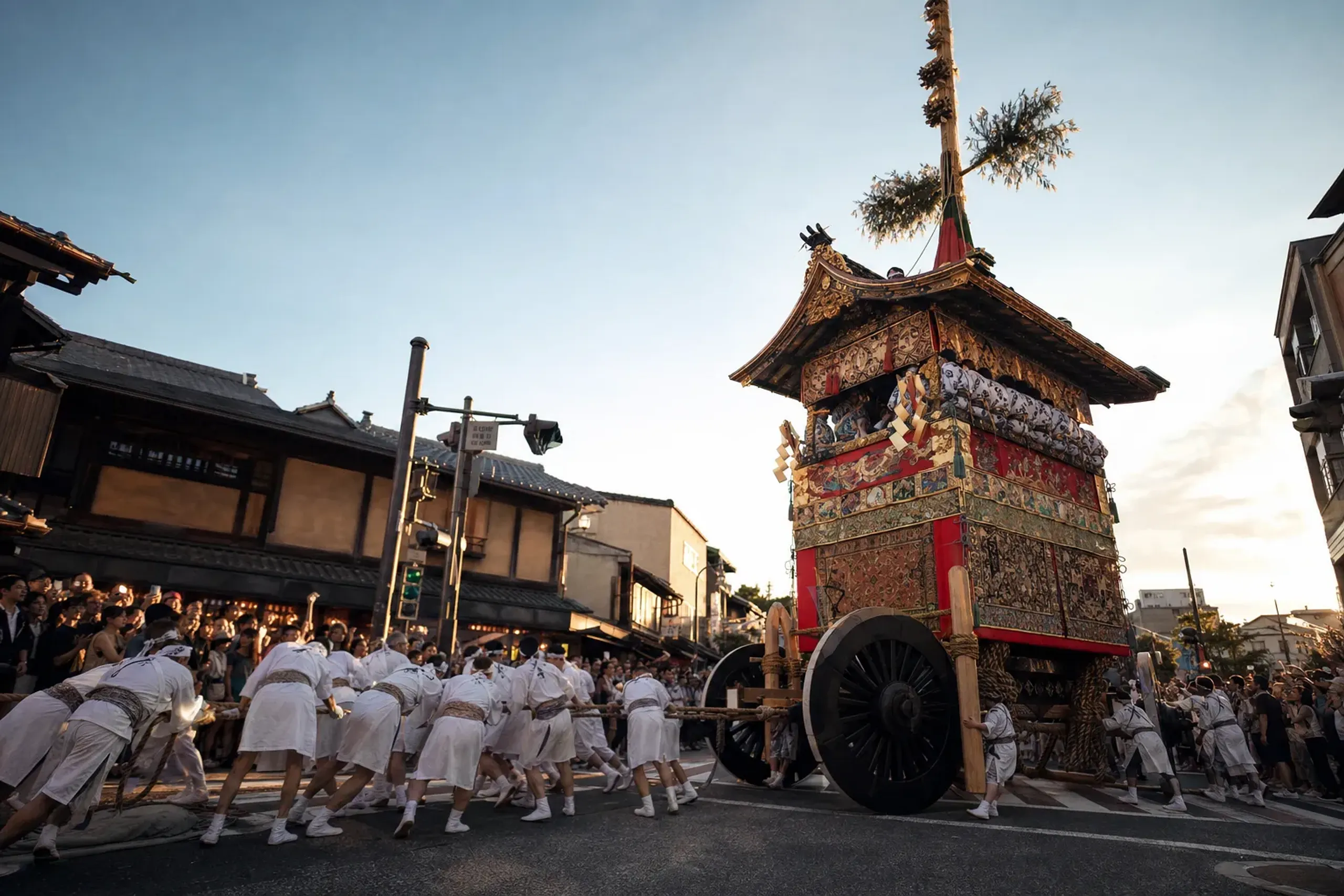
A rigid joint would punish the beams. Rope binding cushions, absorbs the distortion, and lets the float survive the turn.
Key fact: Tsujimawashi is not a “spin.” It is a heavy pivot managed by human calls, wet bamboo, and a structure designed to flex.
What Are Yoiyama Nights Like, And What Can You Realistically See?
The three evenings before each procession—yoiyoiyoiyama, yoiyoiyama, and yoiyama—turn central Kyoto into a pedestrian festival with traffic closures, night stalls, and float music playing above the streets.
These nights are where the floats become intimate.
By day, you study mechanics. By night, lantern light makes the wood grain and rope textures glow, and you notice textiles and carved details lost in the morning glare.
Some private houses open their entryways to display heirloom screens, a custom called Byōbu Matsuri. It is quiet, almost domestic, and easy to walk past if you are only chasing the “big sights.” Don’t rush past it.
Each neighbourhood shows its decorations and heirlooms at its meeting hall during these evenings. This is one of the few moments a traveller can see the “moving museum” idea while it still stands perfectly still.
A Practical Viewing Strategy For HNW Travelers (Without Overreaching)
Plan one yoiyama evening and one procession morning, then build in buffer time for heat, crowds, and rest; the floats are public street events, and comfort comes from timing and positioning, not special access.
For many well-travelled guests, the pain point is not interest.
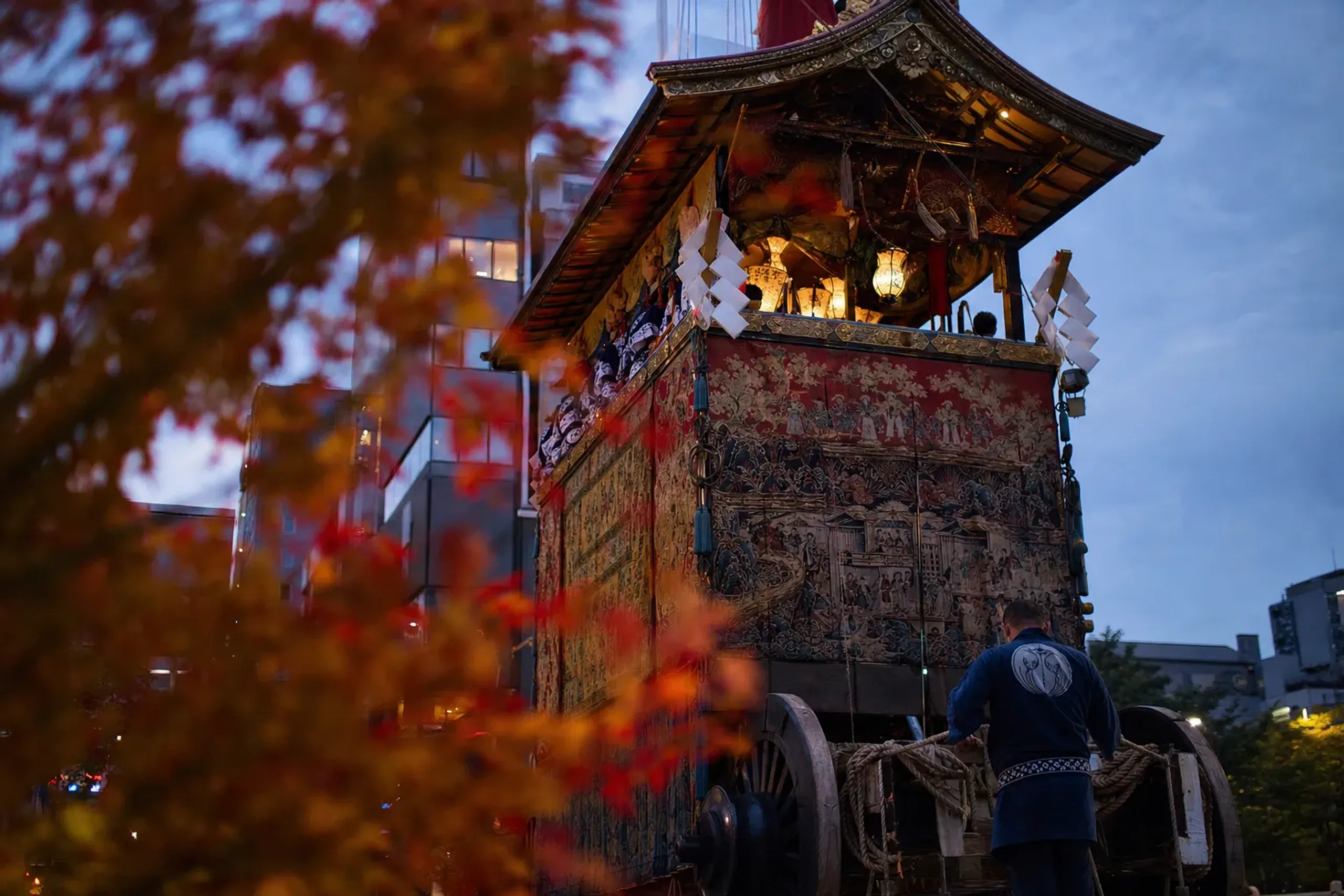
It is friction. July in Kyoto can be punishing, and the densest blocks near Shijō–Karasuma and Shijō–Kawaramachi can bottleneck within minutes.
Our team at Japan Royal Service approaches this like a choreography problem. Small choices matter: where you enter the pedestrian zone, when you cross the route, where you step out for water, and how you avoid being stranded when streets close. A well-built bespoke itinerary quietly removes those frictions before you ever feel them.
Use the festival’s own structure to your advantage. Yoiyama for close-up atmosphere. Procession morning for the engineering, especially at a turn.
Option A: You Want The Turn And The Physics
Stand at a major intersection and commit to waiting.
- Arrive early enough to claim a clear sightline near Shijō–Kawaramachi or Kawaramachi–Oike.
- Watch the bamboo being laid. That is your cue the corner is approaching.
- Expect slow movement. The turn is earned, not scheduled to the minute.
Option B: You Want Detail, Textiles, And Calm
Choose yoiyama nights and prioritise the neighbourhoods.
- Go early in the evening for heirloom displays before the densest crowds build.
- Spend real time at one or two floats, rather than “collecting” ten.
- Listen for Gion-bayashi from above. It changes how the whole street feels.
Paid Viewing Seats And Hotel Viewing Programs: What They Mean (And Don’t)
Official paid viewing seats for Yamahoko Junko are sold through Kyoto’s official tourism channels, with premium categories offered in front of Kyoto City Hall in recent years, including very high-priced tiers.
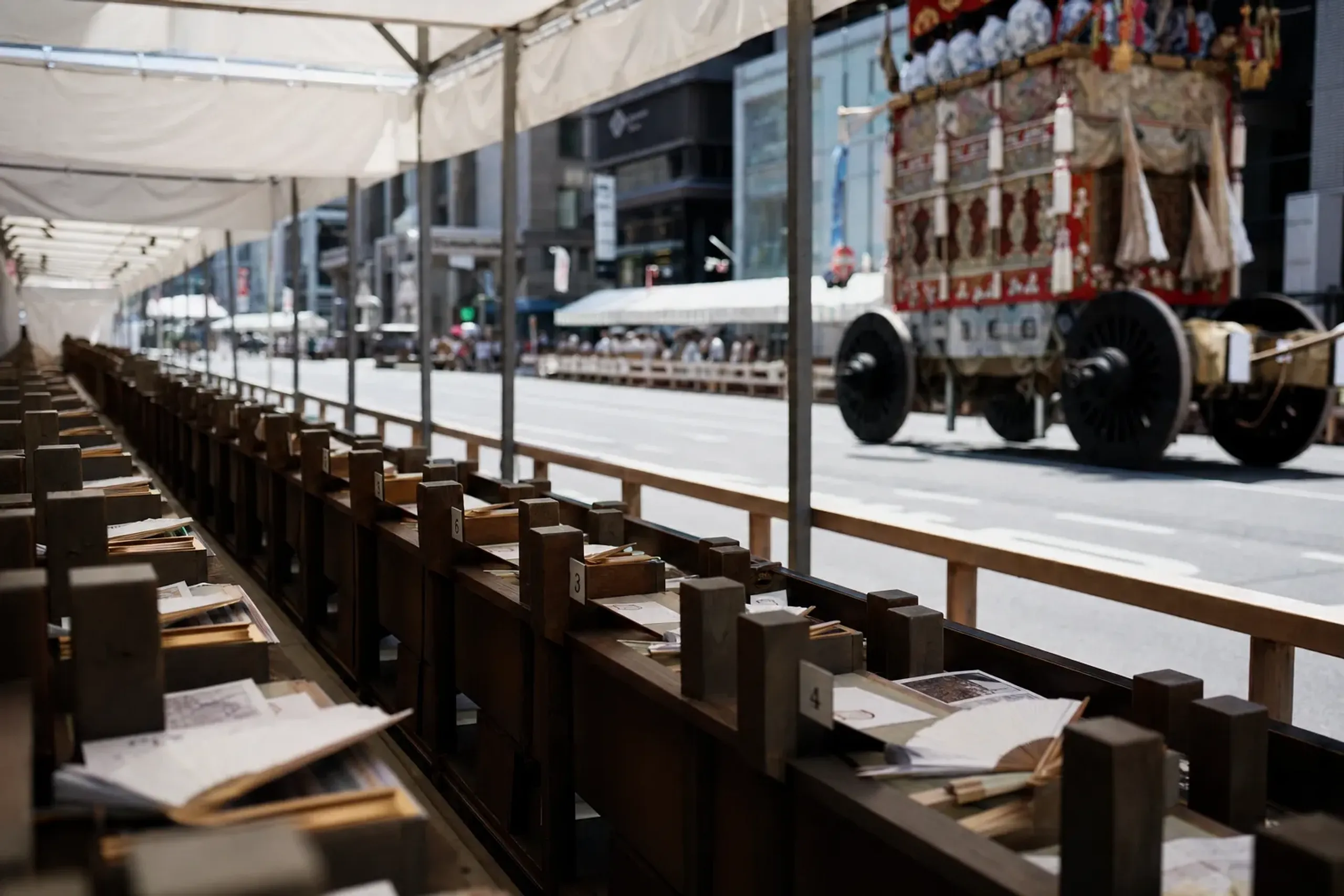
Kyoto’s official tourism site states that paid viewing seat tickets for the 2026 procession went on sale at 10:00 AM JST on 1 June 2026, and lists premium categories in front of Kyoto City Hall, including 125,000 yen (front row) and 155,000 yen (second row onwards).
Those figures are useful as a signal: demand is real, and comfort has become a formal product. Still, a seat does not solve everything. You may still face heat, walking distance, and street closures that complicate arrival.
Some hotels also publish viewing programs. ROKU KYOTO (LXR Hotels & Resorts), for example, publicly advertises a Gion Matsuri Yamahoko Junko viewing program that includes hospitality by a maiko, per its official page. Programs like this can suit travellers who want a structured setting around the public event.
For discretion-focused guests, the goal is often simpler: a quiet plan, minimal exposure, and a clean exit. Your identity and your itinerary stay entirely your own. That takes judgement more than any ticket category.
How To Plan Your Day Around Street Closures And Heat In Central Kyoto
Assume long walks and limited shade, and stage your day so you are never forced to cross the procession route at the worst possible time.
Kyoto’s centre during Gion Matsuri is not merely “busy.” It is a moving restriction map. Traffic controls and pedestrian zones quietly change the feel of distance.
We suggest thinking in three blocks: (1) arrival, (2) viewing, (3) recovery.
Recovery is not optional. Ignoring it is the most common mistake.
If you are travelling with family members or older guests, keep the plan short and precise. One key corner. One yoiyama night. Then an early return.
Transport: The Quiet Advantage
Private pickup and drop-off reduce friction when streets close and taxis vanish.
On the subject of private transportation, it’s worth being direct: a good chauffeur plan is less about luxury and more about control—timing, hydration stops, and knowing where vehicles can legally stage when the city grid tightens. It is the kind of anticipatory care you never see and never have to ask for.
Kyoto is compact on a map. During Gion Matsuri, it can feel oddly far. That mismatch is precisely where travellers lose their time.
Hidden Japan Inside The Float Towns: What Google Misses
Hidden Japan during Gion Matsuri lives in the float neighbourhoods’ small rituals—meeting halls displaying heirlooms, lantern-lit streets, and the quiet labour of preservation—rather than any closed-door “VIP” area.
This festival is owned by its communities. Respect that boundary. The most meaningful moments are often public, yet easy to overlook because they are not packaged for you.
What we can arrange is the quiet framework around those moments — the timing, the introductions where they are welcome, the discretion, and the seamless movement that lets you meet a thousand-year tradition on its own terms. To begin shaping your July in Kyoto around the Yamahoko, contact us here for a tailored proposal.