In this guide
Hirosaki Castle, Aomori Prefecture (Hirosaki City)
Cherry Blossom Season at Hirosaki Castle
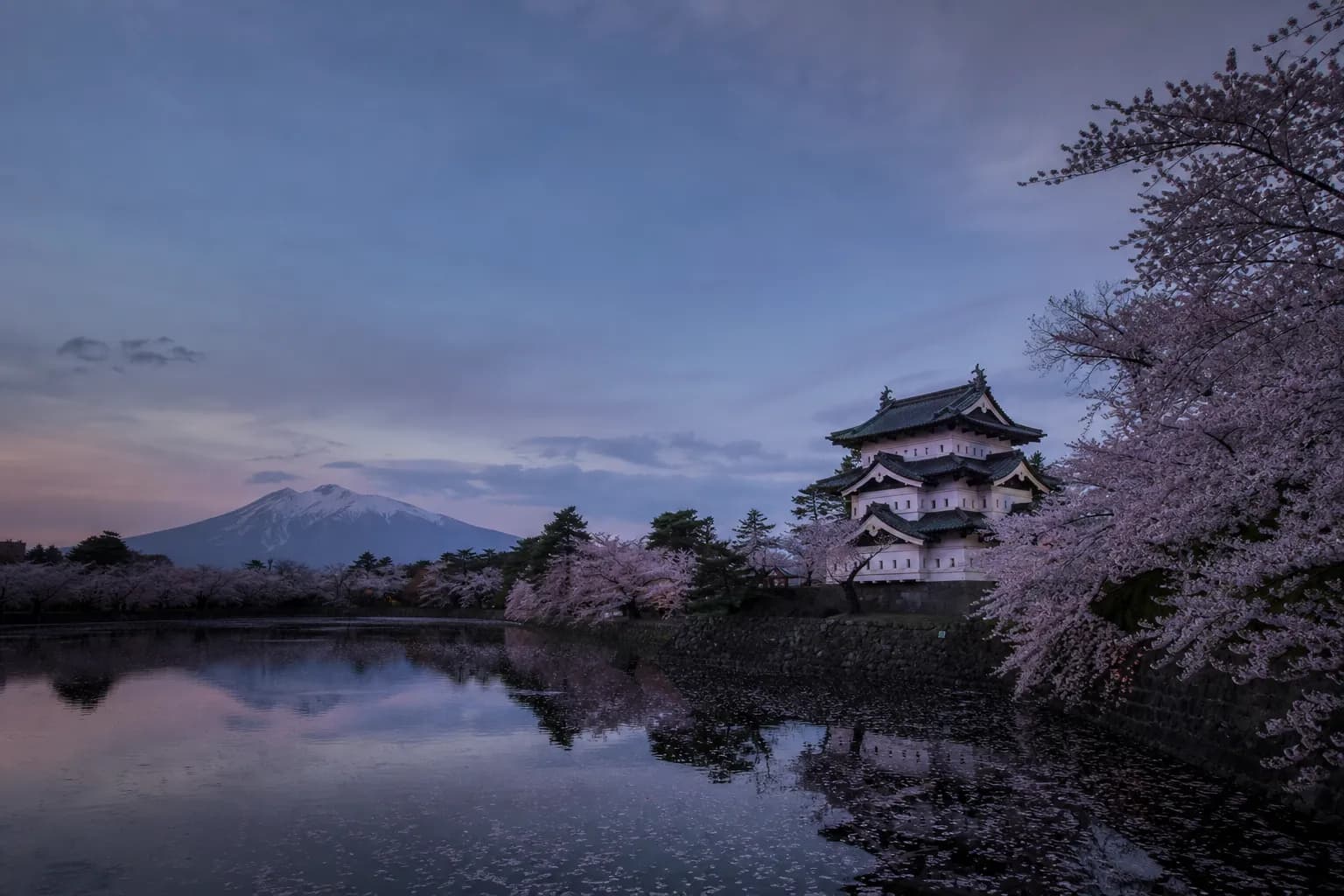
Every year in late April, Aomori Prefecture turns pink as cherry blossoms come into bloom. Hirosaki Park is celebrated as one of Japan’s Top 100 Cherry Blossom Viewing Sites and one of Japan’s Top 100 Sights of People and Nature, and is widely regarded as offering some of the finest sakura scenery in the country.
Hirosaki Park is home to 2,600 trees and more than 50 varieties of cherry, including Somei Yoshino, Shidarezakura (weeping cherry), and Yaezakura (double-layer cherry). During the Hirosaki Cherry Blossom Festival—held every year from April 23 to May 5—the park welcomes more than 2,000,000 visitors.
Beginning with the Sakura Tunnel (cherry blossom tunnel) along the west moat, the park delights visitors with a range of vistas throughout the season. You can:
- Paddle a small boat to see blossoms reflected on the moat
- Visit at night for illuminated trees
- Watch as fallen petals create a carpet of blossoms
The Origins of Japan’s Largest-Scale Cherry Blossoms
Hirosaki Park’s cherry blossoms are praised as being among the largest in scale in Japan. Their history dates back to 1715, when the Tsugaru clan requisitioned 25 Kasumizakura cherry trees from Kyoto and planted them on the grounds of Hirosaki Castle (today’s Hirosaki Park). With continued care from local residents, the trees flourished. By the Taishō era (1912–1926), the castle was surrounded by magnificent cherry trees.
History of Hirosaki Castle
Hirosaki Castle is located in Hirosaki City, Aomori Prefecture, in Japan’s Tōhoku region. In the Edo period, the first castle tower was built in 1609 by order of Nobuhira Tsugaru, the region’s governor. In 1627, lightning struck and ignited stored gunpowder within the compound; the resulting fire completely destroyed the inner citadel and other structures, including the castle tower.
After the fire, Hirosaki Castle stood without a tower for nearly 200 years, until reconstruction began in 1810. The current tower is one of twelve extant castle towers in Japan and is designated a National Important Cultural Property.
Within Hirosaki Park, you can also find several watchtowers—Tatsumi (southeast), Hitsujisaru (southwest), and Ushitora (northeast)—named for the traditional Japanese terms once used for cardinal directions. Each tower is positioned in accordance with its name relative to the castle.
General Information
- Address: 1 Shimoshiroganecho, Hirosaki-shi, Aomori 036-8356
- Telephone:
- General Incorporated Foundation Hirosaki City Midori Association: 0172-33-8733
- Hirosaki City Park and Green Land Sector: 0172-33-8739
- Hirosaki Municipal Tourist Center: 0172-37-5501
- Period: April 23 to May 5 (annually) Dates may change.
Opening Hours
- Food stalls: 9:00–21:00
- Night illumination: 18:30–22:00 (Pay Zone and Hours)
- Honmaru and Kita no Kuruwa: 7:00–21:00
- Hirosaki Castle Arboretum: 9:00–18:00 (Tickets sold until 17:30)
Admission (Entrance Fees)
- Honmaru and Kita no Kuruwa: Adult ¥320 (¥250) / Child ¥100 (¥80)
- Hirosaki Castle Arboretum: Adult ¥320 (¥250) / Child ¥100 (¥80)
- Combination ticket (Honmaru, Kita no Kuruwa, Arboretum, and Fujita Memorial Garden): Adult ¥520 (¥470) / Child ¥160 (¥130)
Prices in parentheses ( ) are group-discount rates. Group discounts apply for parties of 10 or more.
Official Links
- Website: https://www.hirosakipark.jp/en/
- Facebook: https://www.facebook.com/hirosakipark.jp
- Twitter: https://twitter.com/@HIROSAKIPARK_JP