In this guide
- 01The Festival Was Cancelled, Not The Crowds
- 02How Long Is The Wait At Chureito Pagoda In Early April?
- 03Why This Single Frame Became The One Everyone Wants
- 04How Hard Is The Walk To The Chureito Pagoda Viewing Deck?
- 05The Countermeasure Window: What Changes During 1–17 April 2026
- 06What About The Controlled Burn On 12 April 2026?
- 07Is The Evening Illumination At Chureito Pagoda A Real Alternative?
- 08The Kawaguchiko North-Shore Alternative: Same Fuji, Different Flow
- 09When Is The Fuji Kawaguchiko Sakura Matsuri In 2026?
- 10How To Reach The Kawaguchiko North Shore From Kawaguchiko Station
- 11Bloom Timing Reality: Fuji Five Lakes Often Runs Later Than Tokyo
- 12How To Visit Responsibly When Crowds Are The Story
- 13What We Recommend For A Calm April Morning (Step By Step)
- 14What Japan Royal Service Can Handle For This Trip
- 15Frequently Asked Questions
Dawn at Arakurayama Sengen Park can feel almost silent for a minute.
Then the line becomes visible. It snakes past the steps, pauses, tightens, and starts moving again in short pulses.
Mount Fuji may be clear. Or not. Either way, the crowd is real.
The Festival Was Cancelled, Not The Crowds
Fujiyoshida City will not hold the Arakurayama Sengen Park cherry blossom festival for 2026, citing overtourism and its impact on residents’ living environment.
That decision is the headline. The quieter truth is harder to swallow: cancelling a festival does not cancel demand for Japan’s most copied Mount Fuji view.
The city’s own 2026 visitor guidance warns of a timed rotation system at the observation deck during the season, with typical waits of about 1 to 3 hours. That is an official expectation, not a rumour circulating on social media.
A formal “enhanced countermeasure period” runs 1–17 April 2026, with traffic control, security staff, temporary parking and toilets, and an extended span of traffic restrictions through 19 April. Visitors are asked to use public transport, avoid residential areas, and refrain from photographing people without authorisation.
Key fact: For 2026, Fujiyoshida City explicitly anticipates 1–3 hour waits at the Chureito Pagoda observation deck during peak season due to timed rotation crowd control.
How Long Is The Wait At Chureito Pagoda In Early April?
In early April peak periods, Fujiyoshida City’s 2026 guidance expects typical waits of about 1 to 3 hours at the observation deck due to timed rotation entry.
What makes this site different is not the sheer number of visitors.
It is the bottleneck.
The deck is managed with a rotation system documented as groups of roughly 50 people, admitted for about 5 minutes at a time. The view is iconic, but the viewing space is finite.
Visitor reports from 2024 show how quickly a single morning escalates: around 6:30am the wait was roughly 30 minutes; around 7:00am it reached roughly one hour; around 8:00am it pushed to roughly one and a half hours. One account noted the queue leading to the stairs can feel worse than the stairs themselves.
Our experience is that this is not a one-season story. The same pattern has held across 2023, 2024, and 2025. Any serious plan has to assume it as the baseline.
Why This Single Frame Became The One Everyone Wants
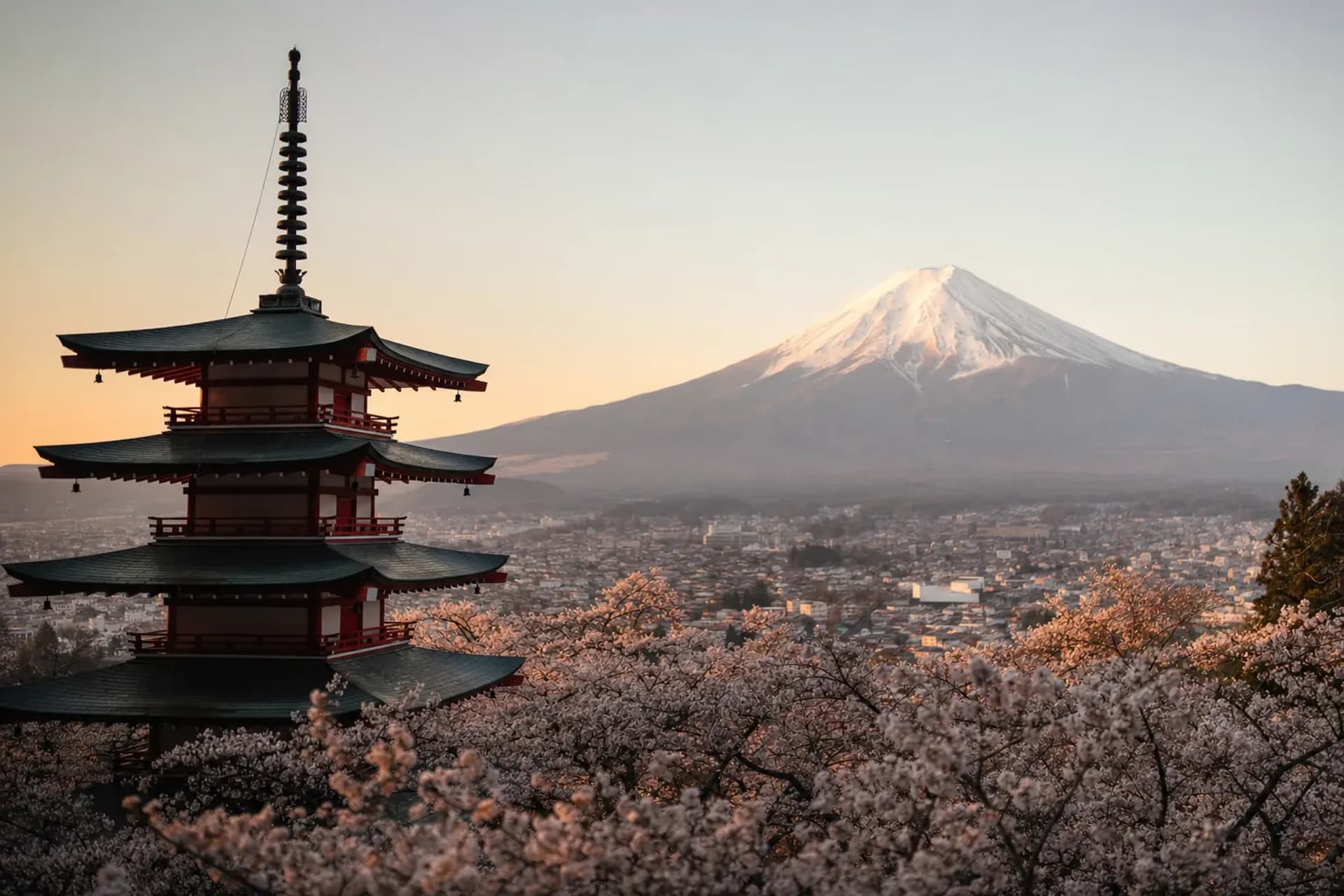
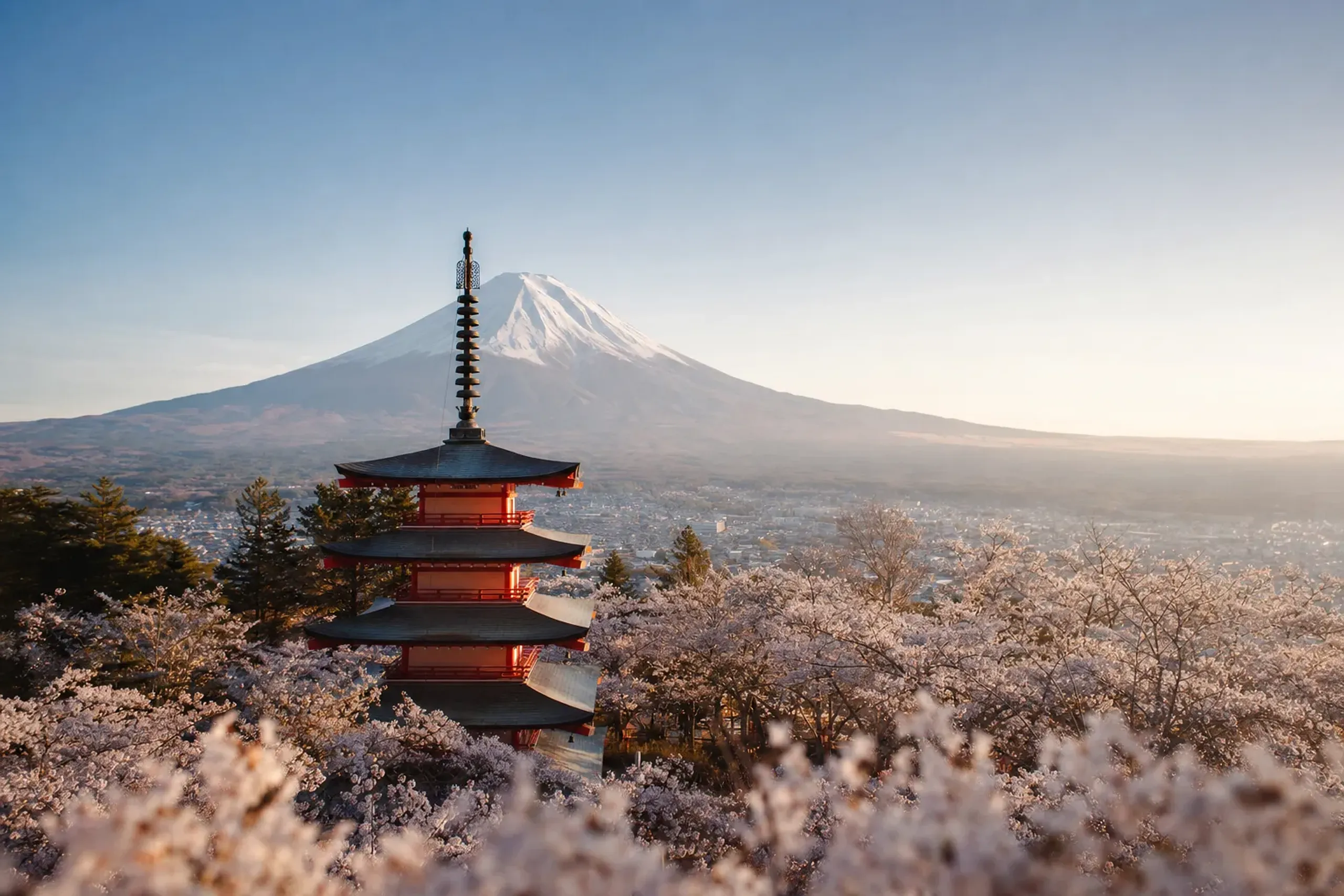
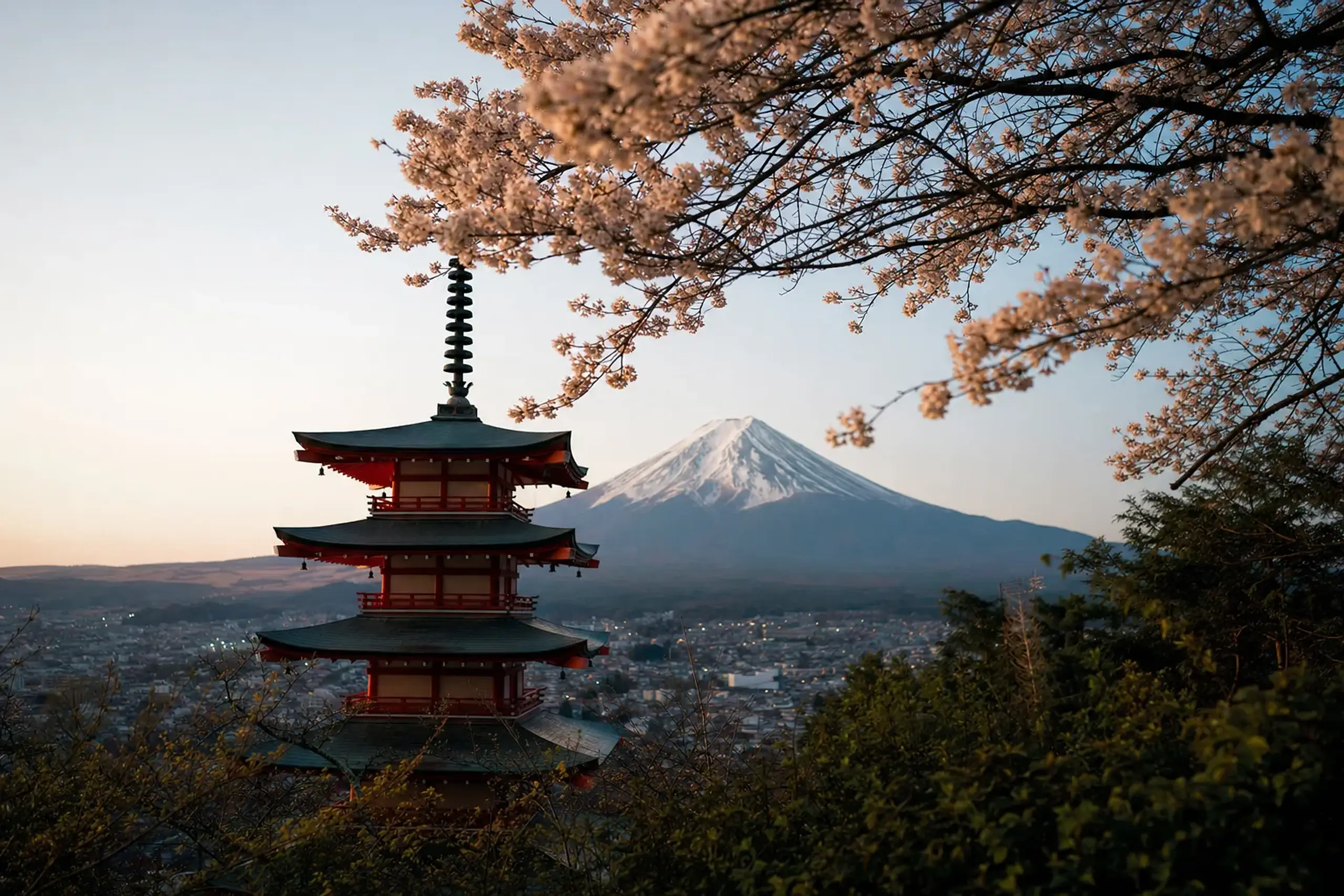
The Chureito Pagoda photograph—pagoda, cherry blossoms, and Mount Fuji aligned in a single vertical composition—appeared on the cover of the Michelin Green Guide Japon.
That detail matters because it is verifiable. It also explains the scale of the image’s global reach without resorting to vague claims.
Arakurayama Sengen Park holds roughly 650 cherry trees, mostly Somei-yoshino. In April, when the blossoms catch the morning light and Fuji’s snow line is still crisp, the scene reads cleanly even through a phone camera.
The five-storied pagoda, properly the Chūreitō, is a war memorial. Treat it that way. Pause. Lower your voice. There is a quiet wabi in a place built for remembrance, and a perfect photo is never worth behaving badly to obtain it.
How Hard Is The Walk To The Chureito Pagoda Viewing Deck?
Reaching the Chureito Pagoda viewing deck typically takes 15 to 20 minutes via either 398 steps or a longer winding road route.
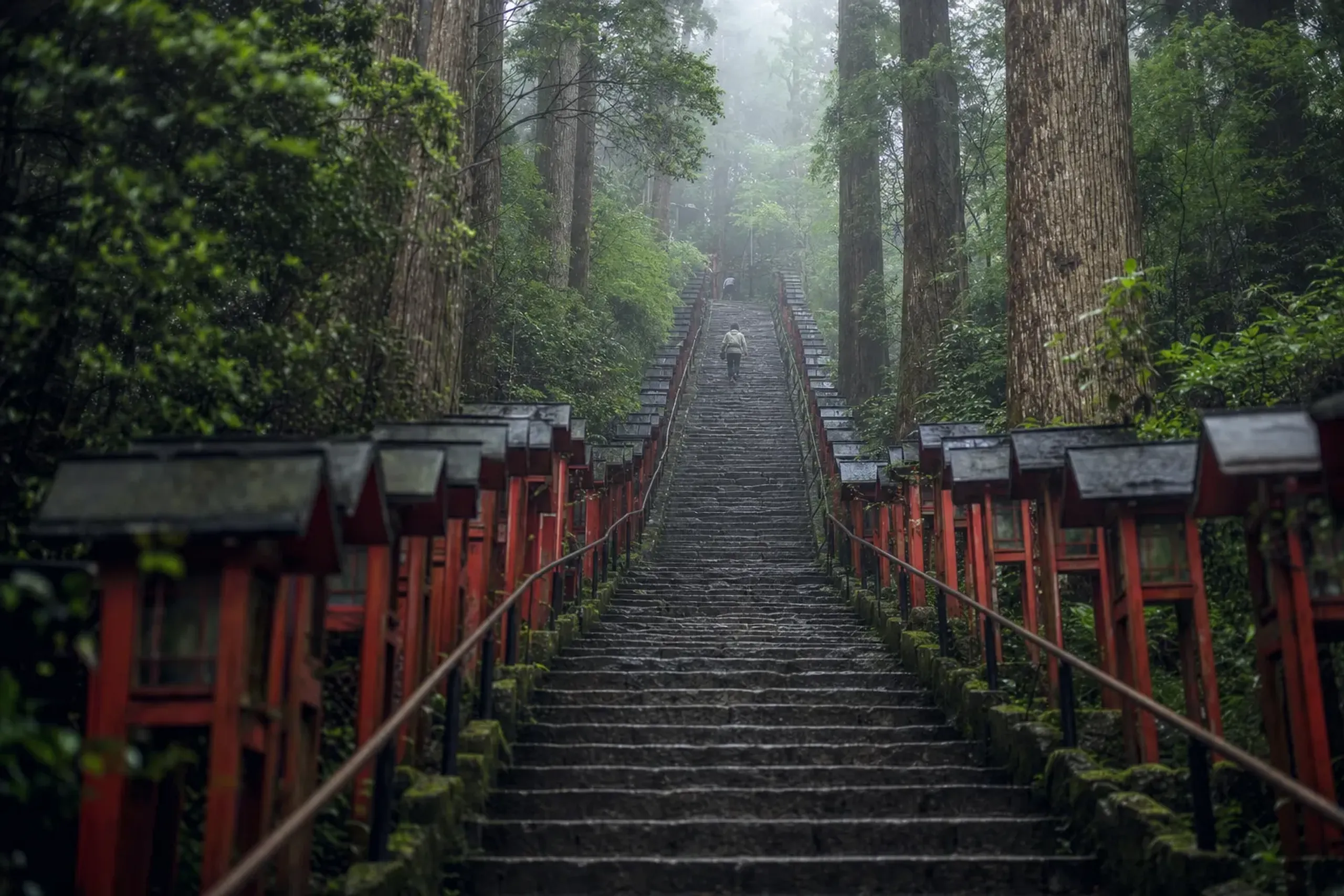
The stair route is called the Sakuyahime Stairs, named for Konohanasakuya-hime, the deity enshrined at Arakura Fuji Sengen Shrine and traditionally associated with Mount Fuji and cherry blossoms.
Those steps are not “difficult” in the way a mountain hike is difficult. They are relentless, especially when you stop-and-start in a queue while balancing a camera bag.
For families and multigenerational groups, we suggest deciding early: stairs for speed (when they are moving), or the road for steadier pacing. A tiny decision. A big shift in the mood of the morning.
The Countermeasure Window: What Changes During 1–17 April 2026
During the enhanced countermeasure period (1–17 April 2026), expect a more controlled, more supervised park environment. It is designed to protect residents and manage safety.
In practical terms, you may encounter traffic control points, temporary facilities, and clearer “do not enter” boundaries around residential streets. The city also extends certain traffic restrictions to 19 April.
This is precisely where a well-made itinerary should behave like a good guest. Leave margin. Avoid peak pinch points. Keep your group together and quiet, especially near the shrine.
If you are travelling with a private chauffeured car, the smartest benefit is not speed. It is discipline: entering and exiting the area cleanly, without improvising through narrow neighbourhood roads.
What About The Controlled Burn On 12 April 2026?
A traditional controlled burn is scheduled for Sunday 12 April 2026 (backup date Sunday 19 April), and smoke can obscure Mount Fuji on those dates.
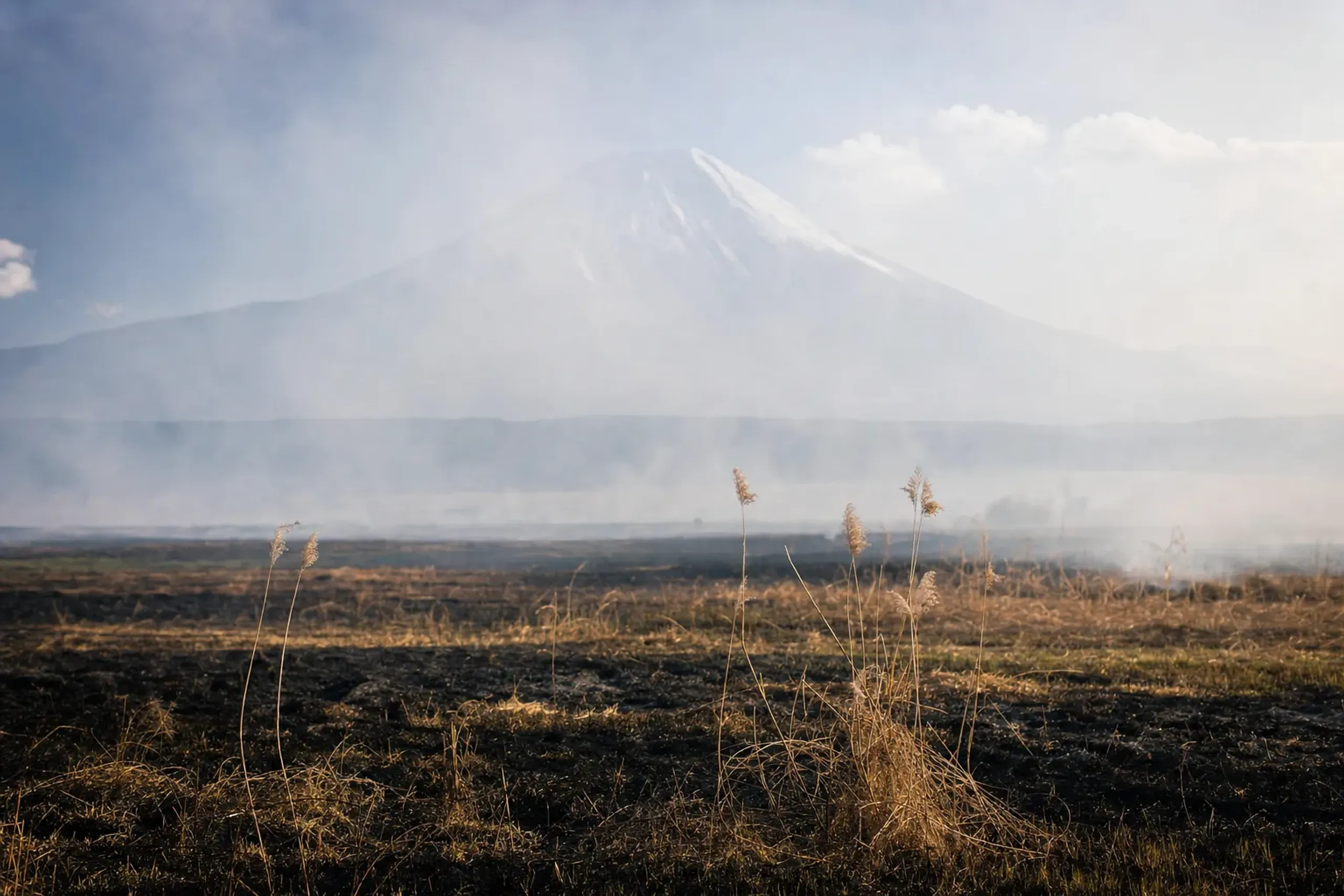
This burn is land management, not a tourist spectacle. It is conducted annually in April by the Onshirin forestry cooperative together with a historic commons association tracing its roots to eleven former villages, on national commons land within the Kita-Fuji training area.
If your only reason to come is a clear Fuji photograph, this is a serious planning note. If you care about why these landscapes endure at all, it is also a quiet lesson: the view is maintained by human hands over centuries, not left to accident.
JRS will confirm the latest local guidance close to your travel dates, since operational details can shift year to year.
Is The Evening Illumination At Chureito Pagoda A Real Alternative?
Yes—the Chureito Pagoda is illuminated in the evening, and the most photogenic timing is just before full sunset, when Fuji’s silhouette can still read behind the lit pagoda.
Once darkness is complete, Mount Fuji becomes hard to see with the naked eye, even if the pagoda itself looks dramatic. The sweet spot is the in-between: a fading sky, the rising city lights of Fujiyoshida below, and the pagoda’s structure holding the whole scene together.
Will it be empty? No promise. But it moves to a different rhythm, and it produces a genuinely different image from the famous morning frame.
One caution: bring a steady hand, and keep your expectations realistic on visibility. Night does not improve clouds.
The Kawaguchiko North-Shore Alternative: Same Fuji, Different Flow
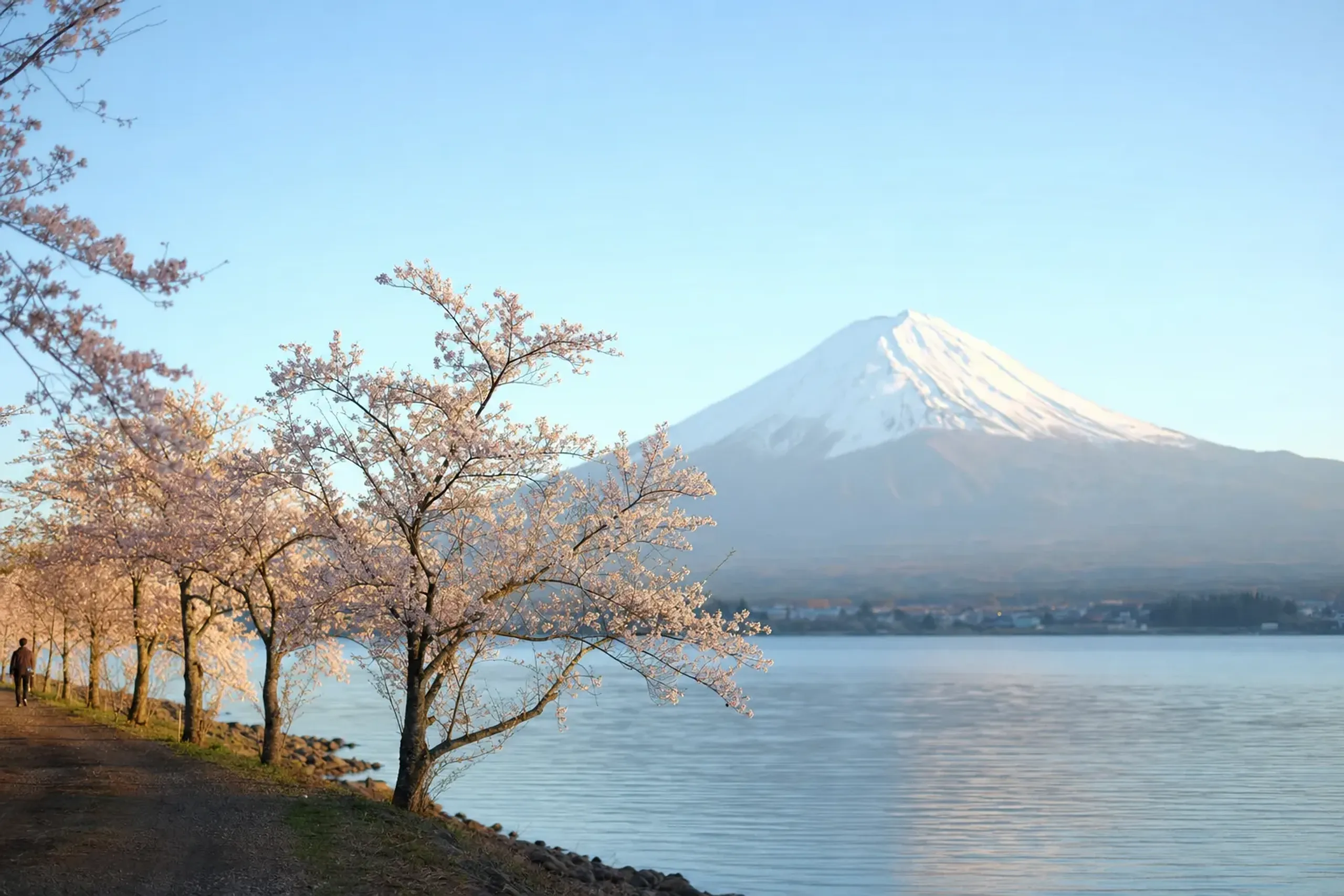
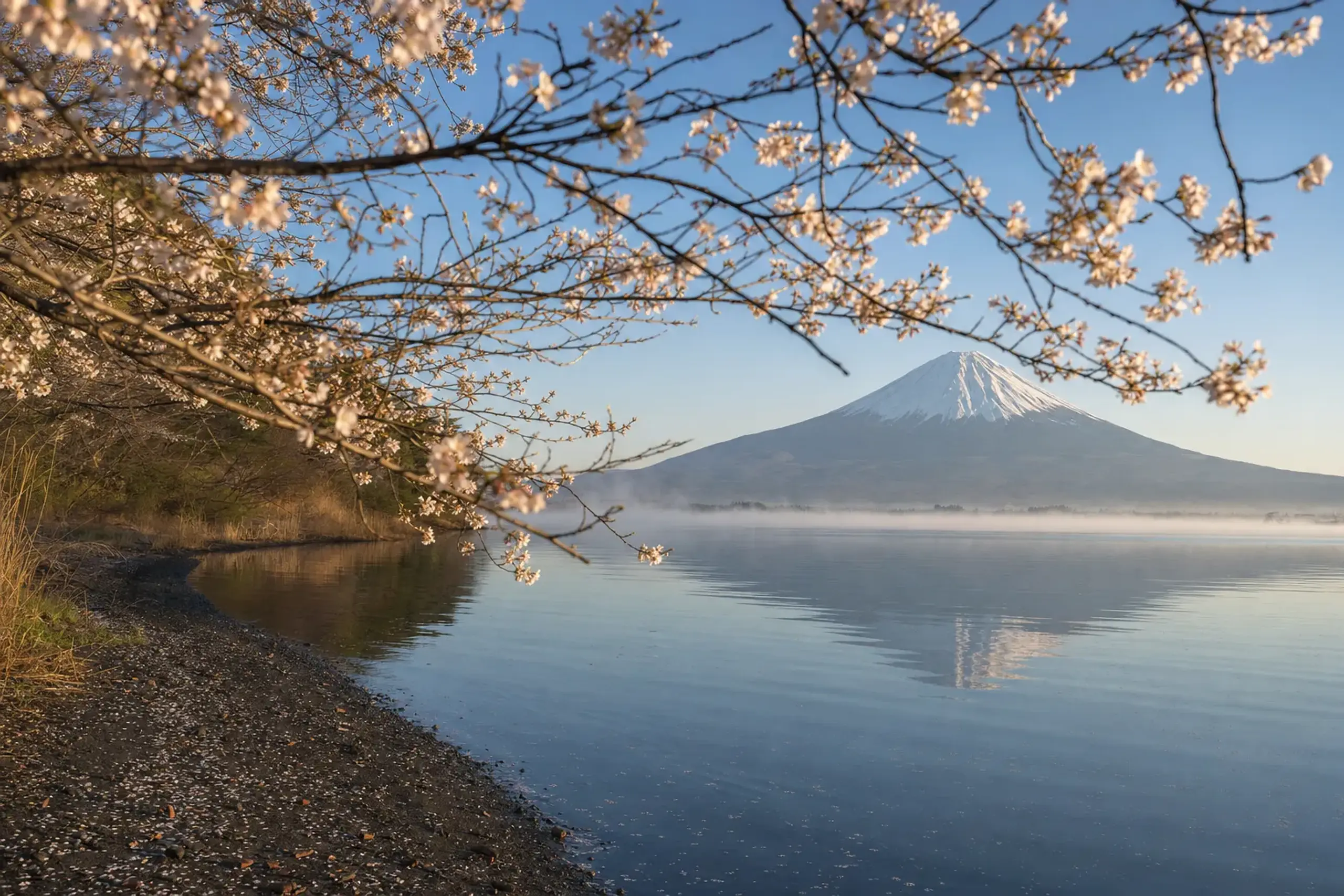
Along Lake Kawaguchi’s north shore, near the Round Hall area (close to the Kawaguchiko Music Forest Museum and the Itchiku Kubota Art Museum), a walking trail runs about 1 km, lined with roughly 200 cherry trees.
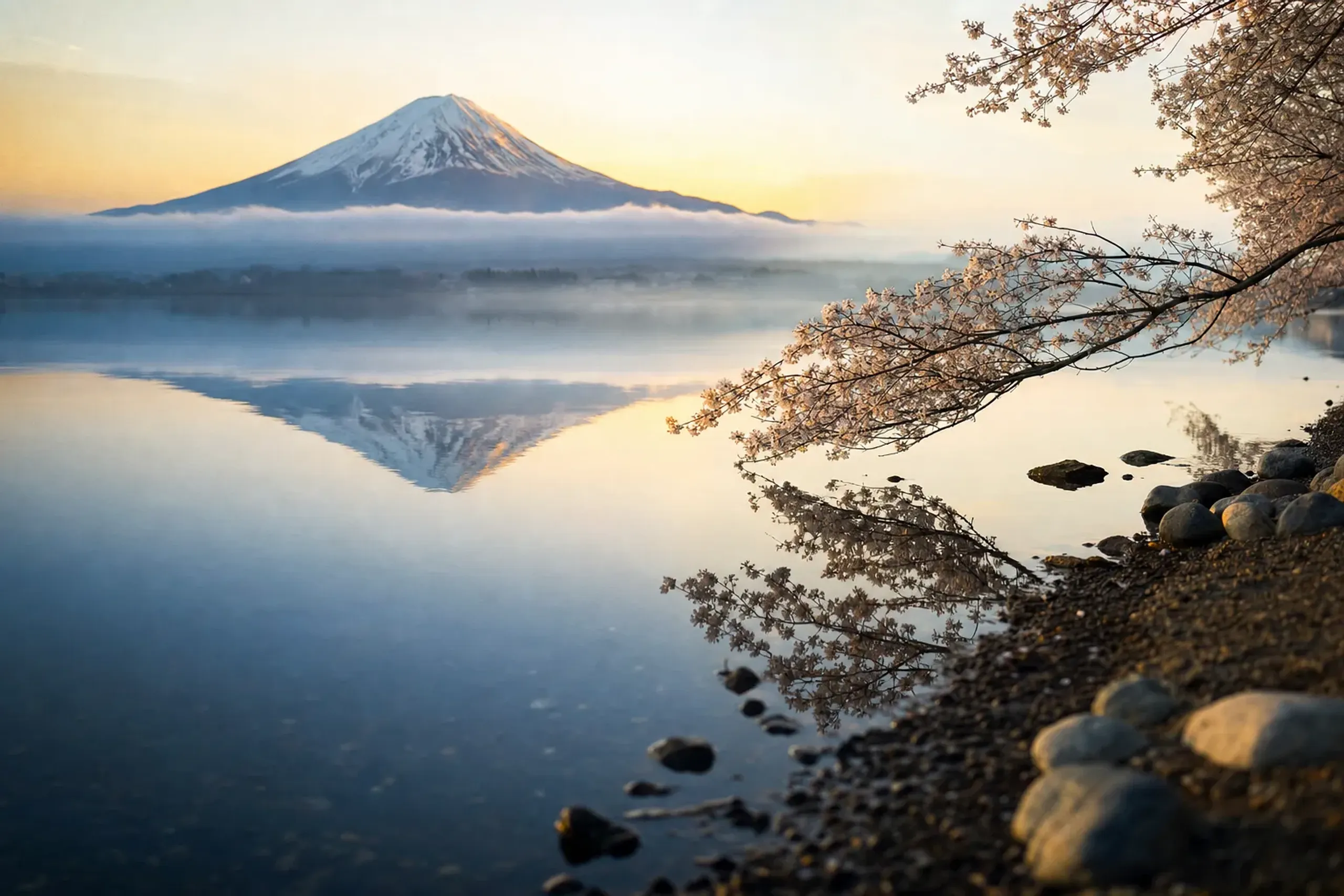
Mount Fuji sits across the lake, and the water’s surface often gives you a second Fuji—soft, rippled, slightly imperfect. That imperfection is the point; it is the sabi in the scene, the beauty that lives in what is unpolished and impermanent.
In sections, shibazakura (moss phlox) blooms alongside the cherry trees, adding a lower band of colour that photographs beautifully even when Fuji hides behind cloud.
This is not a secret spot. It is simply a place where the crowd pressure is spread across a longer path rather than compressed into a single deck behind a timed gate.
When Is The Fuji Kawaguchiko Sakura Matsuri In 2026?
The 15th Fuji Kawaguchiko Sakura Matsuri is scheduled for 28 March to 12 April 2026, with a pre-announced 3-day extension to 15 April if the blooming runs late.
Evening illumination runs from sunset to around 9:00pm, and a concurrent craft market is typically held from around 10:00am to 5:00pm.
Be clear-eyed about crowding. Weathernews has rated this area “somewhat crowded” on weekdays and “crowded” on weekends and holidays.
The distinction is operational: nothing in the available reporting mirrors Arakurayama’s timed rotation system, official 1–3 hour wait warning, or overtourism-driven festival cancellation. It is still busy. It is simply managed differently.
How To Reach The Kawaguchiko North Shore From Kawaguchiko Station
The north shore cherry-blossom area is about 20 minutes from Kawaguchiko Station via the Kawaguchiko loop retro bus, or roughly 25 minutes by car from the Chūō Expressway’s Kawaguchiko interchange.
For HNW travellers, the real advantage here is not status. It is control.
A short private transfer lets you pick a timing window that fits your day—early light, late light, or the calm pocket between the day-trippers and the overnight guests.
When we plan a day here, we keep the route simple and the pauses deliberate. Fewer stops. A better feeling throughout.
Bloom Timing Reality: Fuji Five Lakes Often Runs Later Than Tokyo
The Fuji Five Lakes region sits higher in elevation than central Tokyo, so the blossoms often peak later; check local updates rather than assuming Tokyo’s timing applies here.
As a labelled recent reference, 2025 reached full bloom around 16–19 April in this area. That is not a forecast. It is a reminder that “early April” can still be too early.
This matters for both Arakurayama and Kawaguchiko’s north shore. Arrive too soon and you will still face the crowds—only with fewer blossoms to show for it. Knowing precisely what to see, where, and in which week is the difference between a good trip and a wasted one; this is the quiet expertise of shun that a proper plan is built around.
Our suggestion: treat late March through mid-April as a planning window, then refine the day-by-day call closer to travel.
How To Visit Responsibly When Crowds Are The Story
Overtourism here is not abstract. It has already prompted formal policy.
So we advise guests to behave as though they were invited. Keep voices low near the shrine, follow the posted rules, and avoid photographing people without their consent—especially residents in the surrounding streets. Discretion is not only about protecting your own privacy; it is also about honouring the privacy of the community that lives here.
If you are set on the classic observation deck photo, commit to patience. Rushing only makes you careless.
And if your day starts to feel like a contest, step away.
Walk the road route. Find a quieter corner. You came to Japan to breathe.
What We Recommend For A Calm April Morning (Step By Step)
We cannot erase the crowds at a world-famous viewpoint. What we can do is help you move through it with far fewer sharp edges.
- Pick your priority: the classic morning frame, or a calmer experience with a strong image.
- Choose one primary site: Arakurayama (accept the queues) or the Kawaguchiko north shore (accept “crowded,” but with more room to move).
- Build a buffer: if you aim for Chureito, treat 1–3 hours as plausible, not worst-case.
- Watch the calendar: note the controlled burn date (12 April 2026; backup 19 April) if a clear Fuji matters to you.
- Decide your exit: leave before your energy dips, not after.
Small choices. A large payoff.
What Japan Royal Service Can Handle For This Trip
Japan Royal Service can handle accommodation, guiding, and transfers for a Lake Kawaguchi spring visit, with planning shaped around real crowd conditions and current local guidance.
For transport, our guests often choose private chauffeured service for timing control and privacy; the first step is deciding your preferred vehicle and pacing, after which we tailor the day around it. For details on our fleet and approach, see private transportation.
If you want the day designed around your priorities—photography, multigenerational comfort, or simply not wasting an hour in the wrong queue—we build it as a tailor-made plan, then refine the timing as bloom and weather updates come into focus.
When guests ask us why this level of planning matters for “a park and a view,” we give a plain answer: April here is operational, not merely pretty.
If you are considering Lake Kawaguchi and Fuji for spring 2026, the earlier we begin, the more quietly we can secure the right rooms, the right hours, and the right approach to a viewpoint the whole world is chasing. To begin a confidential, unhurried conversation about your dates, contact us here.
Frequently Asked Questions
Is Arakurayama Sengen Park Still Worth Visiting In April If The 2026 Festival Is Cancelled?
Yes, Arakurayama Sengen Park can still be worth visiting in April 2026, but you should plan for crowd controls and possible 1–3 hour waits even without a festival.
The festival cancellation is a signal that the city is prioritising residents’ daily life. Treat that as your cue to visit with patience, restraint, and respect.
What Time Should We Go To Chureito Pagoda To Reduce Waiting?
Going very early can reduce waiting, but you should still expect queues during peak days because the observation deck uses timed rotation entry in season.
In 2024 reports, waits increased quickly from 6:30am onward, and the line to the stairs often felt longer than the stairs themselves.
Is The Kawaguchiko North Shore Actually Less Crowded Than Chureito?
The Kawaguchiko north shore is still busy—rated “crowded” on weekends—but it typically spreads visitors along a 1 km path rather than funneling everyone into a single timed observation deck.
That difference in flow can make the experience feel calmer, even when the area is popular.
Can We Count On Seeing Mount Fuji From Either Spot?
No, you cannot count on seeing Mount Fuji from either spot, because visibility depends on weather and cloud cover rather than the viewpoint itself.