In this guide
- 01How Did A Rice Cracker Inspire The Design Of Kintai Bridge?
- 02What Makes Kintai Bridge's Engineering So Unusual?
- 03Who Built Kintai Bridge, And Who Crossed It First?
- 04Did The Original Kintai Bridge Survive The Floods?
- 05Is The Kintai Bridge Standing Today The Original?
- 06How Long Is Kintai Bridge, And Why Is It Famous?
- 07What Is Around Kintai Bridge Worth Seeing?
- 08What Japan Royal Service Arranges At Iwakuni
- 09Frequently Asked Questions
- 10Why Choose Japan Royal Service
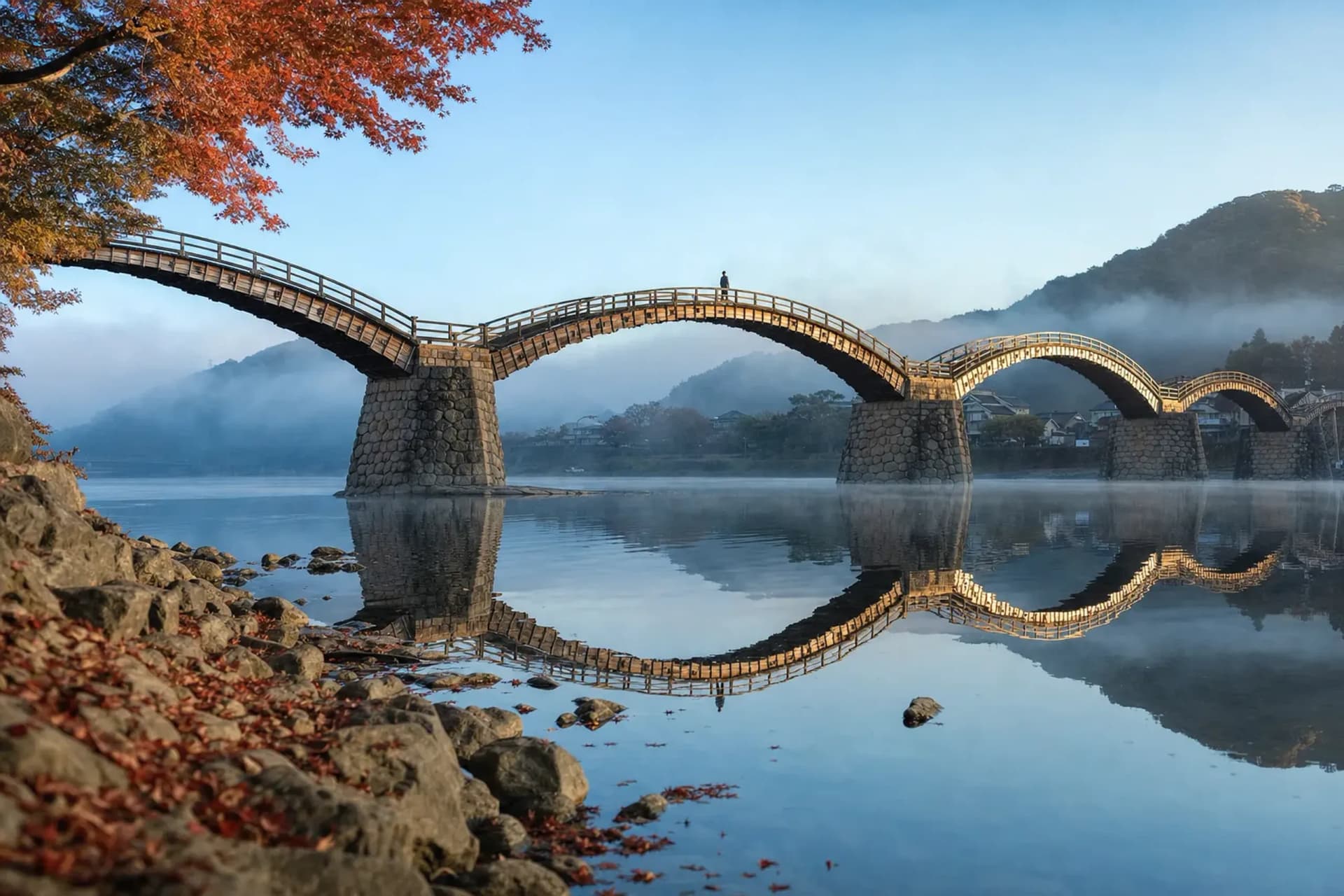
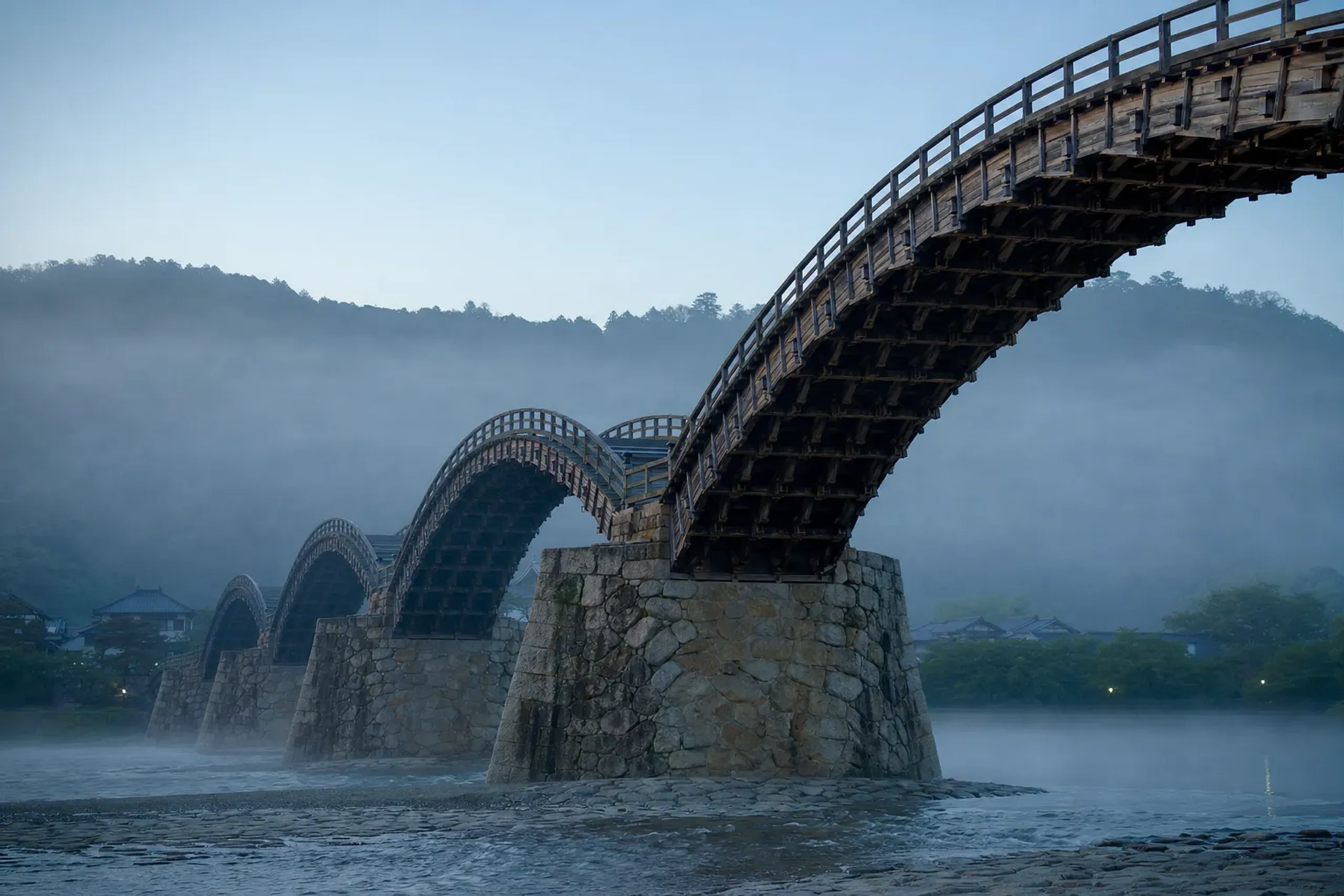
Stand beneath the central spans on a clear afternoon, and the light does something to the wood. Five arches curve above the Nishiki River, the timber warm and dark where the sun has worked into it for decades. The river runs shallow and wide here. Below the arches, no piers touch the water — the spans simply lift, hang in the air, and come down again on stone.
Most visitors photograph it and move on. That is a loss. Because the shape overhead began not with an architect's drawing, but with a humble snack curling in the heat. Kintai Bridge in Iwakuni, Yamaguchi Prefecture, carries one of the most specific origin stories in all of Japanese engineering — and our team at Japan Royal Service has grown quietly fond of telling it properly.
How Did A Rice Cracker Inspire The Design Of Kintai Bridge?
Lord Kikkawa Hiroyoshi, third lord of the Iwakuni domain, was toasting a kakimochi rice cracker when he watched it curl into an arch under the heat. That gentle curve became the basis for the bridge's design.
It sounds like a folk tale invented long after the fact. It is not. The story is documented and repeated in Iwakuni's own records. A lord, a fire, a cracker bending as it warmed — and a mind attentive enough to see a bridge in it.
There was a second influence, less charming but every bit as real. A naturalized Chinese monk, Dokuritsu Shōeki, told the lord of a six-arch bridge connecting islands at West Lake in Hangzhou, described in a Chinese text.
That continuous-arch idea — arches linked in a row, marching across the water — shaped the bridge's structure alongside the cracker's curl.
The connection outlived them both. In 2004, Kintai Bridge and West Lake were officially designated sister bridges, and a friendship monument was erected at the lake in Hangzhou. A rice cracker in one century, an international bond three hundred years later.
What Makes Kintai Bridge's Engineering So Unusual?
Kintai Bridge is built so that load actually increases the arch's strength rather than weakening it. Weight pressing down forces the interlocking timbers tighter together. The bridge grows firmer under the very people crossing it.
That principle is the heart of the thing. Consider the layout. Five spans in all. The two end spans, nearest the banks, are ordinary post bridges — flat, supported from below, nothing exotic. Only the central three are true arches, and those three carry the drama.
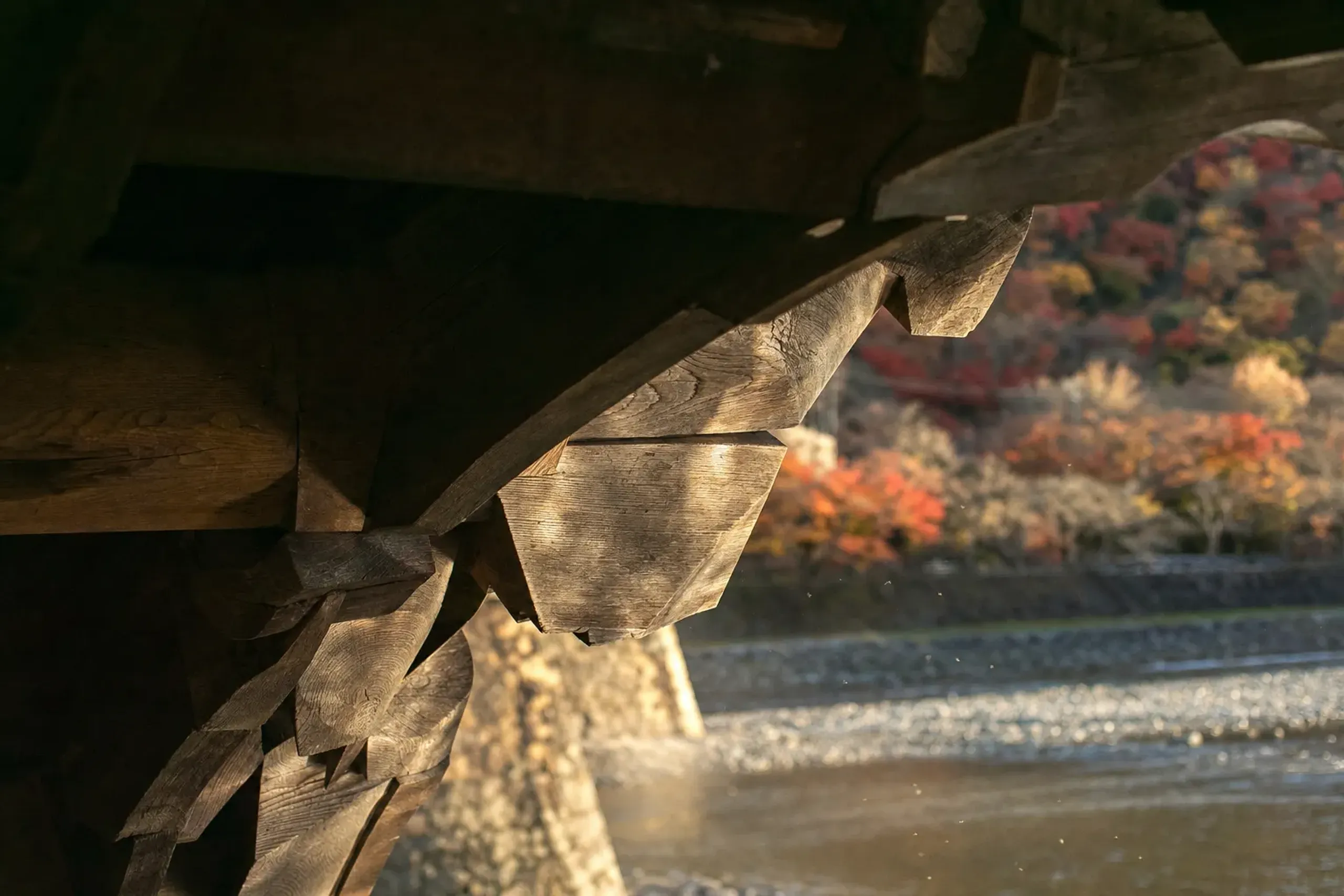
Within each central arch, no pier touches the water. The structure rests instead on stone masonry foundations — four stone pier bases set in the river and two abutments on the banks, six foundations in all. From these, wooden cantilevered beams project outward, layer upon layer, each reaching further than the last until they meet at the crown of the arch.
The joinery is where the shokunin skill shows. Interlocking carpentry locks the timbers together, reinforced at key structural points with wrapped metal bands and metal clasps. This is not decorative craft but load-bearing craft — the hands of master carpenters working to tolerances that keep the arches aloft. You will read elsewhere that the bridge uses no nails at all.
That is not quite true, and we prefer the honest version.
The nail question, stated precisely: Most of the primary structural joints use no nails — the timbers hold each other through carpentry alone. But some boards and a portion of the metal bands are nail-fixed. The bridge is a triumph of joinery, not a total absence of metal.
Who Built Kintai Bridge, And Who Crossed It First?
Groundbreaking came on 8 June 1673. The bridge was designed by master carpenter Kodama Kurōemon under Lord Kikkawa Hiroyoshi's direct supervision — the lord is recorded as opening a folding fan to trace the exact curve of the arch himself.
Picture that scene. A fan snapping open, the ribs fanning into a shallow curve, a lord holding it against the sky to fix the shape of what he wanted. He set up a residence near the river to oversee the work in person. This was not a project delegated and forgotten.
Construction finished in October 1673. And here is the detail that lingers. When the bridge opened, the honour of the first crossing went not to a samurai or a priest, but to a local farmer named Seibei — chosen because his twelve-person family was known throughout Iwakuni for living in unusual harmony.
That choice tells you something. Iwakuni was a modest domain, assessed at only 30,000 koku — small by Edo-period standards. A minor holding built a bridge of astonishing ambition, then handed the first steps across it to a farmer whose household simply got along well.
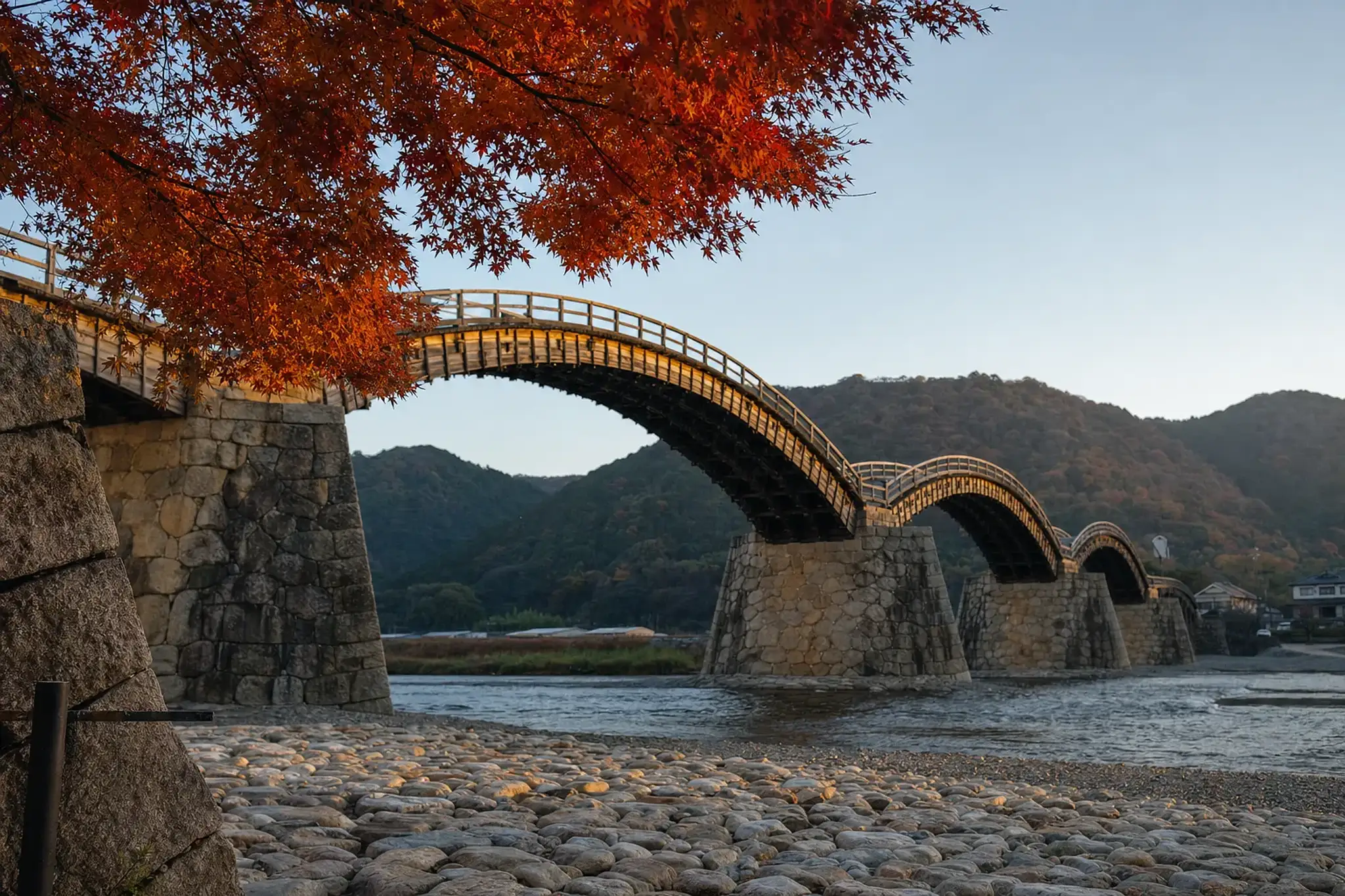
The scale of the engineering set against the modesty of the domain still strikes us.
Did The Original Kintai Bridge Survive The Floods?
The first bridge lasted only about eight months. A flood destroyed it in 1674. But it was rebuilt within the same year with reinforced foundations — and that version stood for 276 consecutive years.
The reinforcements were the lesson. After the 1674 collapse, the builders paved the riverbed with stone and set retaining stones into the base, anchoring the piers against the water that had swept the first attempt away. Further stability work followed in 1682, including bracing timbers to reduce the swaying that plagued long wooden spans.
Then the bridge simply held. Flood after flood rose against those stone piers, and the arches stayed up. From 1674 until 1950, no torrent took it down. That is 276 years of the Nishiki River doing its worst, and the bridge answering with silence.
What finally beat it was Typhoon Kezia in 1950. Not gradual decay, not neglect — a single violent storm ending a record that the post-flood reinforcements had made possible. The stone paving and the bracing timbers had done their quiet work for nearly three centuries before the weather at last won.
Is The Kintai Bridge Standing Today The Original?
No. The bridge you cross today is a faithful reconstruction. It was rebuilt in 1953 after Typhoon Kezia, and its wooden superstructure was fully replaced again in 2004 due to decay of the 1953 timber.
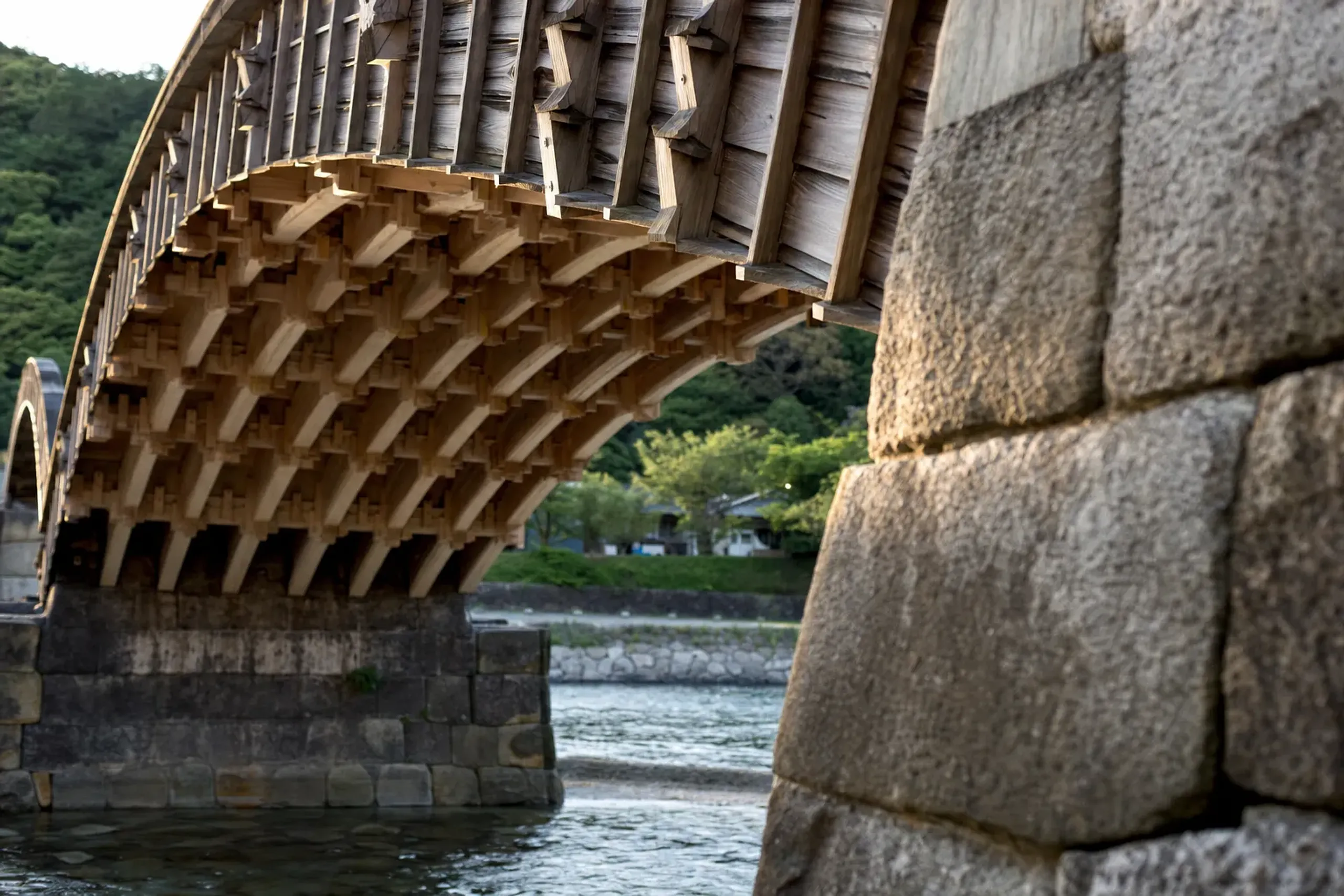
The 1953 rebuild carries an honest secret. Concrete was poured into the core of the stone pier foundations for added strength, while the visible stone-and-wood appearance was carefully preserved. Modern reinforcement hides inside a historical form — the arches look exactly as they should, and the piers beneath carry a quiet twentieth-century spine.
By the early 2000s, the 1953 wooden structure had decayed enough to warrant full replacement. In 2004, carpenters rebuilt the superstructure entirely, following the traditional joinery. So the arches curving over your head are craftsmanship of this century, shaped to a design from 1673, resting on foundations reinforced in 1953. Three eras, one bridge — and, in that layering of restraint and continuity, a quiet expression of wabi: beauty that lives in what endures rather than what dazzles.
How Long Is Kintai Bridge, And Why Is It Famous?
Kintai Bridge is most consistently cited at 193.3 metres long and 5 metres wide, with an effective usable width of 4.2 metres. It is ranked among both Japan's Three Great Bridges and Japan's Three Strange Bridges.
One source gives the length as 225 metres, but the 193.3-metre figure appears far more consistently, and that is the number we use. The width matters once you walk it — the arches are steep enough that steps are built into the deck, and crossing them is a small climb rather than a flat stroll.
The two rankings are worth pausing on. To sit among the Three Great Bridges is one distinction.
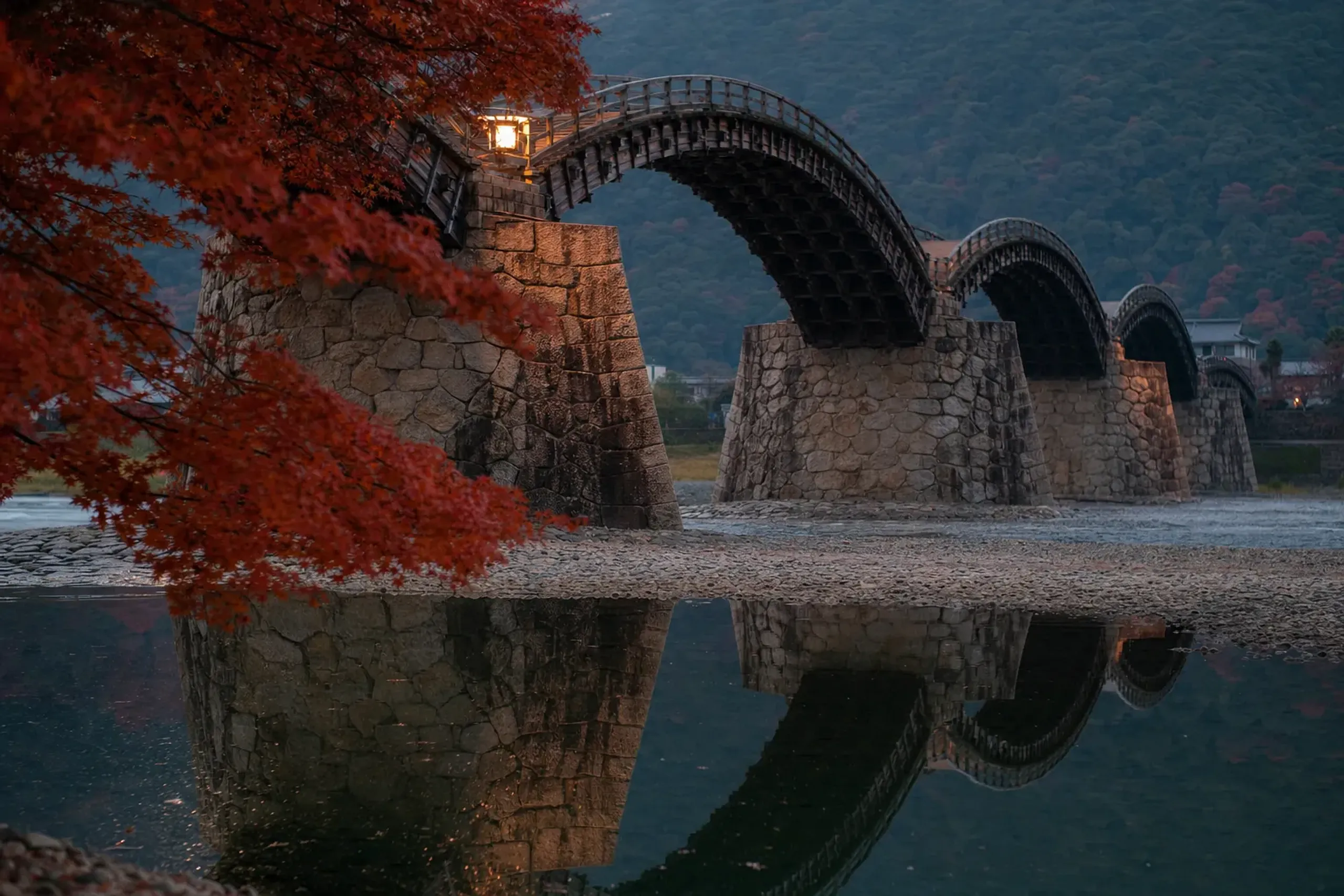
To also sit among the Three Strange — or Unusual — Bridges is another entirely, earned by the sheer oddity of five wooden arches without piers in the water. Kintai Bridge holds both titles at once.
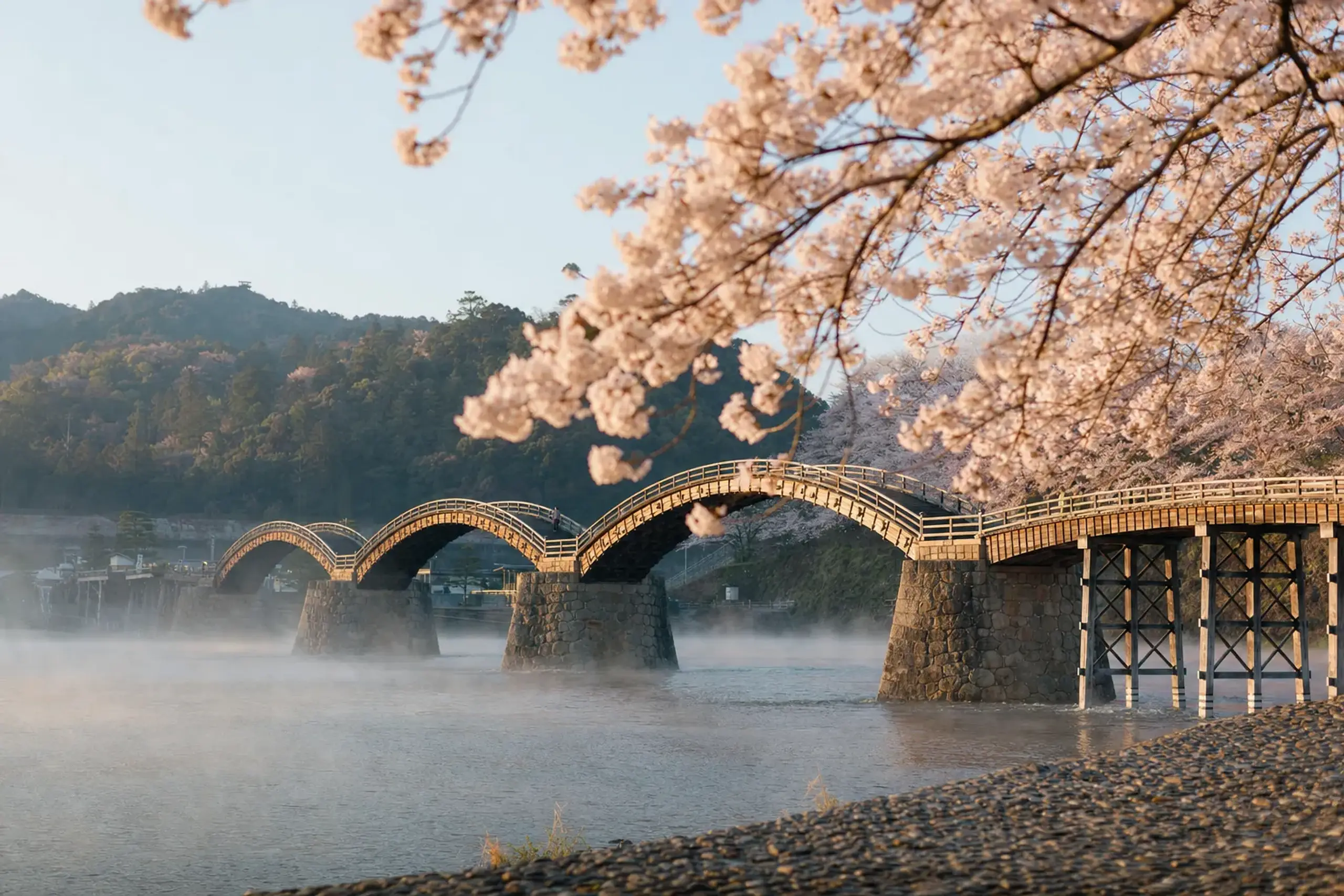
There is a third recognition, and it is the one that draws spring crowds. The bridge and the surrounding Kikkō Park are jointly selected among Japan's 100 best cherry-blossom viewing spots. In late March and early April the banks fill with pink, and the arches frame the blossom in a way photographs never quite capture. Knowing precisely which week to arrive — and how quickly the bloom turns — is the kind of seasonal timing our concierge exists to get right.
What Is Around Kintai Bridge Worth Seeing?
Kikkō Park sits on the Yokoyama side of the bridge, on the former grounds of the Kikkawa clan residence. Within it you will find a Kikkawa family museum, an Iwakuni antiquities museum, Kikkō Shrine built on the former residence site, and neighbouring Momijidani Park.
The park rewards slowing down. This was the domain lord's own ground — the same family whose third head watched a rice cracker curl — and the shrine now standing on the residence site keeps that history close. Momijidani Park, as the name promises, turns to maple red in autumn.
Two seasonal events anchor the calendar. The annual Kintaikyo Festival falls on 29 April, with processions and performances by the river. And in summer, Ukai — cormorant fishing — runs on the Nishiki River from 1 June to 10 September in 2026, with viewing from pleasure boats between 7:00 and 9:00 in the evening.
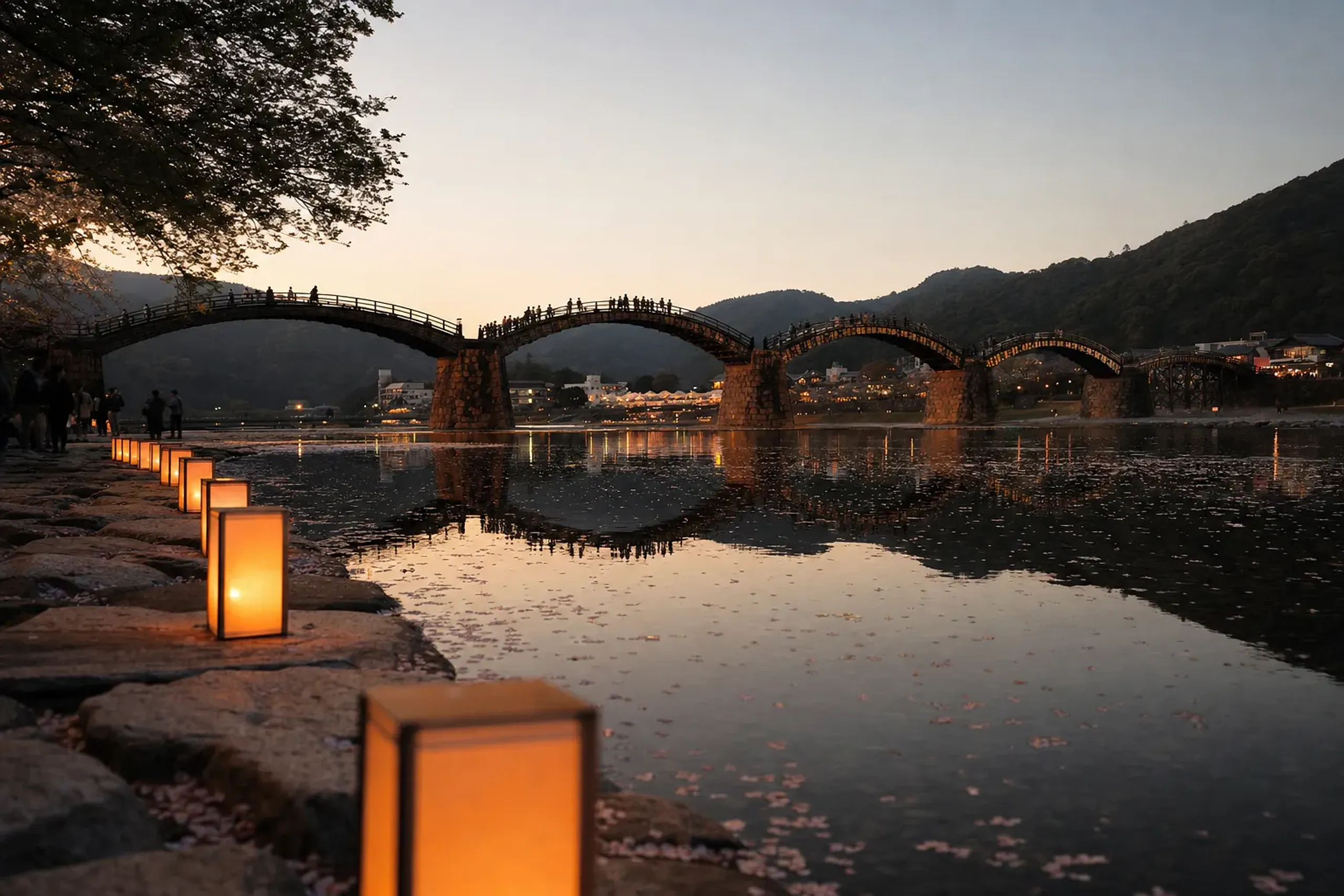
Please confirm the current festival and Ukai schedules, along with any admission procedures, close to your travel dates, as civic programming and fees are periodically revised.
What Japan Royal Service Arranges At Iwakuni
Iwakuni sits within easy reach of Hiroshima and Miyajima, which makes it a natural addition to a wider journey. Our team at Japan Royal Service arranges private guiding at Kintai Bridge and Kikkō Park, and private chauffeured transfers from Hiroshima, Miyajima, or wherever your itinerary begins.
A driver removes the friction. The bridge lies between JR Iwakuni Station and Shin-Iwakuni Station, and public transit means bus or taxi connections that eat into a good afternoon. In our experience, arriving by private car at golden hour — the arches catching the last light, the crowds thinning to almost no one — turns a photo stop into something closer to an hour of quiet, with the moss and stone of the riverbanks left to speak for themselves.
For summer visits, our concierge can advise on how the Ukai evening fits alongside the Iwakuni Castle ropeway and a ryokan stay, folding the bridge into a tailor-made itinerary rather than leaving it a solitary stop. Where an introduction opens a door — a quiet dinner, a craftsman's workshop, a ryokan that takes guests only by referral — we know how to make it. We also coordinate accommodation across Yamaguchi and Hiroshima to suit the season and the pace you want, with the discretion our guests expect as a matter of course.
Frequently Asked Questions
When Is The Best Time To Visit Kintai Bridge For Cherry Blossoms?
Late March through early April, when Kikkō Park's cherry trees bloom. The bridge and park are jointly listed among Japan's 100 best sakura spots. Confirm the exact blossom forecast close to your travel dates, as timing shifts year to year.
Can You Watch Cormorant Fishing At Kintai Bridge In 2026?
Yes. Ukai cormorant fishing runs on the Nishiki River from 1 June to 10 September 2026, with viewing from pleasure boats between 7:00 and 9:00 p.m. Our concierge can advise on how to pair it with a ryokan stay.
How Do You Get To Kintai Bridge From Hiroshima?
Iwakuni sits close to Hiroshima and Miyajima, making a private chauffeured transfer the smoothest option. The bridge lies between JR Iwakuni Station and Shin-Iwakuni Station; by public transit, travelers connect onward by bus or taxi from either station.
Is The Current Kintai Bridge The Original 1673 Structure?
No. The 1953 rebuild followed Typhoon Kezia, and the wooden superstructure was fully replaced again in 2004. The current arches follow the original 1673 design and joinery, resting on foundations reinforced with hidden concrete in 1953.
Why Does Kintai Bridge Use No Piers In The Water?
The three central spans are true arches engineered so no pier touches the water within each arch. Wooden cantilevered beams project outward from six stone foundations to form the arches, with load pressing the timbers tighter together.
Why Choose Japan Royal Service
Kintai Bridge is a public historic landmark — anyone can walk it. What we offer is the difference between crossing it and understanding it. Our guides carry the rice cracker story, the fan tracing the arch, the 276-year record against the floods, and they tell it standing beneath the very spans it describes, at the hour when the light is best and the crowds have gone.
When you are ready to weave Iwakuni into a wider journey through Yamaguchi, Hiroshima, and Miyajima — timed to the blossom, the maples, or the summer cormorants — contact us here, and we will begin shaping an itinerary around the season and the pace that suit you.