In this guide
- 01Why Does Kōraku-en Have So Much Open Lawn?
- 02The Garden Took Thirteen Years To Build
- 03What Is Borrowed Scenery, And How Does Okayama Castle Fit?
- 04The Lord Who Performed Noh In His Own Garden
- 05Can You Go Inside Enyōtei?
- 06Recognition, Cranes, And The Garden After Dark
- 07What Japan Royal Service Arranges At Kōraku-en
- 08Frequently Asked Questions
- 09Why Choose Japan Royal Service
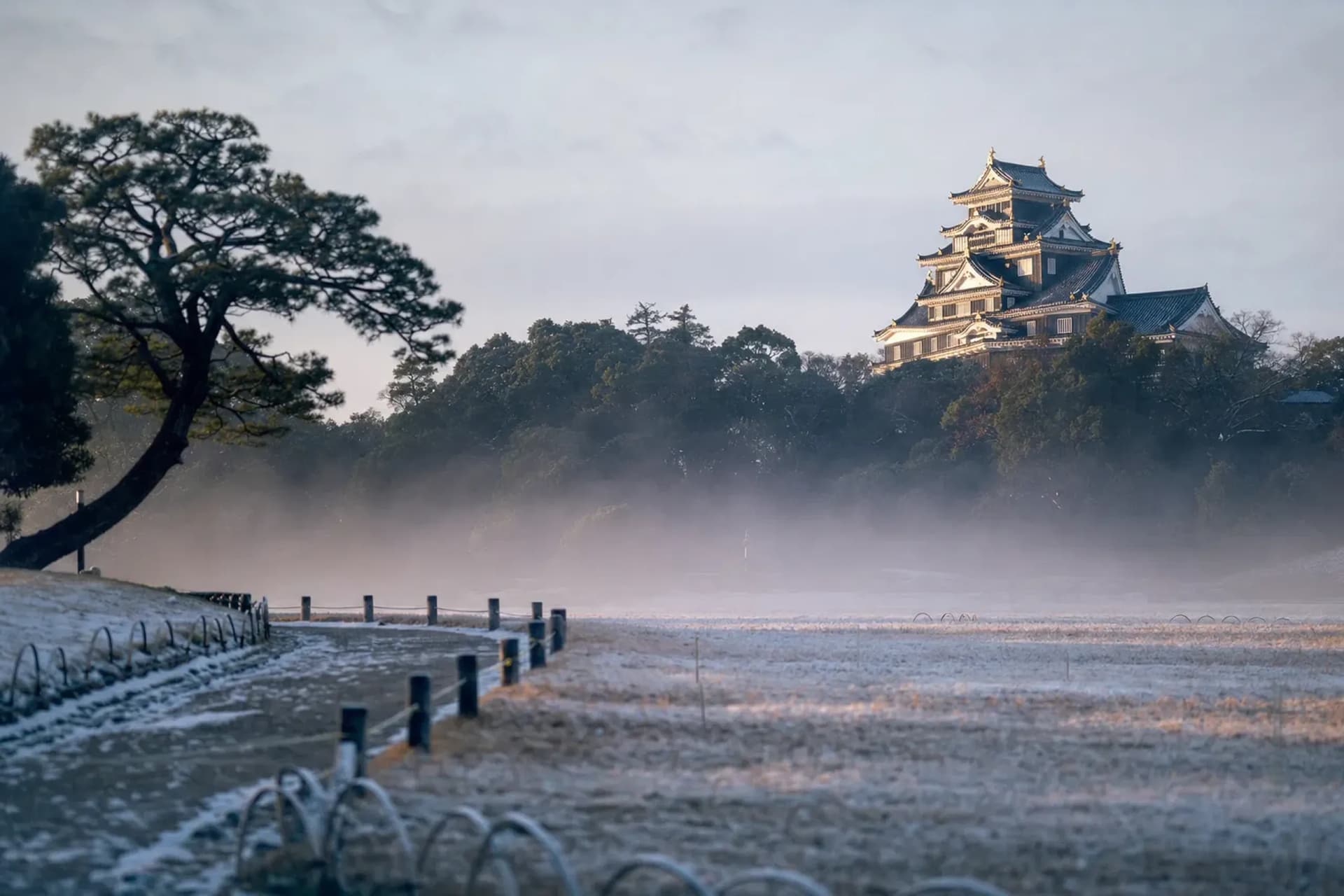
Stand at the edge of Kōraku-en on a still morning and the first thing you notice is space. Wide, unbroken lawn rolling toward stands of pine and maple. Beyond the water, the black keep of Okayama Castle rises against the sky, framed as if someone placed it there on purpose. Someone did.
Most visitors assume this open, pastoral calm was the founder's vision three centuries ago. It wasn't. The lawn everybody photographs is the result of a budget cut. And once you know that, you cannot unsee it.
Why Does Kōraku-en Have So Much Open Lawn?
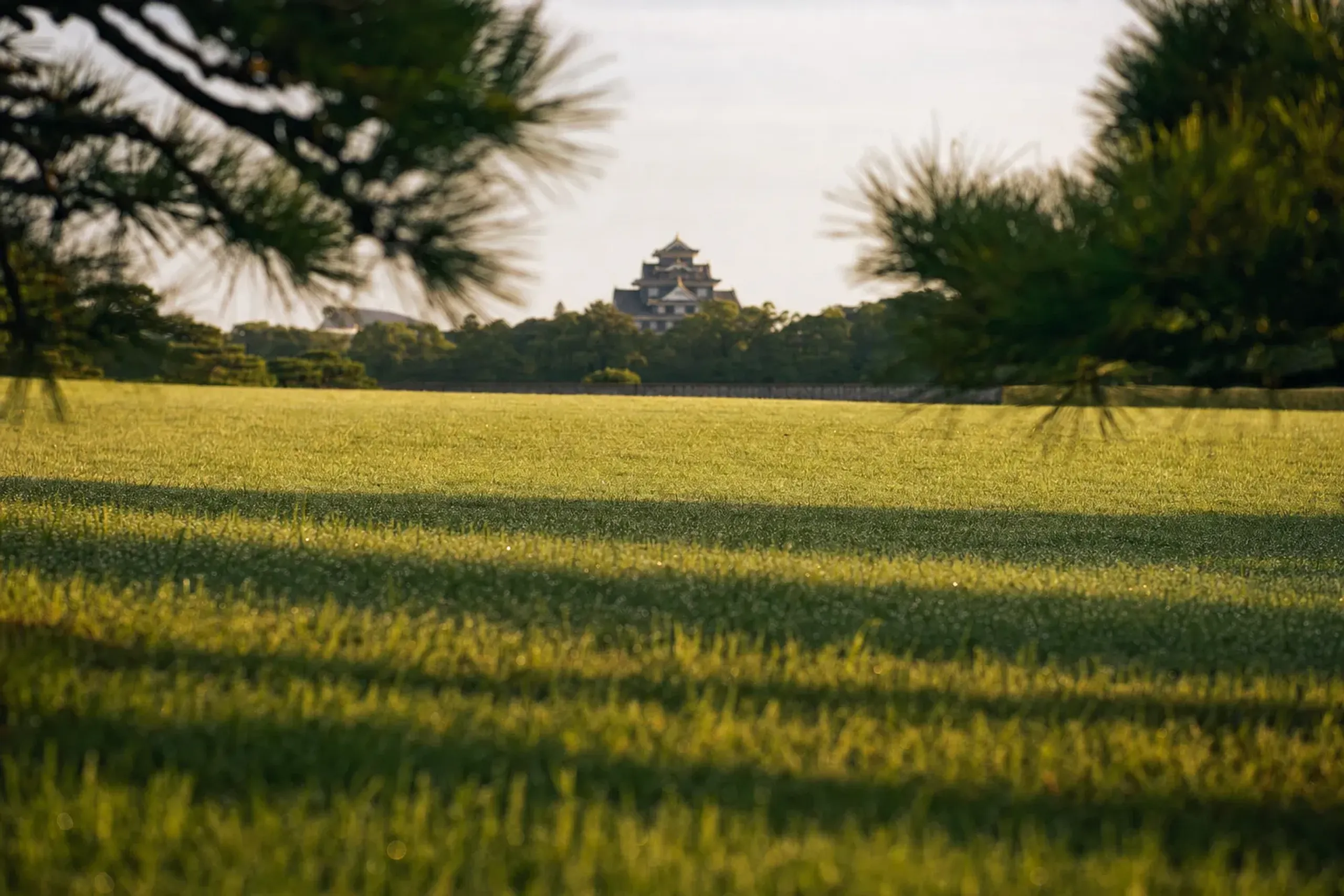
Kōraku-en has large open lawns because a later lord converted the garden's working rice paddies to grass as a cost-cutting measure — lawn required far less upkeep than cultivated fields. It was economy, not original design.
When Ikeda Tsunamasa, the second lord of the Okayama domain, began building the garden in 1687, he favoured a working, agricultural landscape. Real rice paddies. Cultivated fields. A daimyo's idealised countryside, productive and alive, laid out for contemplation rather than ornament.
Three generations later, his descendant faced financial strain across the domain. The paddies were expensive to maintain. So they went — replaced by lawn, which asks for far less. The signature expanse that draws photographers today, and that most guides quietly present as the founder's aesthetic, is in fact what a squeezed budget left behind.
We find guests love this correction. It reframes the whole walk. That serene emptiness isn't refined restraint handed down from 1700 — it's the honest residue of a domain trying to save money.
History rarely arrives this candidly.
The Garden Took Thirteen Years To Build
Kōraku-en was commissioned by Ikeda Tsunamasa and built under the direct supervision of his chief retainer, Tsuda Nagatada. Work began in 1687, during the Jōkyō era, and finished in 1700. Thirteen years of digging, planting, and shaping.
The scale is deliberate. The garden spreads across roughly 133,000 square metres. Of that, the lawn now covers around 18,500 square metres — a large share, but far from the whole picture. Winding streams, ponds, tea houses, and stands of plum and cherry fill the rest.
The site itself is unusual. Kōraku-en sits on a sandbar in the Asahi River, directly across the water from Okayama Castle. That river separation is not incidental. It gives the garden its sense of being a world set slightly apart, reached deliberately rather than stumbled into.
Originally the garden carried the name Goenzen — a reference to its position behind the castle. The name Kōrakuen came later, in the Meiji era. Different name, different era, same ground.
What Is Borrowed Scenery, And How Does Okayama Castle Fit?
Borrowed scenery, or shakkei, is a design technique where a distant structure or landscape outside the garden is framed to appear part of it.
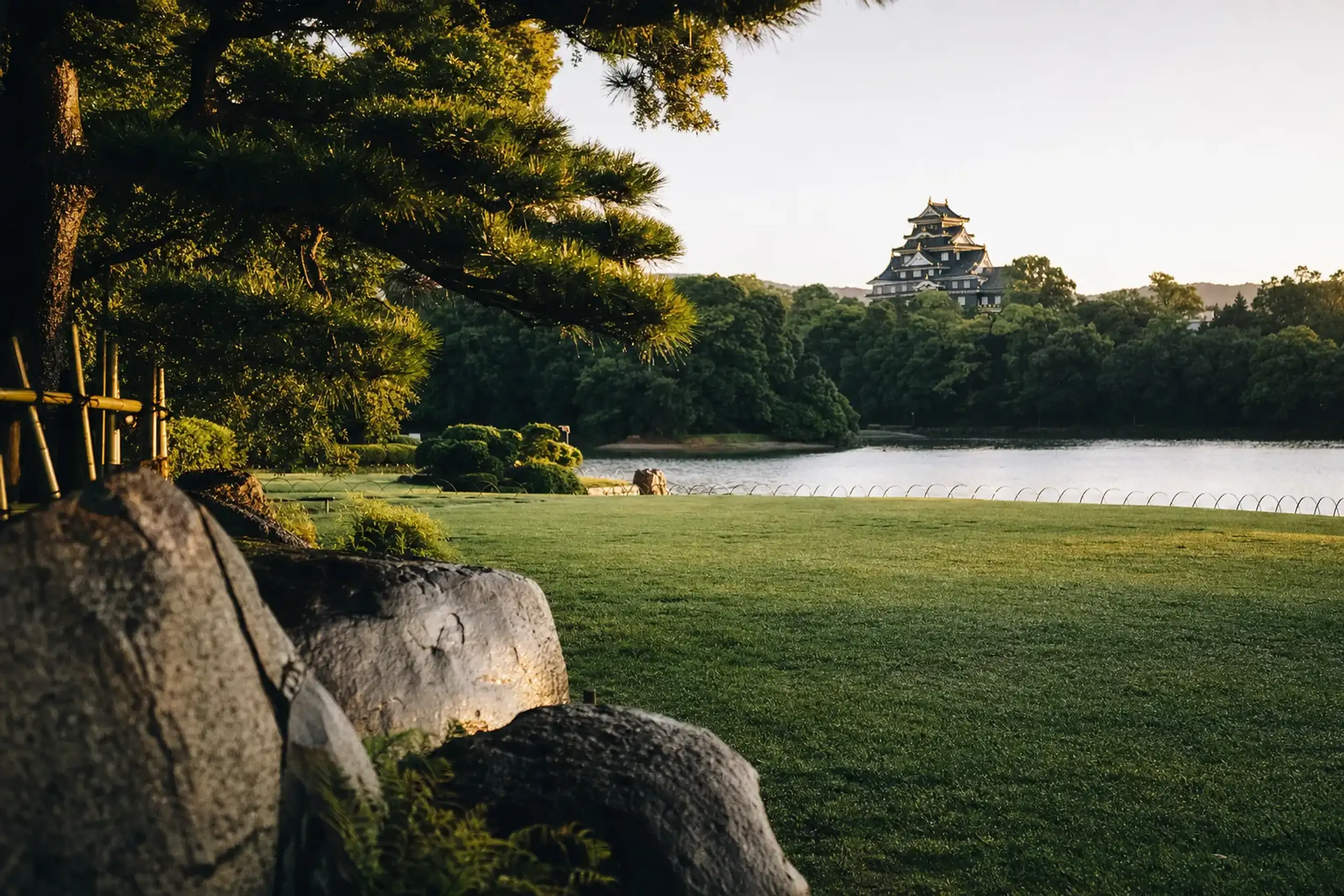
At Kōraku-en, Okayama Castle's black keep is the borrowed element, visible across the Asahi River from within the grounds.
This is not a happy accident of geography. The garden's sightlines were arranged so the castle reads as a composed backdrop, tying the daimyo's private landscape to the seat of his power just beyond the water. Locals nickname the castle U-jō, or Crow Castle, for its dark exterior — and against Kōraku-en's green, that darkness works as a deliberate accent.
Walk the paths and the castle appears, disappears, and returns as the vantage shifts. That rhythm is the point. A stroll garden is meant to reveal itself in sequence, and the castle is one of its recurring notes. Miss the framing and you've walked past the garden's central conversation.
The Lord Who Performed Noh In His Own Garden
Here is a human detail that most descriptions skip. Ikeda Tsunamasa was himself an accomplished Noh performer. Not a distant patron who funded a stage and watched — a man who put on the costume and performed.
He is recorded performing Noh personally, at a dedicated stage built within the garden, for his own retainers and even for the domain's common people. A daimyo in mask and robe, moving through the slow, exacting choreography of Noh, before an audience that included ordinary townsfolk.
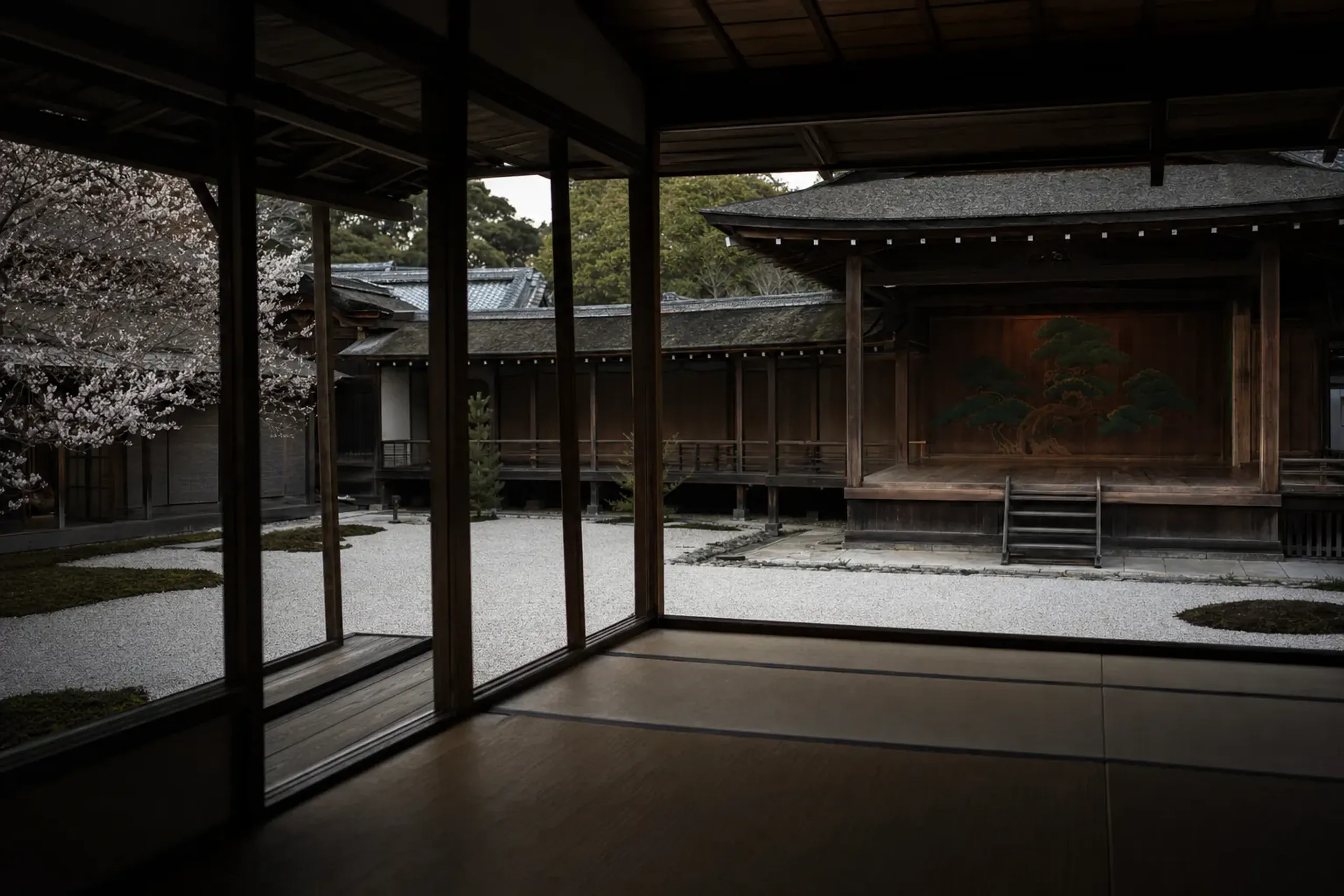
A significant collection of his fine Noh costumes survives to this day.
Picture it. The garden emptying of daily business, the stage prepared, a lord who ruled a domain stepping into a role that demanded years of discipline to perform at all. This is craft — the same devotion a shokunin gives a blade or a bowl — practised at the highest social register, for the pleasure of it.
The Noh stage and its adjoining viewing hall, the Eishō-no-Ma, are normally closed to the public. They open occasionally for kyōgen performance days, and Noh schools from around Japan still perform at the garden as part of its annual event calendar. Our concierge team confirms current-year scheduling before a visit, so guests who care about this heritage can time their arrival to it.
Can You Go Inside Enyōtei?
Enyōtei is normally closed to the public. It typically opens its interior to visitors for a limited period in late May each year — one of the rare windows to see the garden from inside the lord's own reception hall.
Built in 1691 as Ikeda Tsunamasa's living quarters and reception hall, Enyōtei was positioned with intent. It commands a panoramic view across the whole garden. The building exists to let a visitor stand where the lord stood and see the landscape as he saw it — a single composed sweep, arranged to be read from that exact seat.
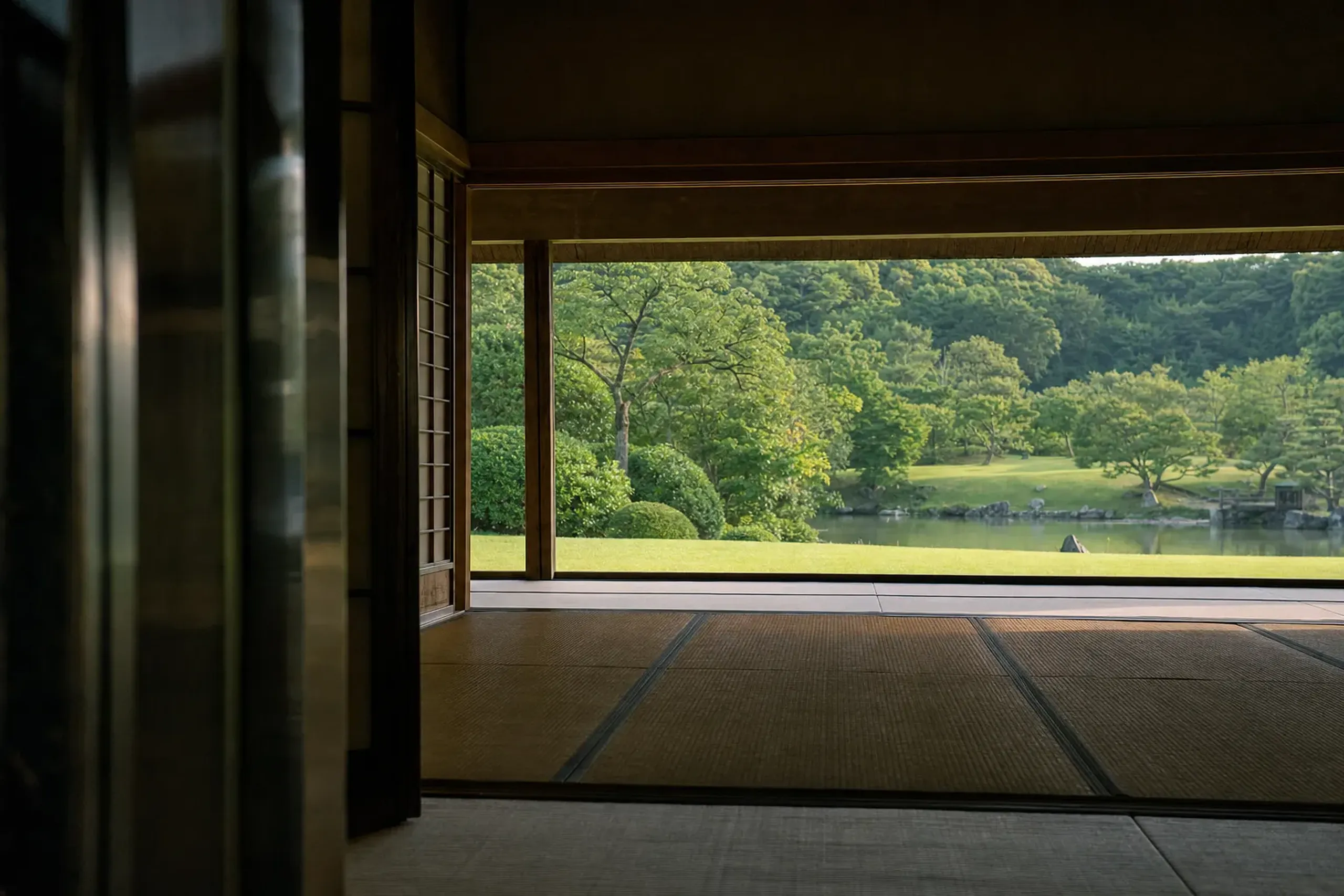
The hall you see today is a reconstruction. The original was destroyed in air raids during the Second World War. It was rebuilt in 1960 to the original floor plan, so the sightlines the founder designed remain intact.
Plan around this: Enyōtei's interior generally opens to the public only for a short stretch in late May. Dates shift year to year, and kyōgen or Noh event days are scheduled separately. Our team verifies the current-year openings before we build the day around them.
Recognition, Cranes, And The Garden After Dark
Kōraku-en carries Japan's highest landscape-heritage status. It was designated a Special Place of Scenic Beauty in 1952, and it holds three stars in the Michelin Green Guide Japon. It is also counted among Japan's Three Great Gardens, alongside Kenroku-en in Kanazawa and Kairaku-en in Mito. Each of those three makes a different argument about what a garden should be.
There is wildlife, too. Kōraku-en has raised cranes since 1956, and the red-crowned cranes are occasionally walked across the grounds during seasonal programming — a quiet, unexpected spectacle against the open lawn.
And then there is the garden by night. A limited-run illumination event called Gensō Teien, or Fantasy Garden, transforms the grounds during set periods in summer and autumn.
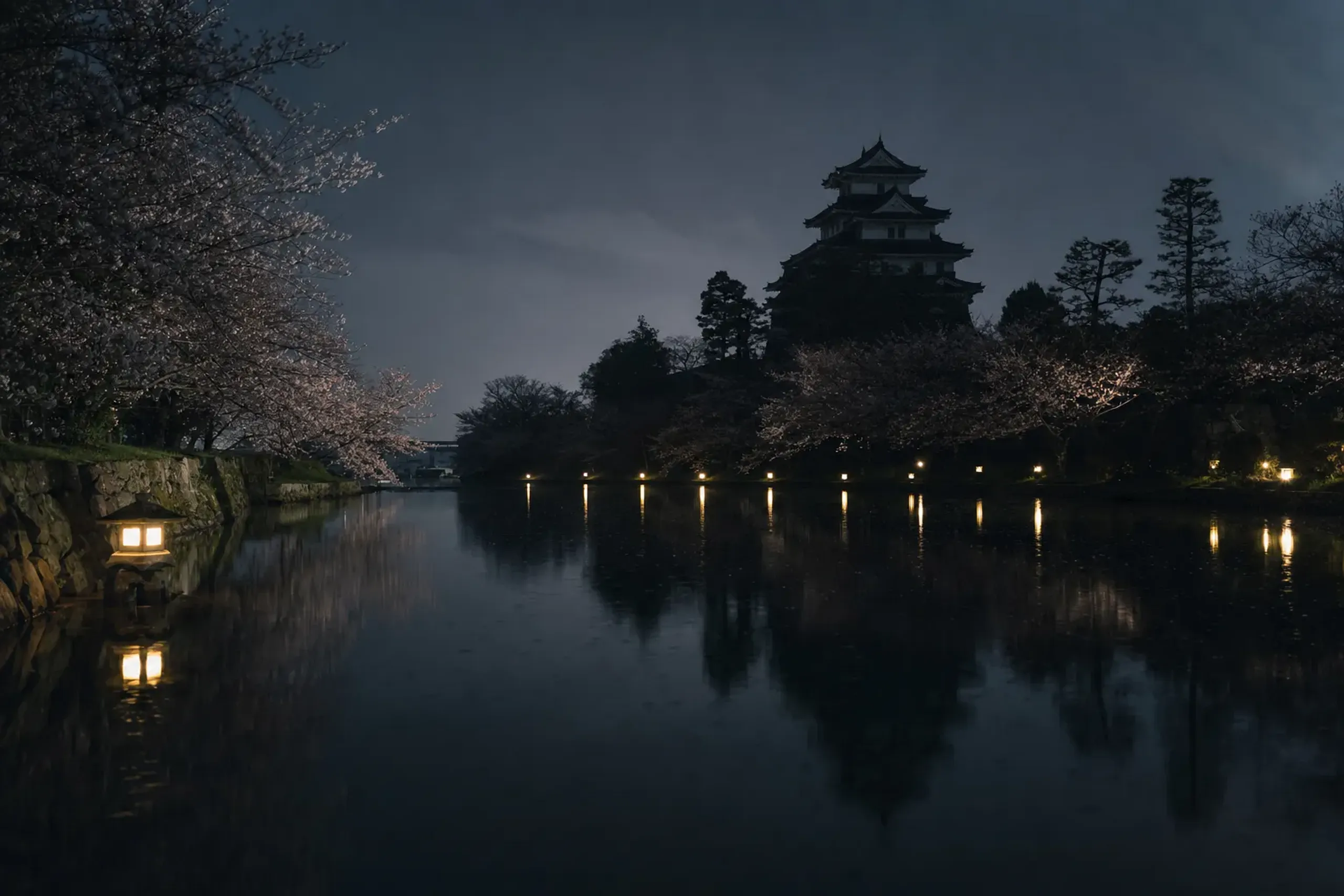
The official 2026 English brochure lists an Autumn Fantasy Garden night opening in mid-to-late November. Lit differently than daylight allows, the lawns and water take on a softer, stranger register — the castle keep glowing beyond the trees.
One more early-morning window deserves mention. The Kanrensetsu lotus viewing festival opens the garden from 4:00 to 8:00 on a set summer date — scheduled for 5 July in 2026 — to catch the lotus blooms as they open at dawn. Few experiences in Okayama match a private, near-empty garden at first light with the ponds in flower.
What Japan Royal Service Arranges At Kōraku-en
For Kōraku-en, our role is precise and stated plainly: private English-speaking guiding within the garden, and private chauffeured transfers to and from it. We do not resell the garden's own tickets or event reservations; those follow official channels, and Kōraku-en publishes its own event pages.
What we do is shape the day around what matters to you. Timing your arrival to the Kanrensetsu dawn opening, or to a kyōgen performance day, or to the late-May Enyōtei window. Sequencing the walk so the castle framing lands, so the light works, so you are ahead of the crowd rather than inside it. Our concierge verifies current-year Enyōtei dates and any Noh or kyōgen scheduling before you travel, so nothing is left to chance.
Kōraku-en also sits at the head of a rewarding corridor.
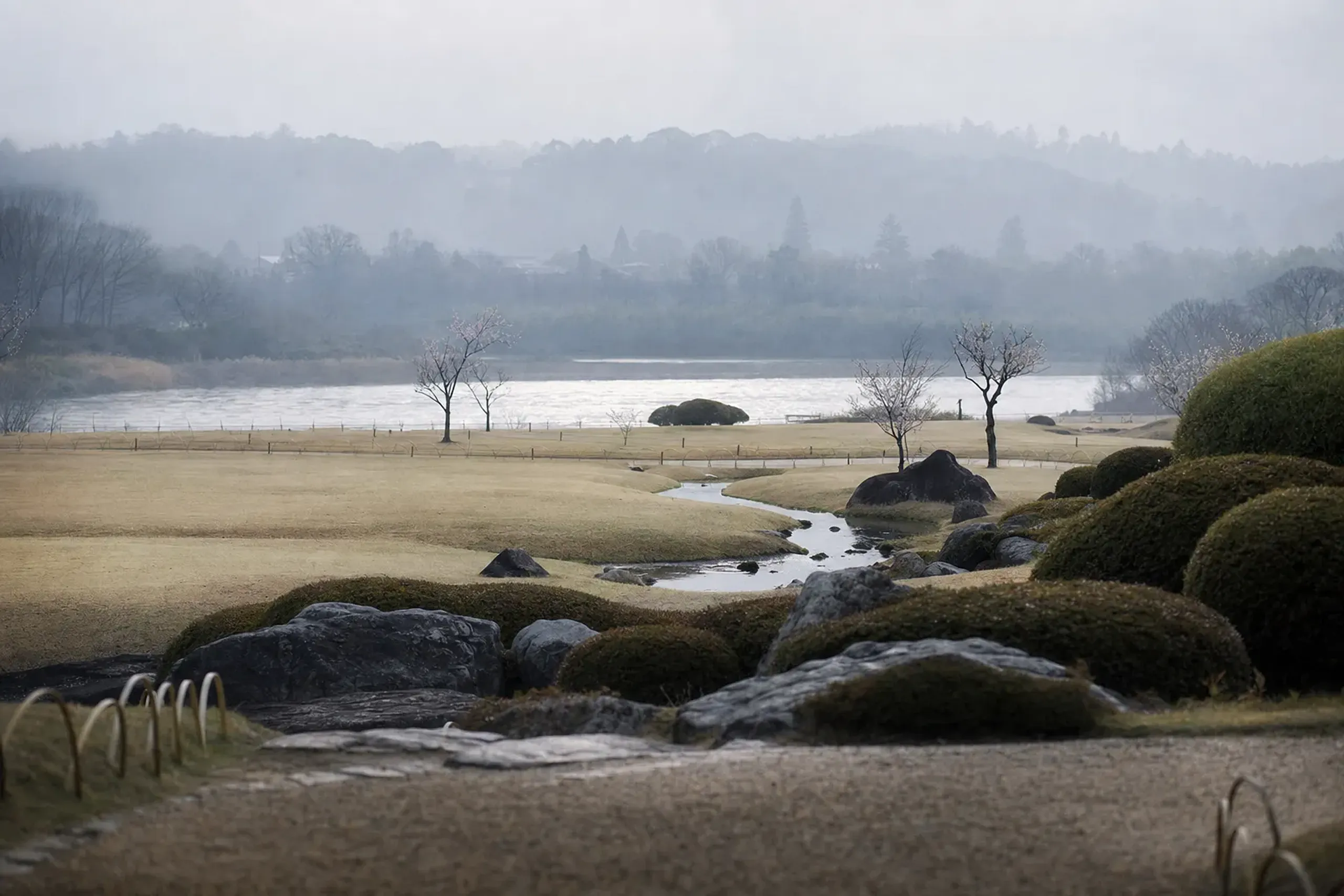
Many guests pair it with the canals and storehouses of the Kurashiki Bikan Historical Quarter the same day, then continue toward the Seto Inland Sea art islands. For multi-day journeys we coordinate tailor-made itineraries and considered accommodation across the region.
Frequently Asked Questions
Is Kōraku-en Garden's open lawn part of the original 17th-century design?
No. The founder, Ikeda Tsunamasa, built the garden with working rice paddies and cultivated fields around 1687–1700. A later lord converted those paddies to lawn as a cost-saving measure, since grass needed far less upkeep. The famous open expanse is a budget cut, not original intent.
When can visitors go inside Enyōtei at Kōraku-en?
Enyōtei is normally closed to the public and typically opens its interior for a limited period in late May. Exact dates change yearly. Our concierge confirms the current-year opening before arranging a visit so guests can see the garden from the lord's own vantage point.
What is the best time to see Kōraku-en at its most private?
The Kanrensetsu lotus festival offers a rare early-morning opening from 4:00 to 8:00 — scheduled for 5 July in 2026 — with lotus in bloom and few visitors. The autumn Gensō Teien night illumination in mid-to-late November is another low-crowd, high-atmosphere window.
How does Kōraku-en fit into a wider Setouchi luxury itinerary?
Kōraku-en pairs naturally with the Kurashiki Bikan Historical Quarter and continues toward the Seto Inland Sea art islands such as Naoshima via Uno Port.
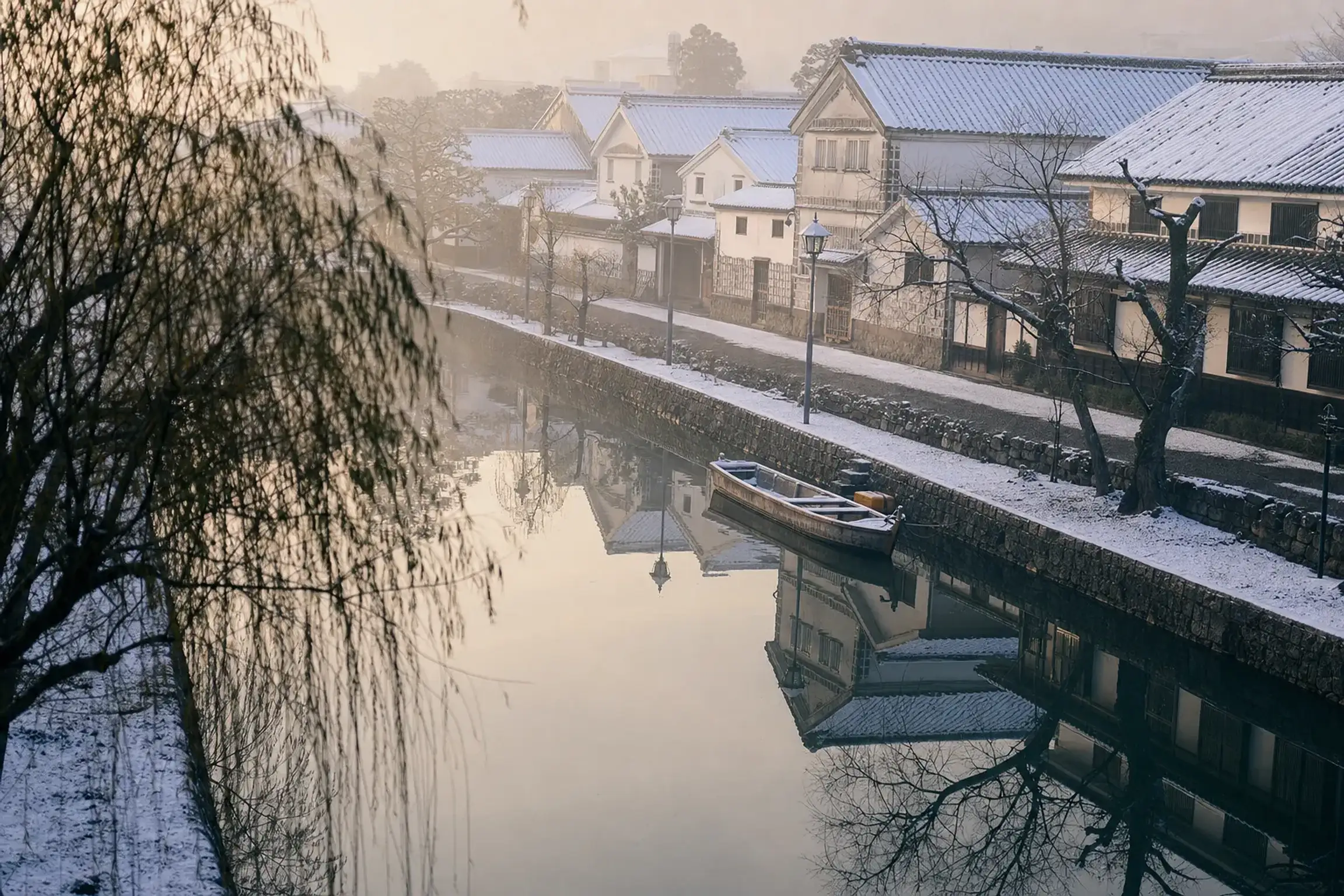
It makes a strong cultural prologue — daimyo landscape design before contemporary island art — with Okayama Station as the logistical spine.
Why Choose Japan Royal Service
Plenty of operators list Kōraku-en as one line inside a broader Setouchi tour. Fewer build a day that respects what the garden actually is. Our team at Japan Royal Service is based in Japan, works with an in-house fleet, and guides in English, Japanese, Thai, and Filipino — which means the details get handled quietly, without the friction of a distant call centre.
In our experience, the difference at a place like Kōraku-en is timing and framing. Knowing that Enyōtei opens only in late May. Knowing the castle sightline that most visitors walk straight past. Knowing when the lotus opens at 4am and how to have the garden nearly to yourself. We hold your itinerary and your identity in confidence, and we plan the day so the garden reveals itself the way its founder intended — even the parts he never got to keep.
To plan a private visit to Kōraku-en, reach our team directly via WhatsApp or LINE, or contact us here.