In this guide
- 01An Age Nobody Has Actually Measured
- 02Why It’s Called “Waterfall Cherry”
- 03What Makes Miharu Takizakura Historically Important?
- 04The Poem That Turned Fame Into Protection
- 05How Many Descendant Trees Does Miharu Takizakura Have?
- 06What You’ll Notice Up Close: Size, Structure, And Survival
- 07When Should You Visit Miharu Takizakura In Spring?
- 08Hours, Illumination Entry, And The 2026 Viewing-Fee Period (Verified)
- 09How To Get To Miharu Takizakura From Miharu Station (And What Changes During Peak Week)
- 10A Photographer’s Micro-Plan: Two Visits, Two Lenses
- 11What Japan Royal Service Can Handle (And What We Verify Each Spring)
- 12Frequently Asked Questions
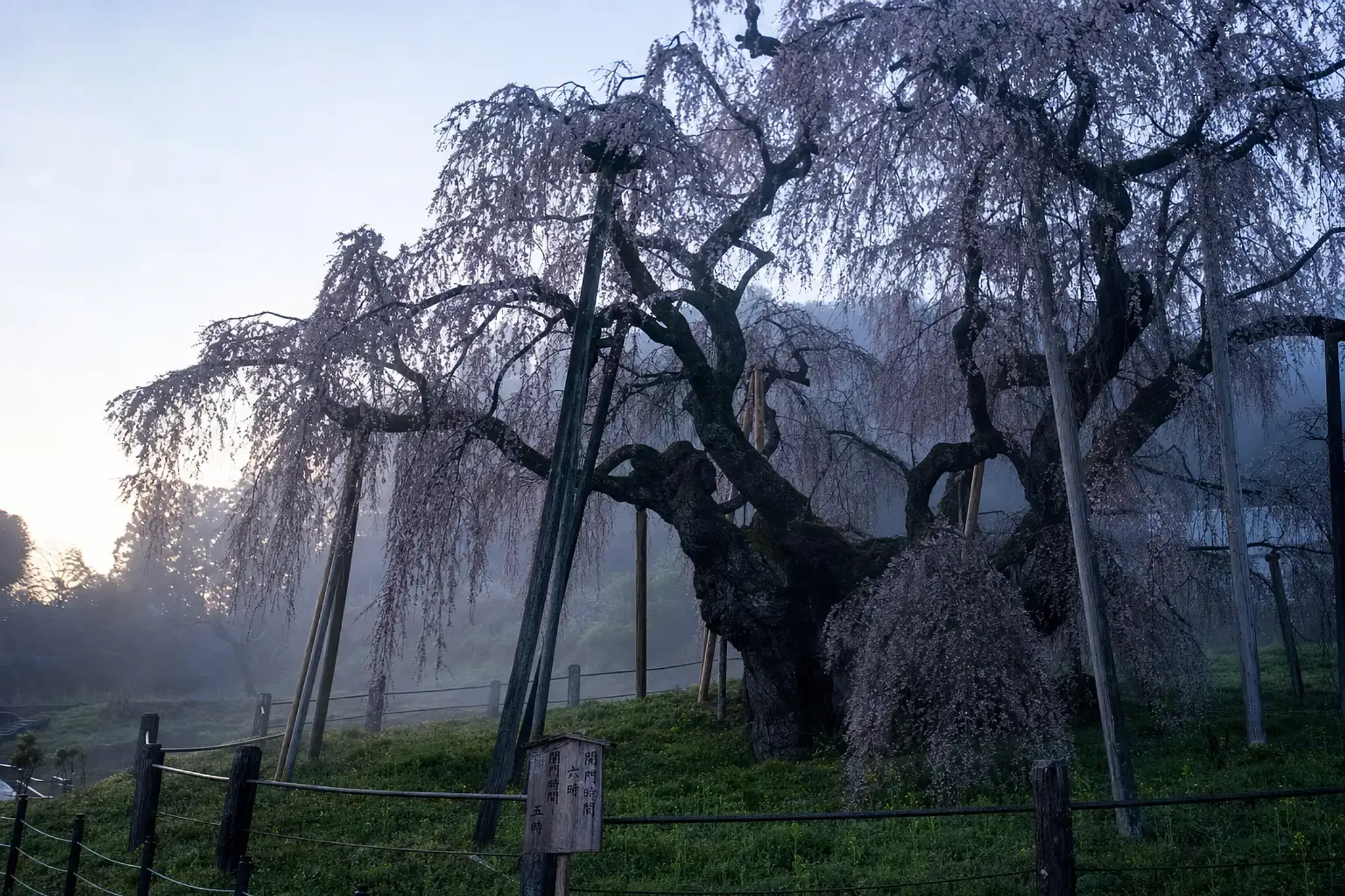
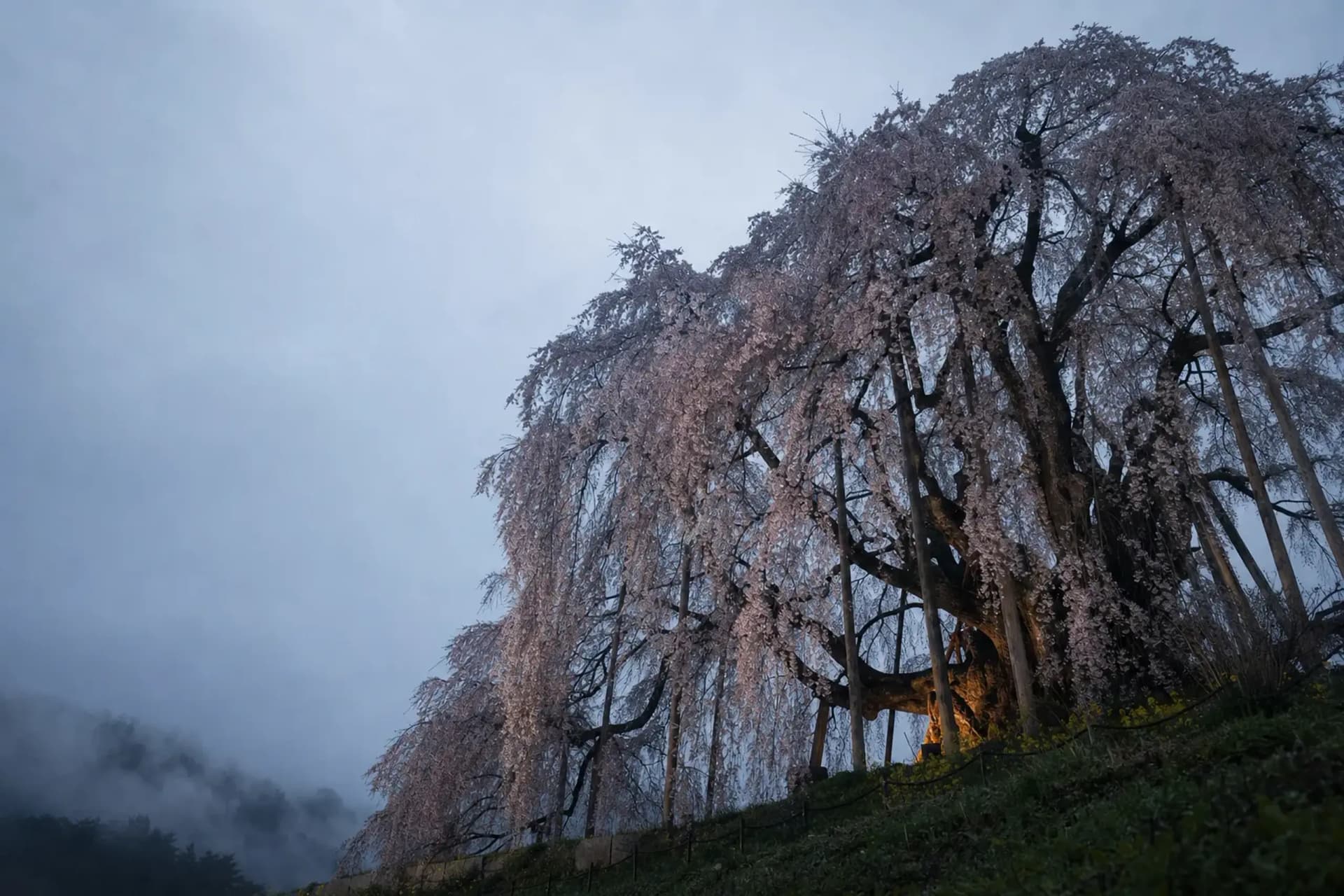
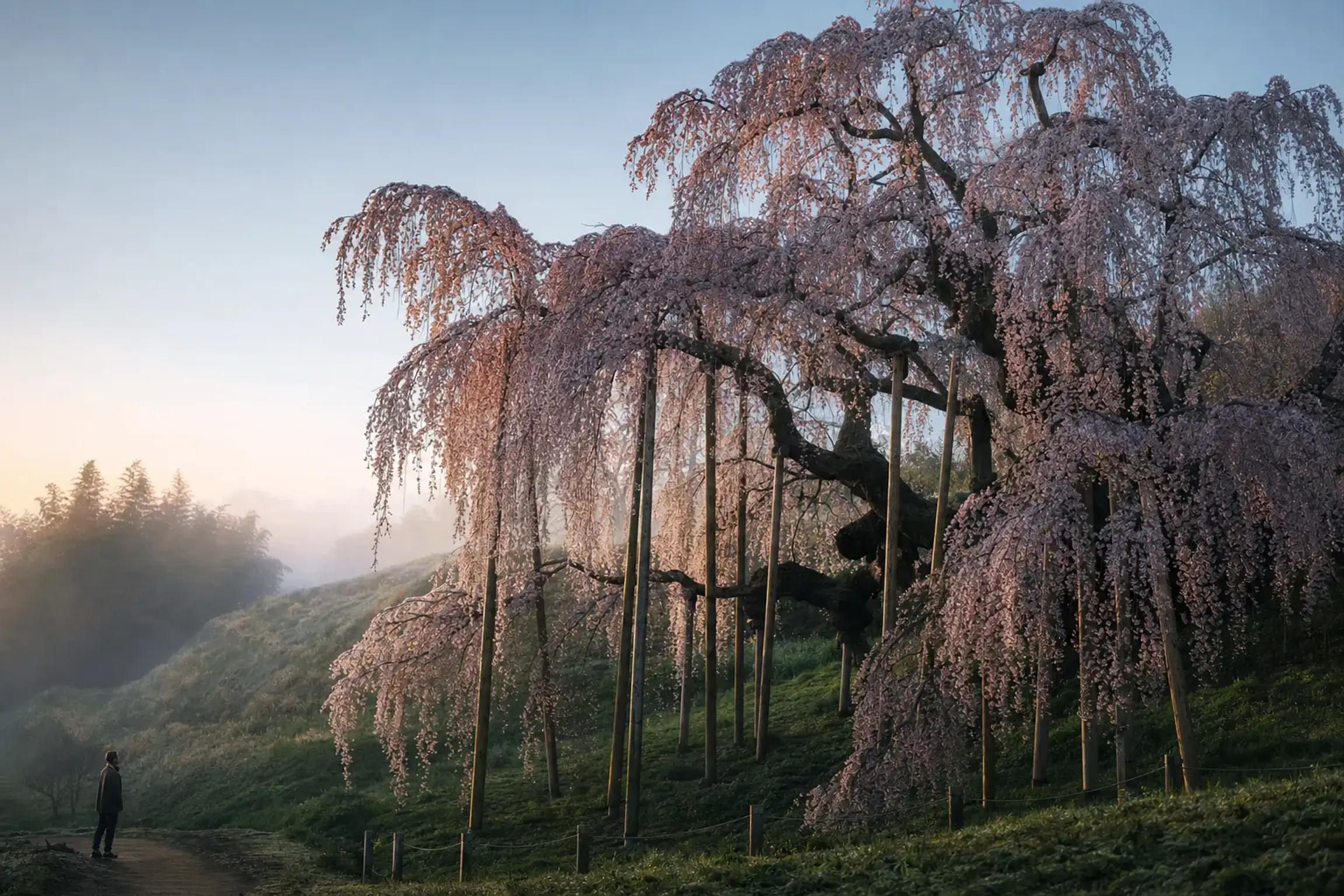
Stand beneath Miharu Takizakura at first light and you feel it before you understand it. The branches don’t “hang.” They pour. Pale crimson blossoms spill in every direction, and the whole tree reads like water caught mid-fall, held in place for one breathless week of the year.
Most people arrive with a neat line already in their head: “Over 1,000 years old.” Convenient. Wrong in the way a simplified story is always wrong. Nobody has actually measured its rings, because coring a living tree of this age and condition simply isn’t done.
What we have instead is a careful, respectful estimate. Old records already describe the tree as enormous in the 1500s. And around it, descendant trees—many themselves 400 to 500 years old—form a living scale model of time. That honesty matters, because it changes what you’re actually looking at: not a number to verify, but a long, unbroken continuity to feel.
An Age Nobody Has Actually Measured
The Miharu Takizakura’s “over 1,000 years old” is a reasoned estimate, drawn from historical descriptions and comparison with its descendants—not a ring count or any direct measurement.
Well-traveled visitors are used to tidy claims. Museums label. Guides repeat. Social captions harden into “facts” by the thousandth share. With Takizakura, the more respectful stance is to accept only what can be verified and to leave space where certainty would require harming the tree itself.
In our experience at Japan Royal Service, this single clarification quietly transforms a visit. You stop trying to “confirm” a headline. You start noticing the body of the thing: the weight of the older limbs, the way the support structures cradle rather than clamp them, the hush that moves through the crowd when wind stirs the blossoms.
If you want one practical takeaway, it’s this. Treat your Miharu Takizakura day like a narrow-window event, because that is exactly what it is. Build in buffer time, a backup day if at all possible, and a clear plan for crowds. Timing, not trivia, is what makes the experience feel private.
Why It’s Called “Waterfall Cherry”
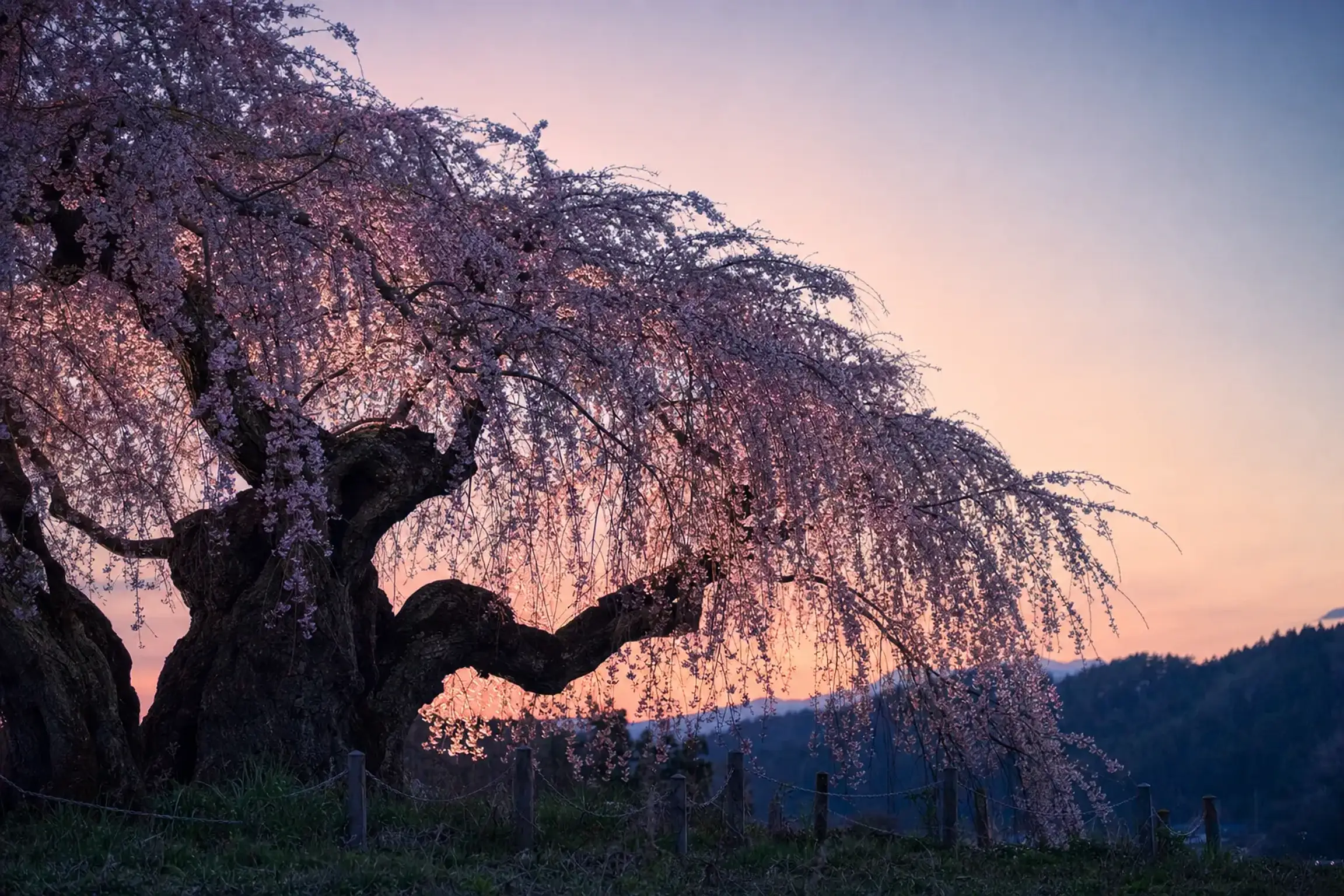
Takizakura means “waterfall cherry.” The name is literal. In full bloom, the blossoms cascade from branches that spread outward like a dome, and the tree looks less like a plant than a natural phenomenon caught mid-motion.
The variety is described locally as an Edohigan lineage beni-shidare-zakura—an Edo higan-type weeping cherry. That lineage matters, because it explains the very feel of the bloom: soft, fine flowers strung along long, falling lines, rather than the puffed, cotton-ball clusters many travelers picture when they think of somei-yoshino.
Look up once, then look down. You’ll often see the “waterfall” effect doubled in a puddle, in damp soil, or in the gloss of a rain-dark path. A small detail. A large memory.
What Makes Miharu Takizakura Historically Important?
Miharu Takizakura was designated a National Natural Monument on October 12, 1922, becoming the first cherry tree ever given that status in Japan.
That date is precise, and the distinction is worth keeping precise too. On the same day in 1922, two other named cherry trees were also designated, and together those three are commonly grouped as “Japan’s Three Great Cherry Trees.” Separately, all five cherry trees designated that day are known as “Japan’s Five Great Cherry Trees.”
It’s easy to see how online summaries blur those numbers. Don’t let them.
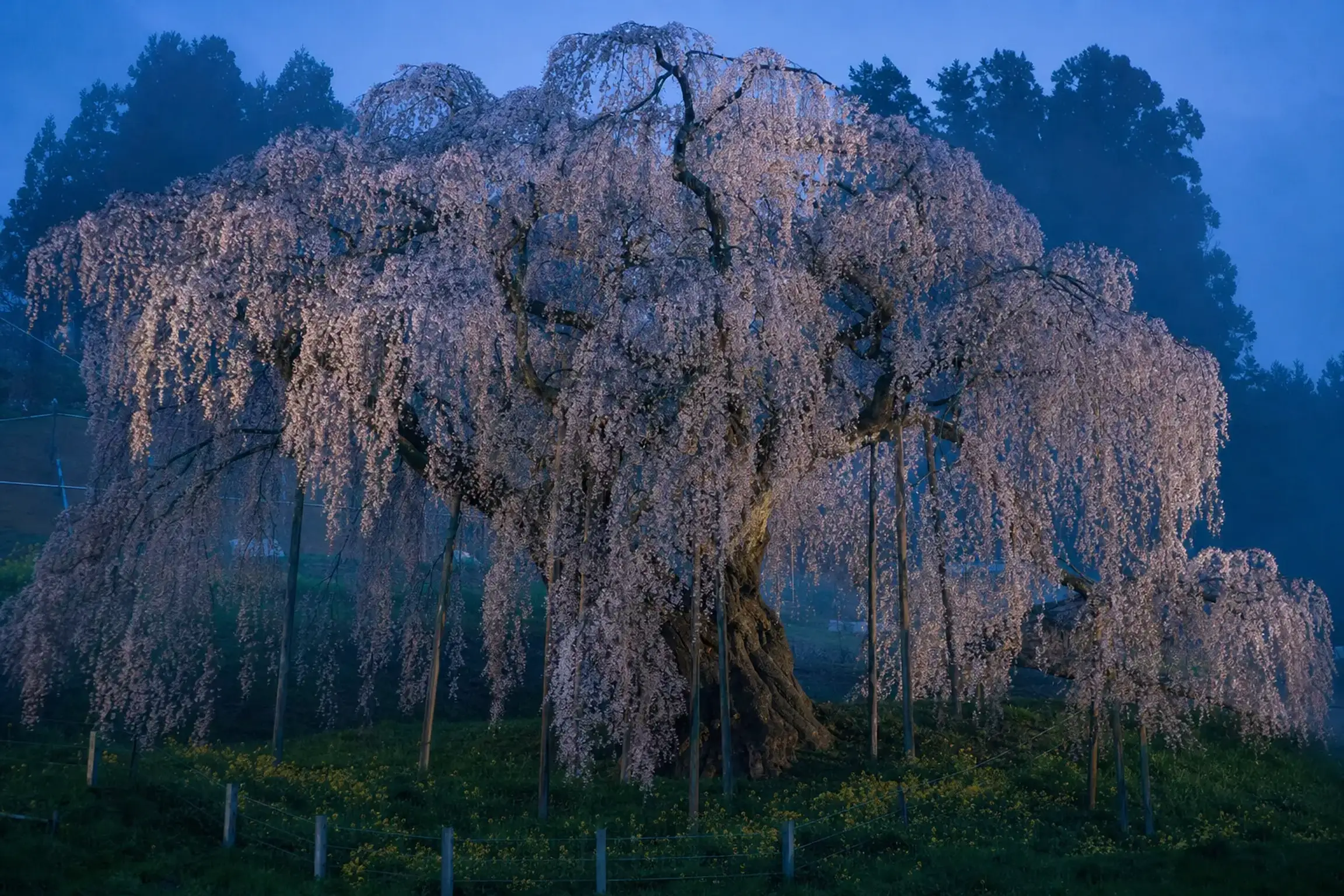
The groupings are part of the story: a single moment when Japan decided certain living trees were cultural heritage, not merely scenery.
In 2022, the designation reached its 100th anniversary. That centennial didn’t change the tree itself, of course. It changed the way we can talk about it. Not just “famous,” but formally protected for a full century—and admired for far longer than that.
The Poem That Turned Fame Into Protection
In the 1830s, a poem by Kamo Suetaka praised the Takizakura and described its fame echoing across the old Tōhoku region. Words traveled. People followed. And that attention triggered something rare: formal protection.
Because the poem spread, the lord of the Miharu domain placed the tree under protection as a goyōboku—a tree reserved for official, lordly use. It’s an Edo-period chain of cause and effect you can still feel standing there today: admiration becoming policy, culture becoming care.
When you visit, it’s tempting to focus only on the blossoms. Try holding a second image in mind at the same time: a domain lord ordering protection because a poem had made the tree too famous to ignore. That is how heritage so often survives. Not through romance, but through decisions. This quiet reverence for restraint and continuity—the same sensibility that shapes Japan’s finest gardens and tea rooms—is what turns a single tree into a national story.
How Many Descendant Trees Does Miharu Takizakura Have?
A survey around 1960 reported more than 420 descendant weeping cherry trees within 10 kilometers of Takizakura, each with a trunk circumference over one meter.
The survey was conducted by Denjūrō Kimesawa and Kichishirō. The detail that tends to get skipped is the shape of the result: the descendant trees were arranged in concentric circles.
Thinner trunks and fewer trees appeared the farther you moved from the center.
This is the most checkable, most physical argument for time that the site offers. Not rings. Not legend. Genealogy. You’re looking at a “parent” tree surrounded by a living map of its own spread across the centuries.
If you’re the type who travels with a camera, this can guide your framing entirely. Don’t only shoot the main tree tight. Step back and include the wider landscape where those circles of descendants ripple outward. It tells the fuller story.
What You’ll Notice Up Close: Size, Structure, And Survival
The tree’s height is commonly given as roughly 12 to 13.5 meters, with a trunk circumference of roughly 8 to 9.5 meters depending on the survey year cited. The branch spread is often described at roughly 22 to 25 meters east–west and 18 to 20 meters north–south.
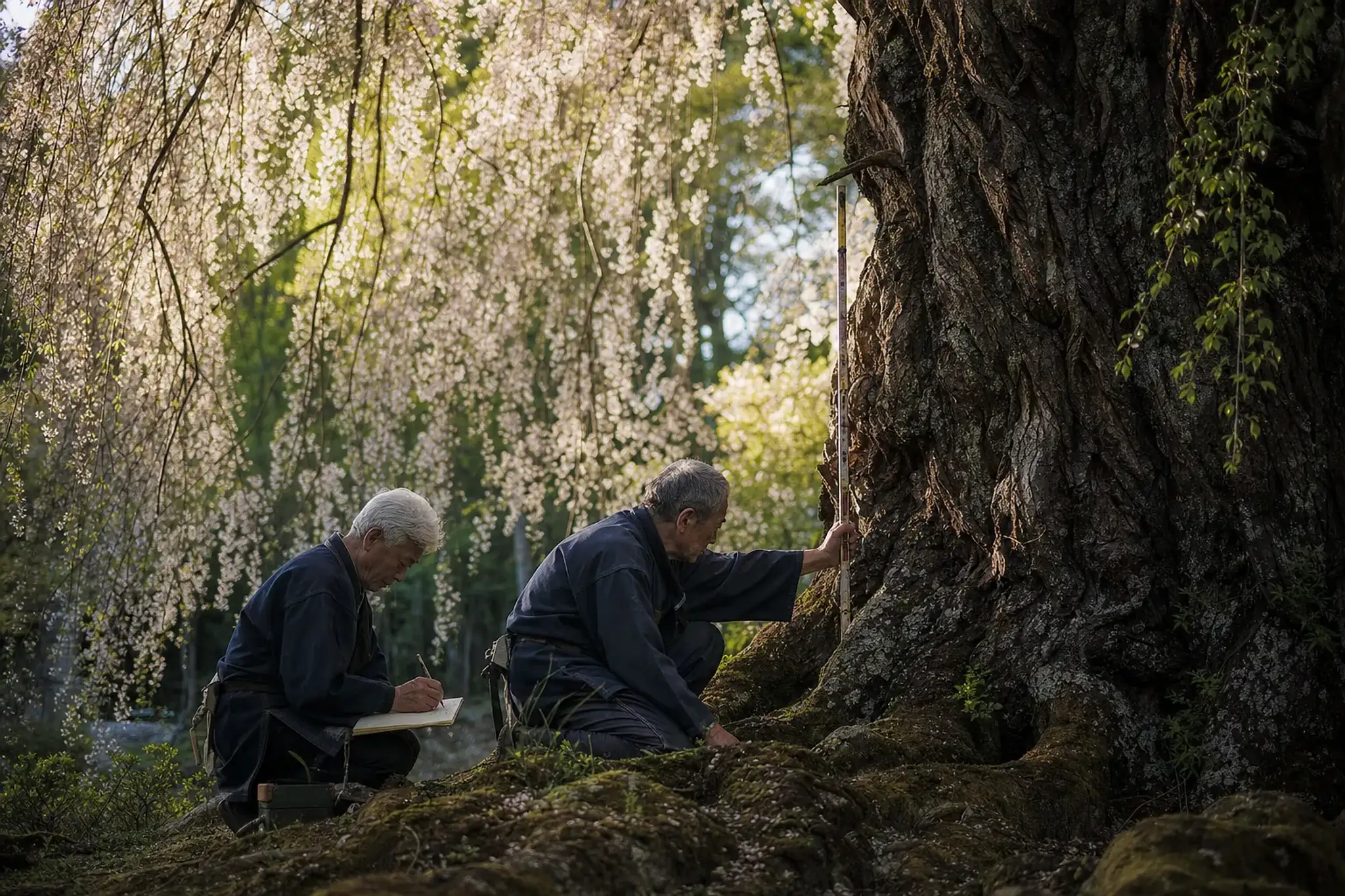
Numbers help. Briefly. Then your eyes take over. The trunk holds an interior cavity that has been filled over time by multiple roots that grew inward to reinforce it. That detail lands differently once you see it in person: survival as a quiet engineering project the tree has performed on itself, over lifetimes.
Expect support structures. They are part of responsible preservation, not visual clutter—the same instinct for care that keeps this heritage alive. If you want clean shots, arrive early. Very early. Crowds and harsh midday contrast are the two things you can genuinely control with a little planning.
Bloom timing is typically mid-to-late April. For reference, Miharu Tourism Association updates reported an official bloom declaration on April 2, 2026 (15:00 update) and full bloom on April 11, 2026 (6:30 update).
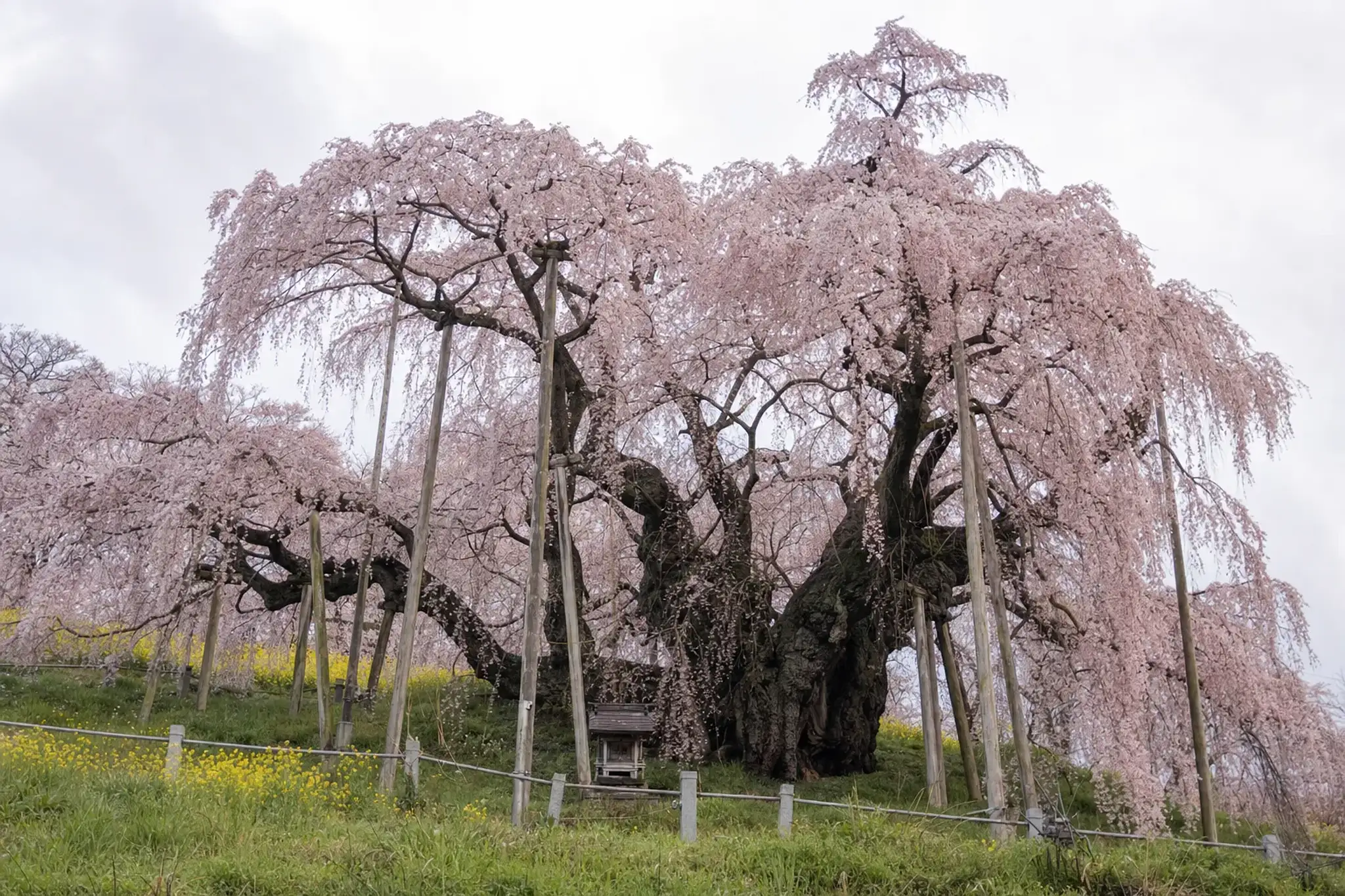
That spread—nine days from declaration to peak—is a useful planning shape, even though the exact dates shift each year.
When Should You Visit Miharu Takizakura In Spring?
Plan for mid-to-late April, then fine-tune close-in using the official local bloom updates; in 2026, bloom was declared April 2 and full bloom was reported April 11.
If you want the tree to feel like a private encounter rather than a shared spectacle, choose your hour as carefully as you choose your date. We often suggest two distinct moods instead of one compromised visit: an early-morning arrival for clear air and calmer foot traffic, and a separate return at dusk if illumination is operating that year.
Weather is the quiet spoiler. Rain can turn the site reflective and dramatic, or it can flatten the petals in an afternoon. Cold nights can hold the bloom back. Warm days can rush it forward. This is precisely why our concierge team confirms current-year bloom timing and any night-illumination scheduling ahead of a client’s visit, using official local updates rather than last year’s guesswork. This is the essence of shun—knowing not merely where to go, but exactly when a place is at its fleeting best.
If you are scheduling a high-stakes trip—an anniversary, a family gathering, a once-a-decade holiday—build at least one flexible day around the likely peak. Big relief. Small cost.
Hours, Illumination Entry, And The 2026 Viewing-Fee Period (Verified)
Miharu Town lists viewing hours as 6:00–18:00, with admission until 20:30 during illumination periods.
Operational details change year to year, so treat this section as the part you re-check each winter before spring travel. For 2026, Miharu Town also published a viewing-fee period beginning April 3, 2026 (the day after the bloom declaration) and running until the tree becomes leafy (hazakura).
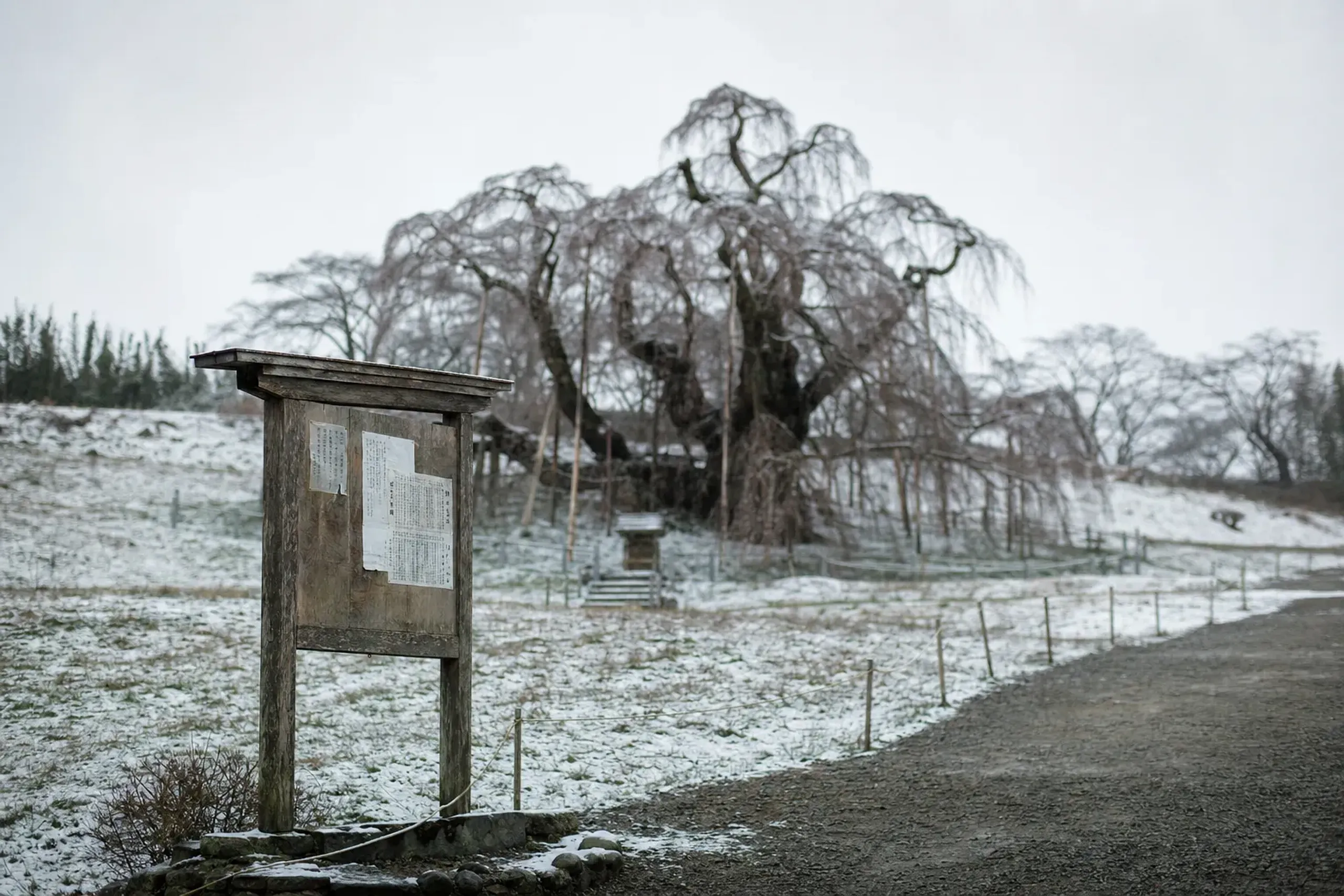
Key fact: The town’s rules hinge on bloom status (declaration, then leaf-out), not fixed calendar dates, so last-minute checks are always sensible.
One more practical note for families. Miharu Town published the 2026 viewing fee as 500 yen (middle-school age and under free). We don’t dwell on minor costs, but we do focus on reducing friction on arrival, and knowing exactly what to expect helps the day open smoothly.
How To Get To Miharu Takizakura From Miharu Station (And What Changes During Peak Week)
In peak season, expect special transport measures; for 2026, a temporary bus between Miharu Station and Takizakura was scheduled for April 4–12.
If you arrive by rail, Miharu Station is the name to anchor to. From there, the last-mile experience is what tends to surprise travelers: traffic controls, queues, and the slow grind of many vehicles converging on the same rural roads within the same narrow hour.
For 2026, the temporary bus service was set to run on a 1-day pass model. Even if you prefer private travel, that detail is worth knowing, because it signals the town’s crowd-management posture during the peak window.
Many discerning travelers choose a private car for the day simply because it lets the schedule breathe. The first mention matters, so here it is: our private chauffeured transportation options are outlined in full on our services page. A quiet vehicle makes for a quiet day.
What we recommend in practice is a run sheet, not a vague plan. Departure time, arrival window, time-on-site, a second pass if the light changes, and a hard stop so the day doesn’t dissolve into traffic on the way home.
A Photographer’s Micro-Plan: Two Visits, Two Lenses
Morning gives you structure. Dusk gives you emotion. Trying to force both into one mid-day stop is the most common mistake we see.
Option A: Early Morning (Calm, Detail, Clean Backgrounds)
Arrive close to opening hours, then move slowly and deliberately. It’s the best window for the tree’s fine lines and for pictures that don’t look like a study in crowd management.
- Bring: a short telephoto for isolating falling strands of blossom and the texture of the trunk.
- Look for: backlit petals while the sun is still low.
- Move: one step at a time; the best angles open up only briefly between groups.
Option B: Illumination Hours (Silhouette, Glow, Fewer Harsh Shadows)
If illumination is offered that year, plan your second visit as an entirely separate event. The town’s published rule for illumination periods is admission until 20:30.
- Bring: a fast prime lens if you shoot handheld; tripods may be restricted depending on conditions and crowd controls.
- Aim for: the moment when sky color is still present, not full darkness.
- Expect: slower movement and more frequent pauses as people compose their shots.
What Japan Royal Service Can Handle (And What We Verify Each Spring)
Japan Royal Service can arrange private guiding and transfers for a Miharu Takizakura visit, with scheduling built around real-time bloom status and on-the-ground crowd conditions.
For our travelers, the luxury here is not velvet-rope language. It’s control. A car that arrives exactly when it should, a plan that survives the traffic, and a guide who knows precisely when to step back so the tree can do the talking.
That restraint—the discipline of doing less, better—is a quieter kind of hospitality, and it is one we hold close.
We also verify the details that tend to drift year to year: the town’s posted hours, the illumination entry cutoff, and the current season’s bloom updates. No guessing. No wishful thinking. And, always, complete discretion around who you are and where your itinerary takes you.
If you want the whole of spring arranged as one coherent, seamless piece, our team can privately advise on a tailor-made itinerary that uses Takizakura as the anchor of the day and keeps everything around it deliberately, restfully simple.
When you are ready to plan your own spring encounter with this thousand-year presence, contact us here and we will begin shaping a private proposal around the season’s exact bloom.
Frequently Asked Questions
Is Miharu Takizakura Really Over 1,000 Years Old?
It is widely described as over 1,000 years old, but that figure is an estimate based on historical records and comparison with descendant trees, not a measured ring count.
Because coring a living tree of this age and condition is not done, there is no direct ring-measurement record. The more honest way to speak about it is “estimated”—and the estimate is still extraordinary.
When Did Miharu Takizakura Become A National Natural Monument?
Miharu Takizakura was designated a National Natural Monument on October 12, 1922.
It was the first cherry tree ever designated in Japan, and the year 2022 marked the 100th anniversary of that designation.
What Are The Official Hours And Illumination Entry Time For Miharu Takizakura?
Miharu Town lists regular viewing hours as 6:00–18:00, with admission until 20:30 during illumination periods.