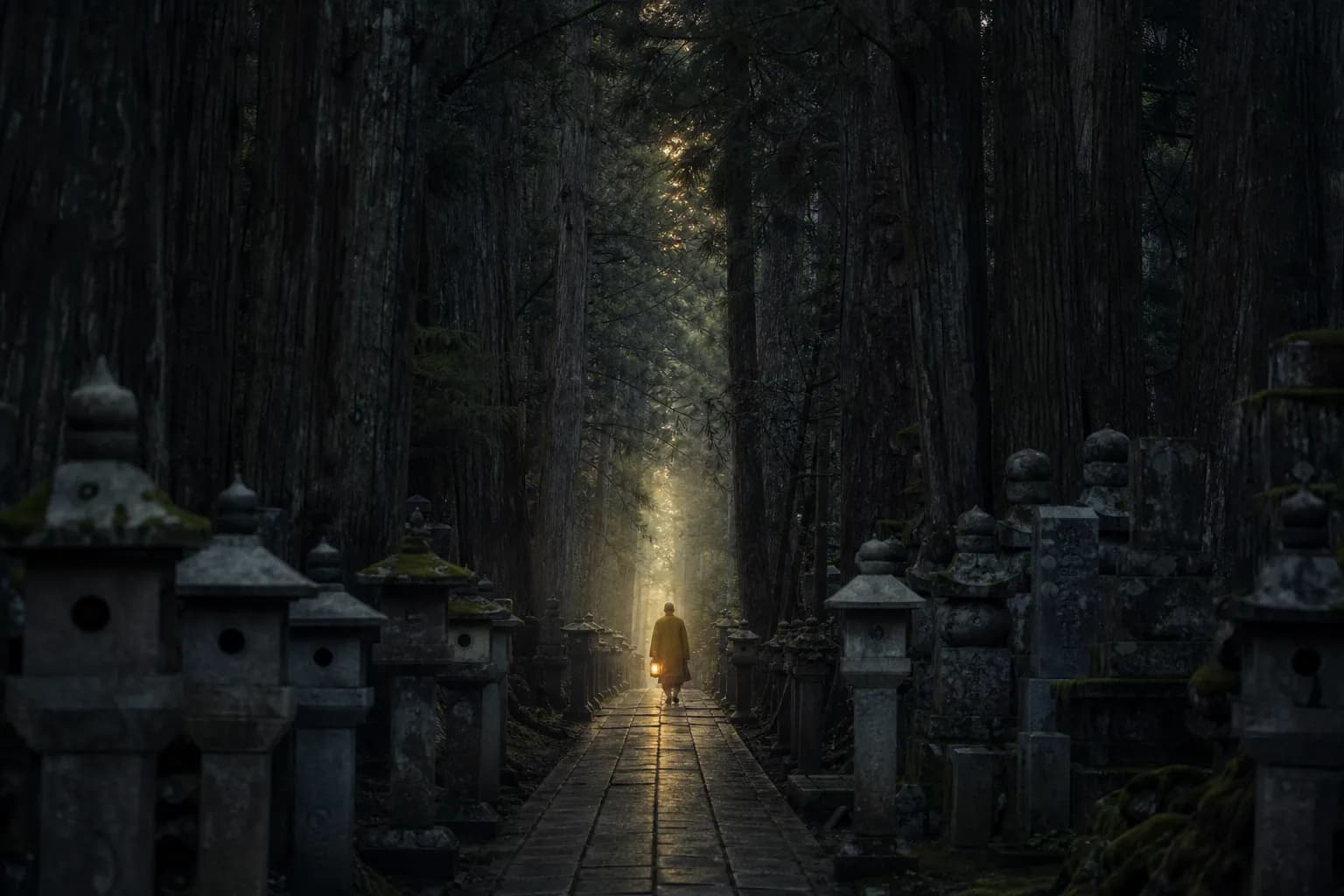
Okunoin Temple is located on the north side of Koyasan. The temple is a sanctuary housing the mausoleum of Kobo Daishi—also known as Kukai—a famed monk, scholar, engineer, and the founder of Shingon Buddhism (774–835 A.D.). Rather than having died, Kobo Daishi is believed to rest in eternal meditation as he awaits Miroku Nyorai (Maitreya), the Buddha of the Future, offering relief to those who seek salvation in the meantime. Okunoin is one of the most sacred places in Japan and a popular pilgrimage destination.
The temple’s vast grounds are home to Japan’s largest cemetery, with memorials and monuments for more than 200,000 souls—including some of the most famous figures in Japanese history. Many wished to be close to the Buddhist pioneer, Kobo Daishi, in hopes of a swift path to salvation.
General Information
- Address: 550 Koyasan, Koya, Ito District, Wakayama , Japan
- Telephone: 736-56-2002
- Opening Hours:
- Torodo (Hall of Lanterns): 06:00–17:30
- Gokusho Offering Hall: 8:30–17:00
- Admission: Free
Ease of Access
The Ichinohashi Bridge is a 10–15 minute walk or a short bus ride (140 yen) from the Senjuinbashi intersection in the town center. From the bus stop, it is about a two-kilometer walk to the mausoleum along the traditional approach through the graveyard.
The Okunoin-mae bus stop is the final stop of the main bus line connecting Okunoin with the town center (Senjuinbashi) and the cable car station. The bus ride takes 20 minutes and 420 yen from the cable car station, or 10 minutes and 220 yen from the town center. There are 2–3 buses per hour. From the bus stop, it is about a one-kilometer walk to the mausoleum through a newer part of the graveyard.
Location
Mount Koya (Koyasan) is a sacred Buddhist retreat and a UNESCO World Heritage site in Wakayama Prefecture, where travelers can stay overnight at a temple, experience prayer rituals, and explore beyond the main sights. No visit to Koya is complete without making your way to Okunoin.
Recommended Route
The first bridge, Ichinohashi Bridge, marks the traditional entrance to Okunoin. Visitors bow to pay respect to Kobo Daishi before crossing. Beyond the bridge begins Okunoin’s cemetery—the largest in Japan—with more than 200,000 tombstones lining the nearly two-kilometer approach to Kobo Daishi’s mausoleum. Over the centuries, many people—including prominent monks and feudal lords—have had tombstones erected here, wishing to be close to Kobo Daishi in death in order to receive salvation.
A second, shorter approach—used by most visitors today—starts at the Okunoin-mae bus stop and cuts the walk to the mausoleum in half. This route passes through a newer section of the cemetery with modern memorials erected by individuals, associations, and companies. Some are unexpectedly distinctive, such as a pest control company’s memorial to the termites their products have exterminated. Regardless of which approach you choose, both paths converge at the Gokusho Offering Hall, near a row of statues depicting Jizo, a beloved Bodhisattva who watches over children, travelers, and the souls of the deceased. Visitors make offerings and pour water over the statues—known as Mizumuke Jizo (Water-Covered Jizo)—to pray for departed family members.
The Gobyobashi Bridge crosses a stream behind the Mizumuke Jizo, separating the innermost precincts from the rest of Okunoin. Visitors should bow to Kobo Daishi once again before crossing; photography, and food and drink are forbidden beyond this point. To the left of the bridge, wooden markers placed in the stream serve as a memorial to unborn children. A few meters past the bridge on the left side of the path is the Miroku Stone, kept in a small cage. Visitors are invited to lift the stone from the lower platform to an upper platform using only one hand. It is said to feel lighter to good people and heavier to bad people, and to provide a connection to the Miroku Bodhisattva.
Torodo Hall (Hall of Lamps) is Okunoin’s main worship hall, built in front of Kobo Daishi’s mausoleum. Inside are more than 10,000 lanterns donated by worshipers, kept eternally lit. In the hall’s basement are 50,000 small statues donated to Okunoin for the 1150th anniversary of Kobo Daishi’s entrance into eternal meditation in 1984. Behind Torodo Hall is Kobo Daishi’s Mausoleum (Gobyo), the site of his eternal meditation. Visitors come from across Japan and beyond to pray to Kobo Daishi, and it is not uncommon to see pilgrims chanting sutras here.