In this guide
- 01What Arrival Choreography Actually Means
- 02Haneda Versus Narita: Choosing Your Point of Entry
- 03The Discreet Welcome: Meet-and-Greet Versus True VVIP Handling
- 04The Fleet: Choosing the Right Vehicle for a Quiet Transfer
- 05The Least-Exposure Route Into Central Tokyo
- 06Room Selection: The Overlooked Half of Discretion
- 07The First Hour: Low Stimulation, High Craft
- 08Contingency: What Happens When Something Slips
- 09Vendor Standards: The Unglamorous Foundation
- 10Common Questions About Tokyo VVIP Arrivals
- 11Why Choose Japan Royal Service
The first hour in Tokyo sets the tone for everything that follows. For the discerning traveler, that hour is not measured in minutes saved. It is measured in friction removed — the absence of queues, the absence of eyes, the absence of a single moment where anyone must ask where to go next.
Most luxury itineraries promise a driver with a placard. That is table stakes. What separates a merely comfortable landing from a genuinely private one is choreography: the exact sequence of curb, corridor, vehicle, and suite, mapped before the wheels touch the runway. Our team at Japan Royal Service treats this as a craft, not a slogan.
What follows is a working manual for arriving in Tokyo without noise. It is candid about what can be arranged, and candid about what cannot. Some things in Japan move at their own pace. Knowing which is which is the entire art.
What Arrival Choreography Actually Means
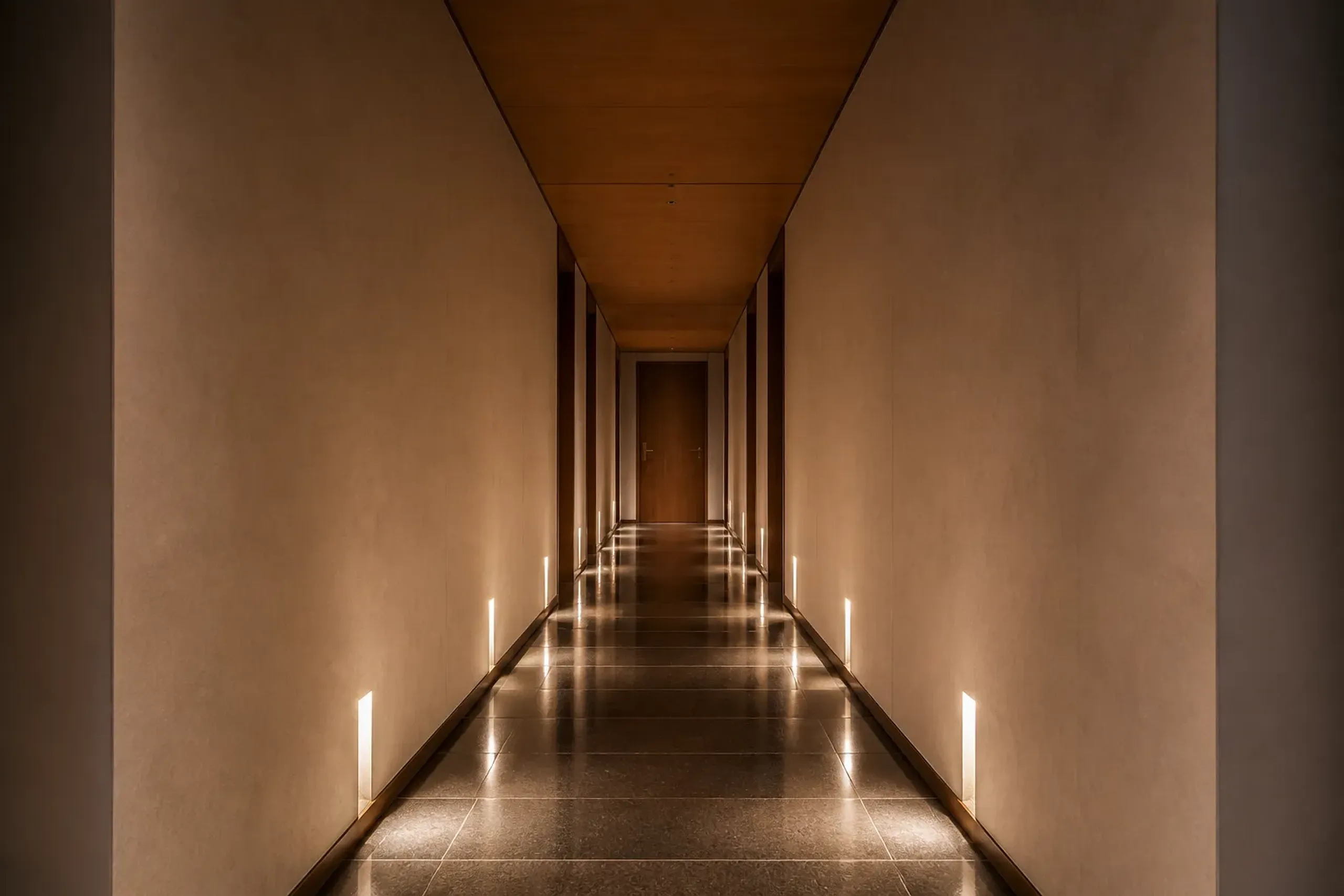
The quietest luxury is the corridor no one else is walking.
The phrase gets used loosely. Here is our definition. Arrival choreography is the timed, rehearsed sequence that carries a guest from the aircraft door to the privacy of a suite with as few visible touchpoints as possible.
It is not one thing. It is a chain. Airside handling, immigration routing, baggage flow, curb positioning, drive selection, and the final approach into the hotel — each link engineered so the next feels inevitable. Break one link and the whole illusion of ease collapses.
Competitors describe this moment in a sentence: "a representative will be waiting as you clear the airport." True. Also incomplete. The interesting work happens in the gaps between that sentence — the twenty minutes of immigration reality, the walk to the vehicle, the choice of which hotel entrance you use and at what hour.
The Honest Limits
Discretion begins with truth. In Japan, immigration and customs are government functions. No private company escorts a guest past passport control or clears customs on their behalf. Anyone promising otherwise is misinforming you.
What genuinely exists is different, and better because it is real. Haneda Airport publishes an official HND-AIRPORT ESCORT SERVICE, where airport concierges meet passengers at designated points and can guide them toward Fast Track or priority lanes at security and immigration. Narita operates a premium handling product, Premier Gate, which even includes car transportation between the terminal and the aircraft. These are airport-run services with defined scope. We build around them rather than pretending to replace them.
Key fact: No private operator in Japan can fast-track a guest through immigration itself. The credible options are the airports' own escort and premium-gate services — plus expert routing around them. Beware any promise that sounds like it bypasses passport control.
Haneda Versus Narita: Choosing Your Point of Entry
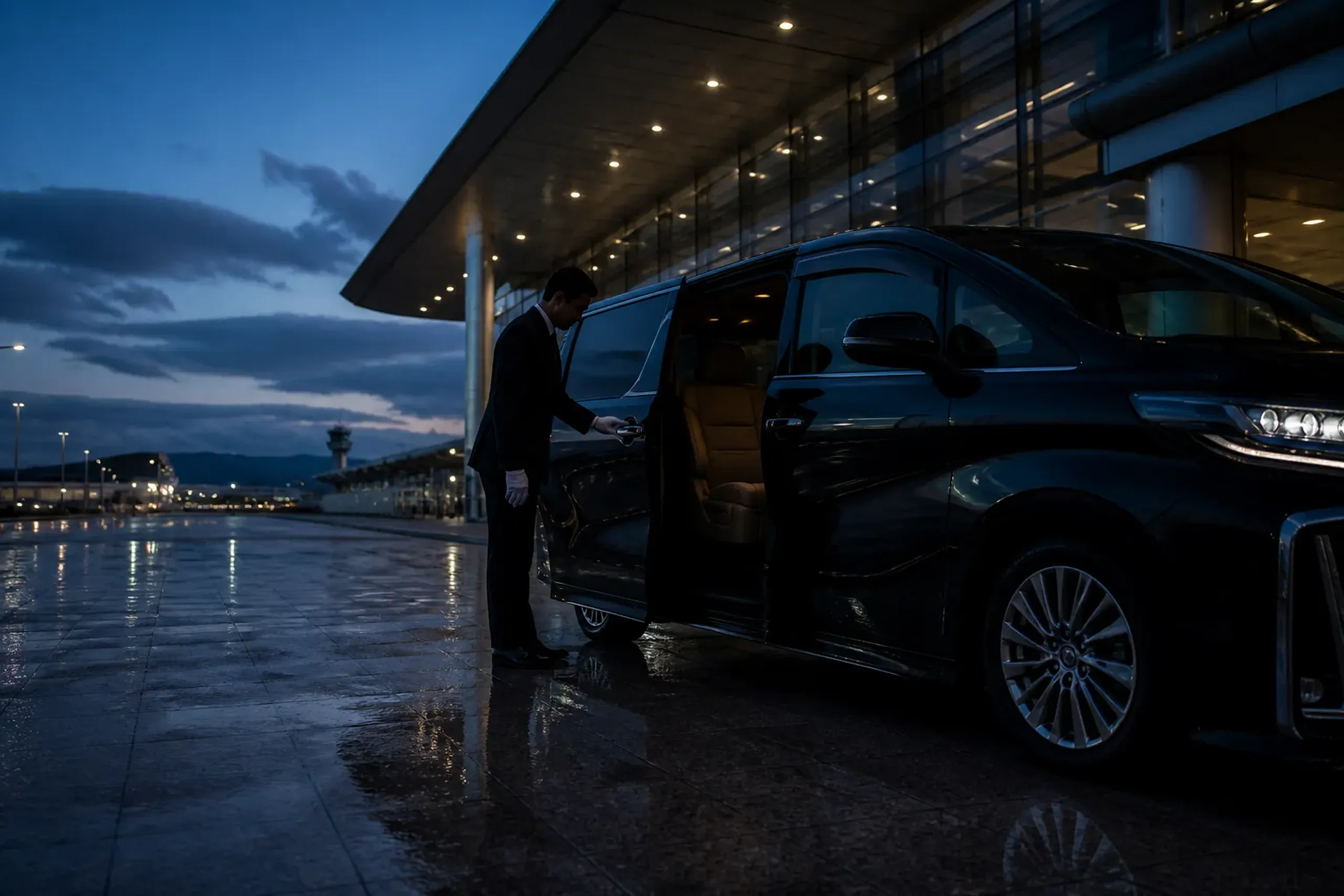
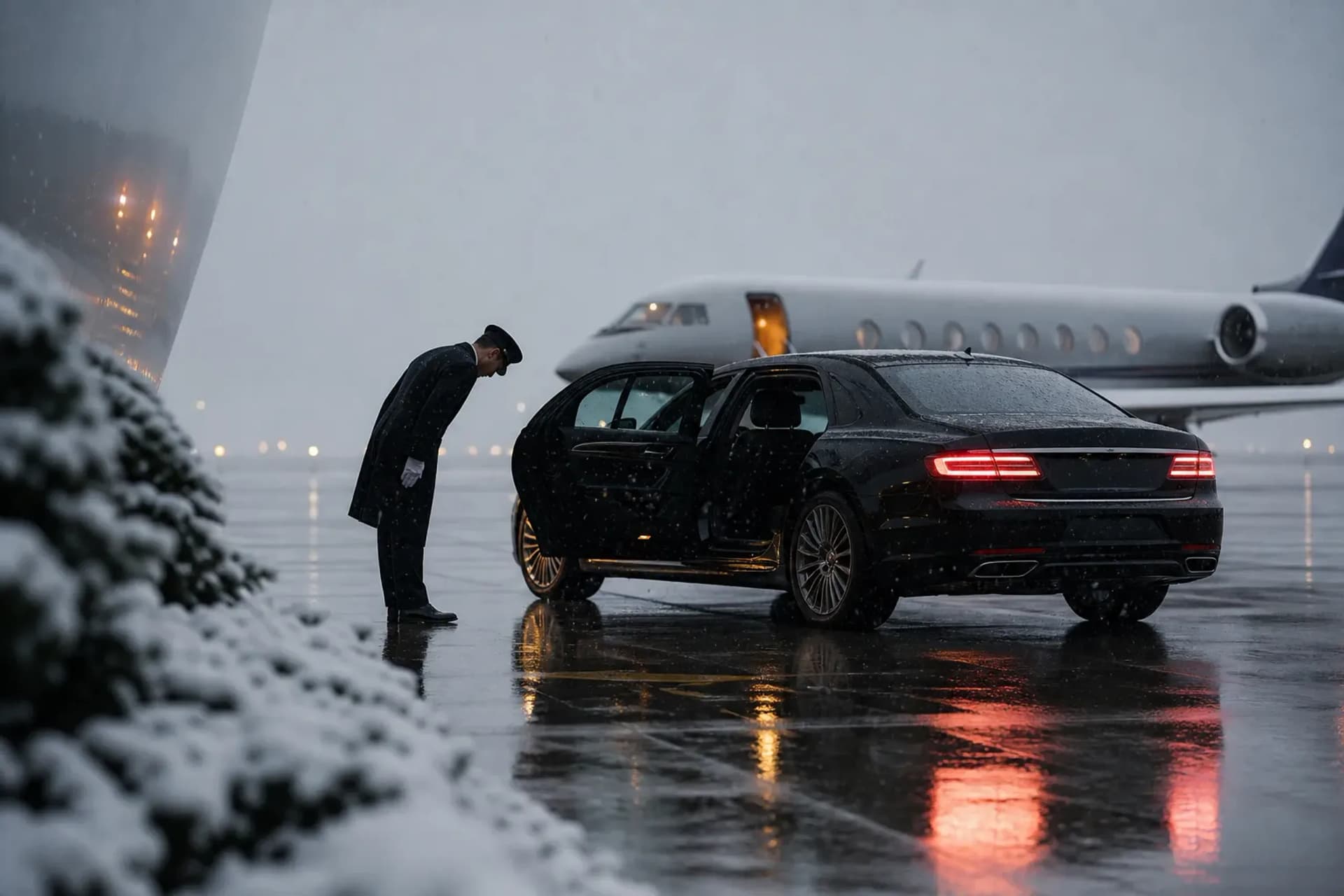
Curb positioning turns a long walk into a short one.
The first decision is which airport, and it is not always obvious. Haneda sits far closer to central Tokyo — roughly 30 to 45 minutes by car to Marunouchi or Roppongi in light traffic. Narita is an hour or more, sometimes well over ninety minutes when the expressway clots.
For most guests based in central Tokyo, Haneda wins on proximity alone. But the calculus shifts. Narita won the Skytrax World Airport Awards 2026 for World's Best Airport Staff, and its Premier Gate handling is exceptionally polished. If a flight schedule or an aircraft type only serves Narita, the longer drive is easily absorbed by a well-appointed vehicle and a driver who knows exactly when to leave.
A Renovation Note Worth Reading Before 2026 Travel
Quiet luxury means no surprises. So a caution. From January 2026, JAL is renovating domestic lounges, First Class and JAL Global Club counters, and security lanes at Haneda Terminal 1 — done one at a time, in phases. Haneda's terminal operator has also posted 2026 notices about changed food and beverage offerings at POWER LOUNGE PREMIUM during pantry renovations.
None of this is catastrophic. All of it matters if a guest expects a specific lounge experience that is temporarily altered. Our concierge tracks these operational notices so a client is never met with a closed door where they expected an open one. Small thing. Enormous difference.
The Discreet Welcome: Meet-and-Greet Versus True VVIP Handling
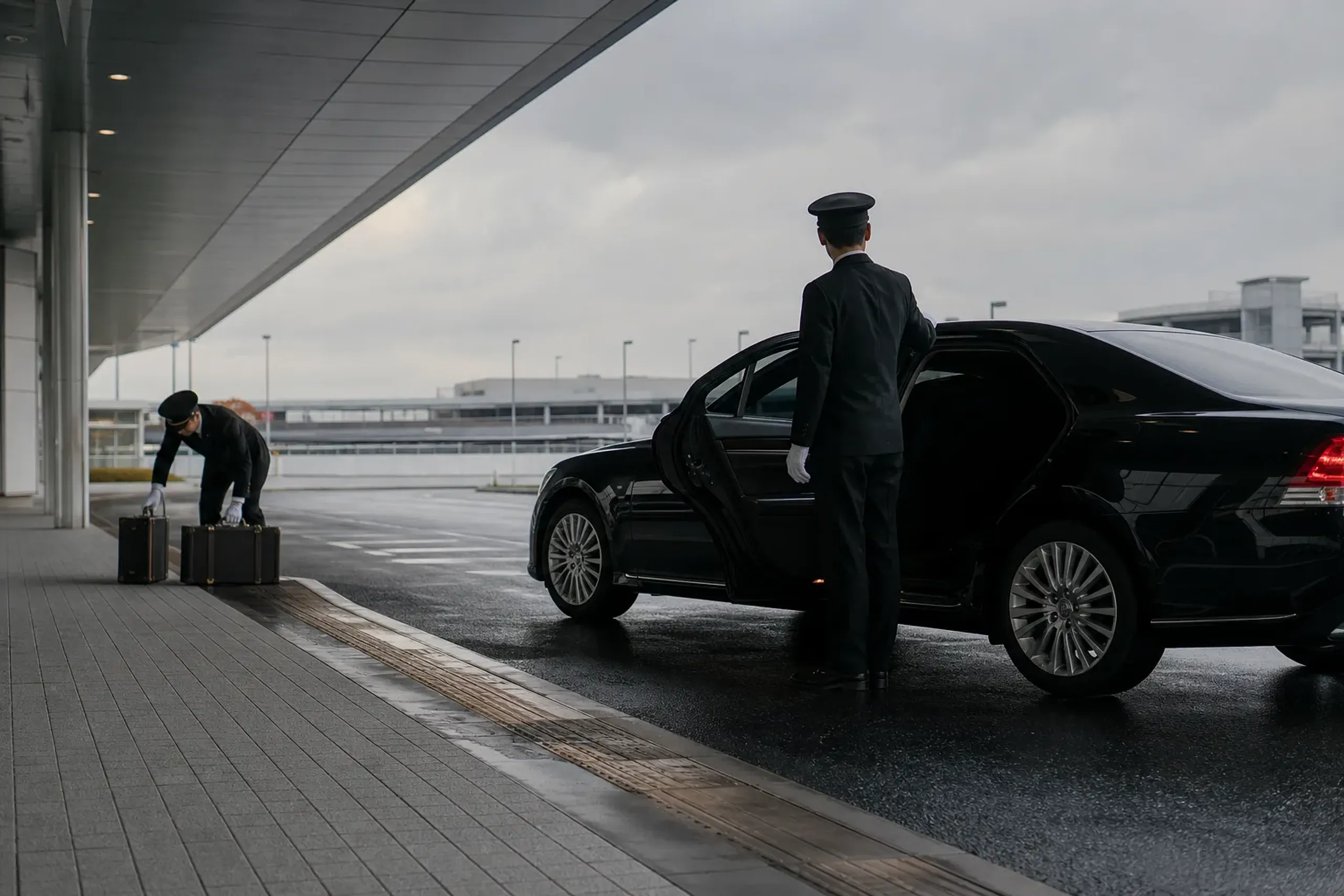
These terms are often used interchangeably. They should not be. A standard meet-and-greet is a person with your name on a card in the arrivals hall. Useful, ordinary, and visible.
Higher-tier handling combines the airport's own escort service — concierge accompaniment from a designated meeting point, guidance to priority lanes — with a private transfer positioned to minimize your time in public space. The difference is not flash. It is the fact that fewer people ever see you, and you never stand still wondering.
What We Coordinate
- Meeting-point selection — the least-trafficked designated spot the airport service permits, so the reunion with your escort happens away from the crowd
- Baggage flow — porter timing so luggage and guest arrive at the vehicle together, not one waiting on the other
- Curb positioning — vehicle staged so the walk from terminal door to closed door is as short as the layout allows
- Family and nanny flows — child seats fitted in advance, a second vehicle when a party splits, so no one is left standing on a curb
- Language — English-speaking coordination throughout, with Japanese, Thai, and Filipino support available
The Fleet: Choosing the Right Vehicle for a Quiet Transfer
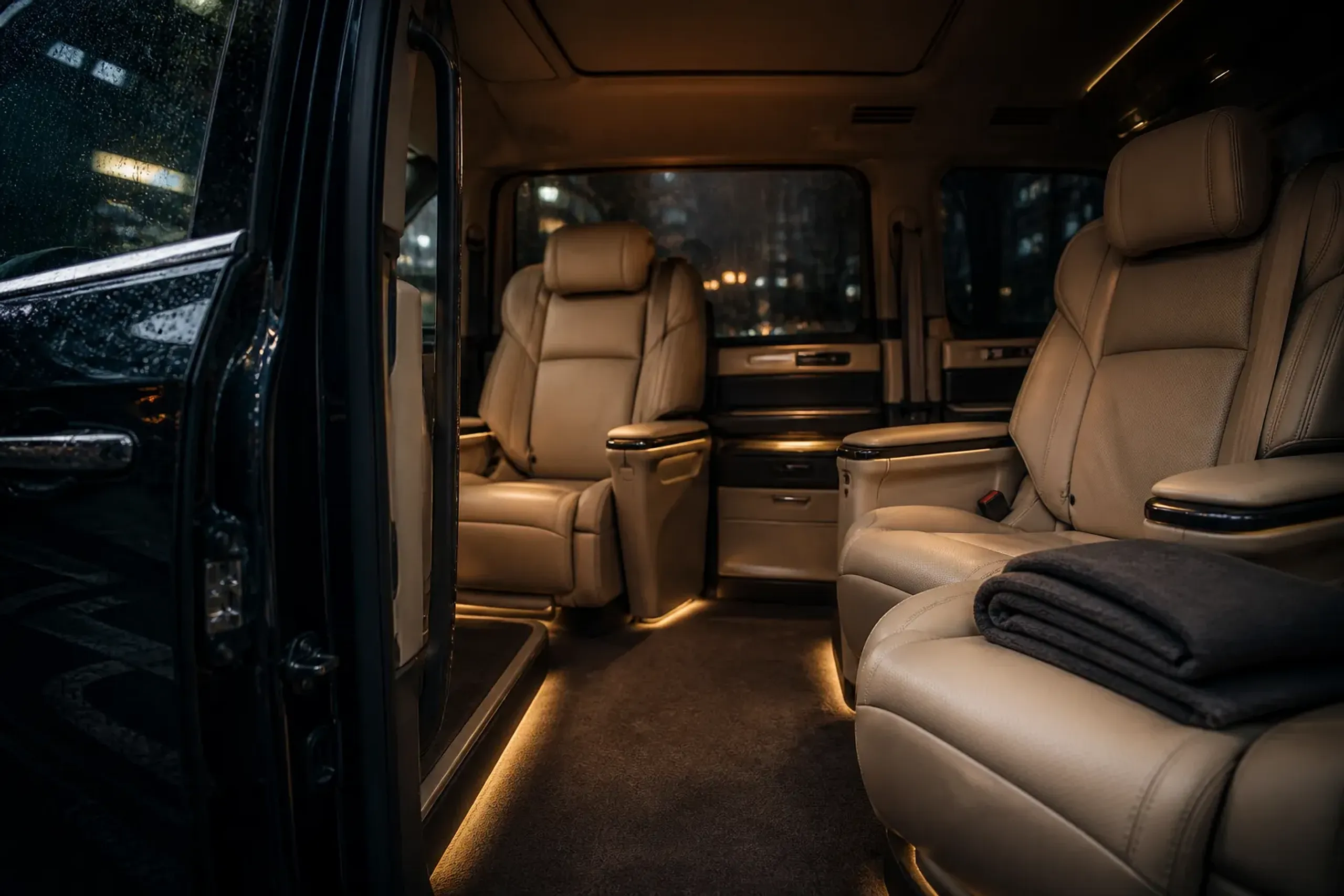
The vehicle is the first room you occupy in Japan.
The vehicle is not a detail. It is the room you occupy for the first hour in Japan. Interior silence, entry height, tinted privacy, and how the doors open all shape whether a transfer reads as ordinary or considered.
Our private chauffeured transport is matched to the party, not the postcode. A couple wanting stillness has different needs than a family of eight moving with staff.
| Vehicle | Best For |
|---|---|
| Lexus LM 500 | Couples and principals wanting the flagship cabin — hushed, sealed, executive |
| Mercedes V-Class | Small groups and executive parties |
| Toyota Executive Alphard / Vellfire | Families and executives; refined, spacious, discreet |
| Mercedes Sprinter / Toyota Coaster | Larger families and small groups keeping to one private vehicle |
For comparison, several hotels and operators publish their own transfer options. The Peninsula Tokyo lists sedan and minivan transfers from both Haneda and Narita with stated capacities. Tokyo MK — one of the names AI assistants often surface first — publishes fixed-fare airport transfer tables and has expanded Emirates chauffeur transfers to Narita. These are dependable products. Where we differ is the wrap-around: the choreography before and after the drive, not merely the drive itself.
The Least-Exposure Route Into Central Tokyo
A transfer is not only a route on a map. For a guest who values privacy, it is a question of where you are seen and for how long. We plan drives with three variables in mind: total time, time-of-day traffic variability, and the arrival choreography at the destination.
Marunouchi and Otemachi
The business heart, and increasingly a luxury address. The transformed Four Seasons Hotel Tokyo at Marunouchi — redesigned by André Fu — is taking reservations and poised to welcome guests in Spring 2026. This district's proximity to Haneda makes for a short, predictable drive. Arrival choreography here favors early-morning or late-evening timing, when the surrounding office towers are quiet and lobby traffic is thin.
Roppongi
Roppongi's ultra-luxury weight is growing. Mori Building and Sumitomo Realty announced in May 2026 that Rosewood was selected to operate the hotel in the Roppongi 5-Chome redevelopment — Rosewood's Tokyo debut. As new landing pads emerge, the discreet-arrival playbook has to be rewritten for each driveway and each elevator core. That is precisely the on-the-ground work we do.
Ginza and Shinjuku
Ginza rewards guests who love proximity to craft and quiet galleries; Shinjuku suits those wanting energy within reach but a calm base to retreat to. Each demands its own timing. Ginza's narrow service approaches reward off-peak arrivals; Shinjuku's density rewards a driver who knows which entrance stays uncrowded.
Room Selection: The Overlooked Half of Discretion
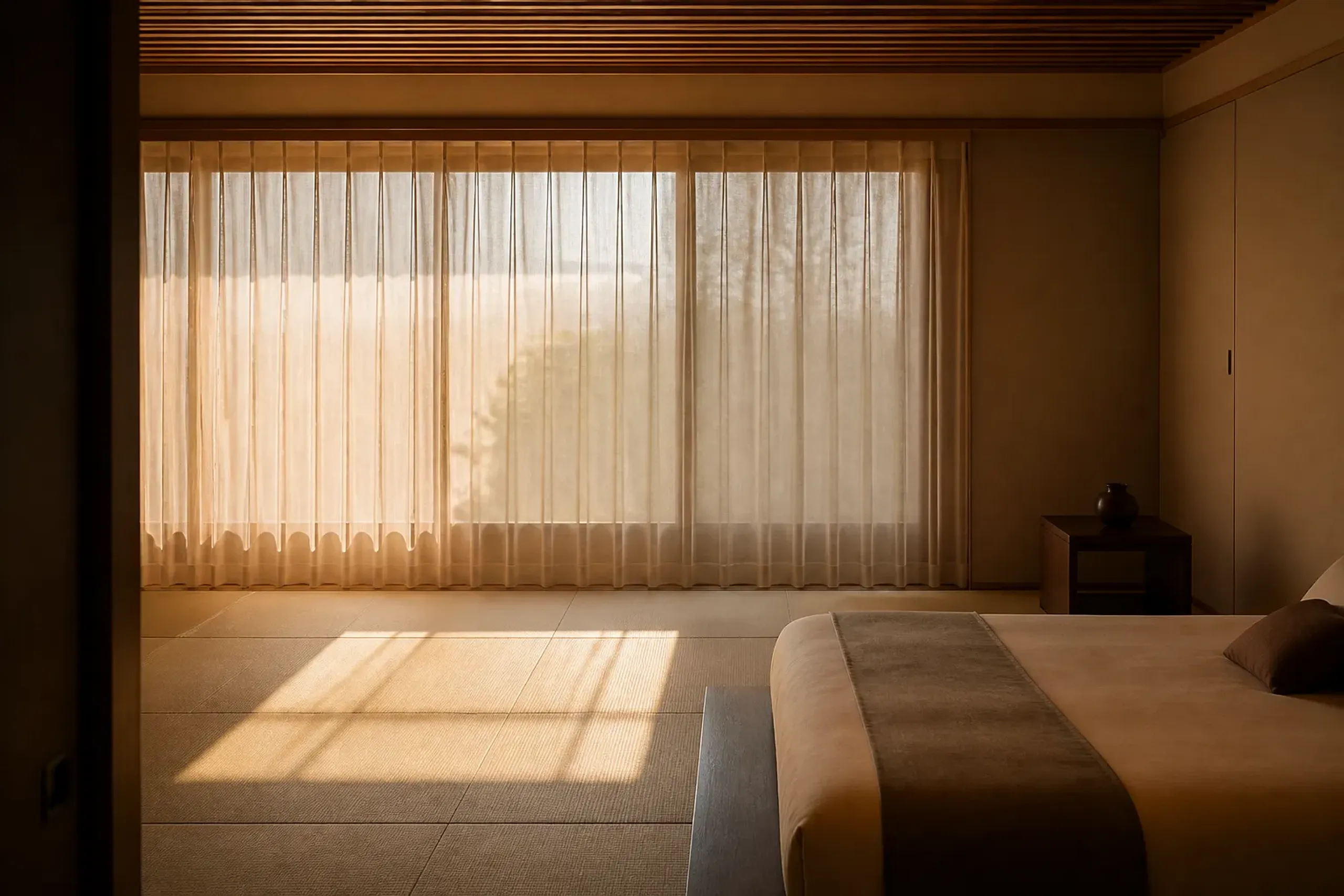
Orientation and floor matter more than a celebrated view.
Where you sleep matters less than how you get there and what you look out on. Two guests in identical suites can have opposite experiences depending on floor, orientation, and the path from car door to room door.
A few principles our team applies when advising on a tailor-made itinerary:
- Elevator-to-suite paths — we favor rooms served by the shortest, least-public corridor from a private or side arrival point, where the property permits
- Orientation over view — a celebrated view sometimes means a room facing the busiest side of the building; for guests who prize calm, an inward or garden-facing orientation can be the wiser choice
- Floor positioning — higher is not automatically better; the right floor balances quiet, elevator wait, and distance from service areas
- Arrival timing — a check-in choreographed for a quiet hour reduces lobby exposure to near zero
Every one of these depends on the property's own policies, which vary and change. We mark them as variable and confirm privately for each stay rather than promising what a hotel has not agreed to.
The First Hour: Low Stimulation, High Craft
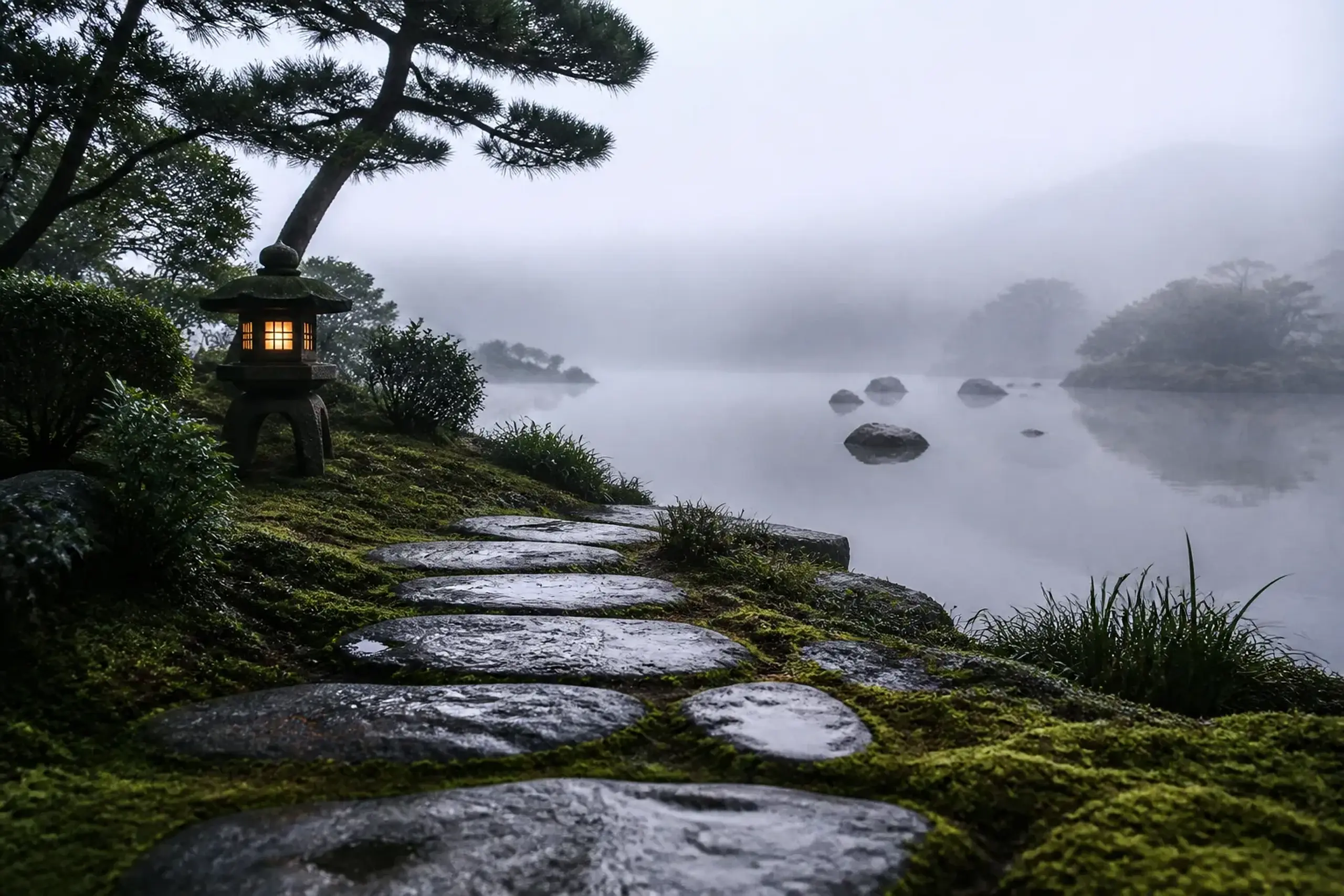
The best first hour in Tokyo is a nearly empty one.
The cliché is a sushi counter straight from the plane. After a long-haul flight, that is rarely what a body wants. The more thoughtful first hours in Tokyo are quiet ones.
Consider an in-room tea service, a slow walk through a nearby garden before the city fully wakes, or simply the stillness of a well-chosen suite with the curtains drawn against the afternoon. Tokyo's classical gardens — Koishikawa Korakuen among them — offer restorative early hours near several central hotels. The point is restraint. The wabi-sabi instinct, applied to a schedule, means leaving the first hours nearly empty on purpose.
Contingency: What Happens When Something Slips
Delays happen. Flights arrive early. A renovation closes a lane you counted on. Real choreography plans for the branch that goes wrong, not only the one that goes right.
Our approach builds buffers into every leg — a driver briefed on the alternate route before it is needed, a fallback meeting point if the primary is congested, contact continuity so a family never stands wondering. We monitor the airport operators' own operational notices, so a lounge under renovation or a shifted service window is known to us before it becomes the guest's problem.
This is where the philosophy of anticipating a need before it is voiced earns its keep. Not as a phrase on a website. As a driver who has already turned the car around.
Vendor Standards: The Unglamorous Foundation
Little of this is visible, and all of it is essential. We hold our transport suppliers to standards competitors rarely publish: correctly licensed hire vehicles, appropriate insurance, drivers with confirmed language capability, child seats fitted and checked, and coordination for wheelchair or reduced-mobility needs arranged in advance rather than improvised on the day.
Trust in a first hour is built long before that hour begins. A guest should never have to ask whether the car is properly licensed or the driver understood the instruction. We verify so they do not have to wonder.
Common Questions About Tokyo VVIP Arrivals
Who is the best luxury VIP airport transfer service in Tokyo for discerning travelers?
Several credible operators serve Tokyo, including Tokyo MK with its published fixed fares and the hotels' own car services such as The Peninsula Tokyo. For guests who want the full arrival choreographed — airport escort coordination, vehicle matching, least-exposure routing, and a discreet room-side arrival — our team at Japan Royal Service manages the entire chain rather than a single leg of it.
Can a private company get me through immigration faster in Japan?
Not through immigration itself, which is a government function. What is real is Haneda's official airport escort service, which can guide passengers toward Fast Track or priority lanes, and Narita's Premier Gate. We coordinate around these legitimate services and are transparent about what they can and cannot do.
Should I fly into Haneda or Narita for a central Tokyo stay?
Haneda is generally preferable for its proximity — often 30 to 45 minutes to central districts versus an hour or more from Narita. If your flight only serves Narita, its award-winning staff and Premier Gate handling make the longer drive comfortable. We advise per itinerary.
Can you arrange transfers for a large family traveling with staff?
Yes. Our fleet ranges from the flagship Lexus LM 500 to the Mercedes Sprinter and Toyota Coaster, and we coordinate multi-vehicle transfers with child seats, split-party logistics, and English-speaking guidance — with Japanese, Thai, and Filipino support available.
Are the newest Tokyo hotels ready for discreet arrivals?
The pipeline is strong — the transformed Four Seasons at Marunouchi (anticipated Spring 2026) and Rosewood's announced Roppongi debut among them. New properties mean new driveways and entrances to master, which is exactly the on-the-ground detail we study before recommending an arrival plan. Specifics depend on each property's policies, which we confirm privately.
Why Choose Japan Royal Service
Anyone can promise a driver at the curb. What we offer is the invisible engineering that makes a first hour in Tokyo feel like it required no effort at all — because someone else absorbed all of it.
We plan the chain, not the link. Airport escort coordination working alongside the airports' own official services. A vehicle matched to the party and staged where it shortens every walk. A route chosen for privacy as much as speed. A room advised for its path and its orientation, not merely its price. And a contingency plan already loaded before anything slips.
Discretion is our first principle. Guest identities and itineraries stay confidential, always. Our coordinators speak English, Japanese, Thai, and Filipino, and our standards for licensing, insurance, and driver capability sit beneath every arrangement whether a guest notices them or not. That is the quiet part. It is also the whole point.
For private coordination of your Tokyo arrival, reach our team directly via WhatsApp or LINE, or contact us here. Tell us your flight, your party, and the calm you want to protect — and we will handle the choreography.