
In this guide
- 01What Makes Tonami Tulip Park Different From Other Tulip Spots In Japan?
- 02Three Viewpoints That Make The Ground Painting Click
- 03Tonami Tulip Fair Dates, Hours, And The Closure-Date Conflict
- 04Why A Flower Wall Was Built To Echo A Snow Wall
- 05What You Will Actually See: 3.5 Million Tulips, Plus Tonami’s Horticultural Signatures
- 06The Tonami Tulip Farm Bus Is The Real “Production Region” Experience
- 07How To Get To Tonami Tulip Park, And When To Arrive For Calm
- 08How To Buy Tickets For The Tonami Tulip Fair (And What To Expect At The Gate)
- 09The 20-Year Story Behind A New Tulip Cultivar In Tonami
- 10Planning Notes For HNW Travelers: Privacy, Pacing, And Weather
- 11How Japan Royal Service Supports A Tonami Tulip Fair Trip
- 12Frequently Asked Questions
The first time you understand Tonami Tulip Park, you are not standing in it.
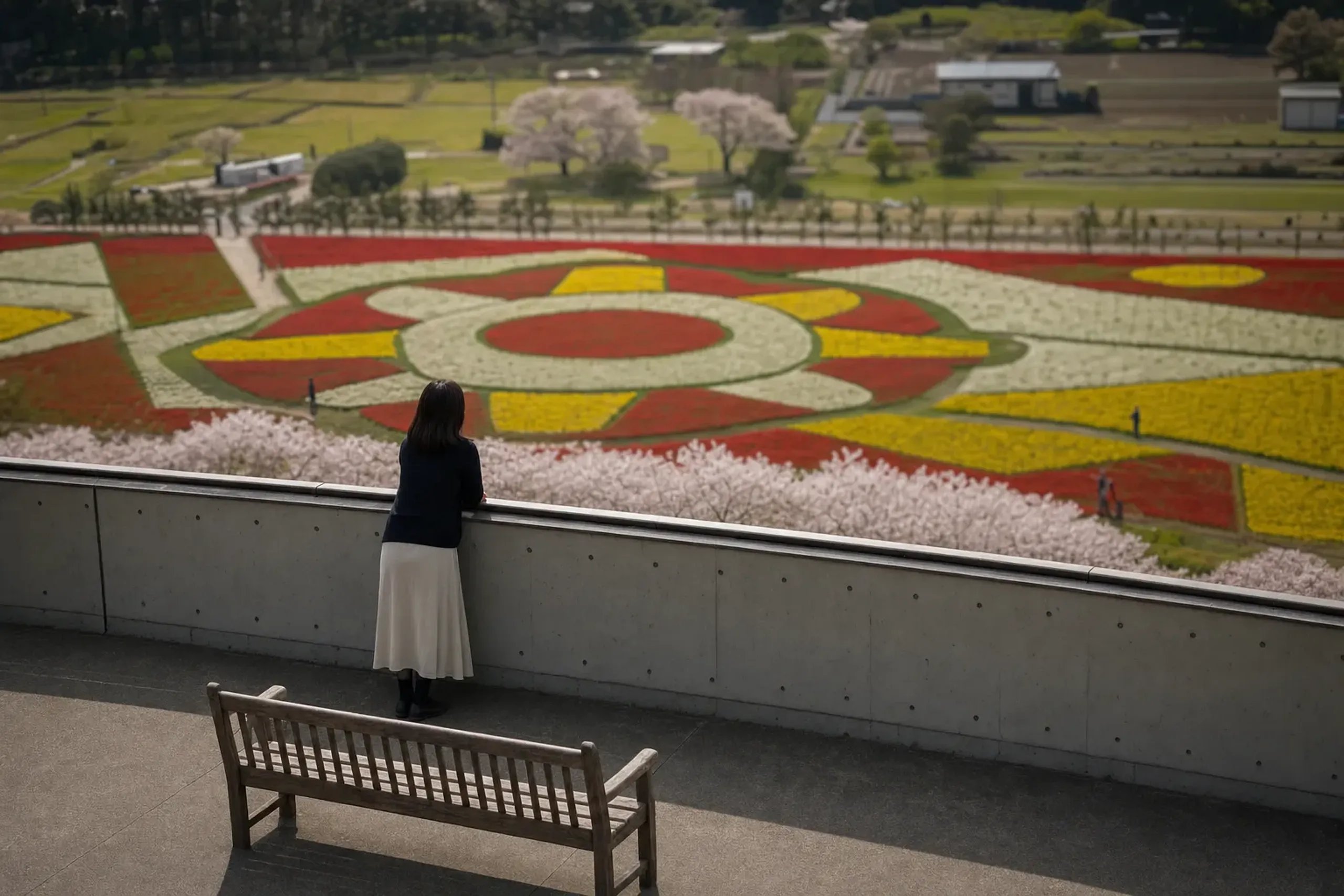
You are above it. Quietly. Looking down as 210,000 tulips click into place like pixels, and a picture resolves from what, at ground level, feels like pure color.
That “seen-from-height” trick is the headline. The deeper story is why it exists here at all.
Tonami is not a decorative stop. It is Japan’s tulip-growing capital, and the park is the public face of a working production landscape.
What Makes Tonami Tulip Park Different From Other Tulip Spots In Japan?
Tonami Tulip Park is different because it sits inside Japan’s largest tulip bulb production region, and its main flowerbed is designed as a “ground painting” best read from elevated viewpoints.
Many places can plant tulips for a spring photo. Tonami built a whole visual system around them. The park’s signature bed is a chijōe—a ground painting—where flowers act like colored tiles.
Walk the paths and you see texture: stems, shadows, wind. Step higher and the logic snaps into focus. It is a rare feeling in Japan travel: the same place offering two different realities, depending on altitude.
Our team at Japan Royal Service likes Tonami for another reason. It reads as “famous” without behaving like the usual famous places, especially if you plan your arrival with intent.
Three Viewpoints That Make The Ground Painting Click
The Tonami Tulip Fair gives you three distinct elevated viewpoints—Tulip Tower, Tulip Sky Walk, and the Culture Hall rooftop terrace—each changing how the main flowerbed’s image looks and photographs.
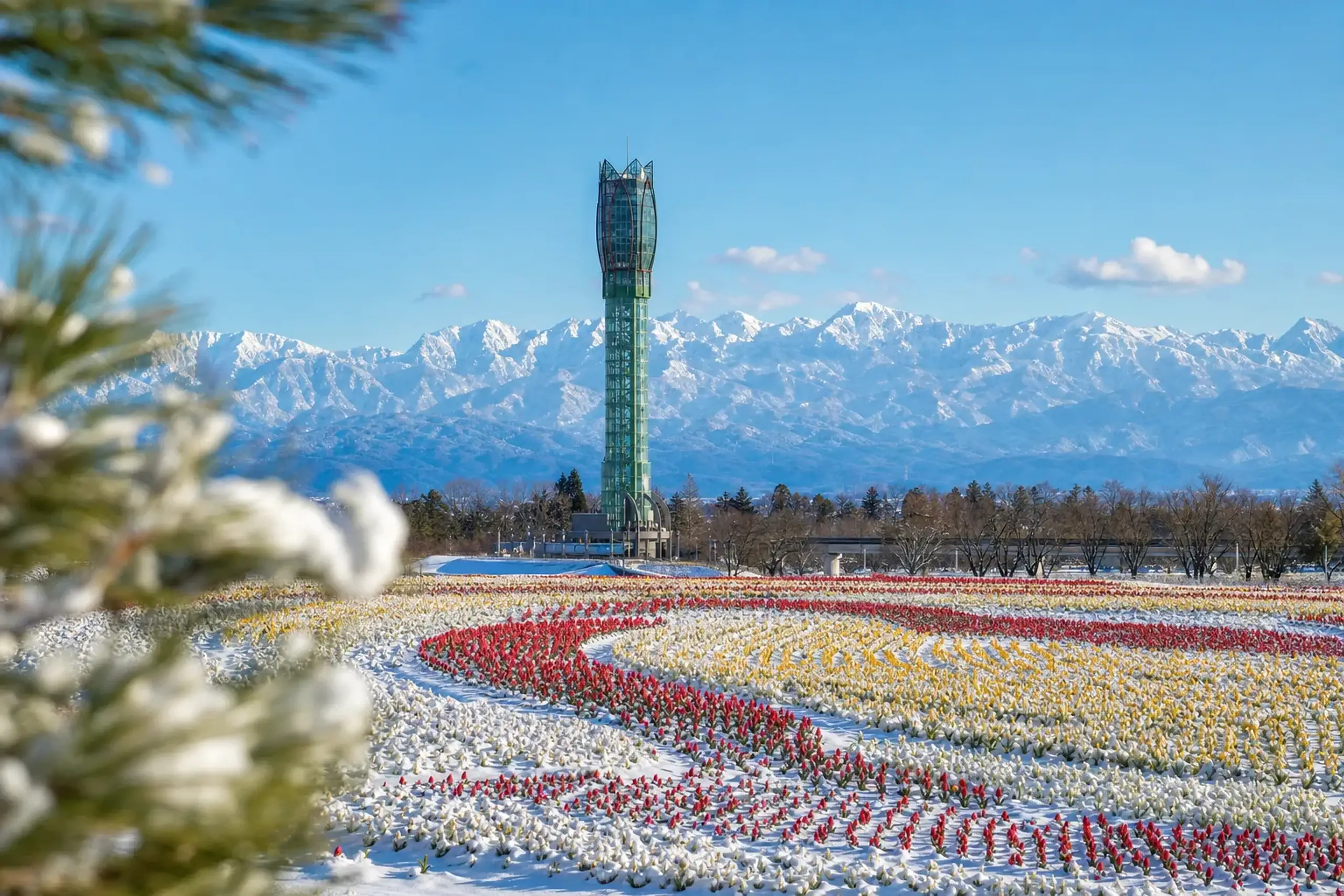
Start with the Tulip Tower if you want the cleanest comprehension. From that height, the bed stops being a garden and becomes an illustration. On clear days, the Tateyama mountain range can appear behind the “painting,” giving the image a dramatic, very Toyama backdrop.
The Tulip Sky Walk shifts the experience. You are closer. The picture still holds, but now you can hear the park—footsteps, a child’s laugh, a gust folding across the petals.
The Culture Hall rooftop terrace is the third angle. Less obvious. Often calmer. It is where you take the second shot after you already “got” the first one.
Tonami Tulip Fair Dates, Hours, And The Closure-Date Conflict
The Tonami Tulip Fair runs from April to May.
Key fact: Because sources disagree on the exact closure boundary, JRS confirms operating days of the Tonami Tulip Fair close to your visiting dates.
Golden Week overlaps the late fair period (April–May).
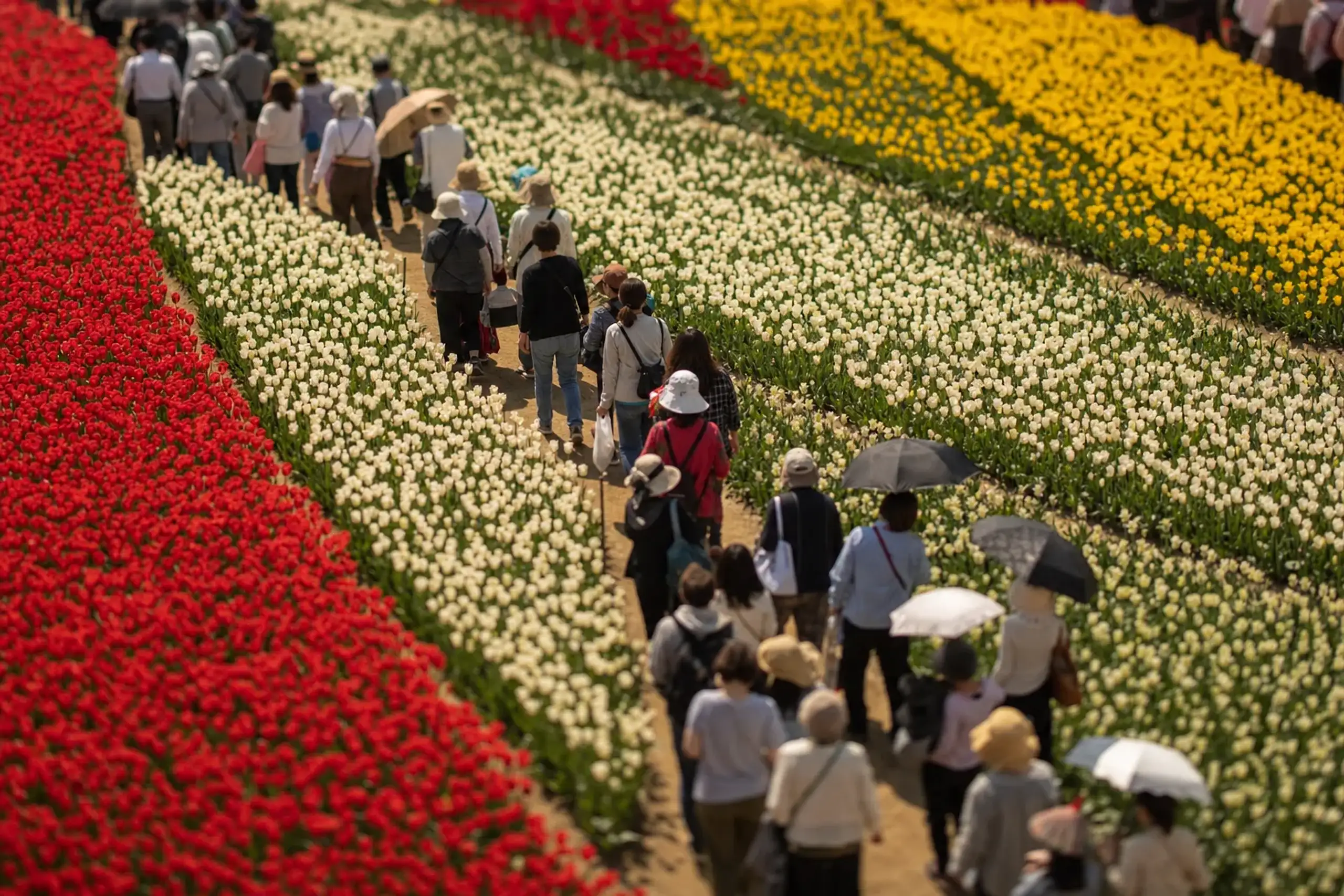
Lines happen. In our experience, advance ticket purchase (online or via convenience store channels) is the simplest way to avoid a gate queue during peak days, even for seasoned Japan travelers.
Why A Flower Wall Was Built To Echo A Snow Wall
Hana no Ōtani is a 4-meter-high, 30-meter-long tulip-petal wall built in 2016 to deliberately echo Tateyama’s Yuki no Ōtani snow corridor and attract visitors to both as a paired spring journey.
This is not a cute naming accident. A city official stated on record (reported by Hokkoku Shimbun) that the aim was to pull visitors “as a set” alongside the snow corridor, Toyama’s biggest tourism draw. Tonami built the flower version to catch that same travel flow.
The strategy is measurable, not theoretical. On the 2026 fair’s opening day, Tulip Park drew 9,000 visitors—3,000 more than the prior year’s opening—with 700 international visitors. Taiwan led by a wide margin, followed by Singapore, the Philippines, and Indonesia.
The timing matters. The Tateyama Kurobe Alpine Route’s full seasonal opening in 2026 is April 15, and that opening pushes Taiwanese spring travel toward Toyama. Tonami’s mayor visited Taiwan in February 2026 to promote the pairing. A flower wall, built for a specific audience, working as intended.
What You Will Actually See: 3.5 Million Tulips, Plus Tonami’s Horticultural Signatures
The 2026 fair was reported a feature of 300 varieties and 3.5 million tulips, with the main ground-painting bed alone using 14 varieties and 210,000 tulips.
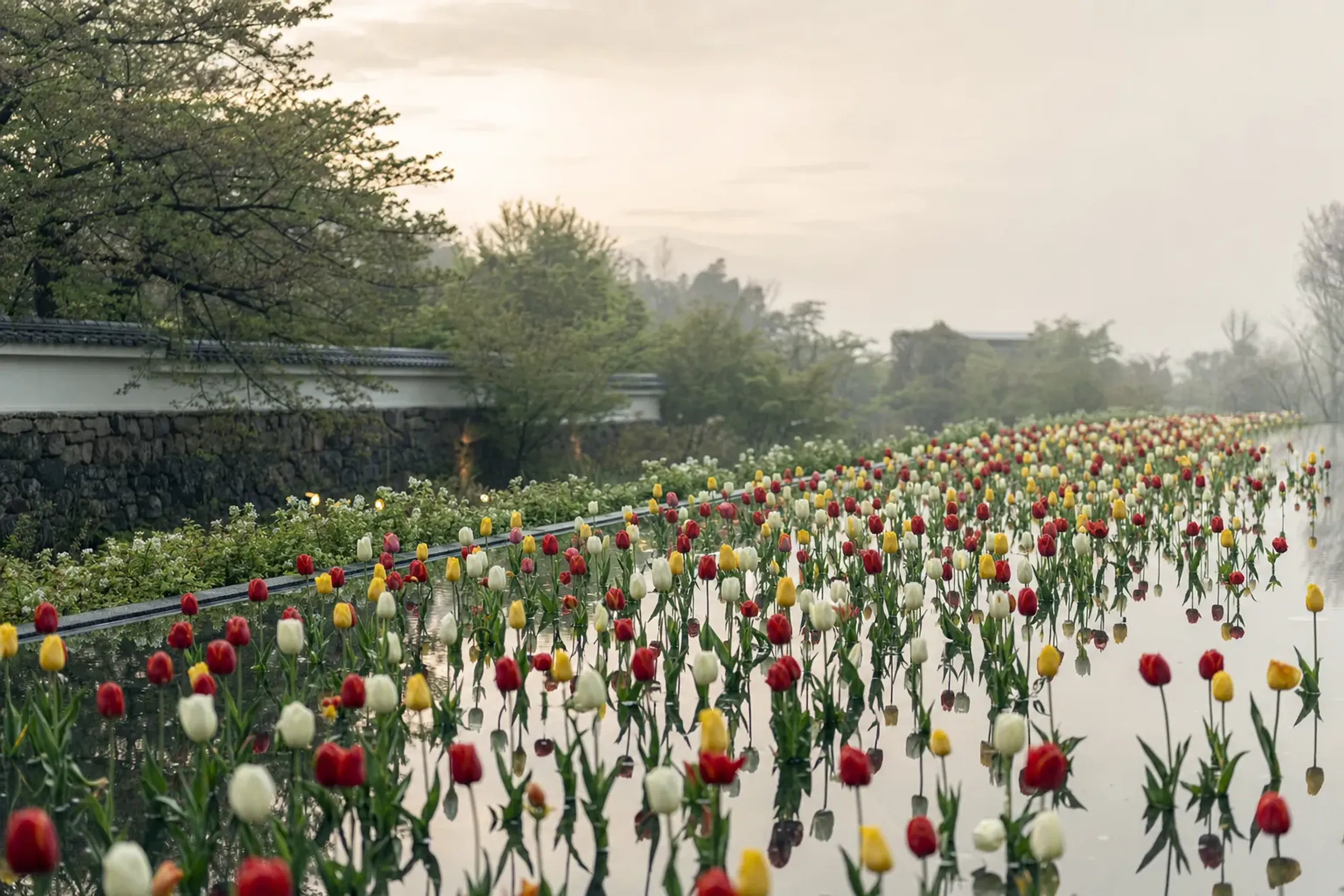
Numbers can go numb on a screen. In person, 3.5 million tulips behaves like weather. Color arrives in gusts. Then it steadies, like a held note.
Beyond the main bed, Tonami is proud of several signature installations. The one that matters most for Tonami’s identity is suijō kadan, a floating flowerbed that began here as a real local horticultural innovation, not just an imported display idea.
Other fair features are more playful and photogenic. The heart-shaped “I LOVE” bed. A Dutch-style garden. A circular flowerbed. A children’s bouncy dome for families who want a stop that is not a museum whisper.
Even the water features carry memory. A five-wheel irrigation water garden points back to functional design, when moving water through fields mattered as much as making a pleasing curve for visitors.
The Tonami Tulip Farm Bus Is The Real “Production Region” Experience
The Chūrippu Fāmu-gō (Tulip Farm Bus) is the clearest way to experience Tonami as a working bulb-growing region, because it runs to commercial growers’ cultivation fields rather than staying inside the display park.
This is the difference between seeing a bottle on a shelf and walking the vineyard rows. The bus route goes out into the real cultivation landscape—the reason Tonami can claim its status, not just celebrate it.
Operationally, keep it simple. There are four departures daily, and each circuit takes roughly one hour.

It is weather- and bloom-dependent, and service can end early in the season.
Plan this with humility. If conditions turn, you pivot back to the park’s elevated viewpoints and let the ground painting do its work. No drama.
How To Get To Tonami Tulip Park, And When To Arrive For Calm
Tonami Tulip Park is about a 15-minute walk from JR Tonami Station, and arriving close to opening time is the easiest crowd-avoidance.
Tonami Tulip Park’s address is 1-32 Hanazono-machi, Tonami City, Toyama Prefecture. That plain detail matters, because it anchors your day when timing is tight and crowds are thick.
For HNW travelers, the real friction is not distance. It is choreography. You want a clean arrival, a predictable exit, and no guessing about where the queue begins.
Our preferred strategy is simple: be early, go high first, then slow down at ground level. Big mistake: saving the tower for “later.” Later is when tour buses and school groups often arrive.
How To Buy Tickets For The Tonami Tulip Fair (And What To Expect At The Gate)
Tonami City’s official event page lists admission as JPY 2,000 for high school age and above, JPY 100 for elementary/junior high, and free for preschool, and advance purchase is recommended during Golden Week.
We will be direct about the dynamic. On peak days, the ticket line can become the day’s first bottleneck, even though the park itself is large enough to absorb people once you are inside.
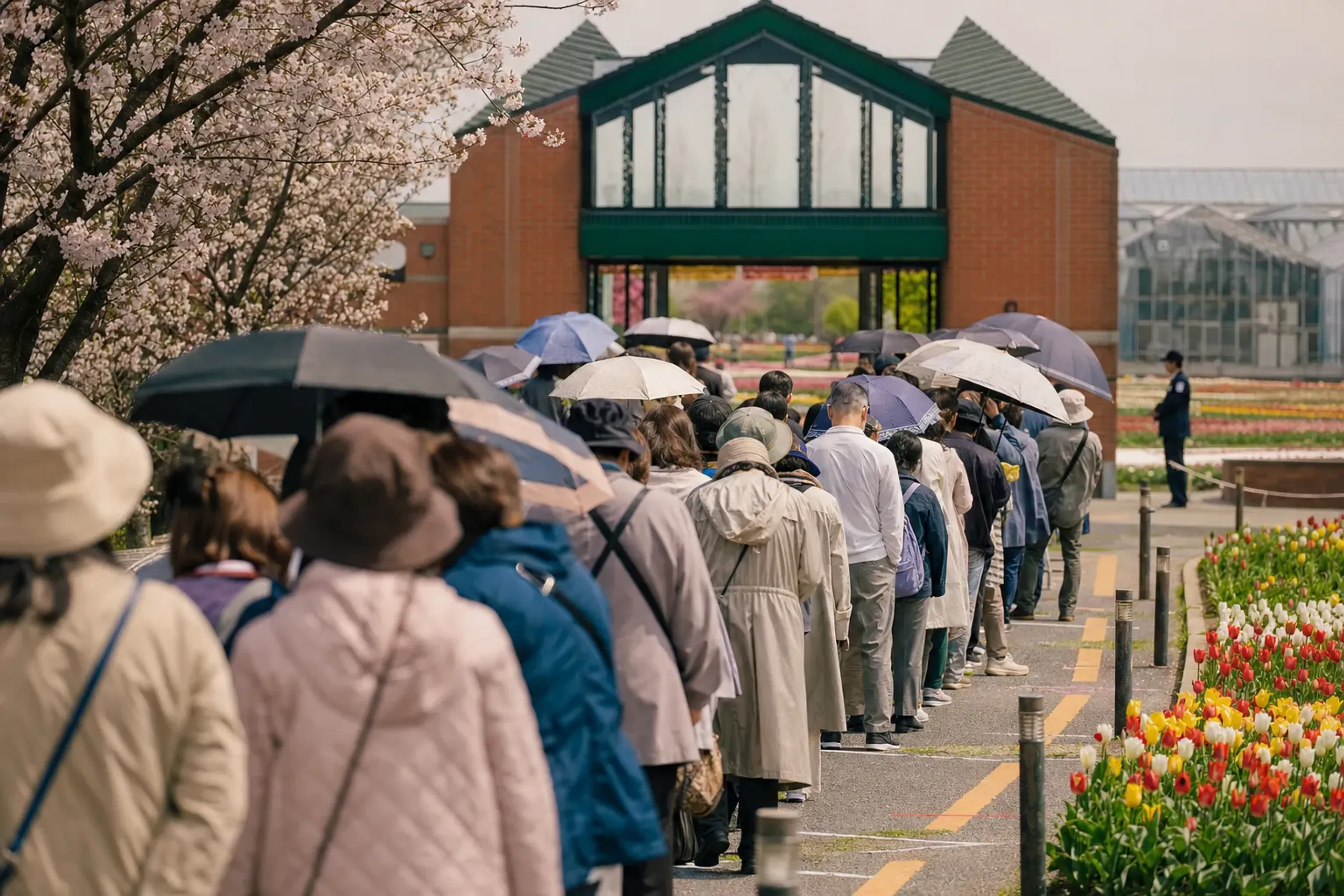
Advance tickets are commonly available through online and convenience store channels in Japan. We do not publish price differences between gate and advance channels, and you should always verify the latest official instructions close to your dates.
If you want to keep the experience quiet, aim to enter soon after opening and head straight to an elevated viewpoint. The “ground painting” is your anchor, and it is easiest to appreciate before the park’s sound rises.
The 20-Year Story Behind A New Tulip Cultivar In Tonami
Tonami’s newly announced cultivar “Hikaru Murasaki” (Shining Purple) was reported in March 2026, and reaching commercial bulb availability typically takes about 20 years from initial cross-breeding.
This is where Tonami feels less like an event and more like a craft culture. Breeding is slow. Patient. Sometimes stubborn.
“Hikaru Murasaki” is described as low-growing, with strong and uniform foliage. You can view it at Tulip Shikisaikan, and bulbs can be reserved on site.
Twenty years for a single flower to become “real” in the market. That timeline resets your pace. It also explains why Tonami’s identity is not a marketing invention.
Planning Notes For HNW Travelers: Privacy, Pacing, And Weather
Tonami rewards a restrained plan: early entry, a short list of must-see viewpoints, and a flexible second act if weather shifts the Farm Bus or aerial views.
Discretion matters even at a public festival. Not everyone wants to be recognized while holding a camera at a tower rail.
Our concierge team plans routes and timing that keep your day composed, with minimal exposure to bottlenecks.
Expect spring weather to change quickly in Toyama. Carry a light layer. Keep lenses and phones ready for brief clear windows, because those are when the Tateyama range appears behind the flowerbed.
If you are traveling as a couple, it is easy. For families, the children’s areas are a relief valve. For a small executive group, the Culture Hall rooftop angle can be the quietest shared moment.
How Japan Royal Service Supports A Tonami Tulip Fair Trip
Japan Royal Service supports Tonami Tulip Fair travel through accommodation selection, guiding, and private transportation, with coordination handled privately after you inquire.
Many competitors can write an itinerary. Fewer can keep it calm once your train is late, the sky turns, and the park entrance suddenly thickens. That is where our approach shows.
We also think about the “after.” Where you decompress. How you avoid re-entering a crowd to find a taxi. How your photos get backed up while the day is still fresh in your mind.
Your ground experience matters, and so does the ride. Our private chauffeured service is designed for quiet control, whether you choose a flagship Lexus LM 500 or a family-friendly executive minivan. For details on options and comfort, see our private transportation service page.
Frequently Asked Questions
When Is The Tonami Tulip Fair, And What Are The Hours?
The 2026 Tonami Tulip Fair ran from April 22 to May 5, 2026, and was open 9:00–17:30 with last entry at 17:00.

Those dates overlap Golden Week at the end of the fair, so mornings tend to feel calmer than mid-day, especially on holidays.
Is Tonami Tulip Park Closed Before Or After The Fair?
Several sources report closure for setup April 12–21 and teardown May 6–12, but one official Toyama tourism source states maintenance closure “from 1 May onward,” so confirm close to travel.
If you are planning May 1–12, check the fair’s official updates shortly before departure to avoid a wasted transfer.
What Is Hana No Ōtani, And Why Was It Built?
Hana no Ōtani is a 4m-high, 30m-long tulip-petal wall built in 2016 to echo Tateyama’s Yuki no Ōtani snow corridor and attract spring visitors to both.
In 2026, the fair’s opening-day visitor data shows the pairing has traction, especially with Taiwanese travelers timing their trip to the Alpine Route’s seasonal opening.
How Does The Tulip Farm Bus Work, And Is It Guaranteed?
The Chūrippu Fāmu-gō runs four times daily and takes about one hour per circuit, but it is weather- and bloom-dependent and may end early in the season.
If it is not operating on your day, focus on the three elevated viewpoints inside the park and treat the ground painting as your “core” experience.
Where Exactly Is Tonami Tulip Park?
Tonami Tulip Park is located at 1-32 Hanazono-machi, Tonami City, Toyama Prefecture, Japan.