In this guide
- 01A Flame Lit In 860 Has Never Gone Out
- 02Who Founded Yamadera, And Why Does Ennin Matter Here?
- 03The Oldest Building On The Mountain: Nōkyōdō And The Founder Beneath It
- 04What Is The Continuous Sutra-Copying Practice At Yamadera?
- 05Bashō’s Yamadera: The Haiku That Almost Didn’t Happen
- 06Which Cicada Did Bashō Hear At Yamadera?
- 07The Sezuka Cicada Mound, The Bashō Museum, And July’s Haiku Festival
- 08How Hard Is The Yamadera Climb: 1,015 Stone Steps?
- 09Gōdaidō: The Cliff Hall That Rewards The Last Steps
- 10How Do You Get To Yamadera From Tokyo, Step By Step?
- 11A Practical Plan For Yamadera That Avoids Crowds
- 12Chūshō-in’s Obinzuru-sama: A Folk Tradition, Not A Medical Claim
- 13When Is The Best Season To Visit Yamadera In Yamagata?
- 14How To Visit Yamadera With A Guide: What To Look For
- 15Frequently Asked Questions
- 16Let Us Light The Way
The main hall is quiet in a way that feels deliberate. Not empty. Guarded.
In that stillness, a small flame is said to be alive—steady, fed, watched over. No theatre. Just fire.
Yamadera’s most repeated story in English is a single line of poetry. Our team at Japan Royal Service prefers to begin elsewhere: with a lamp, and the discipline required to keep it burning for more than a millennium.
A Flame Lit In 860 Has Never Gone Out
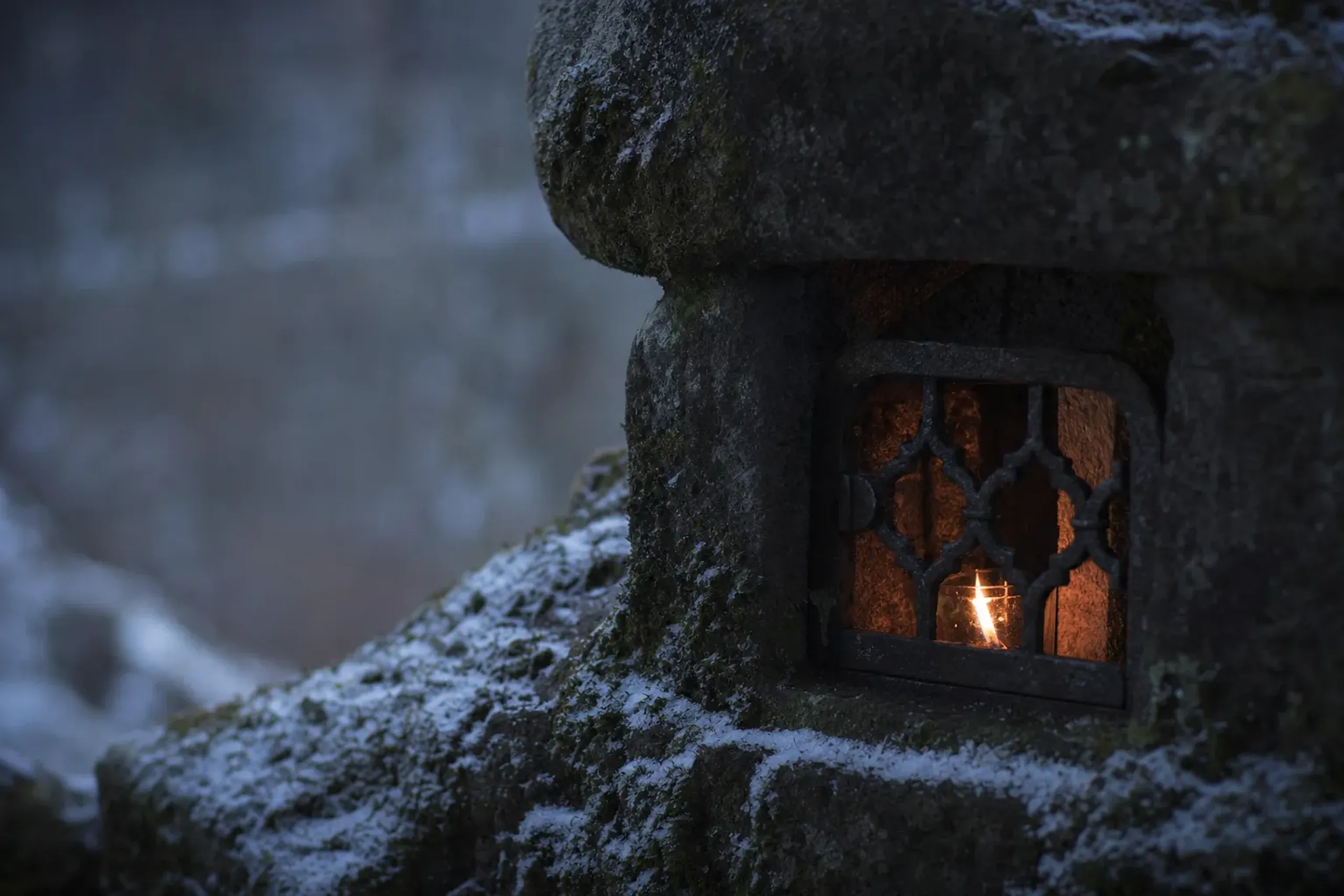
According to Yamadera (Hōshūzan Risshaku-ji), a portion of the Tendai “eternal dharma lamp” has burned continuously in the main hall since the temple’s founding in 860.
The claim is the temple’s own, repeated over centuries and preserved as an institutional vow. If you stand close enough, you understand the point is not proof. It is continuity. The restraint of the gesture—one small flame, tended without spectacle—carries a wabi austerity that no amount of gold leaf could match.
This flame traces back to Dengyō Daishi (Saichō), founder of the Tendai sect, who lit the original lamp at the head temple on Mount Hiei. Yamadera received a divided flame at its founding, and the temple states it has never once been allowed to go dark.
There is a second thread of endurance here, less discussed, and more intimate. The temple also states that incense has been kept burning continuously as an offering to the spirit of its founder, Jikaku Daishi Ennin, since his death in 864.
That is not a tourist detail. It is a way of living with the dead.
Who Founded Yamadera, And Why Does Ennin Matter Here?
Yamadera was founded in 860 by Jikaku Daishi Ennin, the third head priest of the Tendai sect, and his presence is still treated as physically “in” the mountain rather than simply remembered.
Ennin’s founding story is unusually concrete. He purchased the surrounding land from the local lord using 1,000 ryō of gold dust and 3,000 bolts of hemp cloth, covering a ten-ri radius, and built more than 300 halls and pagodas to spread Buddhist teaching in the region.
Then he died only four years after the founding, in 864. The mountain did not release him.
Ennin is interred in a meditation cave directly beneath the Sutra Hall (Nōkyōdō). The founder lies under the oldest building on the mountain, as if the temple’s oldest memory is also its deepest root.
The Oldest Building On The Mountain: Nōkyōdō And The Founder Beneath It
There is a point on the ascent where the path tightens and the air changes. Colder. Resin-heavy.
Nōkyōdō sits on a rock outcropping, small and red, made to hold what was copied by hand. It is used for storing copied sutras, and it is the oldest building on the mountain.
The building is designated as a prefectural cultural property, and it was rebuilt in 1987 after dismantling repair. That modern date is worth stating plainly. Yamadera is not a frozen postcard; it is a working sacred site that has had to be repaired, protected, and put back together—the kind of patient stewardship that reflects the discipline of the shokunin who maintain such places, craftsmen whose careful hands rarely meet outside eyes.
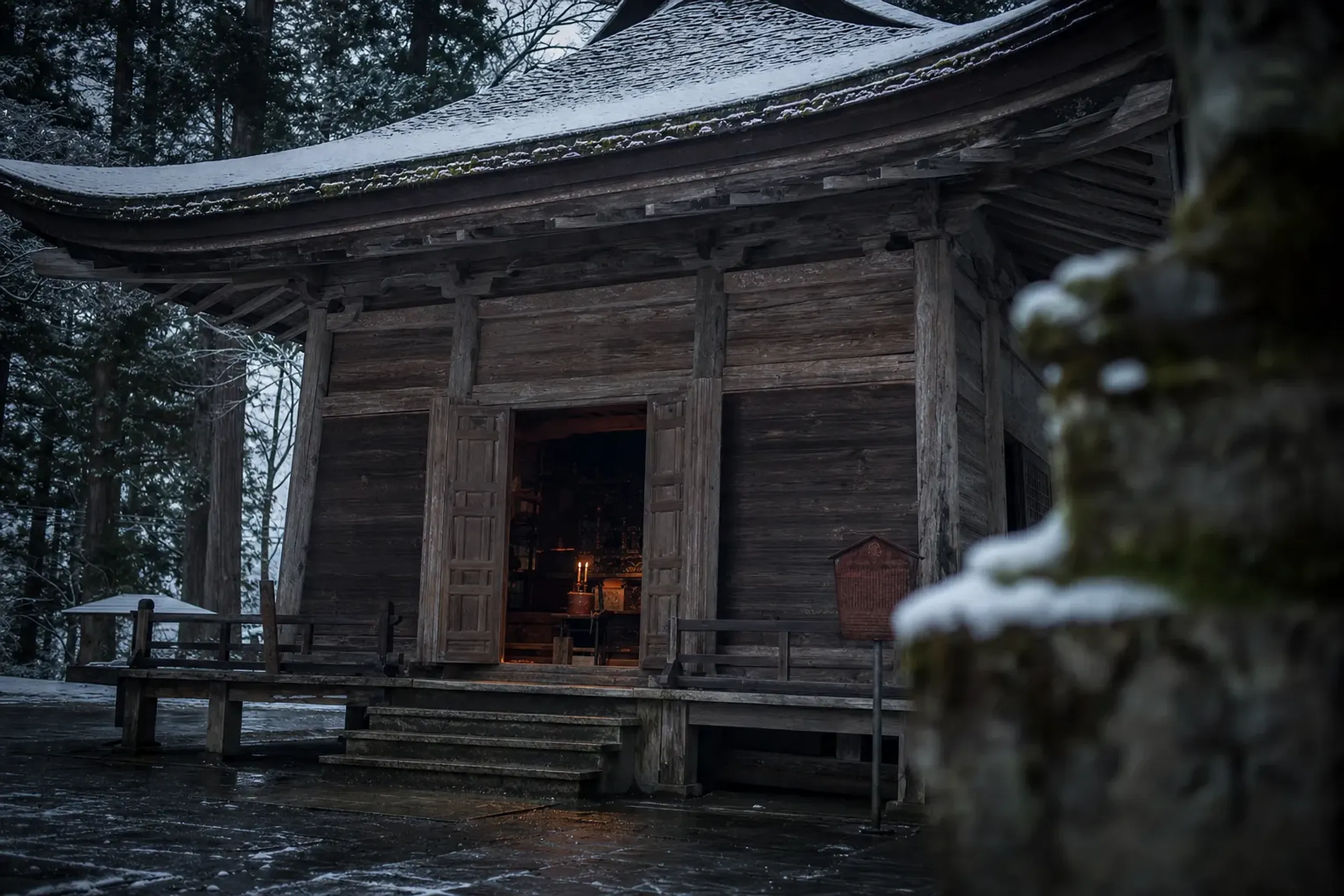
Directly beneath Nōkyōdō is where Ennin is said to rest, inside a meditation cave. The sensation is strange. You are above the oldest structure, and also above the founder’s body, and you realize the mountain is not scenery here—it is doctrine.
What Is The Continuous Sutra-Copying Practice At Yamadera?
Yamadera maintains a continuous sutra-copying devotional practice run in four-year cycles, tied to Ennin’s spirit and treated as an ongoing act of offering.
This is the kind of detail many “highlight lists” skip because it doesn’t fit into one photo. Yet it changes how the visit feels. Yamadera is not only about reaching a viewpoint; it is a system of repetition, copied characters, cycles of time, and vows made ordinary through daily labor.
In our experience, HNW travelers respond to this kind of continuity. It resembles what they respect in their own worlds: compounding effort, patient stewardship, and standards that don’t need applause.
Bashō’s Yamadera: The Haiku That Almost Didn’t Happen
Matsuo Bashō visited Yamadera in 1689 during his journey recorded in “Oku no Hosomichi,” and he composed his famous line here: “Silence—penetrating the rocks, the cry of the cicada.”
The part many visitors never hear is the near-miss. Bashō had planned to bypass Yamadera entirely.
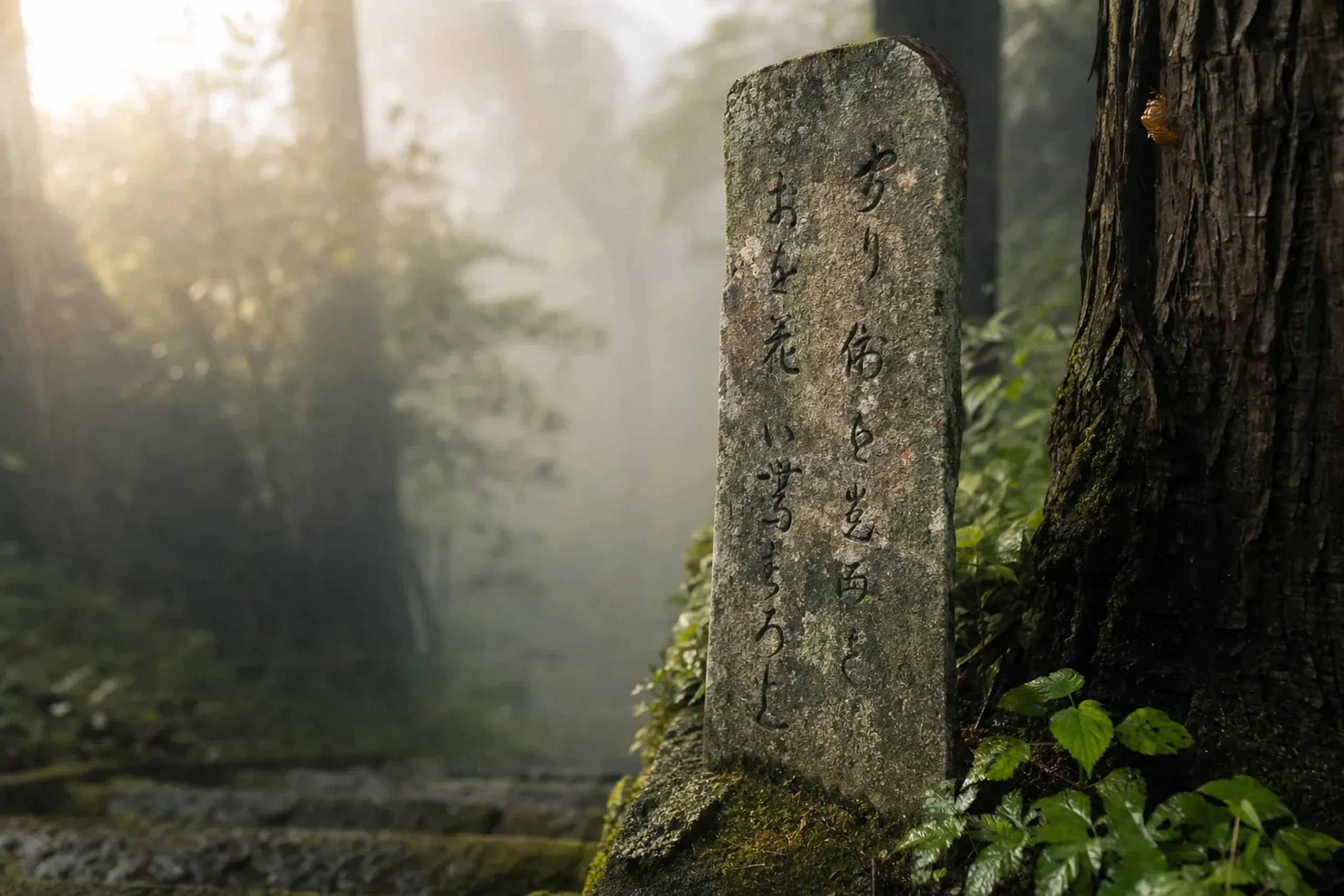
He changed his route and backtracked specifically because locals told him the site was worth seeing. That human detail matters. A poet celebrated for precision was still persuadable, still subject to a stranger’s advice, still willing to reverse a plan because something might be true.
If you’ve ever edited your own itinerary late at night—cutting, tightening, “optimizing”—Yamadera is a quiet warning. Don’t over-prune.
Which Cicada Did Bashō Hear At Yamadera?
Scholars have long debated Bashō’s cicada: Saitō Mokichi argued for abura-zemi, while Komiya Toyotaka argued for nii-nii-zemi, and the dispute eventually settled in favor of nii-nii-zemi without definitive proof.
It is an unusually checkable argument for a poem. Not vague “interpretation,” but a question of species, sound, and plausibility.
Poet Saitō Mokichi favored the larger brown abura-zemi. German-literature scholar Komiya Toyotaka argued the poem points to the smaller nii-nii-zemi, with a different presence in the ear. The conclusion leaned toward Komiya’s view, while acknowledging what can never be proven: we cannot travel back to 1689 and listen beside Bashō.
That humility is part of the charm. Yamadera invites exactness, then refuses certainty.
The Sezuka Cicada Mound, The Bashō Museum, And July’s Haiku Festival
Yamadera’s Bashō-related sites include a later memorial, a museum holding a manuscript, and a living tradition of haiku that returns each summer.
Sezuka is a cicada-mound monument marking where Bashō’s disciples believed he found inspiration. It was erected in 1751—sixty years after Bashō’s actual visit—so it is best understood as a legacy marker, not a contemporary footprint.
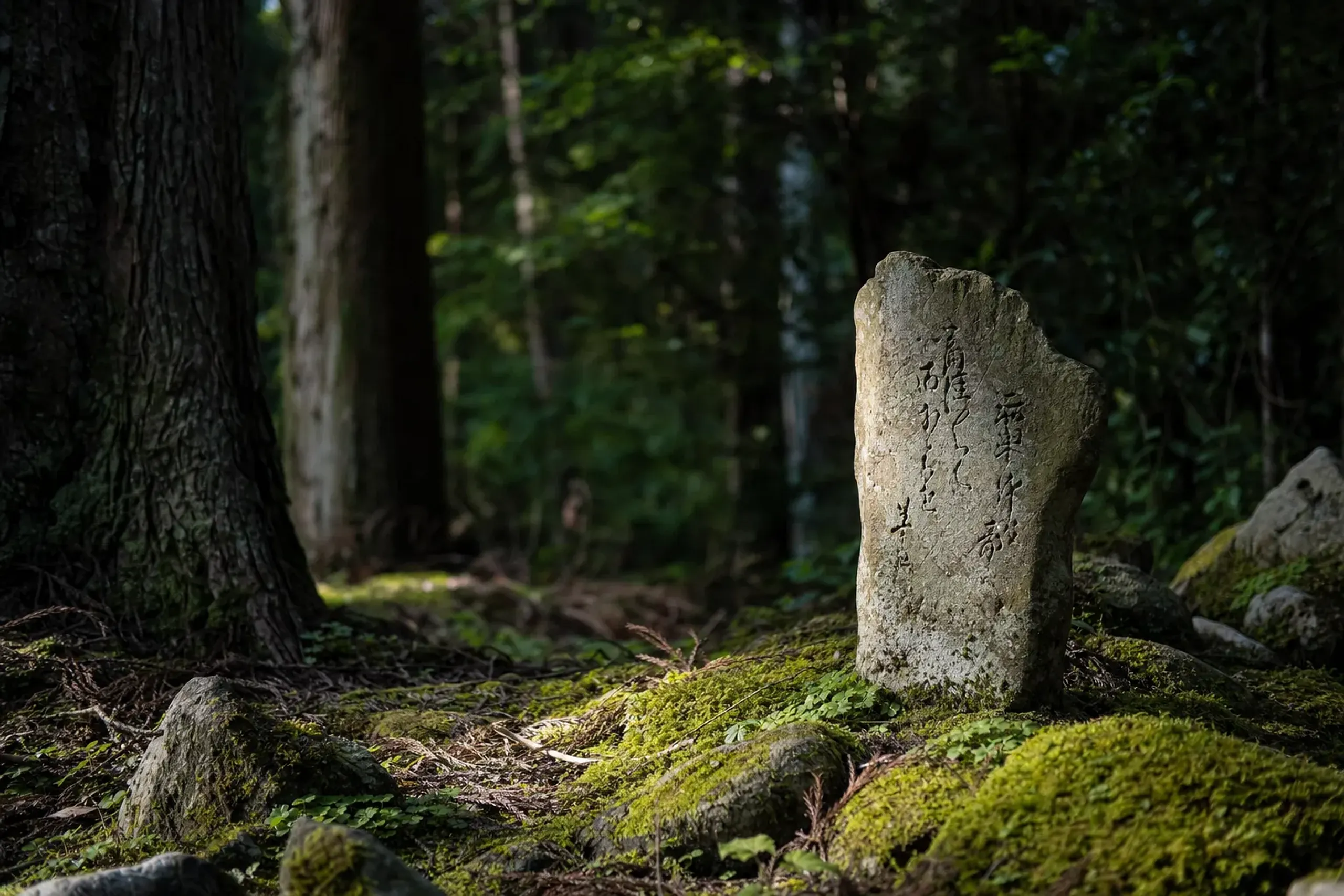
For visitors who want the most concrete connection, the Yamadera Bashō Memorial Museum displays Bashō’s own handwritten manuscript of the poem. Handwriting is intimate. You see pace and pressure, not only words.
Each July, an annual national haiku competition and festival is held in Yamadera, tied directly to the Bashō legacy. If you care about living culture—not only monuments—this timing can turn a “temple stop” into a day that feels quietly current. Knowing precisely which month rewards which experience is the seasonal instinct that separates a good visit from a memorable one.
How Hard Is The Yamadera Climb: 1,015 Stone Steps?
Yamadera’s ascent is 1,015 stone steps, and the climb is traditionally framed as ascetic practice—each step climbed is said to extinguish one worldly desire.
It is not a long hike in distance, but it is persistent. Steps, pause, steps again. The cedar forest keeps your mind from wandering too far.
Plan for a measured pace and a few stops that are more than “photo breaks.” This mountain works best when you let the rhythm do its job. Rushing defeats the point.
If you are traveling with family, or balancing a packed work calendar, Yamadera is still realistic. It asks for steadiness, not athletic ambition.
Key fact: The steps are uneven, and surfaces can be slick after rain or snow; choose footwear with confident grip, not fashion soles.
Gōdaidō: The Cliff Hall That Rewards The Last Steps
There is a moment near the top when the temple town falls away and the air opens.
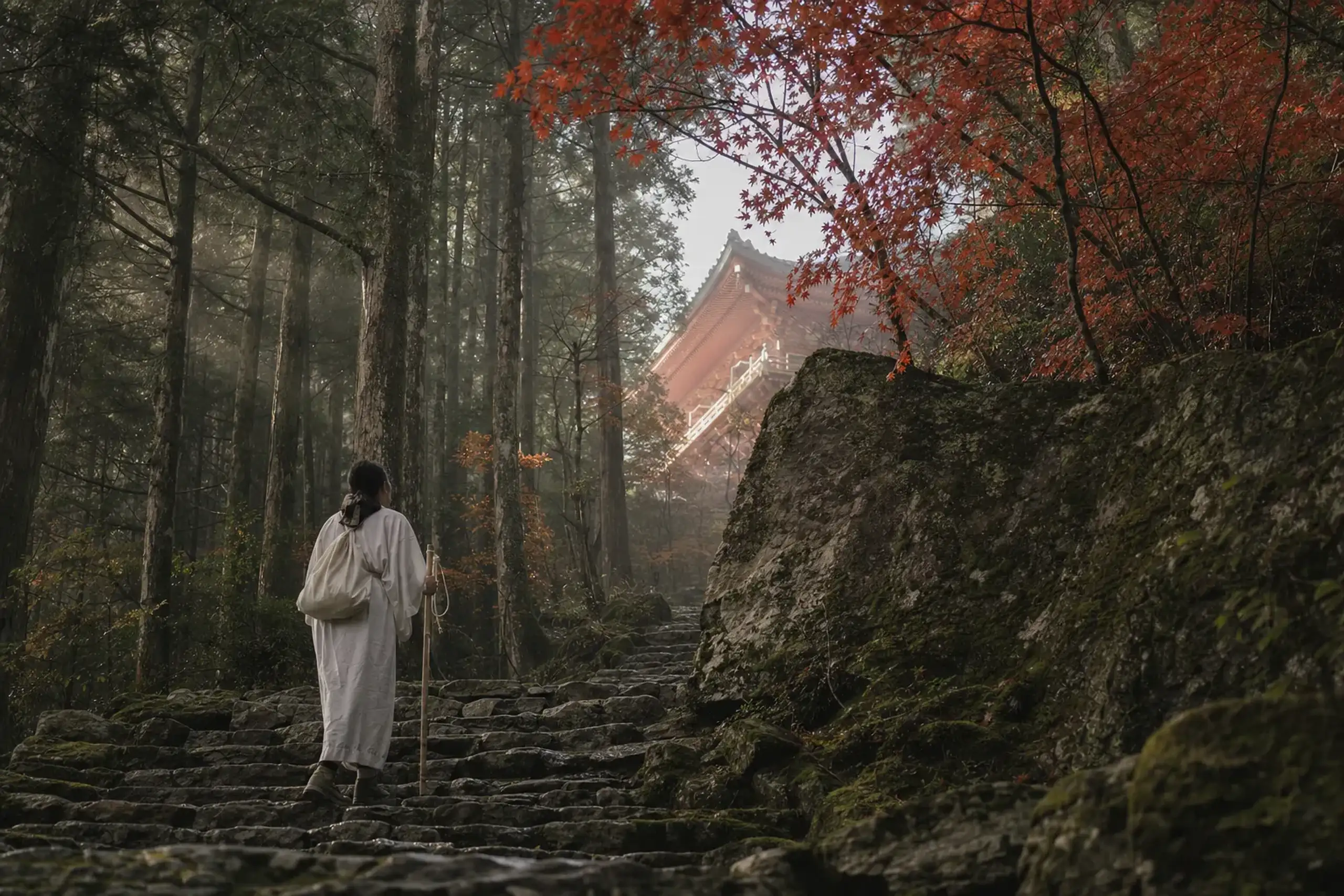
Your breathing changes first. Then your eyes.
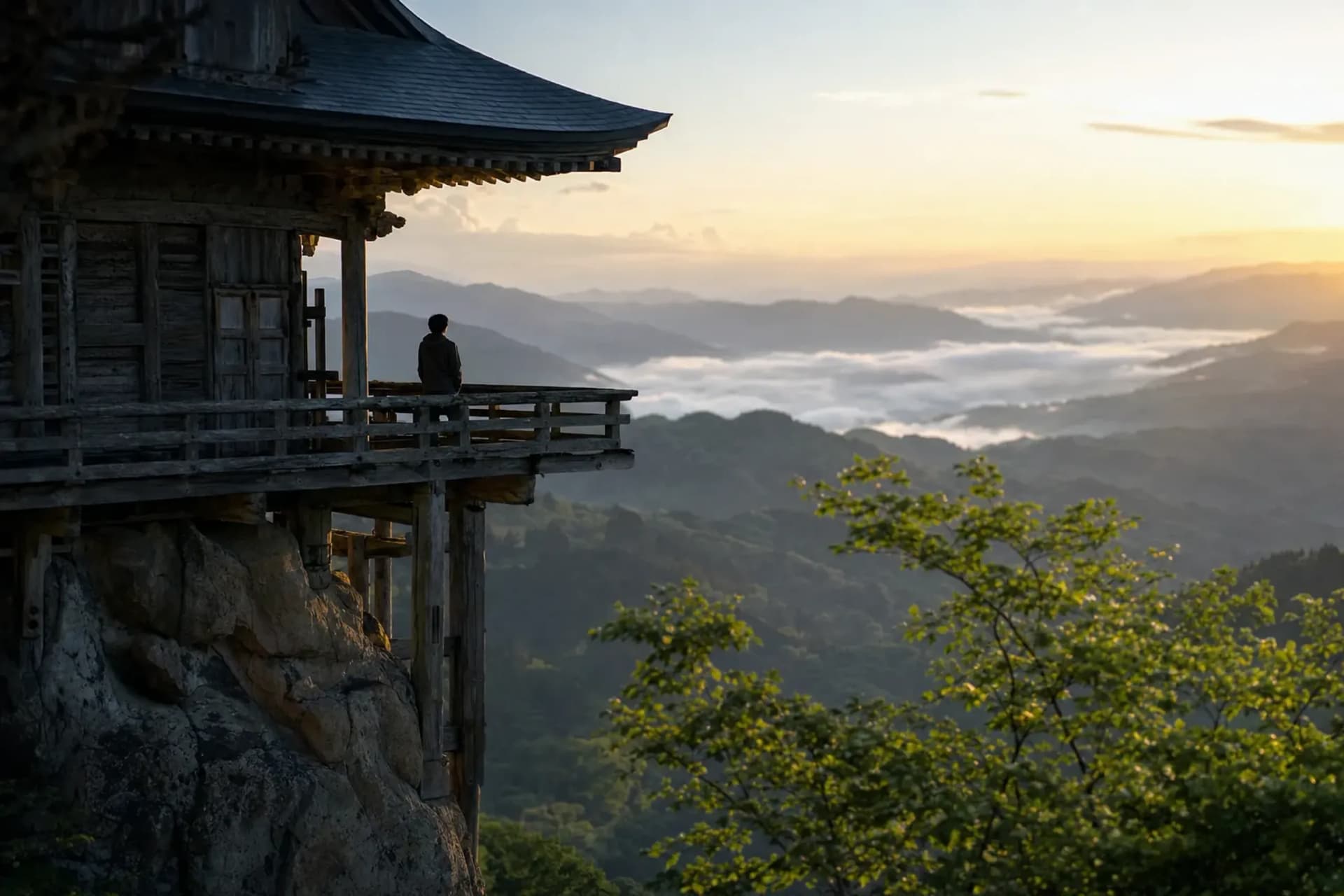
Gōdaidō is a stage-style hall built jutting out from a cliff edge. It enshrines the Five Great Wisdom Kings and serves as the mountain’s best viewpoint over the valley below.
This is where Yamadera becomes more than endurance. The geometry is sharp—wood against rock, hall against void, human scale against slope. There is a sabi beauty in that weathered timber pressed against ancient stone: nothing gilded, everything earned by time.
We often suggest a short, silent pause here, even for travelers who rarely sit still. Thirty seconds is enough. The view does the rest.
How Do You Get To Yamadera From Tokyo, Step By Step?
From Tokyo Station, take the Tohoku Shinkansen to Sendai Station (about 1 hour 20 minutes), then the JR Senzan Line to Yamadera Station (about 20 minutes), then walk about 5 minutes to the temple approach.
This is one reason Yamadera works so well for HNW travelers who value efficiency but dislike being herded. Rail access is clean. The final approach is short.
If you prefer door-to-door ease, our private transportation service can remove the timing friction and keep the day calm—especially for early starts, late returns, or multi-generational groups. The first time you consider it, read it as a comfort choice. On the day, it becomes a pacing tool.
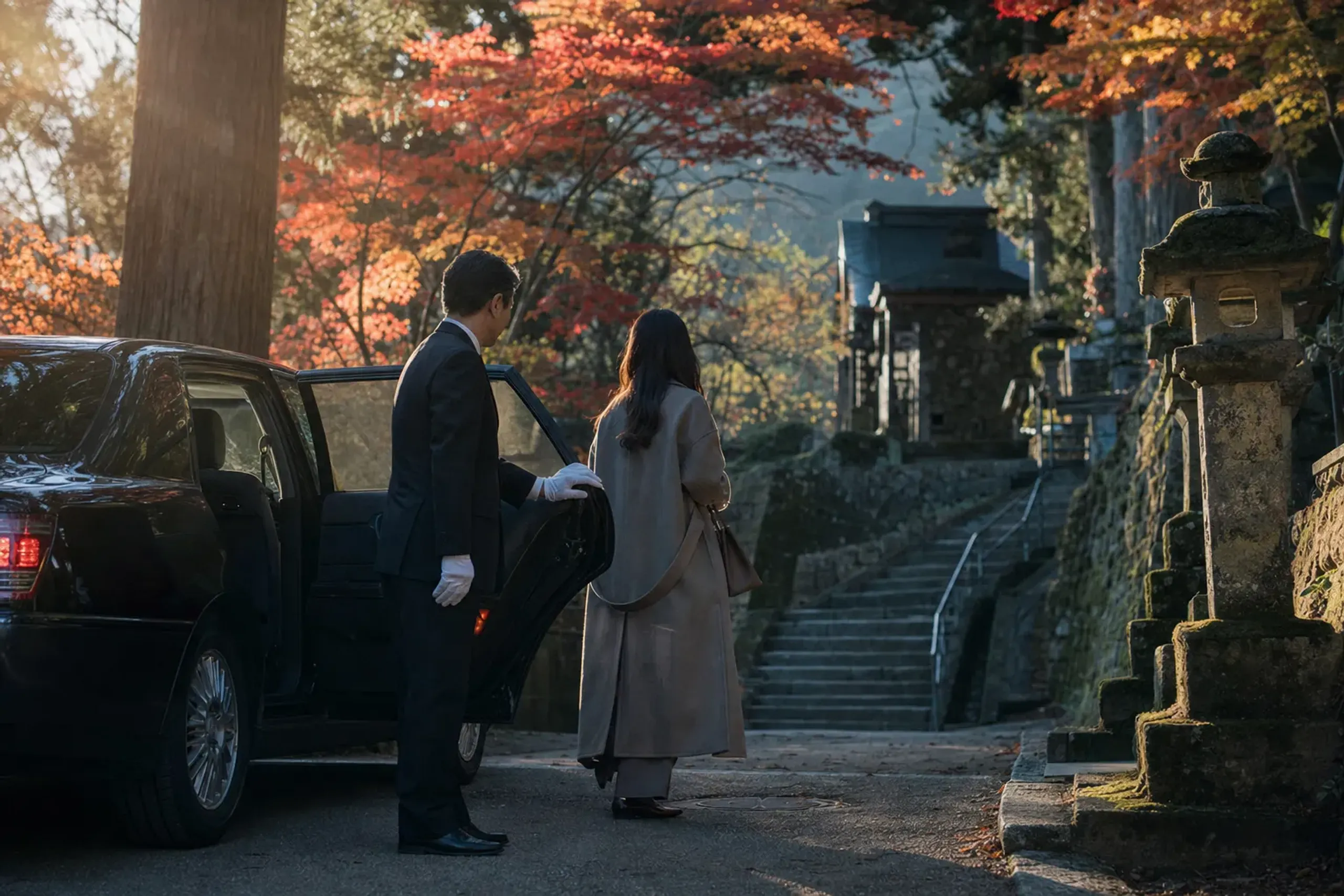
Private chauffeured travel is often what makes Yamadera feel contemplative rather than cramped.
Yamadera (Risshaku-ji) is located at 4456-1 Yamadera, Yamagata-shi, Yamagata-ken. The buildings dot the slopes of Mt. Hōju, northeast of Yamagata City, and the visit is built around an approximately 1,000-step ascent through forest to mountaintop halls.
A Practical Plan For Yamadera That Avoids Crowds
Most Yamadera visits fail for one reason: timing. Not stamina.
For a quieter experience, aim to arrive close to opening hours or later in the afternoon when day-trippers thin out. The mountain absorbs people better when they are not moving in a single dense pulse.
Build the visit in three parts. Approach and first halls. The sustained climb. Then a deliberate descent, when knees get honest and attention loosens.
If you want a simple benchmark, many travelers budget roughly 2–3 hours on site. Give yourself extra time if you plan to visit the Yamadera Bashō Memorial Museum or prefer unhurried pauses at Nōkyōdō and Gōdaidō.
Chūshō-in’s Obinzuru-sama: A Folk Tradition, Not A Medical Claim
At Chūshō-in hall, the Obinzuru-sama figure is traditionally said to grant longevity and cure illness when touched, and many visitors participate as a matter of folk belief.
We treat this respectfully and plainly. It is a local religious custom with a long life in popular practice.
If you choose to take part, do it quietly, and follow the flow of those around you. No performance. No commentary.
And if you prefer not to touch the figure, that is also fine.
Yamadera does not demand a single way of being present.
When Is The Best Season To Visit Yamadera In Yamagata?
Late spring, autumn foliage, and winter snow are the most atmospheric seasons at Yamadera, because the cedar forest and cliff halls change character with light, color, and silence.
In green season, the mountain smells alive—wet stone, sap, shadowed soil. Summer can be lush but warm, and the steps feel longer when the air is heavy.
Autumn is popular for obvious reasons. Color collects on the slopes, and the view from Gōdaidō becomes a layered study in reds and dull golds. If you want photos with fewer people, go early or late, not mid-day.
Winter is severe and clean. The mountain hushes. Conditions can be icy, so plan footwear and pacing conservatively. There is a rare, moss-and-snow silence to Yamadera in the cold months that few travelers ever witness—the kind of hushed austerity that rewards those who plan their timing with care.
How To Visit Yamadera With A Guide: What To Look For
Official tourism channels highlight guided experiences to Yamadera’s inner sanctuary (Okuno-in), including English-language guiding, which can change what you notice beyond “the steps.”
A strong guide here does not recite dates like a brochure. They point your attention toward small things: why a hall sits where it does, what visitors offer, what the mountain has endured, and how Bashō’s line keeps getting re-read.
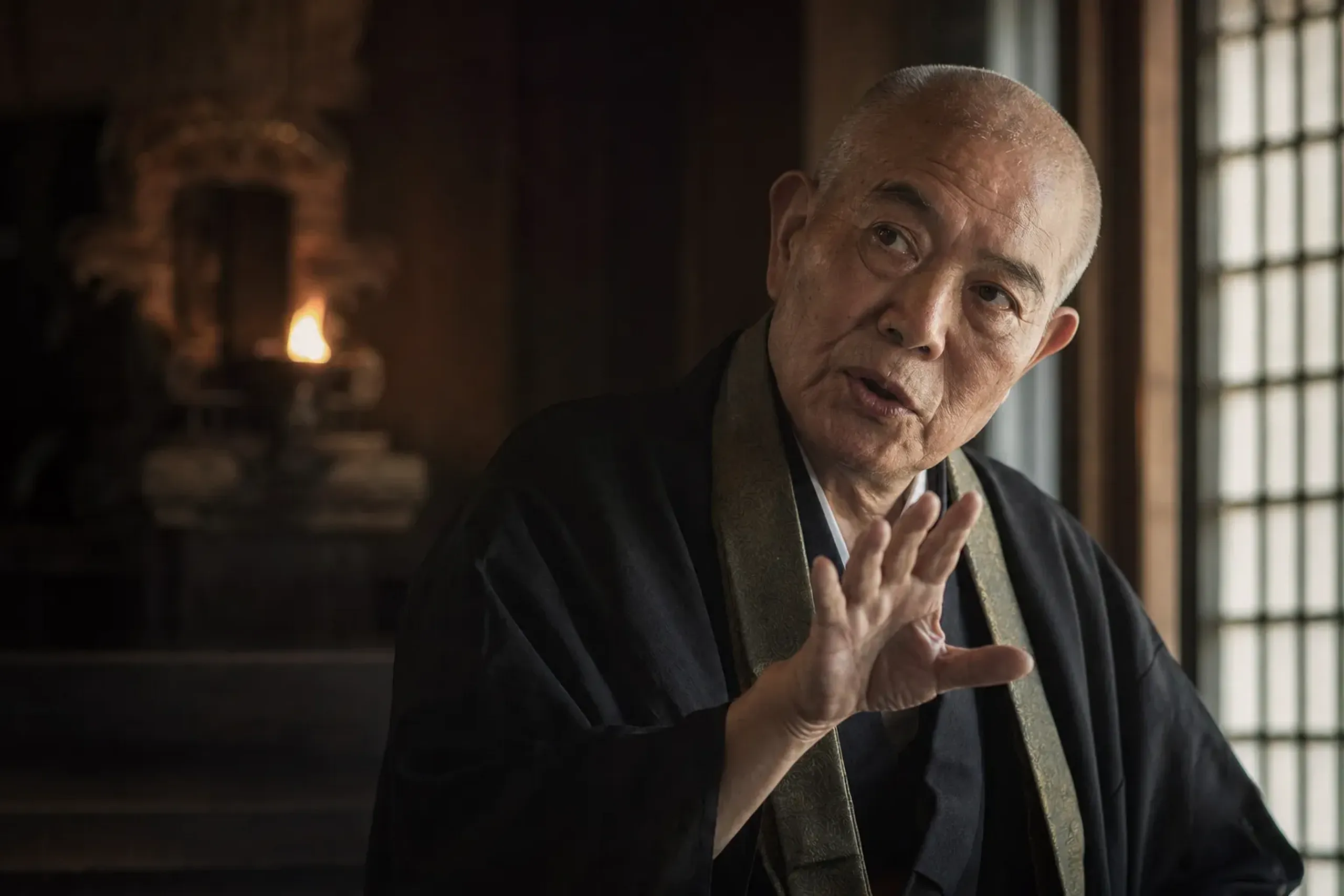
If you prefer to travel with interpretation, tell your guide what you care about. Poetry. Religious practice. Architecture. Or simply the feeling of the forest. Yamadera can hold all of it, but not in a single rushed monologue.
Our team at Japan Royal Service can weave Yamadera into a fully tailor-made itinerary, sharing guidance on guide options and pacing, and we verify current visiting hours and any seasonal event scheduling ahead of your visit—quietly, and with complete discretion regarding your identity and plans.
Frequently Asked Questions
Is Yamadera (Risshaku-ji) the same as Hōshūzan Risshakuji?
Yes—Yamadera is the common name for Hōshūzan Risshaku-ji, a Tendai Buddhist temple complex on Mt. Hōju in Yamagata City.
In conversation, locals and travelers usually say “Yamadera,” meaning “mountain temple,” but official references often use Risshaku-ji.
How Long Does It Take To Climb Yamadera’s 1,015 Steps?
Most visitors take around 30–60 minutes to climb, depending on pace, stops, and conditions.
The descent is usually quicker but can be harder on knees, especially on damp stone. If you want time at Nōkyōdō and Gōdaidō without feeling chased, budget extra.
Let Us Light The Way
Yamadera rewards the traveler who arrives with intention rather than a checklist—who understands that a flame kept alive for over a thousand years is worth approaching slowly, and privately. If you would like Yamadera arranged around your own rhythm, with the right guide, the right hour, and the right season, contact us here to begin a quiet conversation about your journey.