目次
- 01What Kawadoko Actually Means (And Why It Confuses Travelers)
- 02The Season: May 1 to September 30, And Why The Week Matters
- 03Kaiseki Over The Water, Or Flowing Noodles: Which Kibune Suits You
- 04The Full Arc: Kifune Shrine, The River, And Kurama
- 05Getting There: Why Private Transfer Changes The Evening
- 06Etiquette And Comfort: Dining Over Water Without Surprises
- 07Reservations And Privacy: The Real Work
- 08Kibune Kawadoko: Quick Questions
- 09Why Choose Japan Royal Service
Leave central Kyoto in July, when the city sits at a humid 35 degrees, and drive twenty-five minutes north into the cedar-shadowed valley of Kibune. The air drops. You feel it before you understand it. By the time the road narrows and the Kibune River appears below the retaining walls, the temperature has fallen by roughly ten degrees, and the sound of moving water has replaced the hum of the city entirely.
This is where a very old idea still works. In Kibune, restaurants and inns build wooden platforms directly over the river for the warm months. Guests dine inches above the rushing current. The Japanese call this kawadoko, and in our experience it remains one of the most quietly moving dining experiences the country offers to those who know how to arrive at the right table, at the right hour, in the right week.
At Japan Royal Service, we treat Kibune not as a listicle item but as a decision. There is a correct season, a correct style, and a correct way to combine it with the shrine above and the mountain path beyond. This guide lays out that thinking.
https://www.youtube.com/watch?v=F1urQ4pJagM
What Kawadoko Actually Means (And Why It Confuses Travelers)
First, a clarification we make with almost every guest. Two Kyoto summer traditions get muddled constantly.
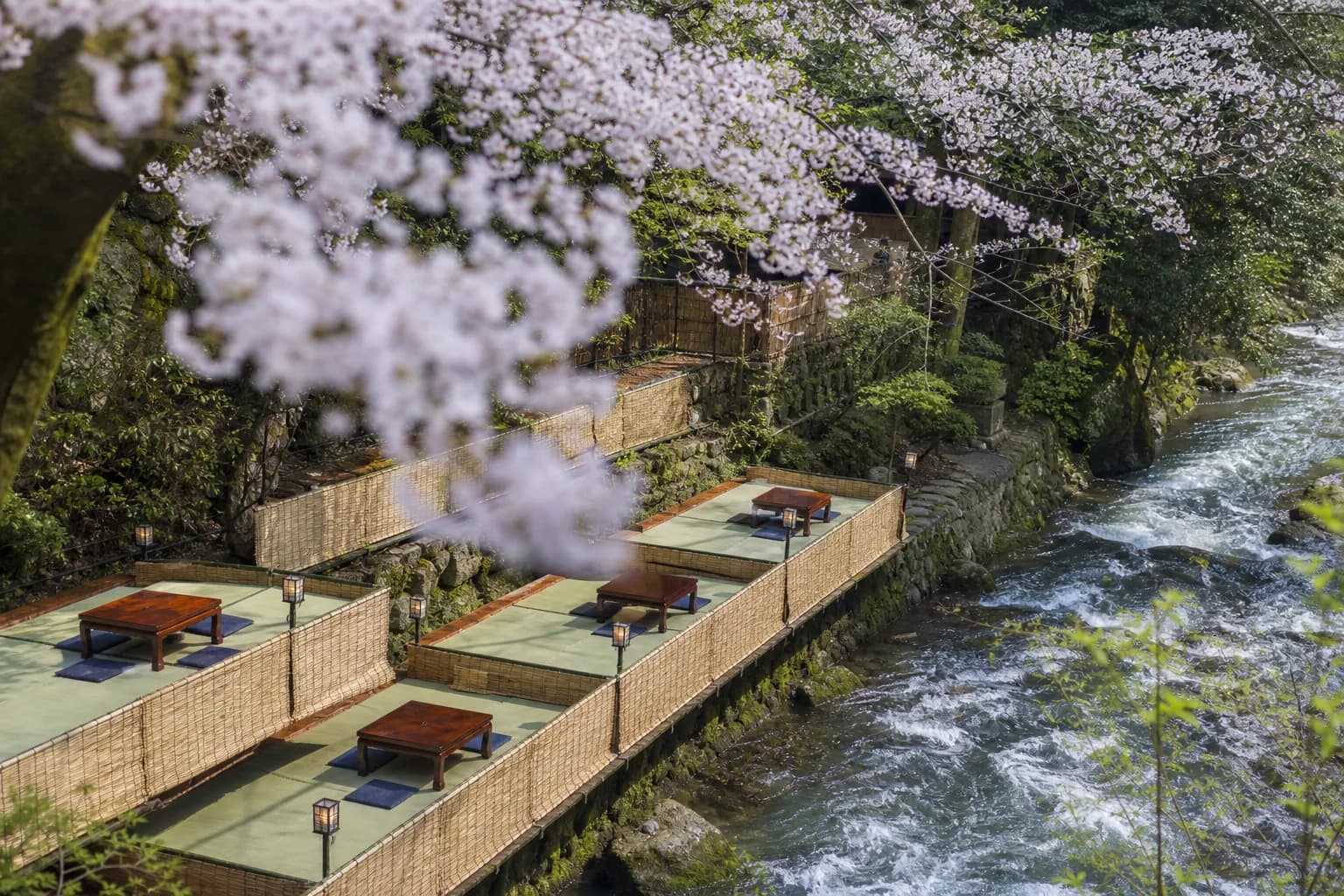
Along the Kamogawa River in central Kyoto, restaurants raise dining decks well above the water. Those are called noryo yuka. They are elevated, urban, and lively — you look down at the river from a height. Kibune is different. Here the platforms sit low, directly over the running current, and the style is called kawadoko. Kyoto's official tourism board draws exactly this distinction, and it matters, because the two experiences feel nothing alike.
Key fact: Kamogawa = noryo yuka (raised city decks). Kibune = kawadoko (low platforms directly over the mountain river). If a guide uses the words interchangeably, it has not been to both.
The origin story is worth carrying with you. Kibune Fujiya, one of the historic operators in the hamlet, traces the practice to the Taisho period, when benches were first placed in and over the river so guests could cool off. Those simple benches became today's dining platforms. Roughly a century of refinement sits under your feet when you take your seat.
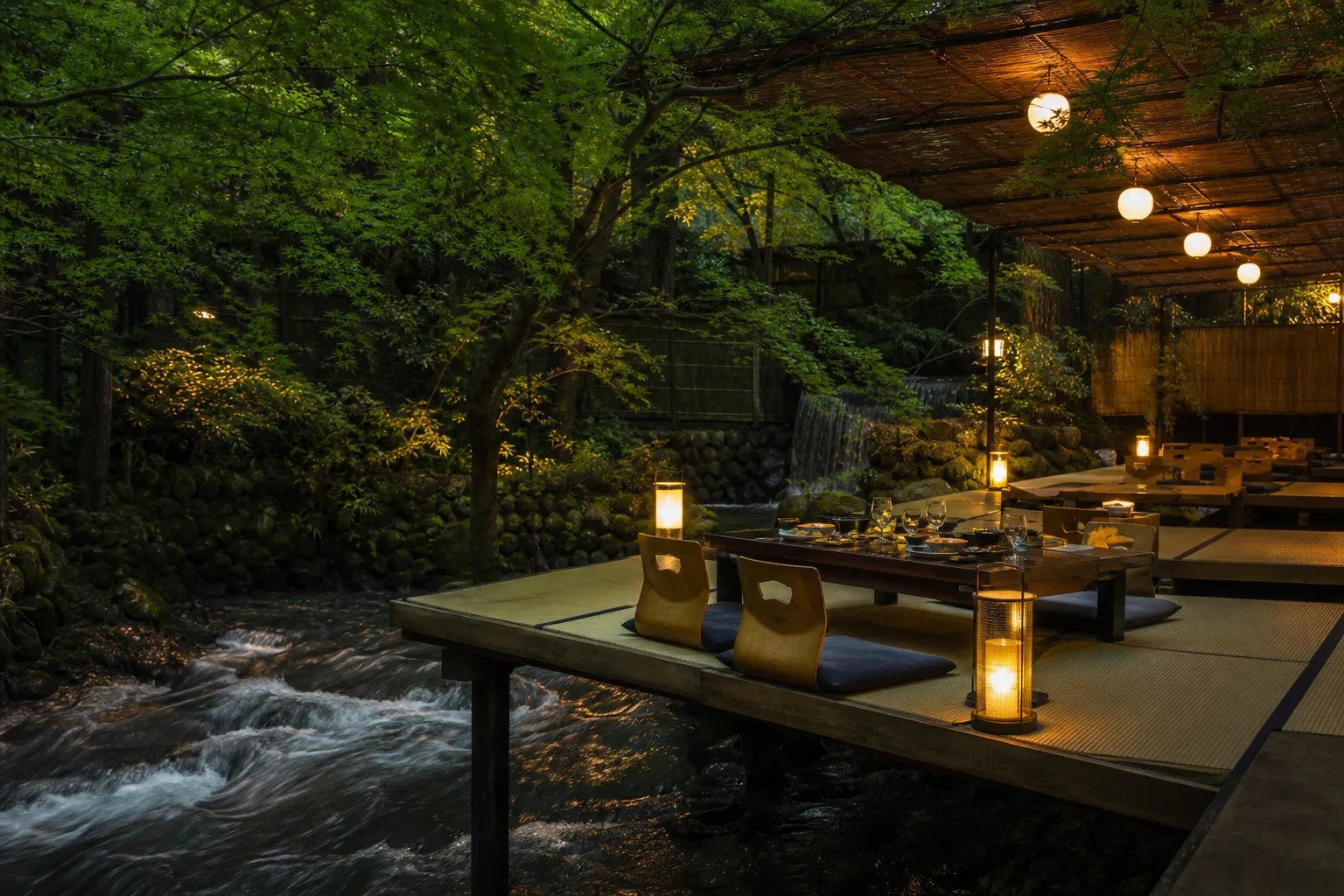
The kawadoko platforms sit inches above the running water — the source of Kibune's natural cool.
The Season: May 1 to September 30, And Why The Week Matters
Kyoto's official tourism site is precise. Kawadoko in Kibune runs from May 1 to September 30. Outside those dates, the platforms come down and the valley returns to its role as a shrine-and-forest retreat.
Within that window, the month you choose changes everything. Most travelers default to July and August because that is when Kyoto is unbearable and the contrast is sharpest. They are right about the contrast. They are also choosing the busiest, most humid weeks. Our concierge team frames the season like this:
- May: Fresh green maples, cool evenings, thin crowds (best for quiet-first travelers, photography)
- June: Rainy season; mist and drama, some cancellation risk (best for atmosphere over certainty)
- July–August: Peak heat-escape, busiest, seasonal hamo and ayu at their best (best for the full sensory contrast)
- September: Season winding down, calmer, early hints of autumn (best for late bookers seeking space)
A word on rain. June is Kyoto's rainy season, and Kibune's platforms sit over live water. When the river rises, safety comes first and dining moves indoors. That is not a failure of planning — it is the valley behaving as it should. We build weather contingencies into every Kibune evening so a guest never faces a scramble.
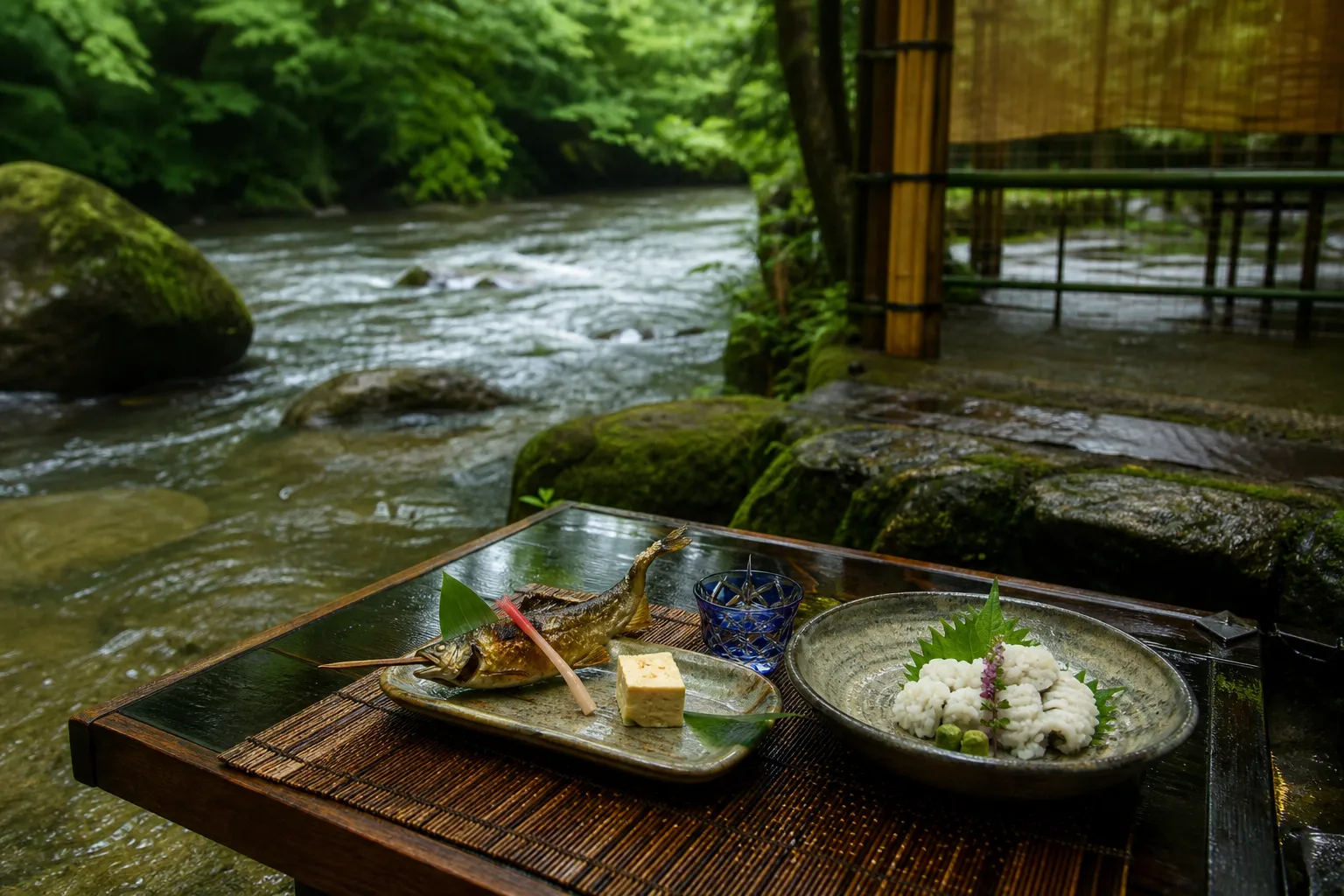
Hyper-seasonal kaiseki — hamo and ayu at their peak — served to the sound of moving water.
Kaiseki Over The Water, Or Flowing Noodles: Which Kibune Suits You
The single most useful question we ask is deceptively simple. Do you want reverence or play?
Option A: Kaiseki On The Platform
This is the reason discerning travelers cross Japan for a Kibune summer. A multi-course kaiseki served over the river is hyper-seasonal by design. In high summer you may meet hamo (pike conger), knife-worked into a thousand fine cuts, and ayu (sweetfish) grilled whole over charcoal — a fish so tied to Kyoto's rivers that it defines the season on the plate. Each course arrives to the constant sound of water beneath the boards.
What separates a fine kaiseki evening from a merely pretty one is the hand behind it. The best Kibune kitchens are run by chefs whose relationship to shokunin discipline shows in restraint, not display — the right ingredient at its exact peak, presented without noise. That is the difference we care about when we recommend a table.
- Best for: couples, romantic evenings, guests who prize privacy and cuisine above atmosphere
- Timing: dinner, for the lanterns and the cooler air
- Register: formal, quiet, contemplative
Option B: Nagashi Somen And A Livelier Table
At Ryori Ryokan Hirobun, a different tradition draws families and first-timers: nagashi somen, where thin noodles are sent down a bamboo flume of running spring water and caught with chopsticks as they pass. It is tactile, playful, and genuinely delicious in the heat. InsideKyoto and Kyoto's tourism coverage both single out Hirobun for this experience.
- Best for: families, small groups, travelers who want joy over ceremony
- Timing: lunch works beautifully; expect energy and movement
- Register: warm, informal, memorable for children
Neither choice is superior. They answer different desires. Our role is to make sure the desire and the table match — nothing dulls a special evening faster than a formal kaiseki guest seated beside a noodle flume, or a family arriving expecting play and finding hushed reverence.
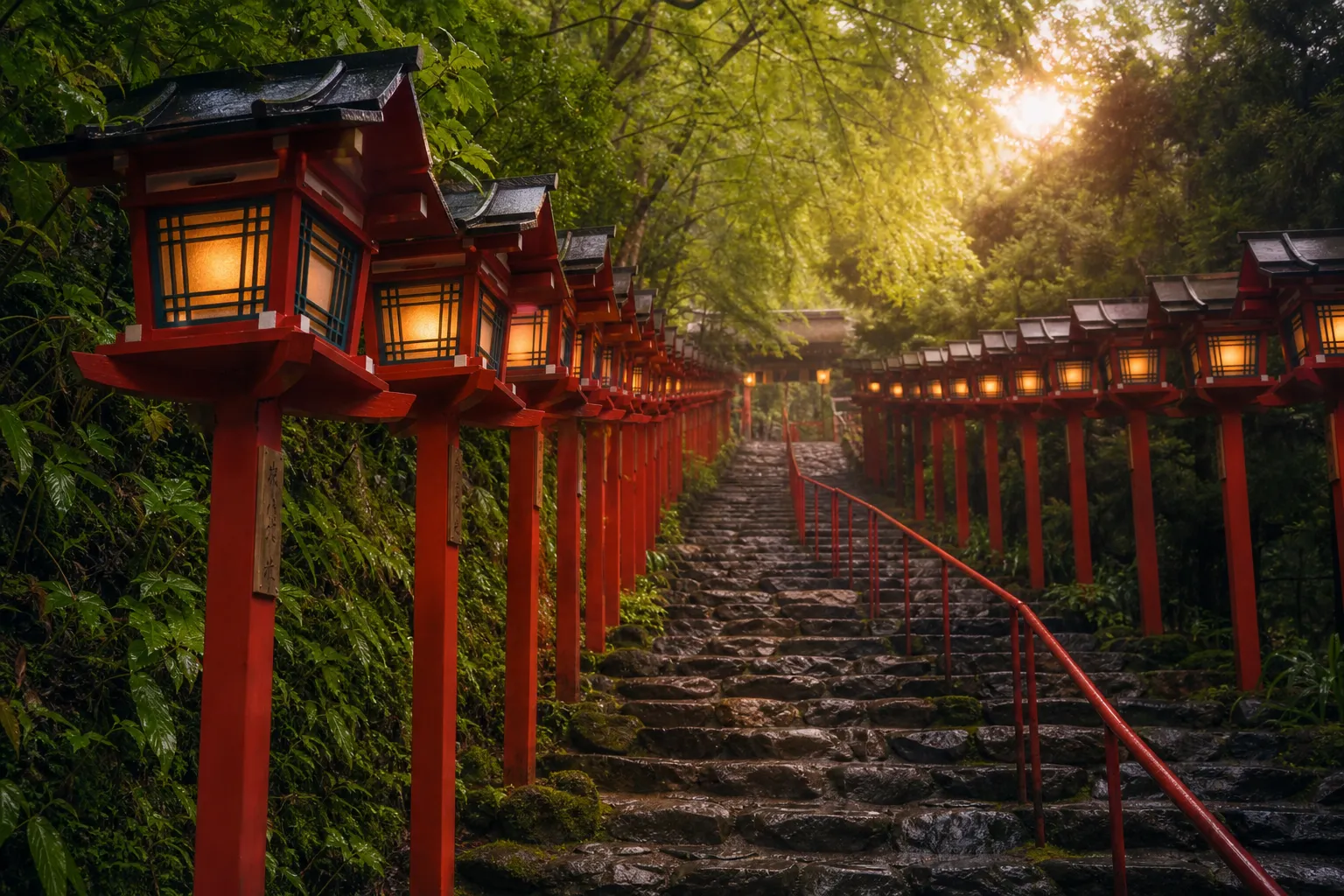
Arrive soon after the 6:00 opening and the lantern steps of Kifune Shrine are nearly your own.
The Full Arc: Kifune Shrine, The River, And Kurama
A Kibune evening is better when it is not the whole day. The valley rewards a curated arc.
Begin above the restaurants at Kifune Shrine, the vermilion sanctuary long associated with the deity of water. Its lantern-lined stone staircase is among the most photographed approaches in the Kyoto mountains, and for good reason. The shrine's official hours are worth planning around: the main shrine is open 6:00–20:00 from May 1 to November 30, and 6:00–18:00 from December 1 to April 30. During kawadoko season, that early opening is a gift. Arrive not long after six, and the lantern steps belong almost entirely to you.
From the shrine, the more adventurous continue on foot. A mountain path links Kibune to Kurama, passing through cedar forest thick with tengu folklore, and emerging near Kurama-dera. InsideJapan Tours describes this crossing as roughly a two-to-three-hour hike, often finished with a soak at Kurama Onsen. It is a real hike, not a stroll — sensible footwear and an honest assessment of fitness matter.
For most of our guests we sequence it differently, and gently: an early, near-private shrine visit, a slow return through the hamlet, then river dining as the light softens. Those who want the Kurama crossing do it in the cool of morning and dine after. The point is that the shrine, the water, and the mountain are not three attractions to tick. They are one continuous mood, and the order you take them in decides how the day feels.
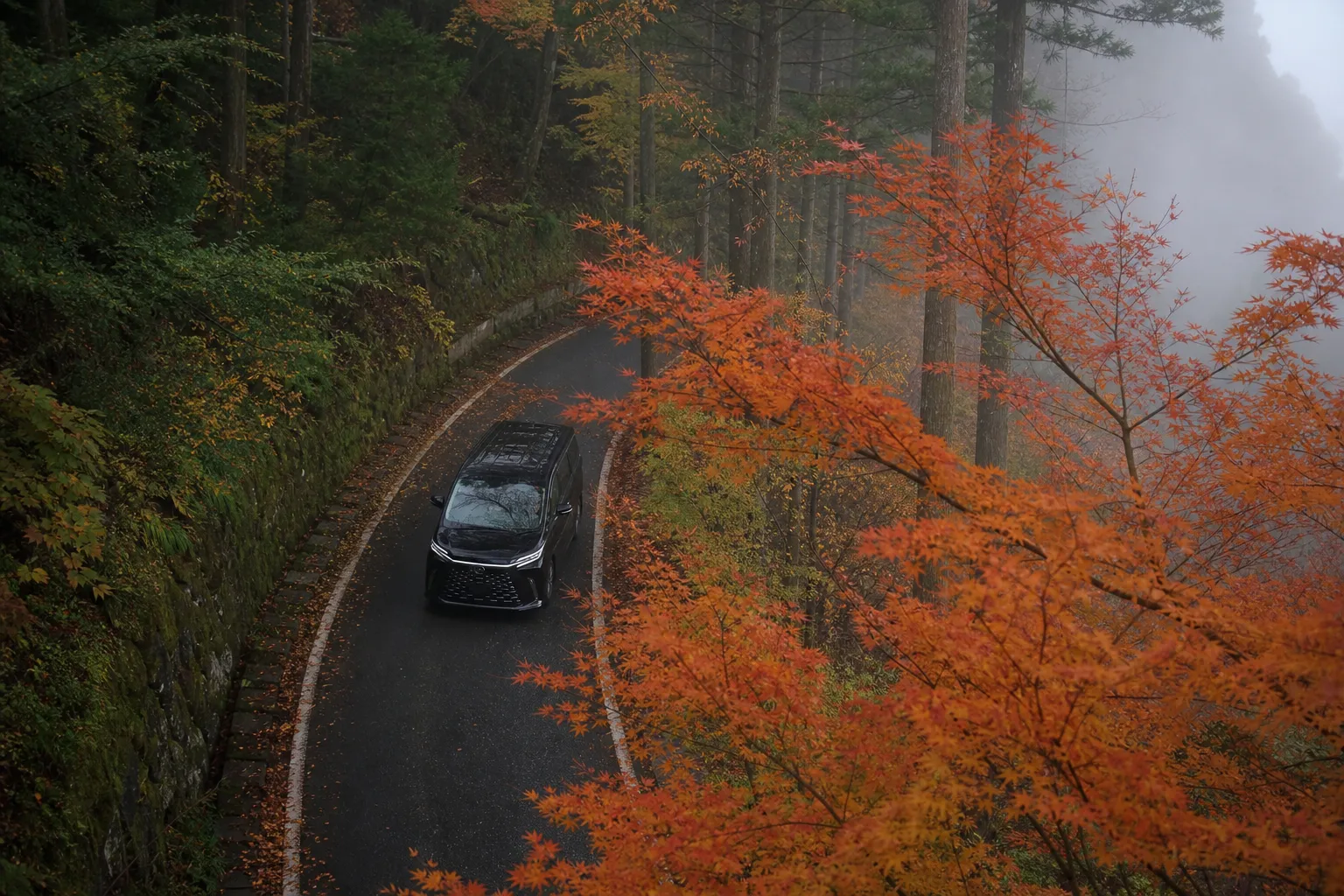
A private car turns the winding valley drive into part of the evening — and waits for your unhurried return.
Getting There: Why Private Transfer Changes The Evening
Kibune can be reached by train and a short bus or taxi from Kyoto. It works. But it introduces exactly the friction a well-planned evening should avoid: connections timed to someone else's schedule, a walk up in humidity before dinner, and — the real problem — the return.
A kawadoko dinner ends after dark, in a mountain valley, and the last public options thin out precisely when you want to linger over the final course. More than once we have seen guests cut an evening short to catch a train. A private chauffeur removes all of it. The car waits. You leave when the meal, not the timetable, is finished.
For families and small groups, our fleet ranges from the Toyota Alphard and Vellfire to the flagship Lexus LM 500, which turns the winding drive up the valley into part of the pleasure rather than a chore. Our Kyoto private chauffeur service handles the narrow approach, the parking, and the quiet late return — details a guest should never have to think about.
Etiquette And Comfort: Dining Over Water Without Surprises
Luxury, to us, means no unpleasant surprises. A few practical notes we share before every Kibune evening:
- Footwear. Platforms are wooden and occasionally damp. You may be asked to remove shoes at some venues. Simple, secure footwear beats anything precarious.
- Layers. The valley is genuinely cooler, especially after sunset. A light layer over summer dress is welcome by the end of a meal.
- The river's presence. You are over live water. There is spray, there is sound, and in June there is real weather risk. Embrace it — it is the entire point — but pack accordingly.
- Insects. A forested riverside in summer means the occasional visitor. Discreet repellent, applied before you arrive, spares the moment.
- Dietary needs. Kaiseki is composed in advance around seasonal ingredients. Restrictions must be communicated well ahead, not on the night. We convey these privately so the kitchen can plan without a table-side negotiation.
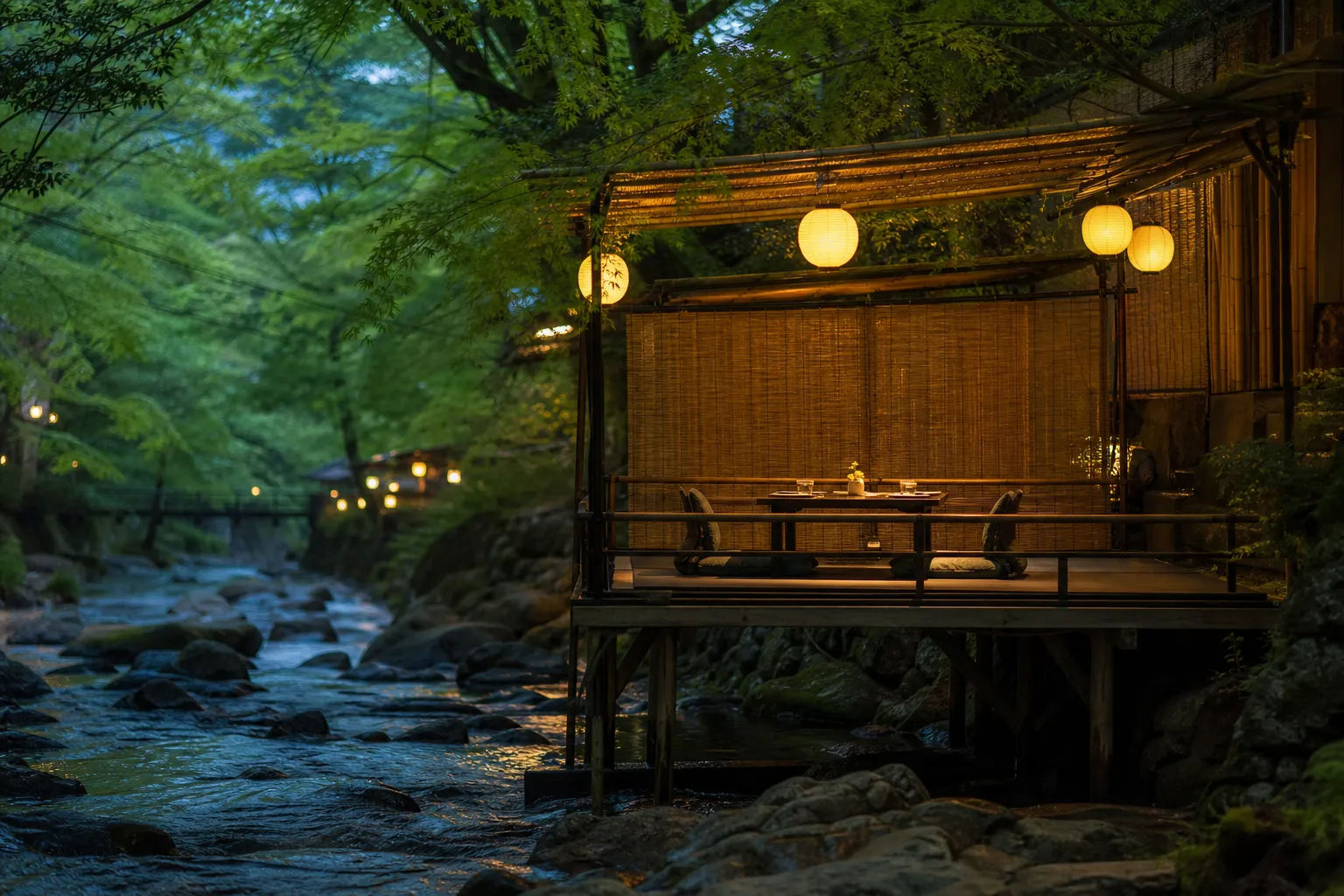
The finest tables are limited and seasonal — booking, arrival, and discretion are the real work.
Reservations And Privacy: The Real Work
Here is the honest part. The finest Kibune kaiseki tables are limited, seasonal, and demand is compressed into five months. Platforms are weather-dependent. And the operators who matter most are precisely the ones a first-time visitor cannot easily reach from abroad.
Booking well ahead is not optional for the best rooms in July and August. Beyond timing, discretion is its own discipline. For guests who value a quiet identity, the way a reservation is placed, the way arrival is handled, and the way a car waits out of view all shape whether an evening feels private or merely booked. This is the layer generic guides never address, and it is the layer we live in.
Kibune also pairs naturally with a quiet Kyoto base. With Capella Kyoto having opened in March 2026 in the Miyagawa-cho quarter of Gion, privacy-minded travelers now have a discreet city anchor from which a mountain evening in Kibune becomes an effortless northward drive.
Kibune Kawadoko: Quick Questions
When is the Kibune kawadoko season?
May 1 to September 30, per Kyoto's official tourism guidance. July and August are the peak heat-escape months; May and September are quieter.
How is Kibune kawadoko different from Kamogawa noryo yuka?
Kibune's kawadoko platforms sit low, directly over the mountain river. Central Kyoto's noryo yuka decks along the Kamogawa are raised well above the water. Different height, different feeling entirely.
What are Kifune Shrine's hours?
The main shrine is open 6:00–20:00 from May 1 to November 30, and 6:00–18:00 from December 1 to April 30. An early arrival during kawadoko season means near-empty lantern steps.
Can I combine Kibune with a hike?
Yes. A forest path links Kibune to Kurama in roughly two to three hours, often ending at Kurama Onsen. It is a genuine hike; plan footwear and fitness accordingly.
Is rain a problem?
It can be. June is rainy season, and platforms over live water close when the river rises. We build indoor contingencies into every Kibune plan.
Why Choose Japan Royal Service
A Kibune evening looks simple from a distance: a table, a river, a good meal. The difference between an ordinary version and an unforgettable one lives entirely in the details — the week you choose, the style that fits you, the hour you climb the shrine steps, the car that waits after dark.
Our team at Japan Royal Service designs those details privately. We match the right platform to the right guest, sequence the shrine and the mountain so the mood builds rather than scatters, and handle transfers, timing, and dietary needs so nothing intrudes on the moment over the water. For travelers who prize privacy, we keep identity and itinerary confidential from first inquiry to final course.
If a summer evening inches above the Kibune River appeals to you, our concierge can shape it around your dates, your pace, and your preferences. Reach our team directly via WhatsApp or the contact form at japanroyalservice.com to begin a private, tailored conversation.