In this guide
- 01Why The Kangensai Date Moves Each Year
- 02What Happens On The Night Of Kangensai
- 03Will The Torii Float On The Day I Visit?
- 04Watching The Kangensai Festival From Shore
- 05Getting To Miyajima For The Festival
- 06Other Summer Notes For Miyajima
- 07How Japan Royal Service Plans A Kangensai Evening
- 08Frequently Asked Questions
- 09Why Choose Japan Royal Service
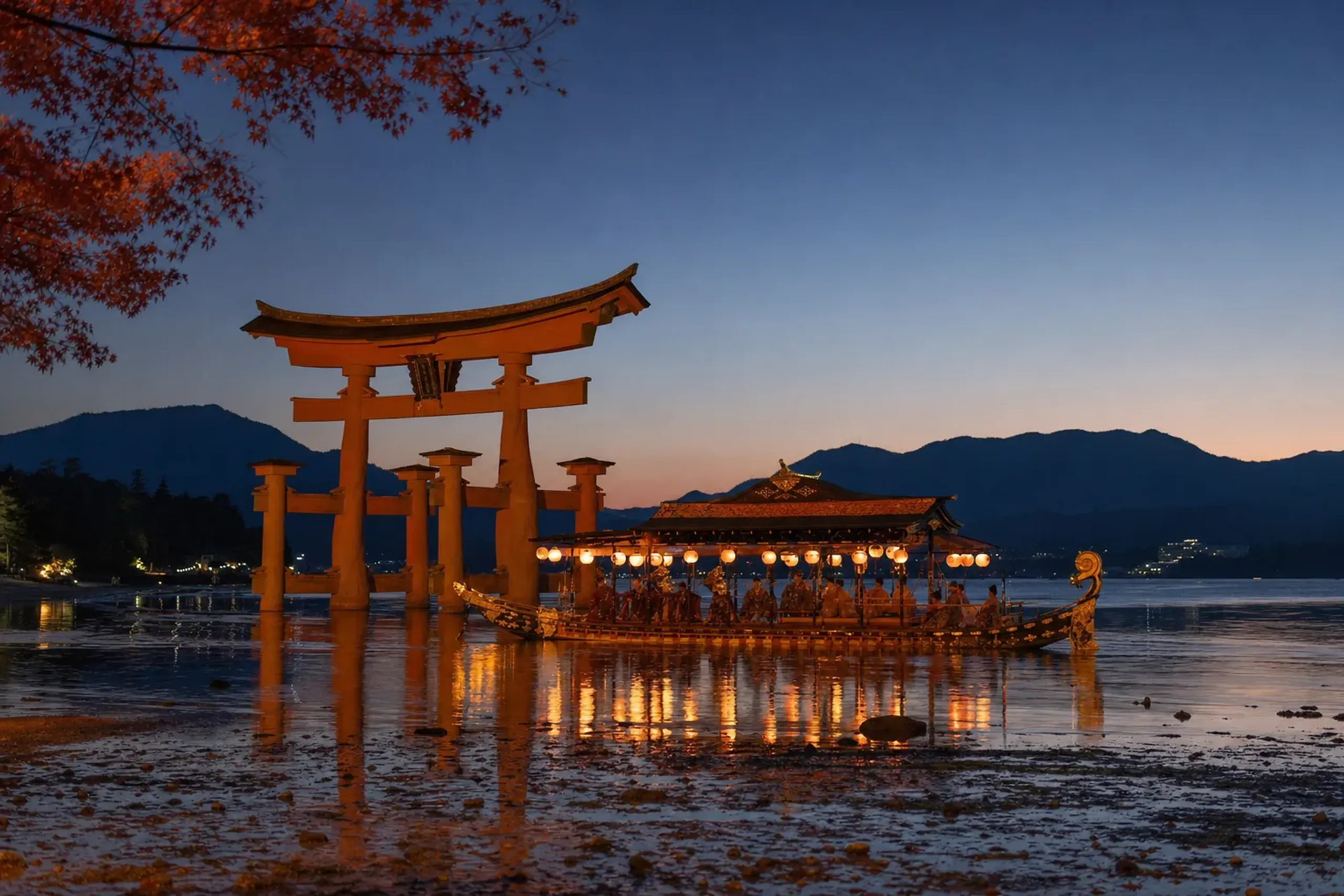
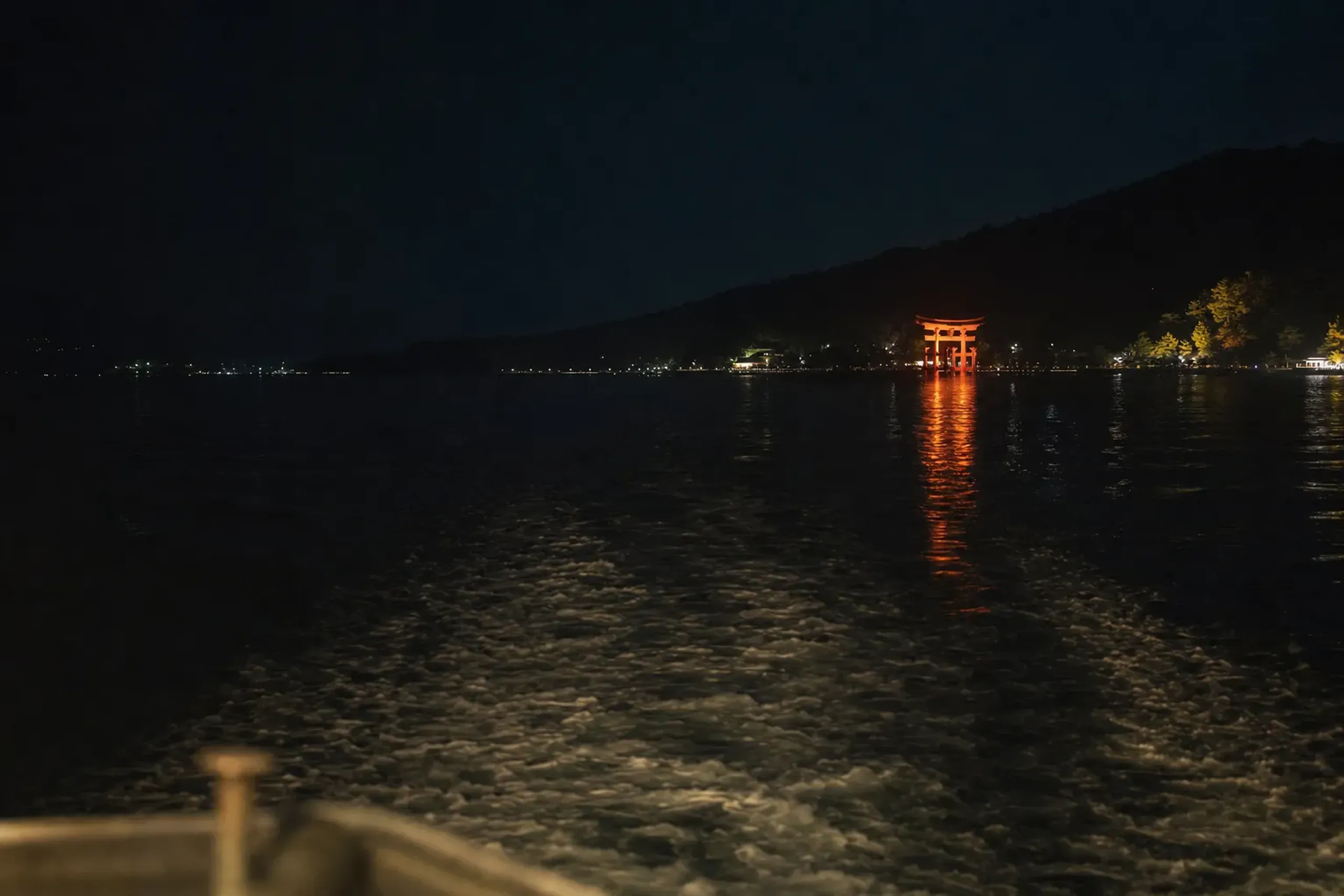
The boat sits low in the water, lanterns swinging, and it does not move. It is waiting. Off the Great Torii at Itsukushima Shrine, the musicians have taken their places, the portable shrine is aboard, and still the vessel holds its position near Hotate Rock. Everyone on the shore understands why. The sea has not yet risen enough.
This is Kangensai, the shrine's greatest rite, and it begins only when the tide allows it. Our team at Japan Royal Service plans many evenings on Miyajima, and this one teaches the single most useful lesson about the island: the water keeps the schedule. Learn to read the tide, and you understand both the festival and the floating torii that draws travellers here all year.
Why The Kangensai Date Moves Each Year
Kangensai falls on the 17th day of the sixth month of the old lunar calendar, which lands somewhere between mid-July and early August on the modern one. In 2026 that is Thursday, 30 July; in 2027 it is Tuesday, 20 July.
The reason is practical, not decorative. The Miyajima Tourist Association explains that the day is chosen so the evening tide runs high enough to float a deep boat, with the moon near full for light over the water, and the worst of the typhoon risk avoided. A spring tide suits all three conditions. So the date drifts year to year, chasing the sea rather than the calendar.
The rite is traditionally traced to Taira no Kiyomori, who adapted the Heian aristocracy's habit of playing refined court music aboard pleasure boats.
Kangen names that music. Centuries later, the same music still carries across the shallows at Itsukushima.
What Happens On The Night Of Kangensai
A departure rite begins at the main hall in the late afternoon, around 15:00. The portable shrine is then carried out to the festival boat waiting off the Great Torii, and the vessel pushes off.
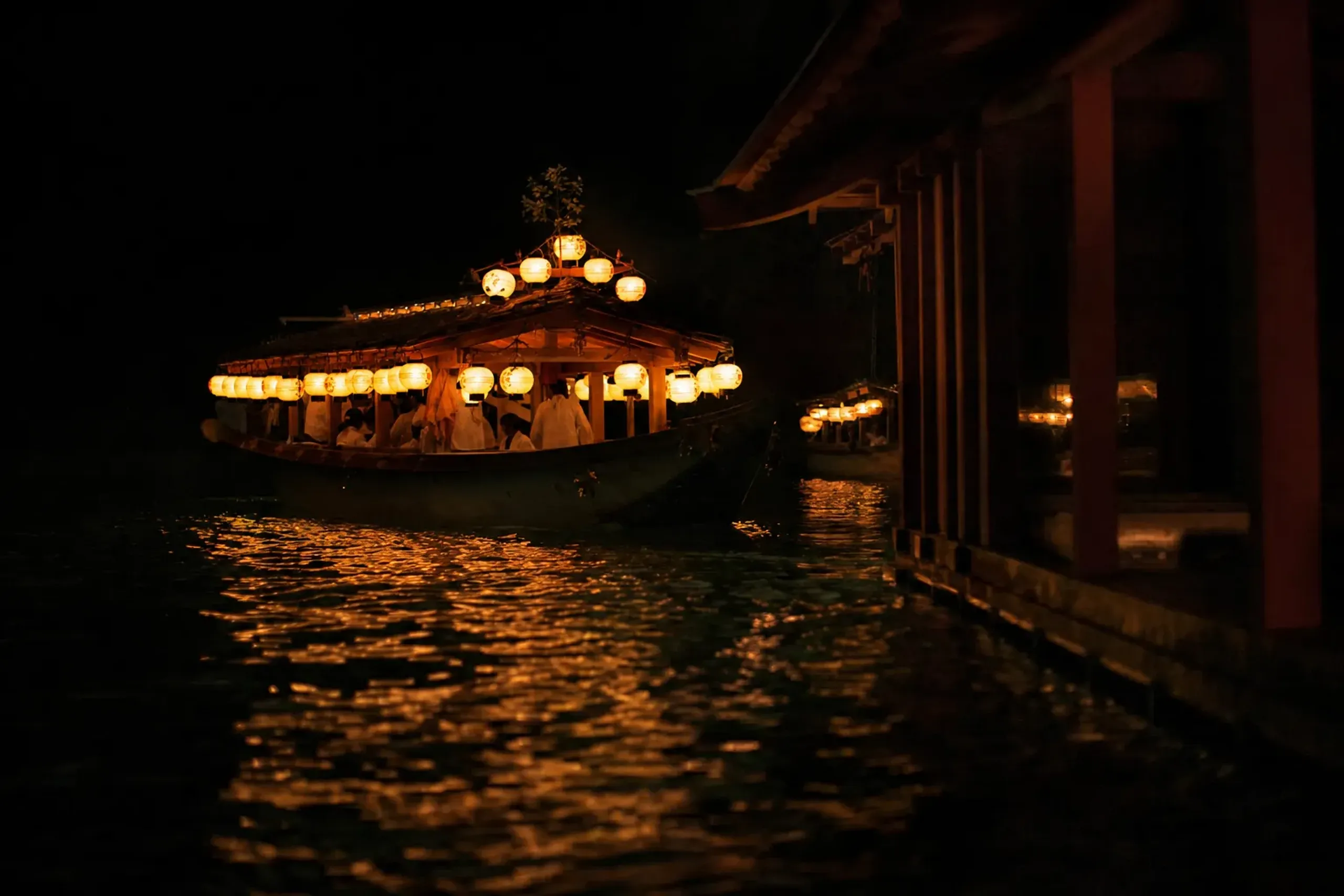
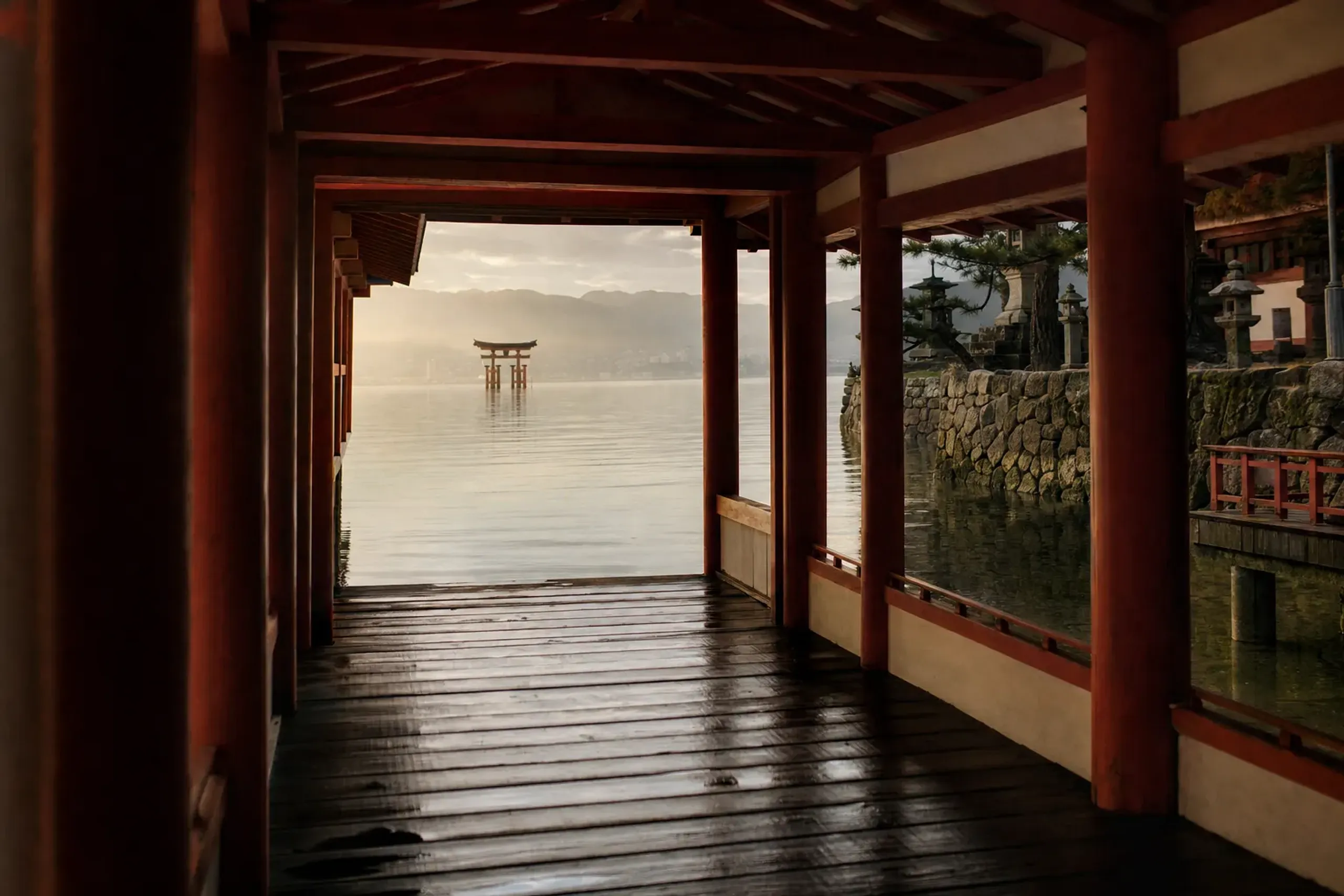
From there the boat follows a long route across the water. It waits off Hotate Rock for the tide to rise, crosses to Jigozen Shrine on the mainland and circles three times, then moves on toward Nagahama and Ōmoto Shrines before returning toward the shrine's famous corridor. There it turns while the musicians play, the lanterns doubling in the dark sea. The whole festival runs roughly from 15:00 to around 23:00.
The association is candid that timings shift with the tide and current. That is the nature of the thing. We do not publish stop-by-stop times for exactly this reason — a schedule read too literally becomes a disappointment when the sea runs slow. Our concierge team briefs guests on the sequence and the likely windows, then stays flexible on the night.
Key fact: The festival does not keep clock time. It keeps tide time. Plan the evening around the water, and keep a wide margin for everything after 19:00.
Will The Torii Float On The Day I Visit?
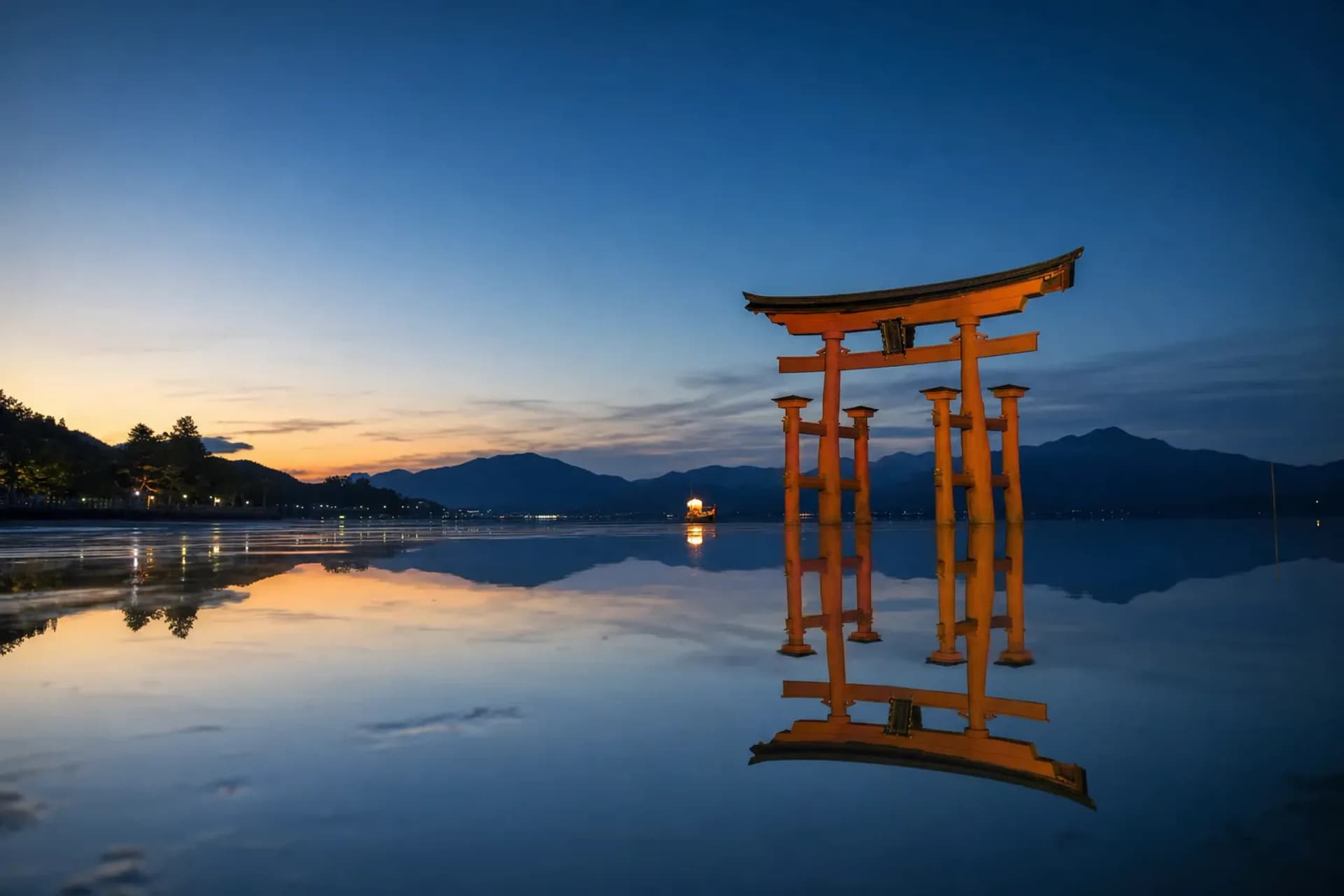
The Great Torii appears to float only when the water rises above about 250 cm, and you can walk out to it on foot only when the water drops below about 100 cm.
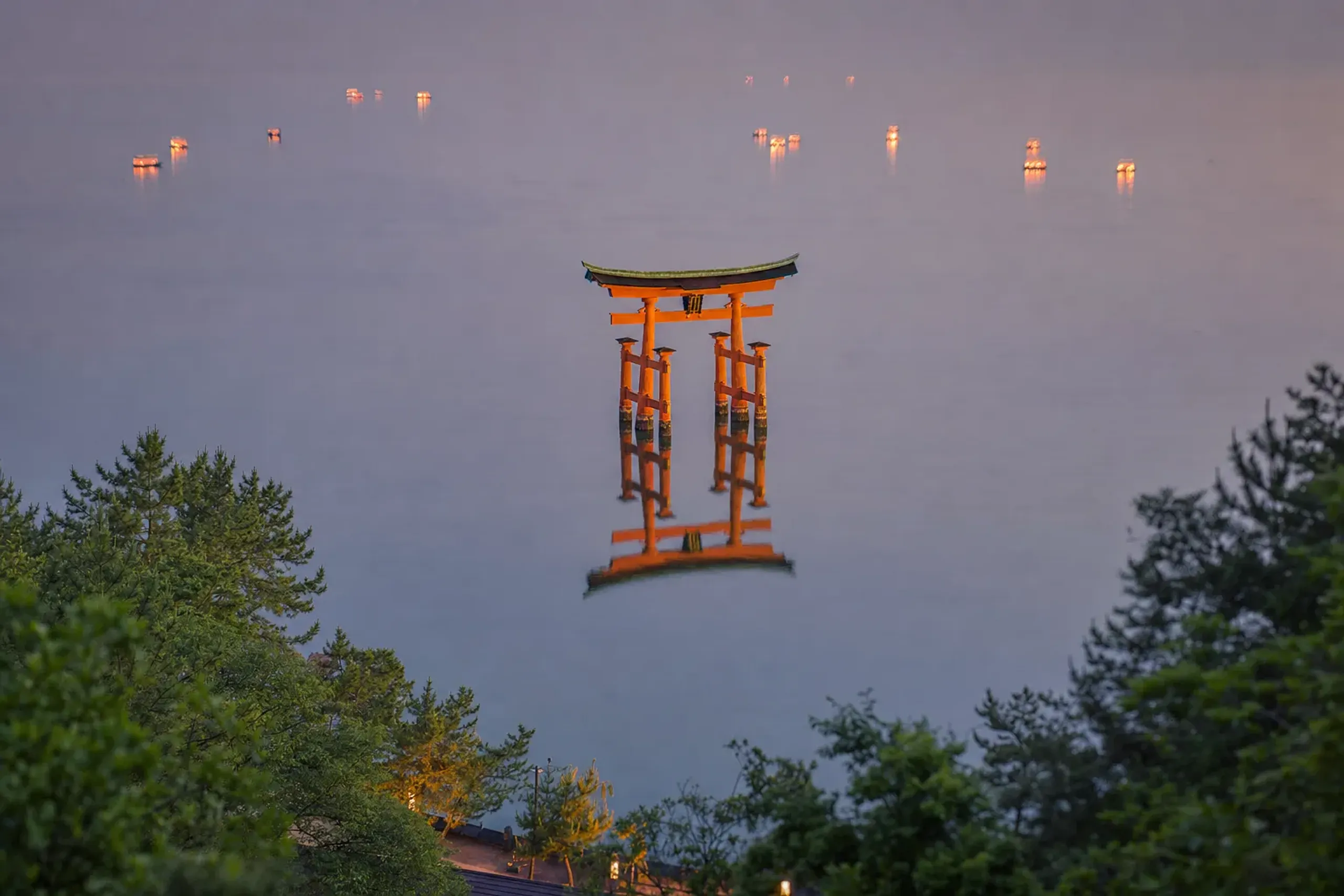
Neither state is guaranteed by the time of day.
This is where two stubborn myths need correcting, and the association itself flags both as misinformation. High tide does not always mean the torii floats. Low tide does not always mean you can walk to it. The actual water level on a given hour depends on the day's tidal range, which shifts through the lunar month. A modest high tide may not clear 250 cm at all.
The Great Torii stands about 16 metres tall, its main pillars cut from natural camphor, weighing in the region of 60 tonnes. The present gate was rebuilt in 1875 and holds its ground by its own weight, resting on pine piles driven into the seabed. It is one of the most photographed structures in Japan, and whether your photograph shows it mirrored in water or marooned on wet sand comes down to a number you can look up in advance.
How To Read The Miyajima Tide Table
Tide tables for Hiroshima Port are published on the association's own site. A few habits make them useful:
- Find your date and read the predicted heights, not just the labels "high" and "low." You want the centimetre figure.
- Compare it to the two thresholds: above roughly 250 cm for the floating impression, below roughly 100 cm to walk out.
- Remember Itsukushima's times run slightly earlier than Hiroshima Port, so give yourself a buffer.
- Note the tidal range runs roughly 3 to 4 metres, which is why the shoreline transforms so completely across a single day.
As an illustration, 30 July 2026 was a spring tide: Hiroshima Port showed a low of 39 cm at 16:19 and a high of 361 cm at 22:47.
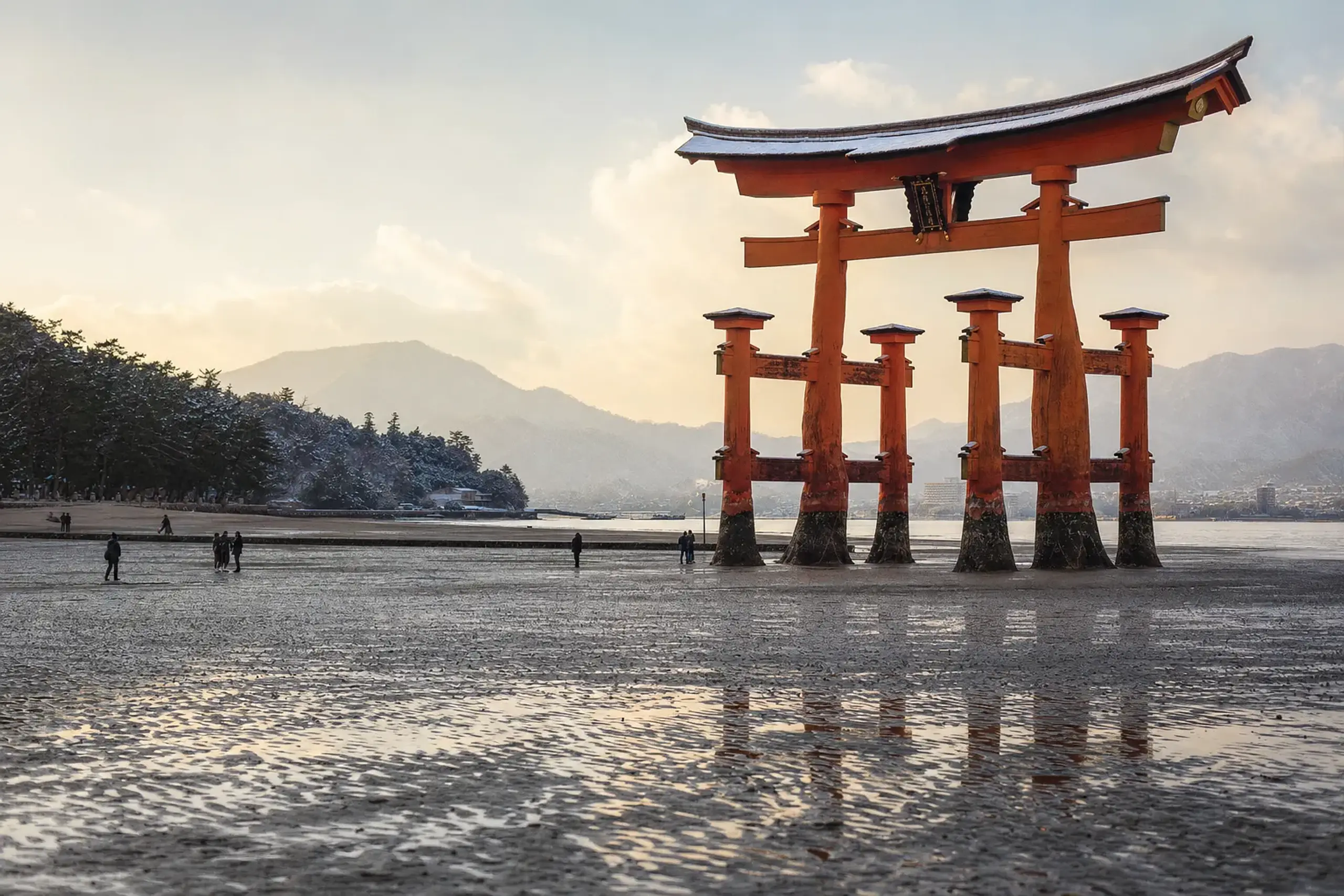
That evening high is exactly what the festival boat needs. It also means a walker who arrived mid-afternoon could reach the torii on foot, while an evening visitor would see it rise clear of the water. Same day, two entirely different scenes.
One safety note that needs no source to state plainly: the tide returns, so watch the time. If you walk out at low water, do not linger. Stairs lead down to the beach near the shrine's entrance and exit; you cannot descend from inside the shrine itself.
Watching The Kangensai Festival From Shore
Crowds gather near Nagahama Shrine and around Miyajima Gakuen, where the returning boat and its music draw the biggest audience. In 2026 a road closure ran from 19:00 to 22:00. Expect dense foot traffic in the hours either side.
The association sells a limited number of paid boat-viewing seats each year. In 2026 these ran as two courses, reservation required, with online sales opening on 1 June, held rain or shine but cancellable in genuinely rough weather. This is the association's own public product with a small number of places, not something any travel company controls.
Terms and pricing change year to year, and 2027 details are not yet confirmed.
For guests who want those seats, our concierge team checks current availability and booking terms on your behalf well ahead of the visit, so you know what is open before you commit to a date. Many travellers, though, prefer a well-chosen vantage on land with a guide who can read the crowd and relocate before the squeeze. Both work. The choice depends on your party and your tolerance for standing room.
Getting To Miyajima For The Festival
From Hiroshima Station, the JR line reaches Miyajimaguchi in about 25 to 30 minutes. The ferry crossing takes roughly 10 minutes, run by two operators, JR West and Matsudai Kisen. From the pier, the shrine is a walk of about 10 to 12 minutes.
A visitor tax of ¥100 has applied since 1 October 2023, collected together with the ferry fare. Not everyone pays it — residents, commuters, preschool children, school groups and holders of disability handbooks are among those exempt. Shrine admission to the halls is ¥300 for adults, with summer hours running around 06:30 to 18:00, closing earlier from mid-October.
On festival night the public transport back toward the mainland tightens exactly when the crowds thin out, late and all at once. This is where unhurried logistics earn their keep. A private chauffeured vehicle waiting at a sensible meeting point on the mainland, with a driver briefed to expect a fluid finish time, turns a long tired scramble into a quiet ride.
Our private transfer coordination uses partner-fleet vehicles matched to the party, from an Alphard for a family to a larger coach for a group.
Other Summer Notes For Miyajima
Setouchi summers are hot, and the walk from pier to shrine offers little shade. Carry water and plan for the heat. Around 500 deer roam the island freely; the association asks that you do not feed them, and in practice that keeps both you and your belongings calmer.
A word on food. Oysters are Hiroshima's winter dish, harvested from autumn into the December-to-February months, so summer is not their season. The island's year-round specialty is anago-meshi, conger eel grilled and laid over rice, rich and worth seeking out whatever the month.
One premise to clear up: do not plan around fireworks. The August Miyajima Water Fireworks ended after 2019 and the association says there is no plan to bring them back. Come for the festival boat and the tide, not for pyrotechnics.
Guests with time to spare often add Mount Misen, at 535 metres, reached by a two-stage ropeway of about 14 minutes, with roughly an hour's round-trip walk from the upper station to the summit. For those extending into the wider Setouchi region, the Seto Inland Sea island-hopping offers a slower sequel, and art lovers often pair the area with a Naoshima art trip.
How Japan Royal Service Plans A Kangensai Evening
Kangensai is a public shrine rite. No one holds early, private or after-hours access to it, and we would never suggest otherwise.
What we arrange is everything around the rite that makes the evening calm instead of chaotic.
That means a cultural interpreter guide who can explain the music, the route and the lunar logic as it unfolds; a private transfer matched to your party; accommodation coordination in Hiroshima or on the island itself; and day planning that reads the tide table before anyone sets a departure time. It is the quiet discipline of a shokunin approach applied to logistics — the right vantage, the right hour, the right ride home, arranged so you notice none of the effort.
Discretion sits at the centre of how we work. Your identity, your itinerary and your preferences stay confidential. For travellers who value a part of the country that the obvious guides overlook, our planning leans into a hidden-Japan sensibility: the tide-reading, the relocation an hour before the crush, the late meal already waiting. A bespoke itinerary turns a famous festival into an evening shaped entirely around you.
Frequently Asked Questions
Will The Floating Torii Actually Float On The Day I Visit Miyajima?
Only if the water rises above about 250 cm that day. Check the Hiroshima Port tide table for your date, read the predicted height in centimetres, and match the hour you plan to visit against that threshold.
Can I Walk Out To The Great Torii At Low Tide?
Yes, but only when the water drops below about 100 cm, which does not happen at every low tide.
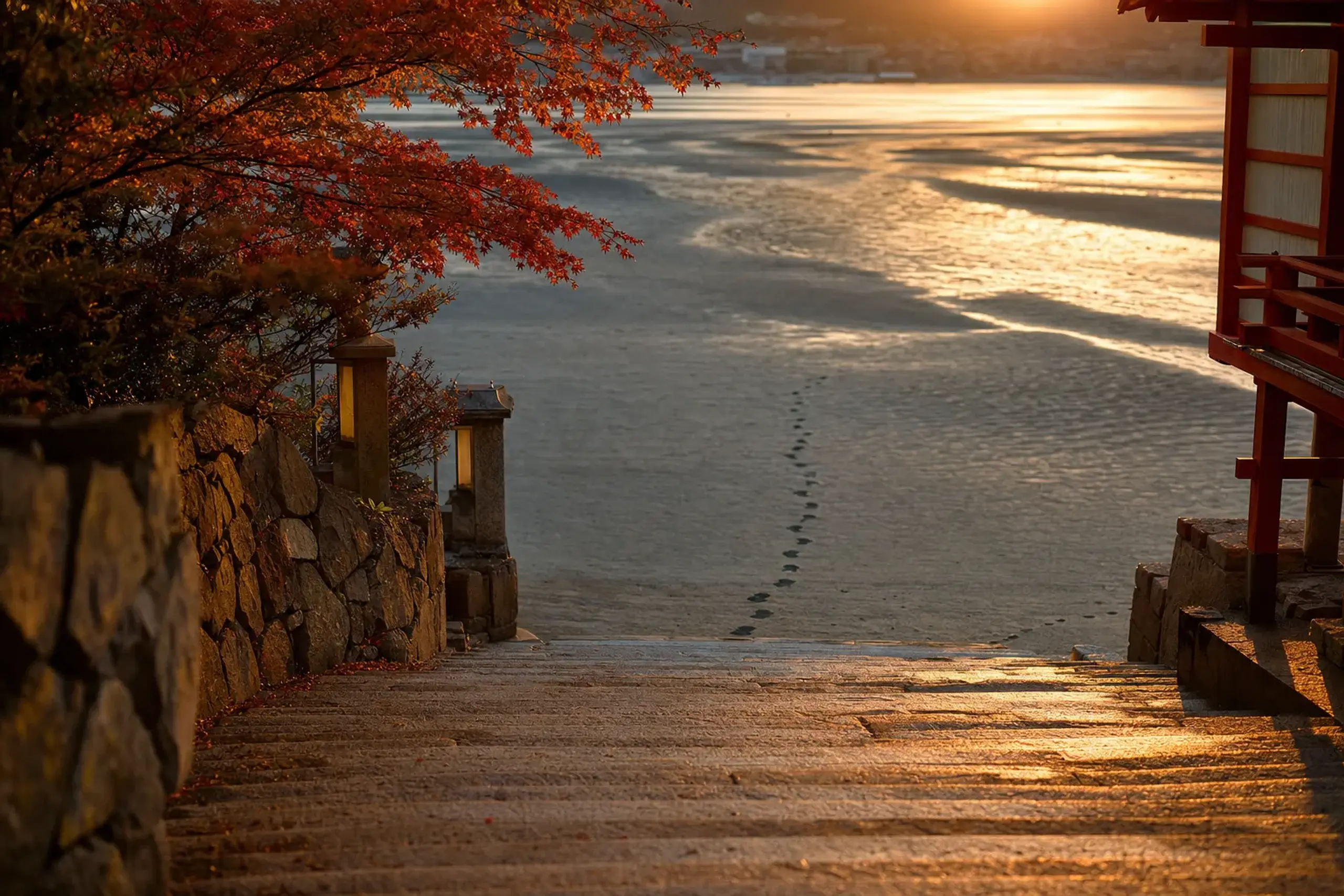
Confirm the day's predicted low on the tide table, descend by the stairs near the shrine entrance, and head back early because the tide returns.
Do I Need A Ticket To Watch Kangensai?
No ticket is required to watch from shore around Nagahama Shrine and Miyajima Gakuen. The association also sells a limited number of paid boat-viewing seats each year, reservation required; our concierge team checks current terms and availability on your behalf.
When Is The Next Kangensai Festival?
Kangensai falls on the 17th day of the sixth lunar month, which is Thursday, 30 July 2026, and Tuesday, 20 July 2027. The date moves each year because it tracks a high spring tide rather than a fixed calendar day.
Why Choose Japan Royal Service
A festival that waits for the sea rewards travellers who plan with it, not against it. That is precisely where our experience shows. Our team at Japan Royal Service reads the tide tables, times the approach, positions you before the crowd closes in, and arranges a comfortable ride back when the night runs long.
We bring native coordination, confidential service, and guides who turn the music over the water into something you understand rather than simply watch. From Hiroshima accommodation to the walk down to the shoreline at the right hour, the evening is built around your pace.
To plan a Kangensai evening on Miyajima, reach our team privately via WhatsApp or LINE, or contact us here.