In this guide
- 01The correction almost every guide gets wrong
- 02Why it matters more on a port call
- 03The boat — the answer to a high-tide-only date
- 04The exposed shrine is not a failed visit
- 05Hours, tide tables and the port-time discrepancy
- 06Timing within the call, mobility and the deer
- 07What we arrange
- 08Frequently Asked Questions
- 09Read on
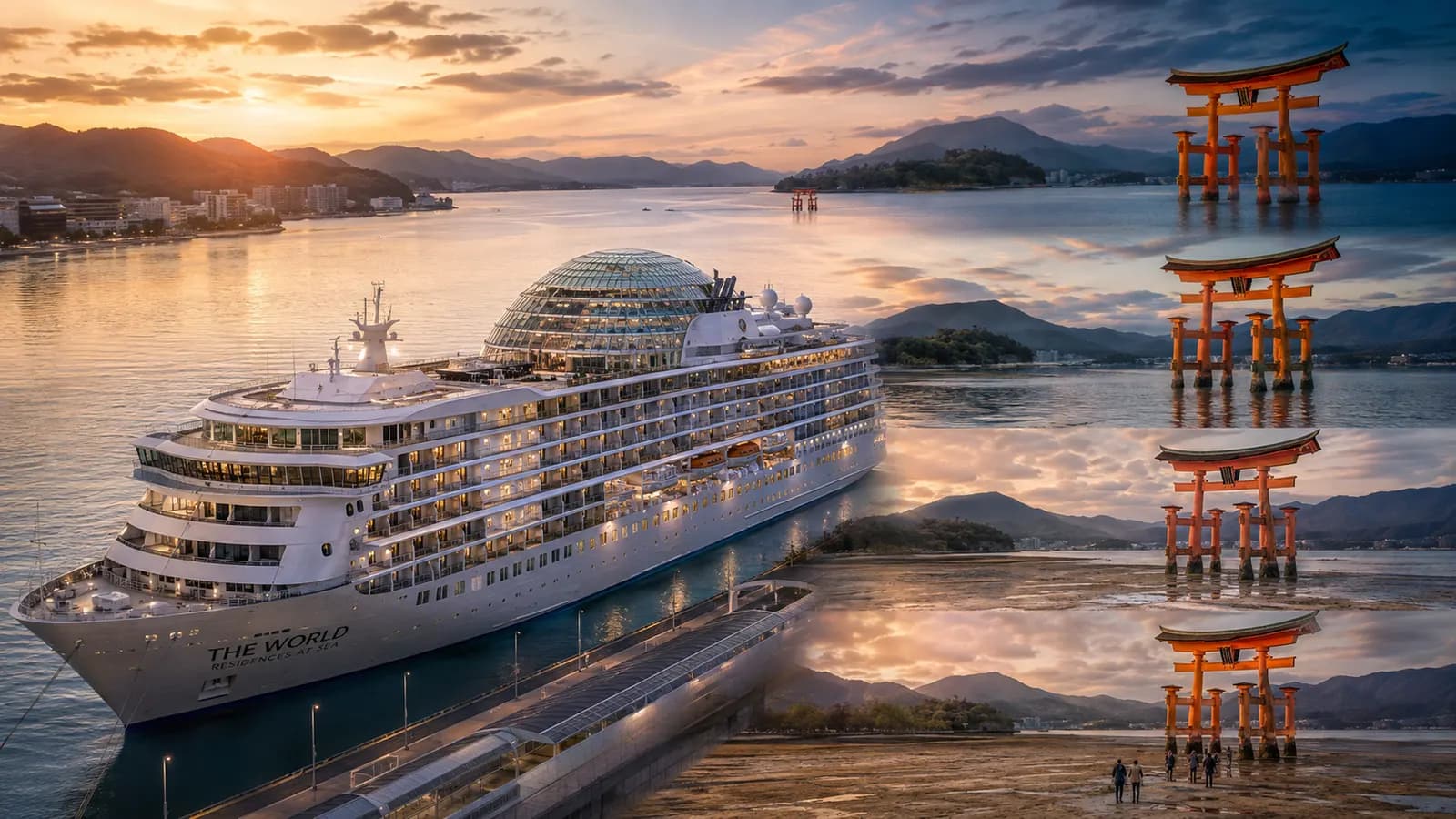
Miyajima, seen from Hiroshima — a shore day for the traveller whose date is fixed and whose tide is not.
The most photographed gate in Japan stands in the sea, and it is not fixed to the seabed. Sixteen and a half metres of camphor wood, held in place by nothing but its own weight and the six legs it stands on. Vermilion against grey flats one hour, vermilion above still water the next.
Almost every visitor to Miyajima sees one of two things: the shrine appearing to float, or the torii standing on exposed sand with people walking out to it. Almost no one sees both, because almost no one gets to choose the hour they arrive. And when a ship fixes your date for you, the question is no longer when should we go — it is what does our date give us.
The correction almost every guide gets wrong
Two things are repeated about Miyajima in nearly every English-language guide, and both are false. The Miyajima Tourist Association says so directly.
- High tide does not mean the shrine appears to float. The shrine floats only when the tide level exceeds 250cm.
- Low tide does not mean you can walk to the torii. You can walk out across the flats only when the tide level falls below 100cm.
These thresholds are absolute, not relative. A day's high water might peak at 200cm and its low might bottom out at 150cm — giving you neither the floating shrine nor the walkable gate. To get both, the water has to rise above 250cm and fall below 100cm within the same day. Not every date does that.
That is the whole post, and it is the most useful paragraph anyone has written in English about visiting Miyajima. The rest is what to do about it.
Why it matters more on a port call
A traveller planning independently reads the tide table first and picks the date to suit it. That is the easy case. On a port call the logic inverts: the date is fixed by the ship, and the tide is simply whatever it is that day. You cannot move the water, so the planning question changes entirely — not when should we go, but what does our given date offer, and what can be built around it.
This is the honest starting point, and everything we arrange follows from it. A date that delivers both faces of the shrine is planned one way. A date that gives only high water is planned another. A date that never rises above 250cm is planned a third. None of them is a wasted day — but they are three different days, and knowing which one your date is before you sail is the difference between a chance and a plan.
Itsukushima Shrine was built out over the water on purpose. The island itself was held to be sacred — so sacred that for centuries commoners were not permitted to set foot on it, and the shrine was raised on piles in the shallows so that worshippers could approach without standing on holy ground. The present arrangement dates from 1168, when Taira no Kiyomori rebuilt it at the height of his family's power. UNESCO inscribed it in 1996. The result is a site with two completely different faces, decided by the moon rather than by you.
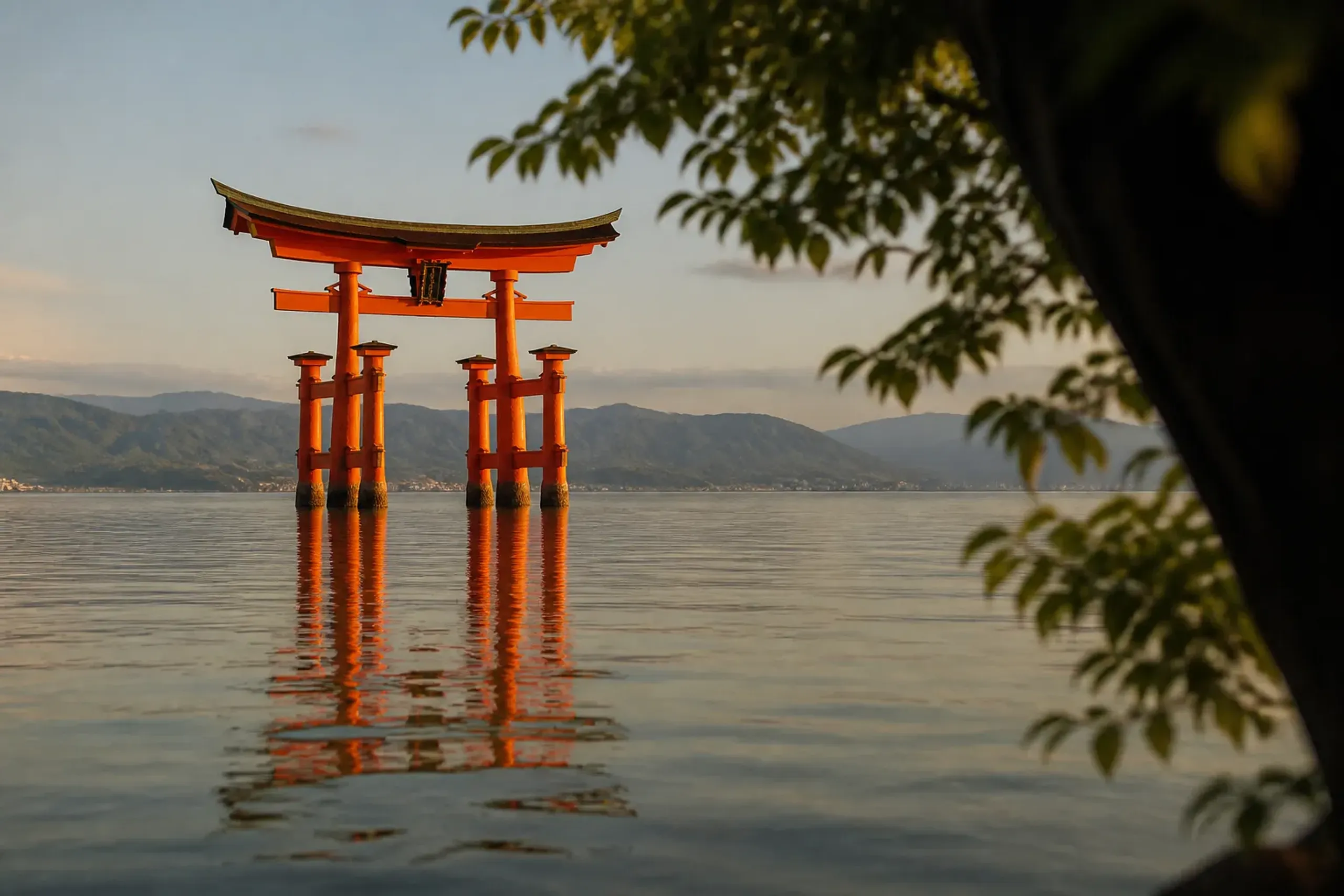
Above 250cm the corridors stand in the sea, the reflections come up under the vermilion, and the great torii sits offshore in open water. This is the image the shrine exists to produce.
The boat — the answer to a high-tide-only date
Suppose your date gives high water but never falls below 100cm. The torii cannot be reached on foot; the flats never emerge. It can still be reached — by water. Small rowed boats work the shallows by day and sightseeing vessels pass beneath the gate in the evening, gliding directly under the beam. A private charter does the same on your own timing, without the queue and without the fixed departure, taking you under the gate when the light is right rather than when the schedule permits.
So the boat is not a luxury flourish; it is the functional solution to a specific arithmetic problem. When the tide will not let you walk, it lets you approach anyway.
The exposed shrine is not a failed visit
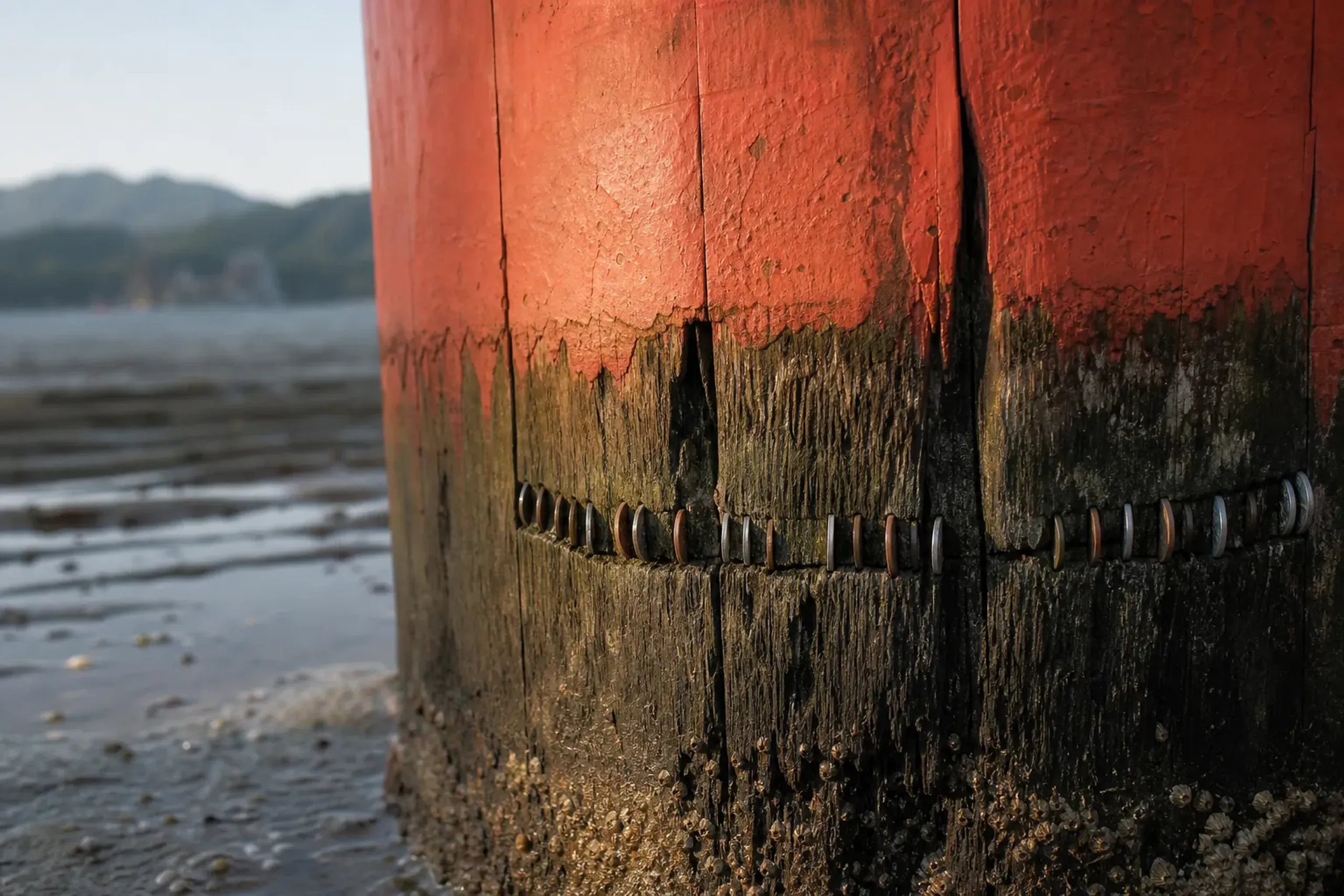
Now suppose the opposite: a date whose high water never rises above 250cm. The shrine will not float. It stands instead on exposed flats, its pillars and piles laid bare, the whole structure resting visibly on the ground it was built to hover above.
This is worth writing as its own thing rather than as a disappointment. Below 100cm the sea withdraws several hundred metres and you walk out across wet sand to stand beneath the gate. You can see the coins pressed into the joints of the legs by pilgrims, and the sheer scale of a structure that from the shore reads as elegant and from beneath reads as enormous. The building you meet at low water is genuinely a different building from the one that floats — the same coordinates, the same timber, a wholly different encounter. It is the other half of the shrine, not a lesser version of it.
Hours, tide tables and the port-time discrepancy
This is the plain-register section. Everything above turns on these figures, so they are worth stating exactly.
- Tide tables are published by the Miyajima Tourist Association for the full year. They are calculated for Hiroshima Port; the times at Itsukushima Port run slightly earlier. This discrepancy catches people — read the tables against your actual landing point, not the city.
- The interval. Roughly six hours separate high and low water, so a call of eight hours or more can in principle catch both faces — but only if that day's tidal range is wide enough to cross both the 250cm and the 100cm thresholds.
- Shrine hours. 06:30 to 18:00 from March to 14 October; 06:30 to 17:30 from 15 October through November; 06:30 to 17:00 from December to February. Admission ¥300 for adults.
- Illumination. The torii and shrine corridors are lit nightly from sunset until around 23:00.
- Access. The island is reached from Hiroshima by ferry, and direct water routes from Hiroshima Port operate. Confirm current direct services and journey times before travel.
Confirm hours, admission and the tide-table publication before you rely on them; the shrine reviews its schedule and the tables are recalculated fresh each year.
Timing within the call, mobility and the deer
The strongest single lever inside a fixed date is the early morning. Before the day boats arrive, the precinct belongs to almost no one. Any guest whose ship berths early can be at Itsukushima at opening, with the corridors and the gate to themselves and the light still low over the water. It is the one hour the island reliably gives, whatever the tide is doing, and it costs nothing but rising.
A word on mobility. Walking to the torii at low water means crossing wet flats that are uneven and slippery, and it is not for everyone. If the walk out is unwise on the day, the boat answers the same problem from the water. Say so in advance and we plan for it rather than around it.
Finally, the deer. They roam freely across the island and have done for centuries. They will take food, maps and loose paper straight from an open bag, and they are boldest in autumn. Keep your distance and keep paper out of sight. There is no need to feed or approach them.
What we arrange
Stated plainly, and each tied to the tide problem it solves:
- Private boat charter to and around the island — the answer to a high-tide-only date, taking you beneath the gate when the flats will not emerge.
- Access to Itsukushima Shrine outside the published day — the early morning before the boats, and the lit precinct after dark, both used to sidestep the crowds that a fixed date otherwise delivers.
- Ryokan accommodation on the island — so that a wide tidal range spread across a long day, or the illuminated shrine at night, is not surrendered to the last ferry back. This is the case the overnight argument makes in full.
- Private guiding within the precinct — a guide who reads the tide table with you and shapes the hours ashore around it, on a tailor-made itinerary rather than a fixed circuit.
We are a Japanese company, working in Japanese, with the people who hold access to these places. The arrangements are made by someone the other side already knows, and your identity and itinerary remain entirely private. Japan Royal Service does not publish its clients, its itineraries, or its rates.
Frequently Asked Questions
Can you see the floating shrine and walk to the torii on the same day?
Only when the day's tidal range crosses both thresholds — rising above 250cm for the float and falling below 100cm for the walk. The timings shift by roughly fifty minutes each day, and on a single fixed date you take whichever the tide gives you. Over a call of several days it stops being luck and becomes a choice.
Is the great torii really not fixed to the seabed?
It stands on its own weight and its six legs. The present gate dates from 1875 and is the eighth on the site.
What if our date gives neither the float nor the walk?
Then it gives something else. If the water stays high, the gate is reached by boat rather than on foot. If it stays low, the shrine stands on exposed flats — a different and equally worthwhile building. We tell you which of these your date is before you sail, and plan accordingly.
Read on
- The only imperial bath in Japan — Matsuyama
- A private morning at Ritsurin Garden — Takamatsu
When a ship fixes the date, the tide decides what that date gives you — and the difference between a chance and a plan is knowing in advance. To read your call's tide table with us, contact us here.