In this guide
- 01Why the altars became a Hiroshima industry
- 02Seven trades, and why no one person makes an altar
- 03What tate-nuri is, and why it is the hard way
- 04The sixth of August, and the street that rebuilt
- 05The fourth generation, and what he did with the technique
- 06What the city gave the G7
- 07What a visit is, and where it is
- 08What we arrange
Horikawa-chō, Hiroshima — one of a series of shore days Japan Royal Service builds for residents and guests of The World.
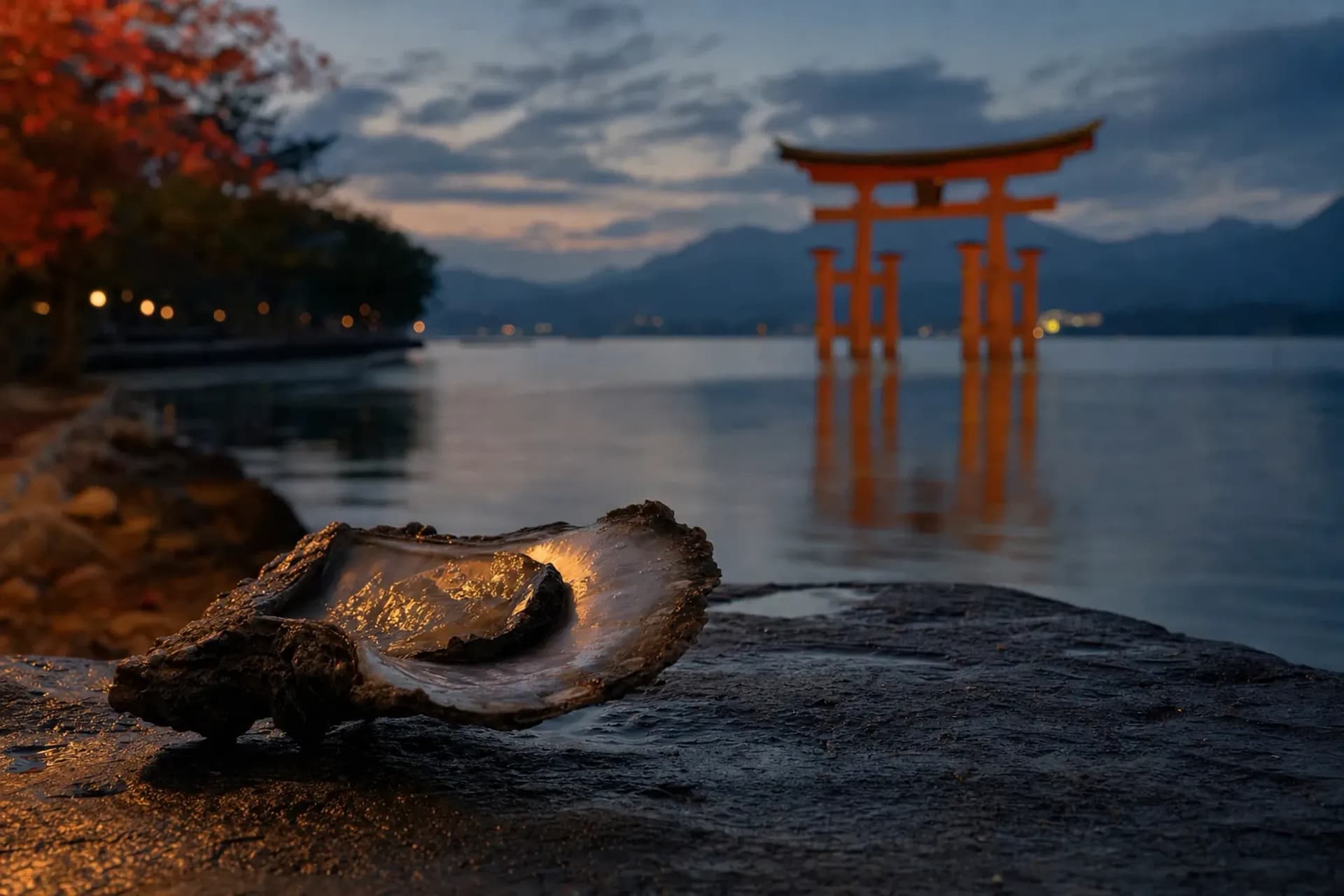
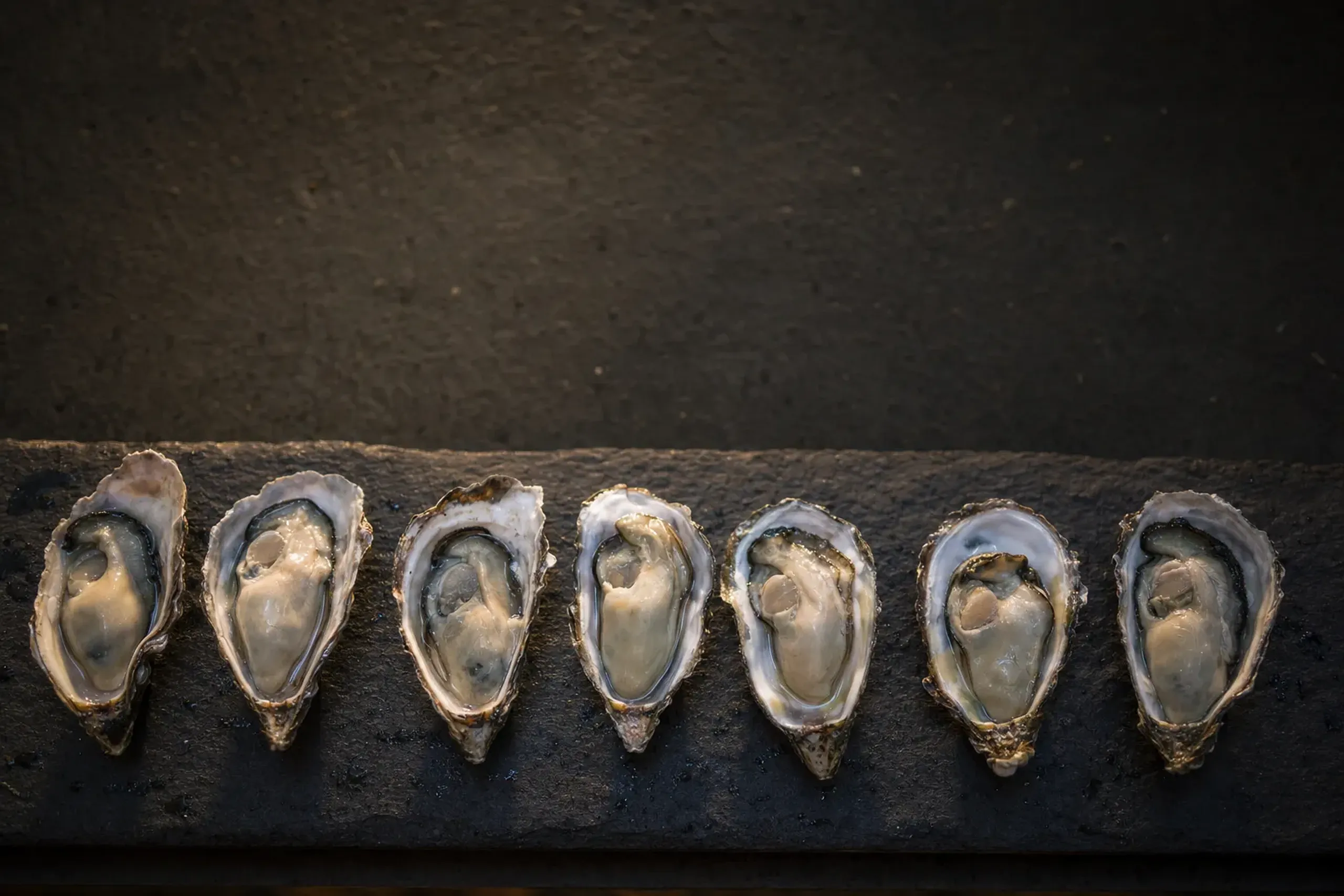
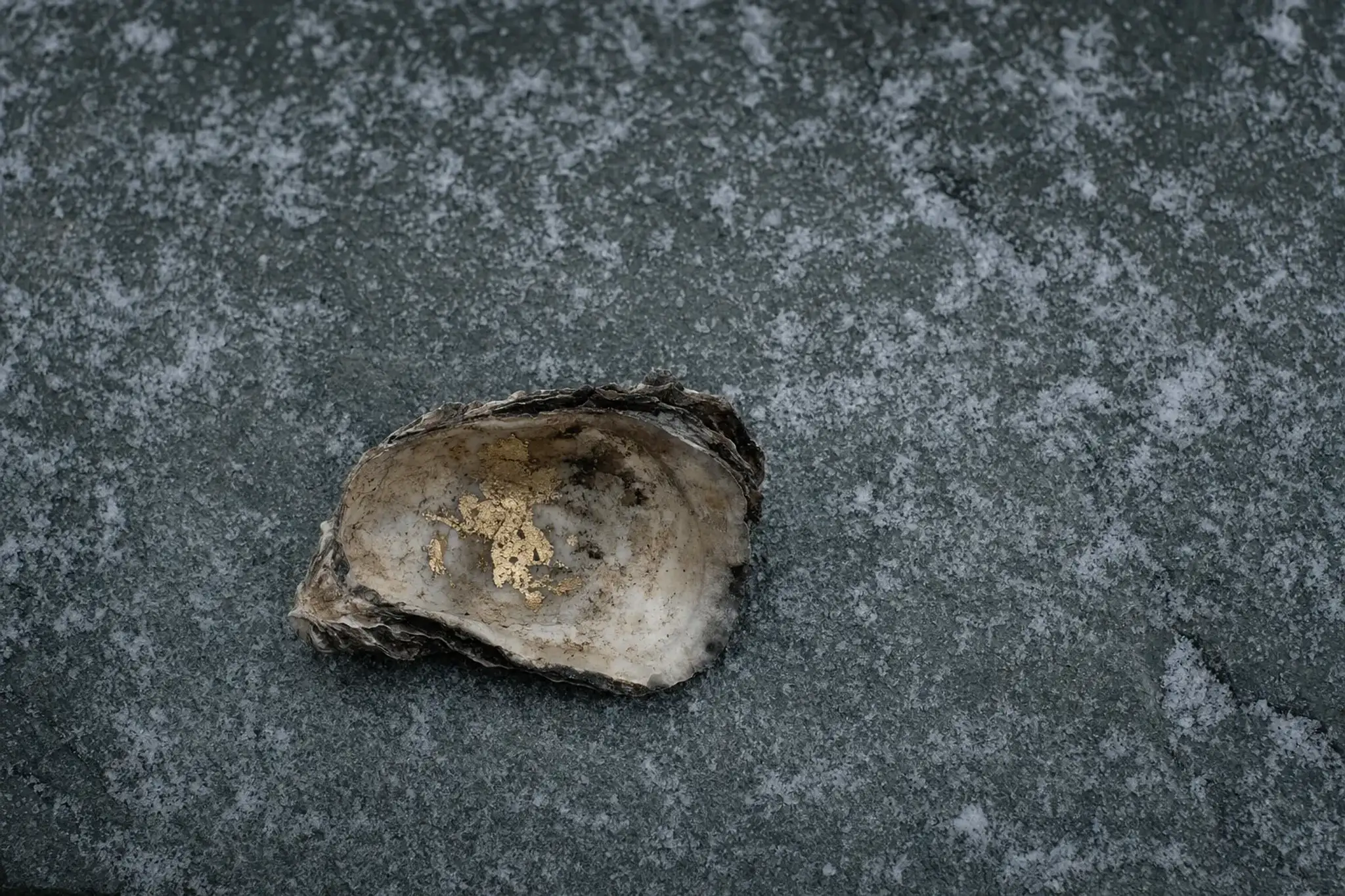
Under the gold leaf of a Hiroshima Buddhist altar there is a white ground, and the white ground is oyster shell.
It is called gofun shitaji. The shells are crushed fine and laid on as the base coat, before the lacquer and the gold ever arrive. Hiroshima Prefecture accounts for roughly six of every ten farmed oysters in Japan, and the national craft association describes the altars without ceremony: a base made from finely crushed oyster shells, a speciality of Hiroshima.
Nothing else in the object tells you as plainly where it was made.
Why the altars became a Hiroshima industry
Household Buddhist altars are made all over Japan. Hiroshima's exist because of what people here believed, and then because of an accident of politics.
The province of Aki — the western half of today's Hiroshima Prefecture — is Jōdo Shinshū country. The prefecture's own cultural encyclopaedia traces the school's arrival in western Japan to the early fourteenth century, when the priest Myōkō moved into the Numakuma peninsula in Bingo and founded Kōshō-ji as a base for preaching across the region. It took hold hard. The believers here acquired a name of their own, Aki monto, and when Oda Nobunaga besieged the Ishiyama Hongan-ji they marched to Osaka to fight for it.
That matters for a craft because of what a Shin Buddhist altar is for. It is not simply a cabinet for remembering the dead; it is a representation of the Pure Land itself, which is why it is gilded rather than merely decorated.
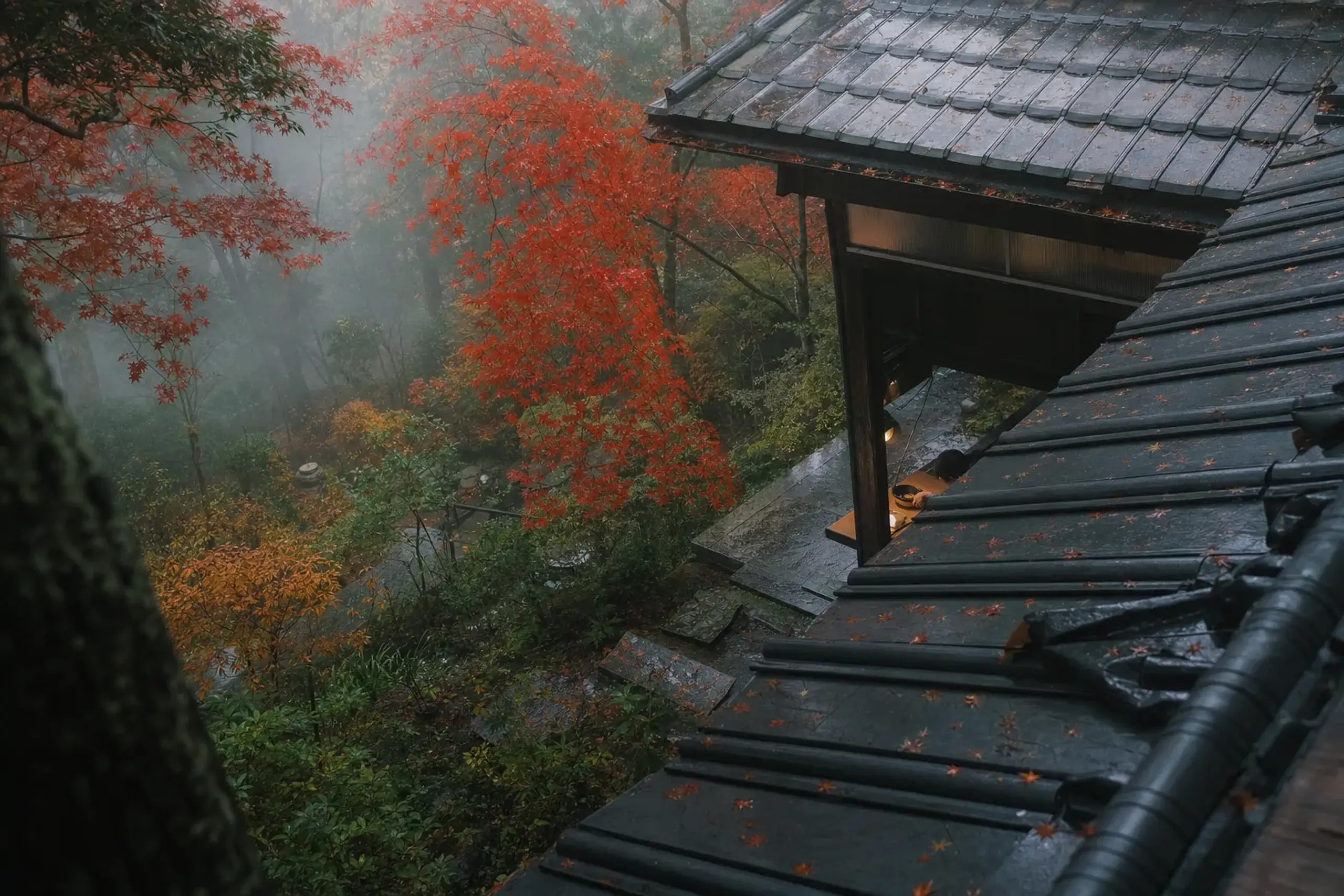
A province full of committed lay believers is a province that needs a great many small gold rooms built to a standard.
The technique arrived later than the demand. In 1619 Asano Nagaakira was transferred from Kishū — today's Wakayama — to Hiroshima, and skilled lacquer craftsmen came with his household; their arrival, in the craft association's phrase, improved altar-making here dramatically. Then in 1716 a monk named Atsutaka went to Kyoto and Osaka, learned the advanced methods used there, and came home. That is the point at which Hiroshima's own technique is considered established.
The rest is geography. Altars are large and awkward, and Hiroshima sits on the Seto Inland Sea. Once Meiji-era shipping opened the country up, the bulk that had been a problem stopped being one, and by the end of the Taishō era — the mid-1920s — Hiroshima was producing more Buddhist altars than anywhere else in Japan. The craft was designated a national Traditional Craft on 6 February 1978, the second in the prefecture after the brushes of Kumano.
Seven trades, and why no one person makes an altar
A Hiroshima altar is not made by a craftsman. In the name everyone uses, it is made by seven of them — the nanashō, the seven masters, the division that both Hiroshima City and the national craft association cite. (The Prefecture's own account of the trade names eight, and the trade association's own workshop walkthrough runs to nine; no single source reconciles the three counts.) The seven named below are the ones the city and the national craft association agree on.
The seven are the kijishi, who builds the wooden body; the samashi, who cuts the pierced openwork panels; the kūdenshi, who builds the miniature palace that stands at the centre; the shumidanshi, who makes the tiered platform beneath it; the kazari-kanagushi, who forges and chases the metal fittings; the nushi, who lacquers; and the makieshi, who draws in lacquer and dusts the drawing with gold.
What is worth knowing before you stand in a workshop is how slow each of those is on its own. The wood — hinoki or sugi — is dried in the open air for more than a year before anyone cuts it. A practised body-maker needs ten days to a fortnight for a single altar; a practised carver a week to ten days. The gold leaf goes on in squares of about twelve centimetres, pressed down one at a time onto lacquer brought to exactly the right state of tack, then left in the damp cabinet for eight hours until it has taken completely.
Only at the very end does anyone see the object: the parts arrive from seven workshops, the fittings are struck on, gauze is stretched over the lattice screens, and the thing is finished. The division of labour is not an efficiency. It is the reason the standard is high, and also the reason the craft is fragile — seven specialisms have to survive, not one.
What tate-nuri is, and why it is the hard way
Two things are singled out whenever officials describe Hiroshima's altars. One is gold leaf. The other is a finishing method called tate-nuri.
The Nara National Museum's glossary defines the technique — under its other name, nuritate — as a lacquering method in which an oil-bearing lacquer is applied and produces its gloss without the surface being ground or polished afterwards.
That is the whole argument. In most fine lacquer the shine is earned after the fact: the cured surface is ground back with charcoal, levelled, and burnished until it is a mirror, and mistakes in the coat can be corrected in the polishing.
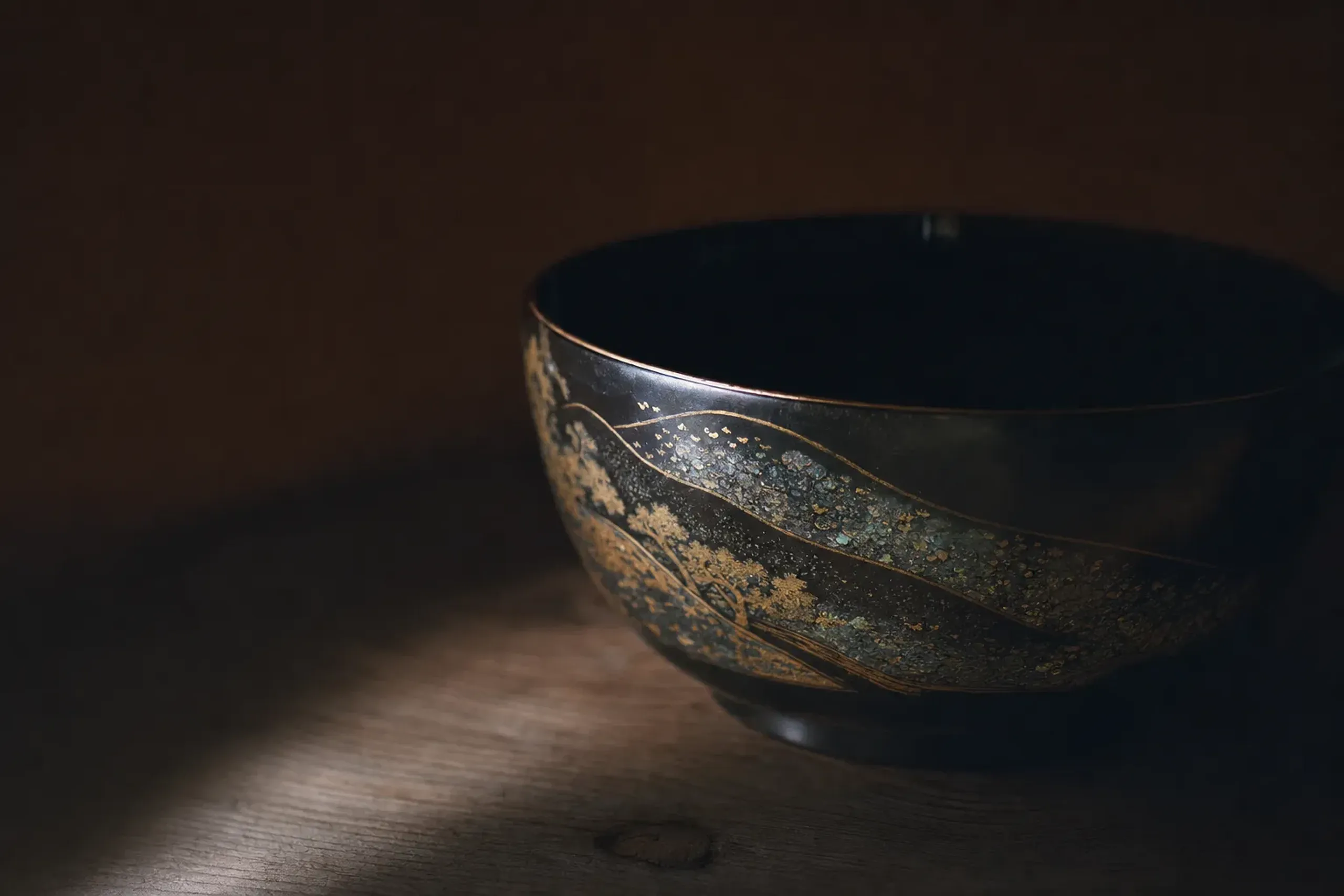
In tate-nuri there is no polishing. The brushed coat is the finished surface. Whatever the brush did, and whatever the dust in the room did, is what the customer receives. It is the technique with no second chance in it, and Hiroshima is known for it.
That is only the last coat. This workshop publishes its own coating sequence: hardening the wood, laying cloth, filling the weave, rounds of ground and of fine filler, undercoat, middle coat, top coat — seventeen operations once the grinding stages between them are counted.
And none of it dries in the ordinary sense. Lacquer does not lose a solvent to the air; it hardens by an enzyme reaction that needs warmth and moisture, which is why lacquer rooms are humidified rather than ventilated. A 2011 study by Egashira, Nabeta and Ogawa measured what the trade already lives with: drying time falls in proportion to both humidity and temperature. The weather is a member of the workshop.
The sixth of August, and the street that rebuilt
The altar makers of Hiroshima lived and worked close together in the flat streets of the delta, and those streets were close to the hypocenter. The national craft association's account of the trade says it without softening: the district where the altar craftsmen lived in numbers was near the hypocenter, and many of them were killed. Hiroshima City's own record is that within a two-kilometre radius almost everything was destroyed and then burned.
What happened afterwards is the part that is easy to skip.
The craftsmen who had survived in the city and those who came back from military service put the trade together again between them. The techniques established in 1716 were not re-invented — they were carried by the people who still had them.
The workshop we take guests to puts the same thing in one sentence on its own tour page: despite the devastation of the atomic bomb, the craftsmanship of the Edo period was not broken, and continues to be handed on. There is a version of a Hiroshima day ashore that consists entirely of the Peace Memorial Park, and it is a necessary version. This stands beside it — the same event seen from inside a trade that lost its people and kept its knowledge.
The fourth generation, and what he did with the technique
Takayama Kiyoshi Co. began in 1913 as a lacquerer's shop serving the altar trade. Its founder, Takayama Kiyoshi, was a nushi — one of the seven — and the company still carries his personal name. It passed its hundredth year in April 2013.
Takayama Naoya, born in 1981, is the fourth generation. He read Buddhist studies at Ryūkoku University's junior college, then apprenticed in Kyoto at a workshop specialising in roiro — the mirror-polished black finish, the exact opposite discipline to tate-nuri, in which everything depends on what you do to the surface after it has cured. He came back to Hiroshima at twenty-eight, was noticed for the restoration of a temple here, and joined the family firm in 2009.
In 2018 he started something the three generations before him had not: a line of lacquer under his own name, made for daily use rather than for worship.
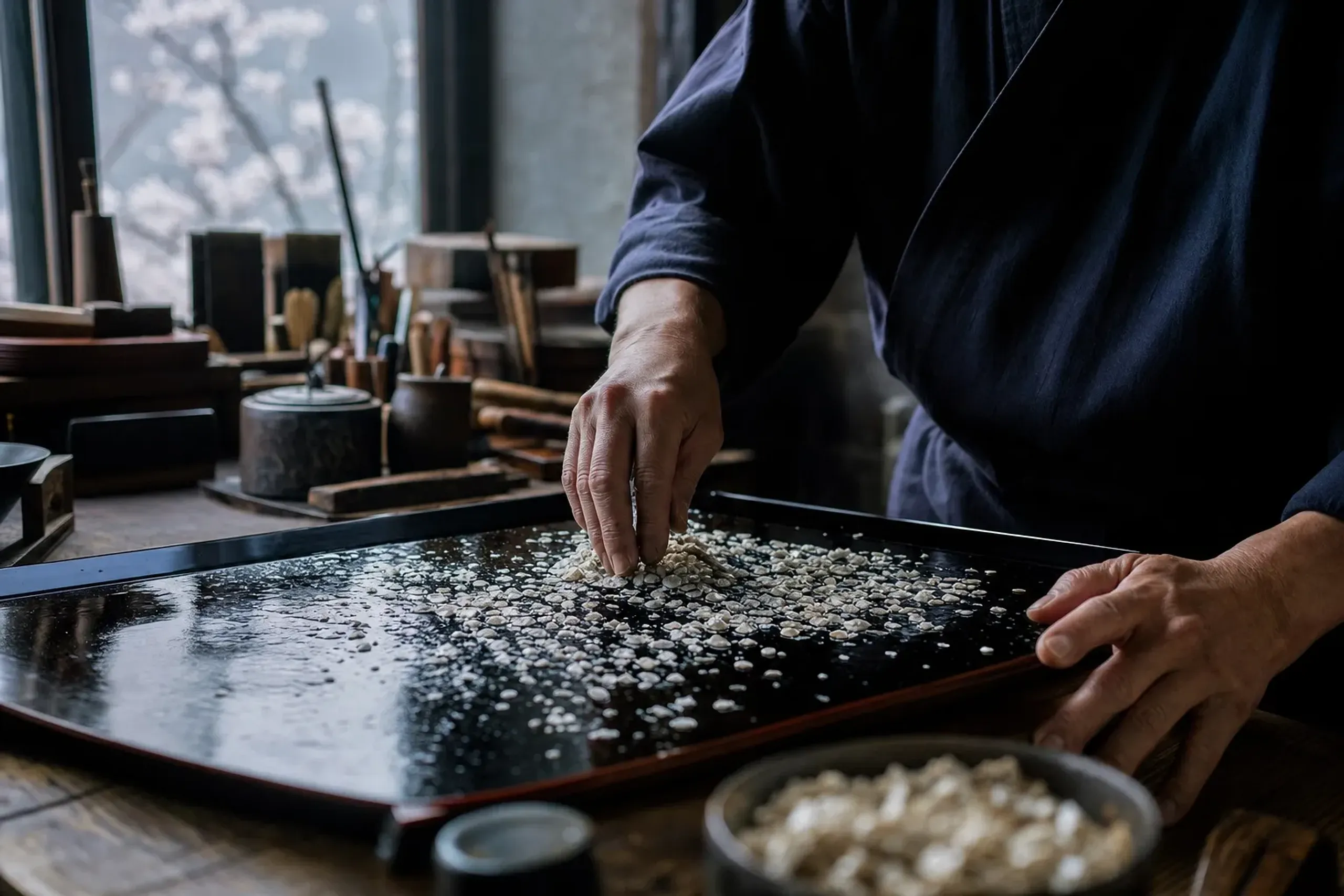
Hiroshima Prefecture describes what he does with the altar-lacquerer's inheritance plainly — he took the technique his family passed down, added the roiro polishing he learned in Kyoto, and set himself the theme of putting lacquer back into ordinary life.
The construction is worth understanding, because it is what you will be looking at. Most lacquerware is lacquer on a turned or joined wooden core. His is not. He uses kanshitsu, dry lacquer: a plaster mould is made, hemp cloth is laid up on it in layers with lacquer paste, and the cloth shell — not wood — becomes the body. The result is thin, light, strong, less troubled by dry air than wood is, and able to take curves a turned bowl cannot.
The awards are on the public record, and they are national rather than local — repeated selection for the Japan Traditional Art Crafts Exhibition and the Japan Traditional Lacquer Art Exhibition, the Asahi Shimbun Prize there in 2021, the Chairman's Prize of the Japan Chamber of Commerce and Industry in 2020, and governors' prizes in three prefectures. In 2021 the work was certified under Hiroshima City's own maker's mark, The Hiroshima Brand.
What the city gave the G7
In May 2023 the G7 summit met in Hiroshima, and the host city had to decide what its gift to the leaders would be. It chose a lacquer sake set by this workshop. The official record of the Hiroshima Summit Prefectural Citizens' Council lists it: a set titled Den, made by Takayama Naoya, presented by the City of Hiroshima to the G7 leaders and to the Presidents of the European Council and the European Commission — a lipped pouring vessel, cups, and a disc to stand them on.
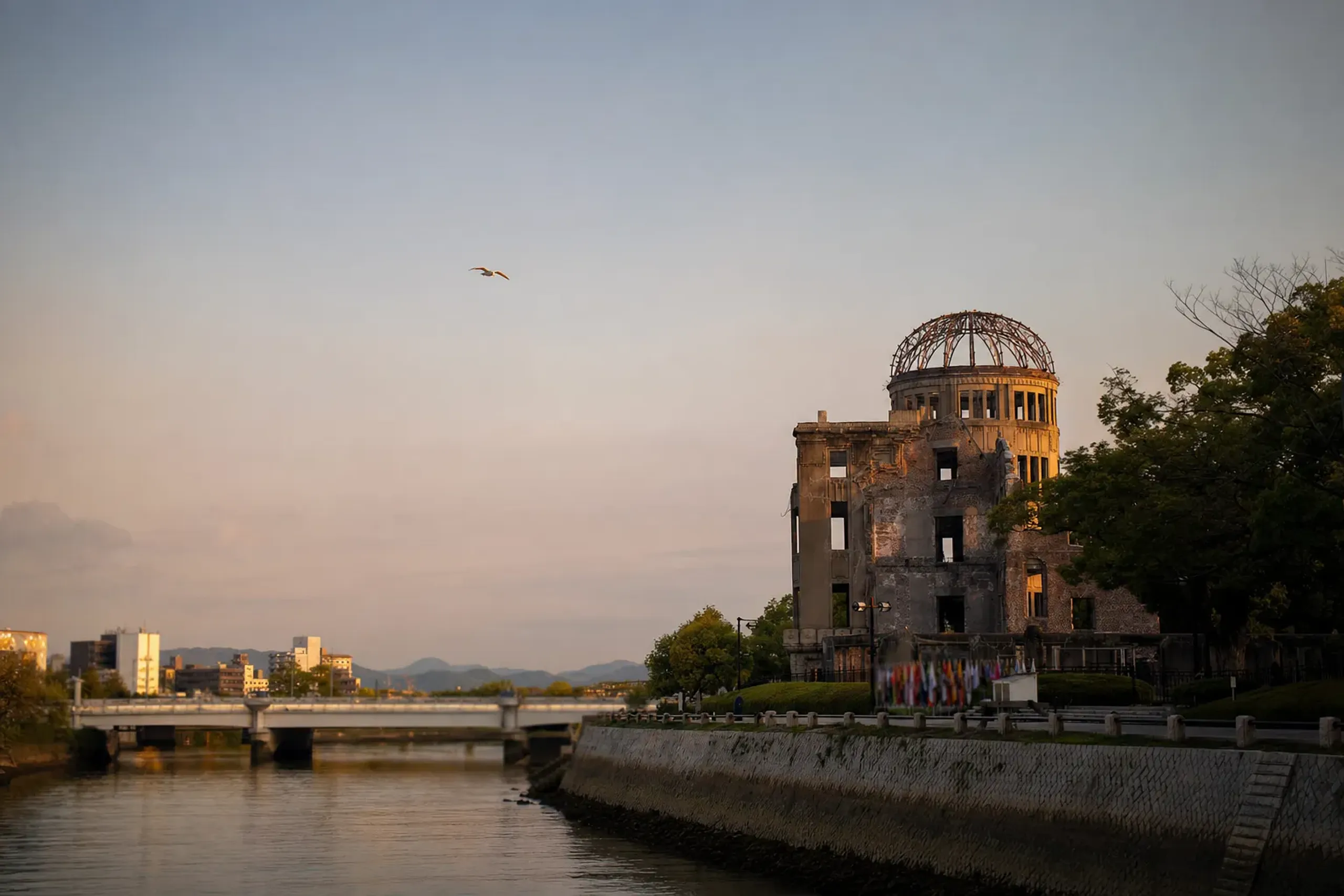
The reasoning the city published is the reason this article exists. Hiroshima Buddhist altars, it wrote, are where Japan's traditional arts are gathered together, and they developed here because of the strength of Jōdo Shinshū belief in this place; the lacquer was chosen as the thing in which that technique is now alive. The form of the vessel is a dove. The colour is the Inland Sea.
Separately, at the request of Kishida Yuko, wife of the then Prime Minister, he made a lacquer piece named Akebono — daybreak — for the spouses of the G7 leaders.
It is a rare thing to stand in the room where a state gift was made, with the man who made it, and ask him about it.
What a visit is, and where it is
The address is 2-17 Horikawa-chō, in Naka-ku. The wholesalers' association gives the street its working name in the address line itself: Butsudan-dōri, Altar Street. Number 2-16 is another altar house and the seat of the trade cooperative; 2-18 is a third — three consecutive doors on one block, in a city centre that was levelled eighty years ago and rebuilt around the same trade.
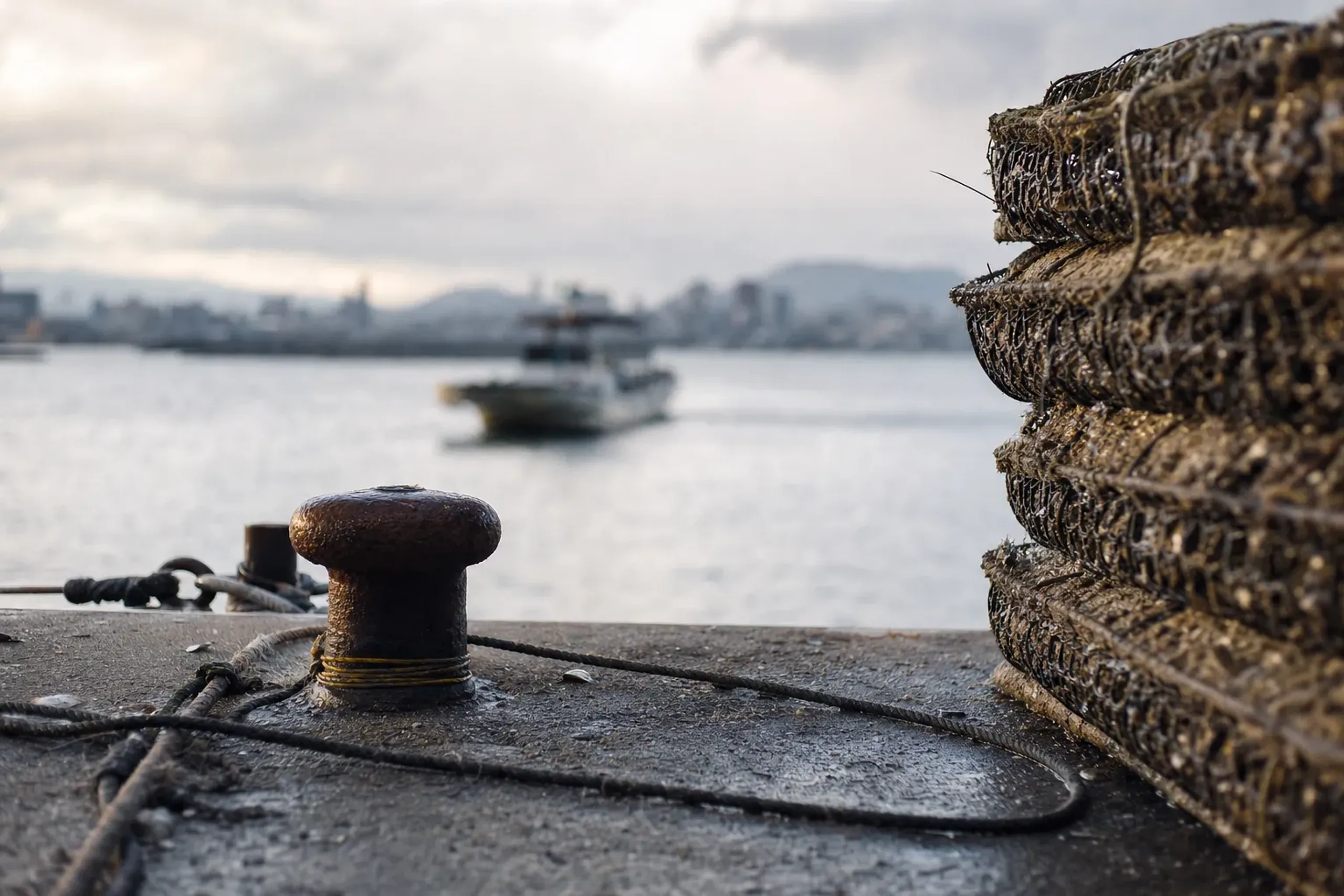
It is about five kilometres from the Ujina port area — a quarter of an hour or so by car, depending on the berth and the traffic. Close enough that it does not have to be the only thing in the day.
There are two formats, and they are genuinely different.
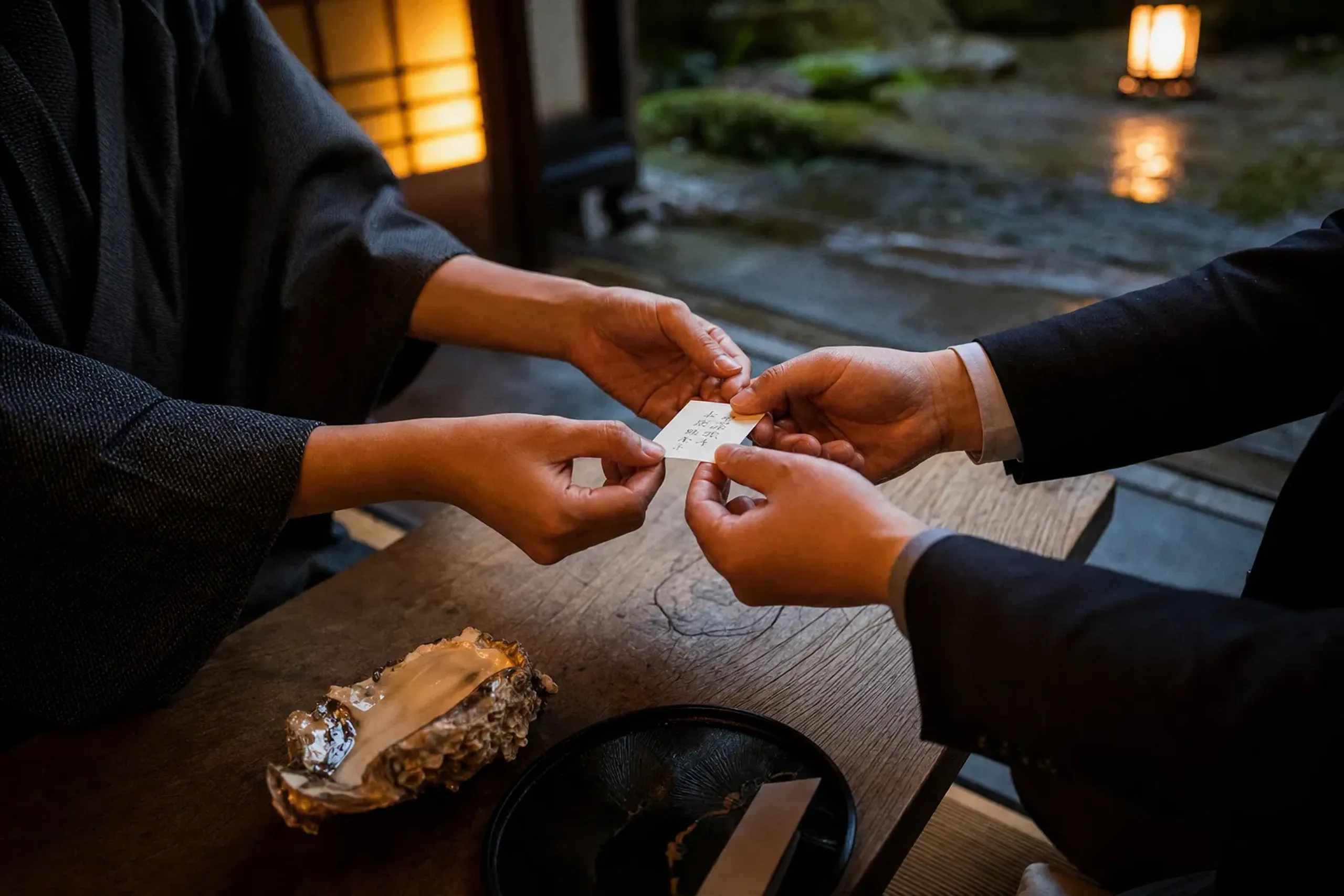
The two-hour visit. Takayama takes you through the workshop himself, explains where Hiroshima altars come from and how the lacquering is done, shows the award-winning work and the summit pieces, and puts you at the bench for part of the lacquering process. You are then given one of his own pieces — a sake cup, chosen from two. Because that piece is his, finished and cured, it leaves with you the same afternoon.
The one-hour visit. A guided walk through the workshop and then a gold-leaf lacquer coaster, which you make and keep.
Both run in English or Japanese, both take a maximum of ten people, and both are morning or early afternoon. Neither can be added on the day: the two-hour session closes the evening before, the one-hour session two days before. Children under eighteen may watch without joining the bench work.
What we arrange
The booking, the timing against your call, the car from the berth, and interpretation where it earns its place — Takayama's sessions run in English, so an interpreter is for the technical middle of a conversation rather than the greeting. If you want it, we will build the rest of the day around the workshop rather than the other way round: the memorial at an hour when it is not crowded, and Miyajima on whichever tide your dates give you.
We are a Japanese company, working in Japanese, with the people who own these places. The arrangements are made by someone the other side already knows. Enquiries are handled privately and directly, at japanroyalservice.com/contact. We do not publish our clients, our itineraries, or our rates.