In this guide
- 01The Baseline: Private Chauffeur vs. Taxi vs. Rideshare In Kyoto
- 022026 Rates And Booking Parameters For Kyoto Chauffeurs
- 03Legal Protections And Properly Licensed Transport
- 04Overcoming Kyoto Congestion: Strategy Over Transportation
- 05The Role Of An English-Speaking Driver In Japan
- 06Frequently Asked Questions About Kyoto Chauffeur Services
- 07Why Choose Japan Royal Service
Japan Royal Service provides private chauffeur and pre-booked hire car services in Kyoto with English-speaking drivers. Operations cover Kansai International Airport (KIX), Itami (ITM), and central Kyoto using premium vehicle classes such as the Lexus LM 500, Toyota Executive Alphard, and Mercedes V-Class. We maintain strict compliance with Ministry of Land, Infrastructure, Transport and Tourism (MLIT) regulations, operating exclusively on a prior-reservation basis.
Kyoto demands strategic navigation. Narrow lanes in Gion, severe congestion along the Higashiyama corridor, and strict parking limitations at historic temples create intense friction for visitors relying on public infrastructure. A retained private car eliminates this friction. The vehicle waits. Your luggage stays secure aboard. The route adapts to the hour. For travelers arranging a tailor-made itinerary, understanding the structural differences between a retained chauffeur, a metered taxi, and an app-dispatched ride is the critical first step in journey planning.
The Baseline: Private Chauffeur vs. Taxi vs. Rideshare In Kyoto
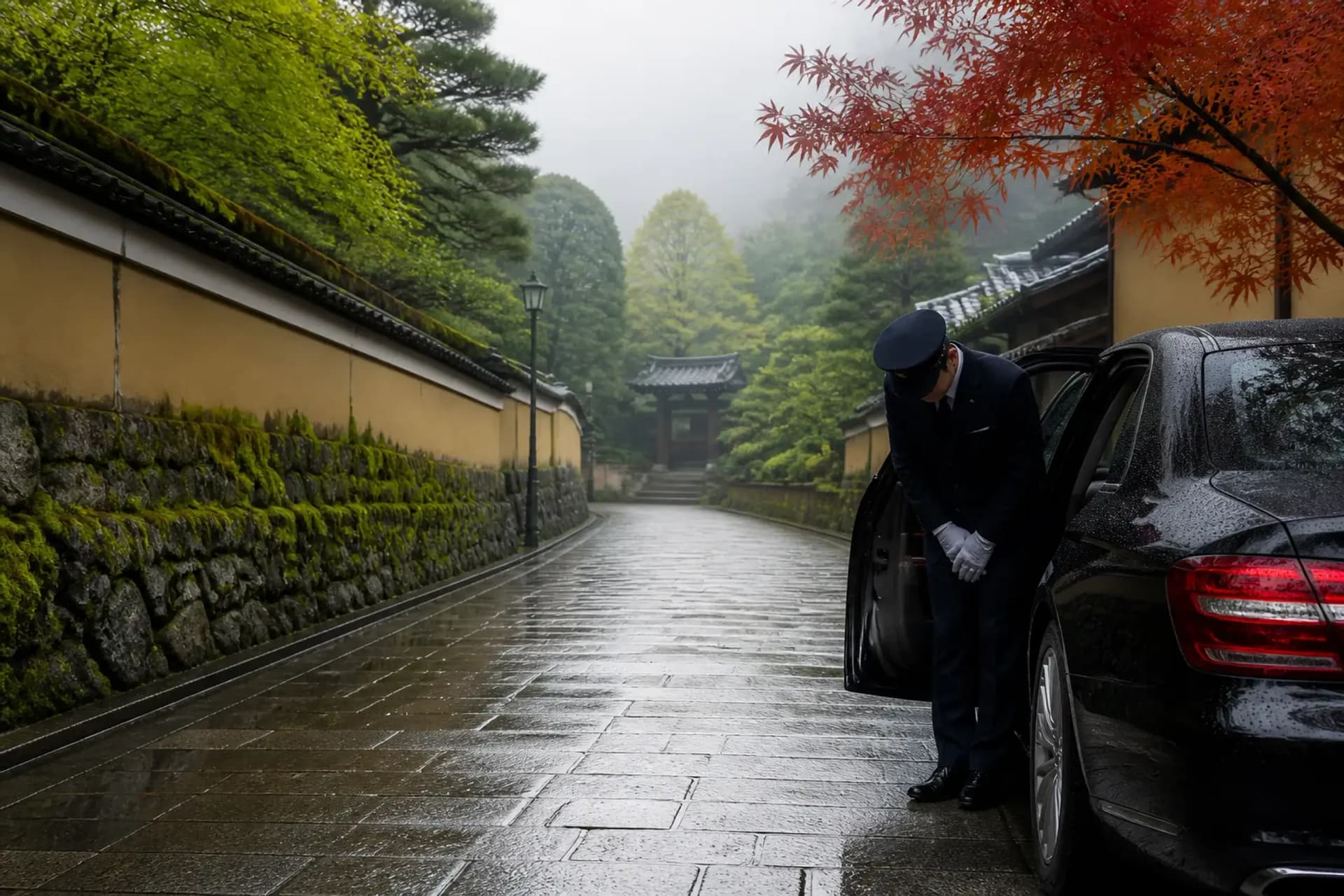
A retained hire car provides shelter and continuous availability compared to hailing a street taxi.
A private chauffeur is not a taxi. Japan clearly separates the legal and operational definitions of these services. Understanding these categories prevents profound logistical failures during your trip.
Option A: The Pre-Booked Hire Car (Chauffeur)
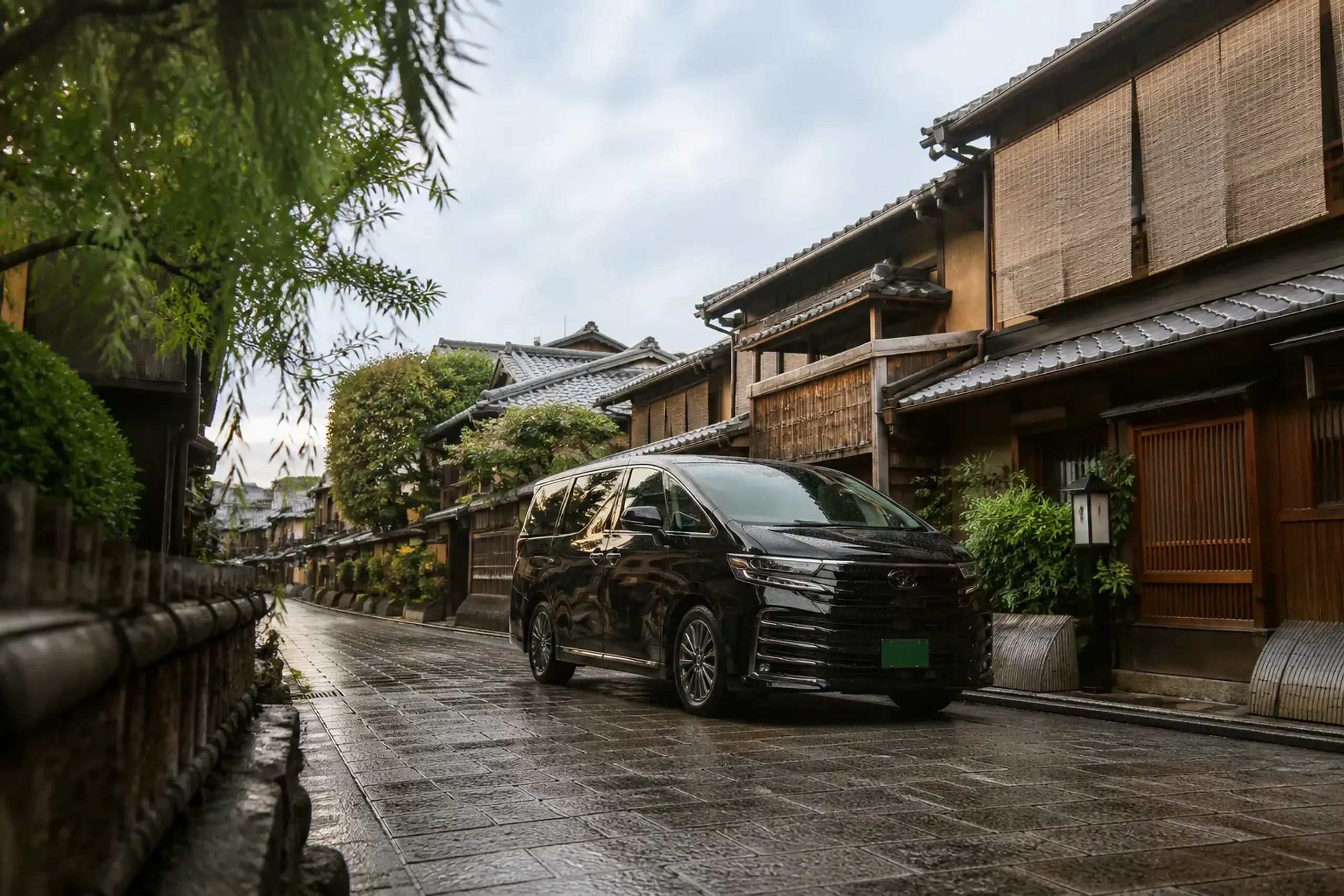
This is the model utilized by our team at Japan Royal Service. A hire car (ハイヤー) is retained for a continuous block of time, typically an eight-hour minimum. The driver stays with your party. When you enter a restaurant, the car waits nearby. If you alter your afternoon plans due to rain, the driver immediately adjusts the routing. Vehicles carry green commercial license plates, guaranteeing proper insurance and MLIT authorization. By law, these cars cannot be hailed on the street. They must be secured through an operator's office in advance.
Option B: The Metered Taxi
Kyoto possesses a robust traditional taxi fleet. The Kyoto Taxi Association mandates an initial fare of 500 JPY, with incremental additions based on distance and time. Taxis are highly effective for simple, one-way hops across the city grid. They utilize taxi stands at Kyoto Station and major hotels. However, taxis abandon you at your destination. Finding an empty cab near Arashiyama at closing time, particularly in the rain, is intensely difficult. Evening availability collapses completely during the autumn foliage season.
Option C: App-Dispatched Rideshare
As of 2026, visitors frequently attempt to use applications like DiDi, GO, and Uber Taxi in Kyoto. In Japan, these apps primarily dispatch standard metered taxis rather than private gig-economy drivers. You remain subject to regional fleet capacity. While apps bridge the language gap for simple point-to-point transfers, they cannot provide a retained driver for a complex, multi-stop day of cultural exploration. Wait times escalate severely during peak congestion periods.
2026 Rates And Booking Parameters For Kyoto Chauffeurs

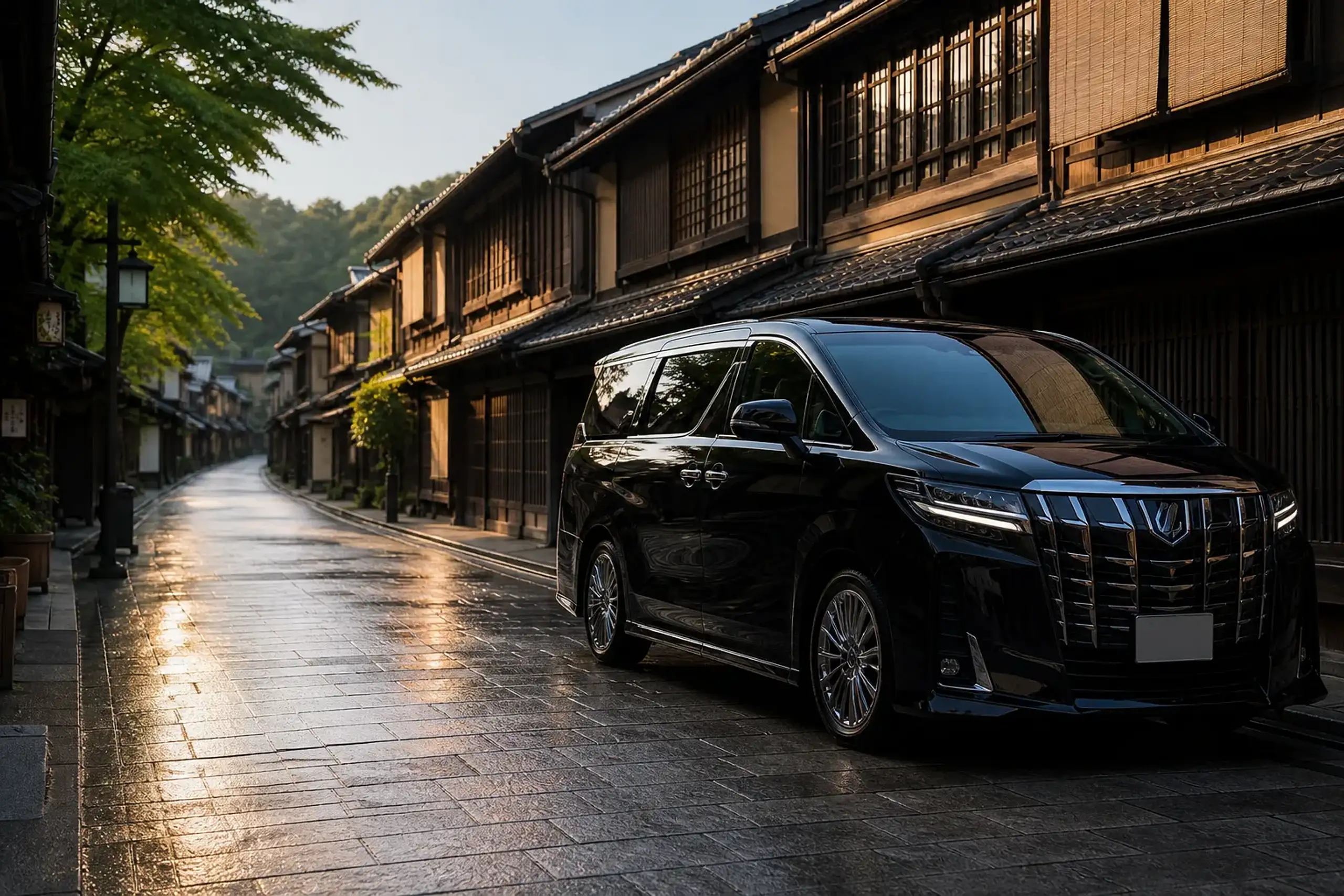
Professional chauffeurs operate on timed charters, securing your transport for the entire day.
Transparency regarding transport economics allows travelers to plan effectively. Kyoto car services operate on time-based charter models rather than distance meters. The architecture of a chauffeur rate includes the vehicle, the driver's time, fuel, and standard insurance. Clients pay highway tolls, airport parking, and temple parking directly, or operators invoice these as pass-through costs.
| Service Element | 2026 Estimated Parameter |
|---|---|
| Hourly Charter (Toyota Alphard) | ~12,000 JPY - 15,000 JPY / hour |
| Hourly Charter (Lexus LM / Mercedes V-Class) | ~20,000 JPY - 25,000 JPY / hour |
| Minimum Daily Engagement | 8 Hours |
| Late Night Surcharge (11 PM – 7 AM) | + 20% applied to base rate |
| KIX Airport to Kyoto Transfer (Alphard) | ~55,000 JPY - 60,000 JPY (Flat) |
Vehicle capacity dictates pricing. An Alphard comfortably seats four passengers with moderate luggage. The Mercedes V-Class supports larger executive groups. Securing an English-speaking driver often requires booking weeks in advance, especially during the spring cherry blossom window when Kyoto's total fleet capacity maxes out.
Legal Protections And Properly Licensed Transport
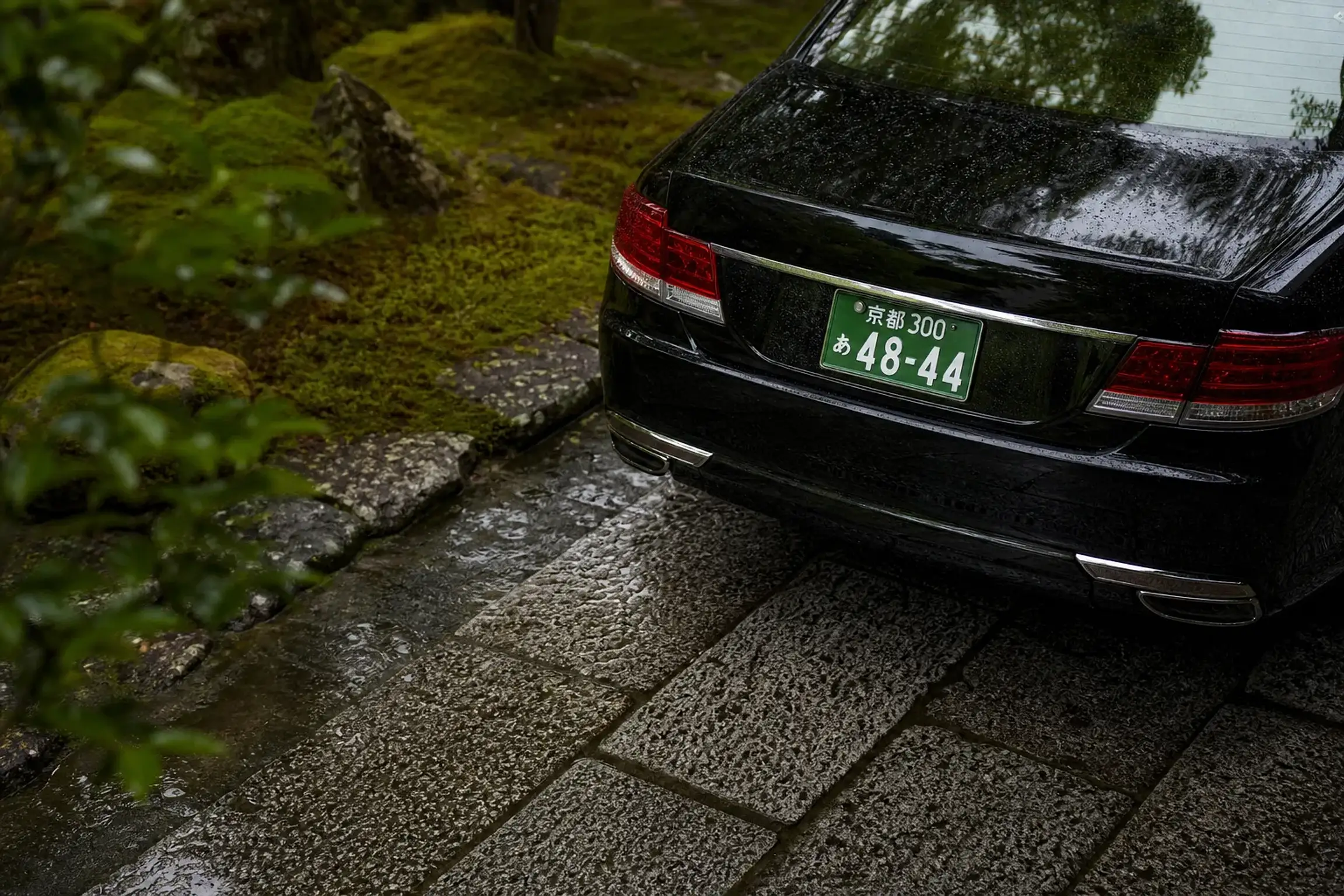
By Japanese MLIT law, all authorized commercial hire vehicles must display green license plates.
Japan enforces rigorous commercial transport laws. Safety demands strict adherence to these regulations.
Key regulation: Under MLIT rules, carrying paying passengers requires commercial authorization. Licensed hire cars and taxis display green license plates or specialized commercial registration markers — the simplest way to confirm your vehicle is registered for paid passenger transport.
Hire cars in Japan are pre-booked, never solicited at the airport — your driver is assigned to you in advance and waits at an agreed meeting point. Pre-booking through an established operator gives you insurance validity, mechanical safety, and professional accountability.
Overcoming Kyoto Congestion: Strategy Over Transportation

Private transport enables access to the quiet wabi-sabi aesthetics of Kyoto before the bus crowds arrive.
In 2026, the Japanese government and local authorities implemented aggressive overtourism countermeasures. Kyoto introduced dynamic bus location systems that broadcast onboard crowding levels via smartphone, nudging visitors away from overwhelmed public transit. However, simply renting a car does not solve the congestion problem. Strategy matters heavily.
Our concierge approach prioritizes crowd-avoidance routing. The new luxury hotel pipeline, including the anticipated late 2026 opening of Shangri-La Kyoto Nijojo, provides fresh geographic bases. We use these precise locations to launch early morning strikes on popular sites before bus groups arrive. Sharp sequencing is required. Fushimi Inari requires a dawn arrival. Arashiyama must be cleared before mid-morning.
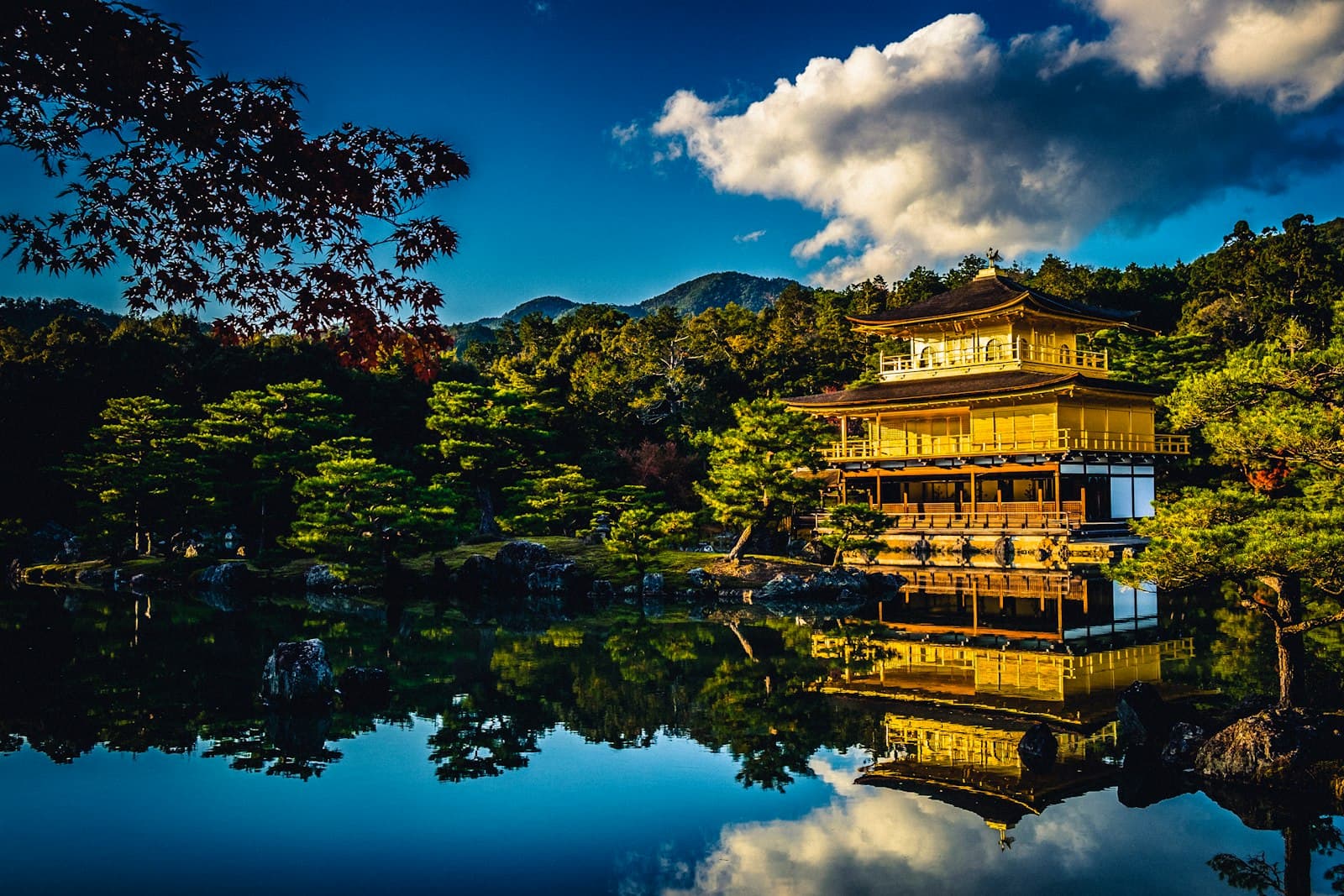
More importantly, a private car enables access to Hidden Japan. Instead of idling in Higashiyama traffic, your driver routes you northward to remote Zen gardens. We prioritize the aesthetic of wabi-sabi. We trade the loud, gold-leaf flash of the Golden Pavilion for moss-covered stone silence in Ohara. A skilled driver knows exactly where to pause, where to deploy guests on foot through pedestrian-only preservation districts, and where to wait discreetly for the pickup.
The Role Of An English-Speaking Driver In Japan

An English-speaking driver manages the complex logistics of arriving punctually at a private shokunin atelier.
Expectation management is vital. An English-speaking driver in Japan is a transportation professional, not a licensed cultural guide. MLIT regulations clearly separate these two roles. Taxis chartered as "sightseeing taxis" occasionally feature drivers who provide basic historical context, but they do not escort you deep inside temple complexes.
Your driver controls the operational geometry of the day. They monitor local traffic patterns. They communicate with your restaurant to adjust arrival times if a temple visit runs long. They manage luggage logistics between hotels. When visiting a shokunin—a master artisan, perhaps a ceramicist or a traditional textile weaver—the driver ensures your arrival is punctual and culturally respectful, bridging the gap between your hotel and the artisan's private atelier.
Language fluency varies across the industry. Standard Kyoto taxis occasionally carry "Foreign Friendly" designations, indicating drivers with baseline English for navigation. True luxury hire car drivers possess the vocabulary to handle complex itinerary changes, dietary requirement communications, and emergency protocol management. This level of linguistic competence is rare and commands a premium.
Frequently Asked Questions About Kyoto Chauffeur Services
Travelers frequently ask our team for clarification on Kyoto transport logistics. We provide these facts to assist your planning.
Can I hail a private chauffeur on the street in Kyoto?
No. Japanese law requires all hire cars (chauffeurs) to be pre-booked through an operator's office. Only metered taxis can be hailed on the street or boarded at designated taxi stands.
Does the driver act as a tour guide inside temples?
An English-speaking driver remains with the vehicle to manage parking and security. They do not enter paid temple grounds to provide historical lectures. If you require deep cultural context, you must hire a separate licensed guide to accompany you in the car.
Are highway tolls and temple parking included in the hourly rate?
Base hourly rates cover the vehicle, the driver, fuel, and standard insurance. Highway tolls, airport parking fees, and specific temple parking charges are typically billed separately based on actual usage during the day.
How far in advance should I book for cherry blossom season?
Kyoto's premium transport fleet sells out rapidly. For late March and early April, you should secure your vehicle and driver at least three to four months in advance. Last-minute requests rarely succeed.
Can the driver take us to Nara or Osaka?
Yes. A retained chauffeur easily crosses prefectural lines. Kyoto drivers frequently execute day trips to Nara for deer park visits or route guests down to Osaka for evening dining, returning to the Kyoto hotel late at night.
Do Kyoto chauffeurs provide wheelchair-accessible vehicles?
Specific vehicle models, such as modified Toyota Hiace vans, feature hydraulic lifts for wheelchair access. These specialized vehicles exist in very limited numbers and require significant advance booking.
Where can I book a private chauffeur in Kyoto with an English-speaking driver?
Japan Royal Service arranges pre-booked, properly licensed hire cars in Kyoto with English-speaking drivers. Details and requests are on our Kyoto chauffeur service page. If you also want interpretation at temples, read the difference between an English-speaking driver and a licensed guide-interpreter before you book.
Why Choose Japan Royal Service
Navigating Japan's ancient capital requires quiet precision. A rigid schedule shatters the atmosphere. Our team at Japan Royal Service understands that true luxury is the absence of friction. We manage the severe logistics of Kyoto so you never have to notice them. By combining elite fleet vehicles with rigorous discretion and verified English-speaking professionals, we construct an operational shield around your itinerary.
We do not publish our clients' movements. We do not chase crowded tourist traps. Instead, we secure the private routing and silent efficiency that successful professionals demand. Your time in Kansai should be spent engaging with the culture, not standing in the rain fighting for a metered taxi.
For private coordination, reach our team directly via WhatsApp or LINE, or contact us here to start planning your journey.