In this guide
- 01What Simose is, and when it opened
- 02How the eight galleries actually move, and how often
- 03Why a 190-metre building tries to disappear
- 04The prize, and exactly what it was for
- 05Where the collection came from
- 06The garden and the terrace, and what you see from them
- 07Ten houses by the same architect, four of them rebuilt from his past
- 08What to know before arranging a visit
- 09Arrange your visit to Simose
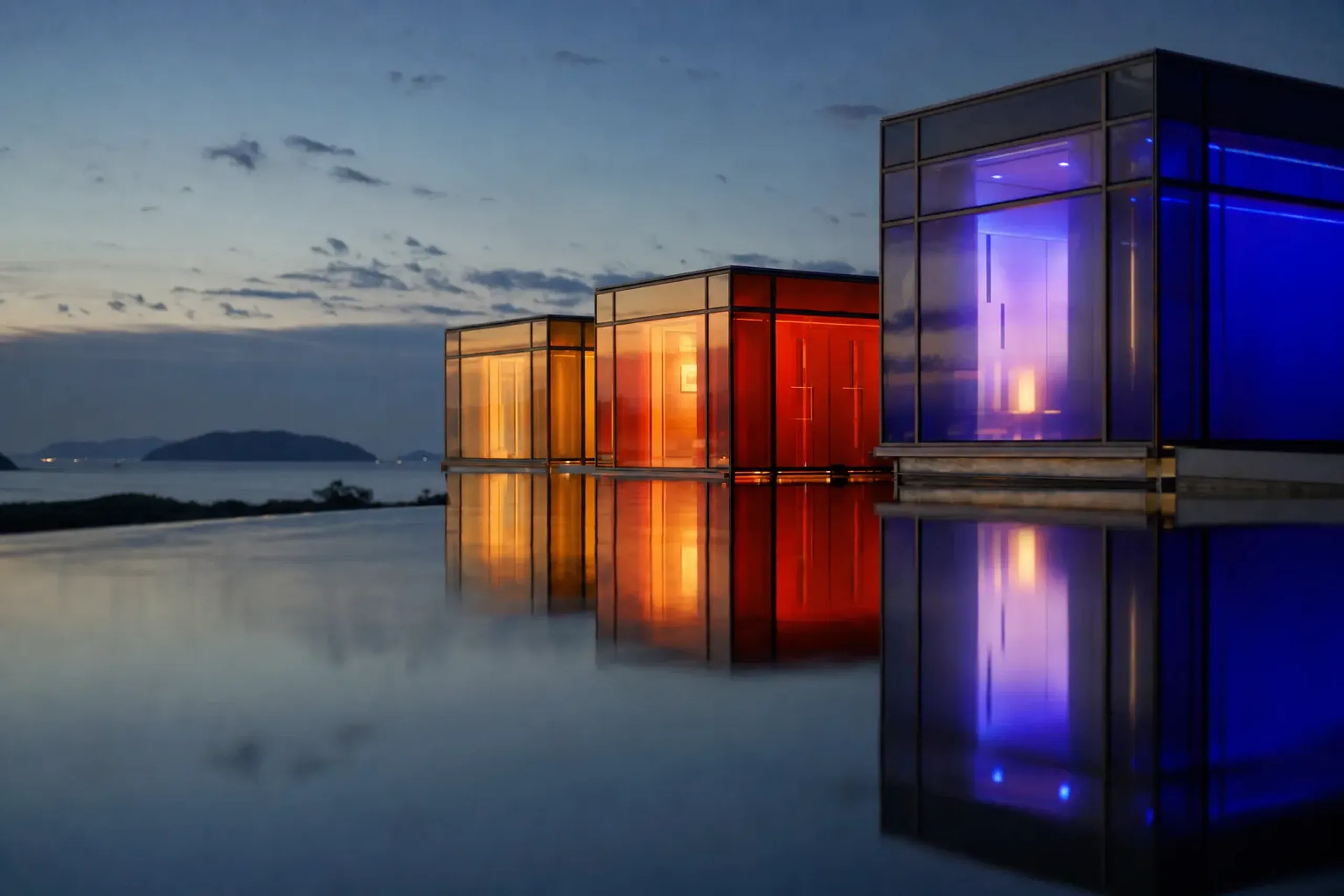
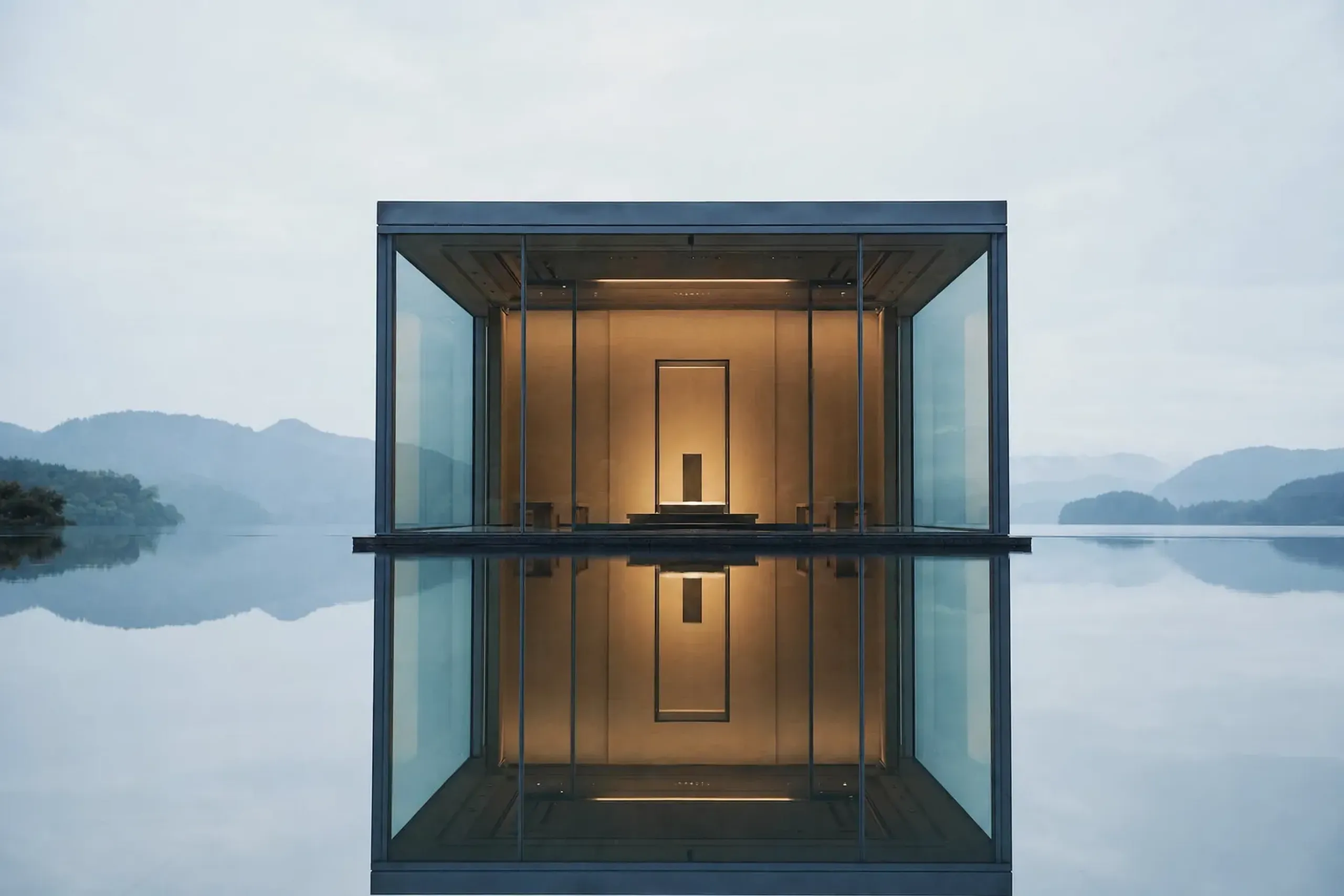
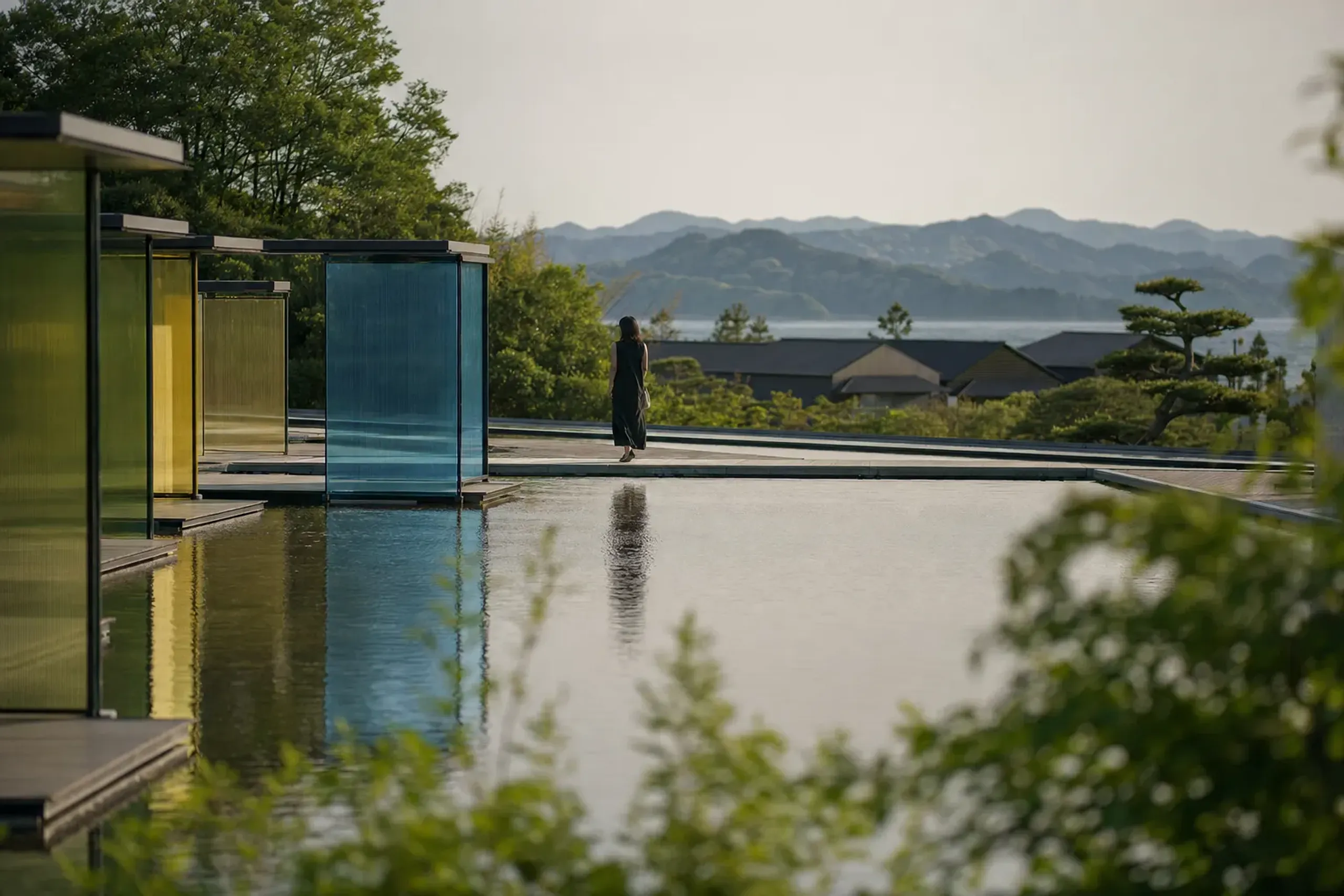
To rearrange the Simose Art Museum, the staff raise the water. Eight galleries, each a ten-metre square box sheathed in coloured glass, stand on a shallow basin at the edge of the Seto Inland Sea. Lift the level of that basin and the galleries lift with it — each was built on a barge, using the shipbuilding technique of the Hiroshima yards — and they can then be walked into a different formation without a crane ever coming onto the site. Seven formations have been worked out in advance. The museum chooses whichever one suits the exhibition it is about to hang, linking the boxes with bridges or ranging them side by side.
This is in Otake, at the western edge of Hiroshima Prefecture, a working port town most itineraries pass through without slowing down. In December 2024 the building was awarded the Prix Versailles in the World’s Most Beautiful Museums category, at a ceremony held at UNESCO headquarters in Paris. It had been open twenty-one months.
What Simose is, and when it opened
The Simose Art Museum opened in March 2023. It was conceived in 2018, the year Marui Sangyo Co., Ltd. marked sixty years since its founding, and it is held by a foundation — the Simose Art Museum Foundation — established on 6 September of that same year to preserve and show the family collection, to acquire and research further works, and to mount exhibitions.
What stands on the ground is larger than a museum. The site runs to 4.6 hectares facing the Seto Inland Sea and holds the museum, ten villas and a restaurant, together called SIMOSE; the villas and restaurant carry the name Simose Art Garden Villa.
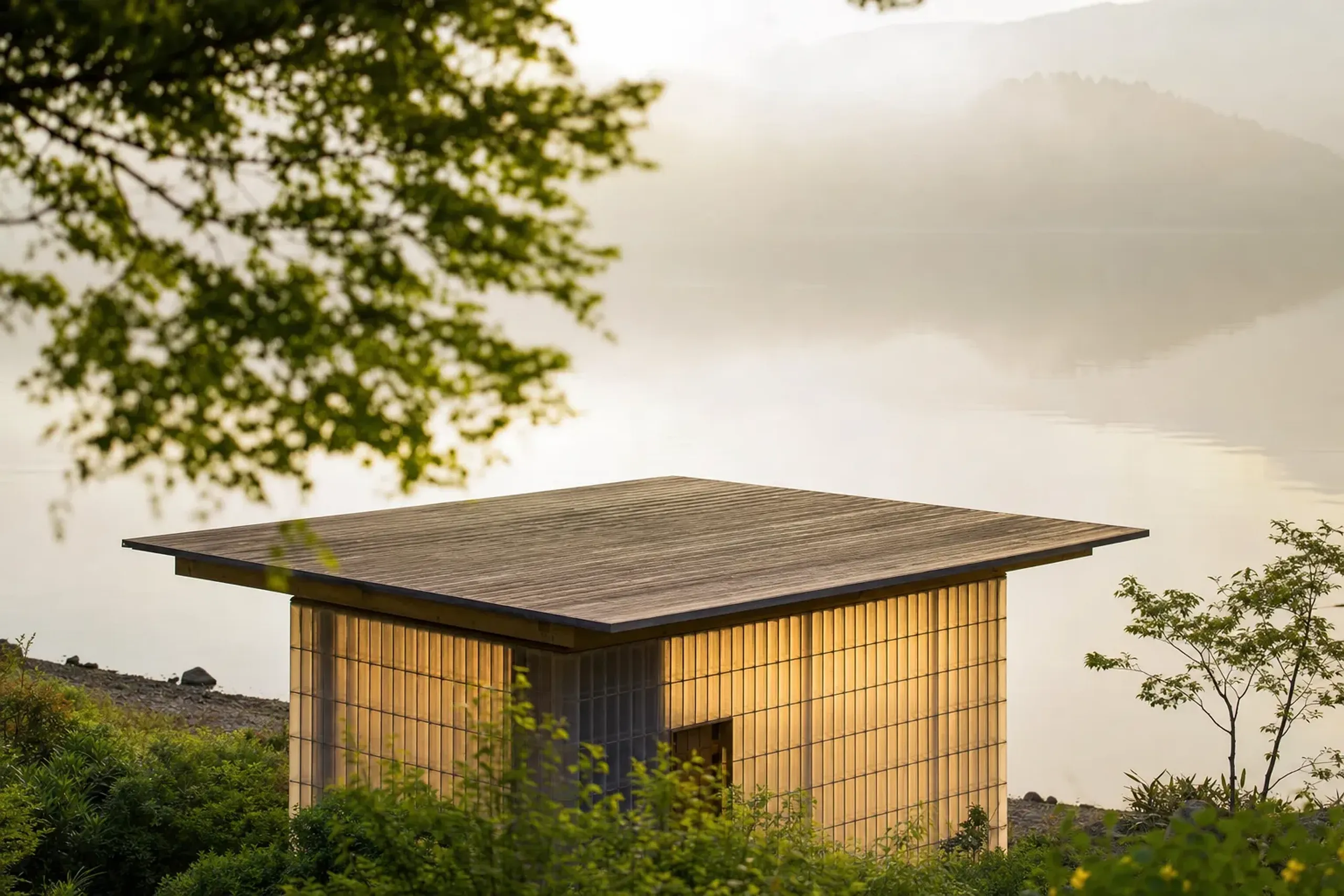
Every building on it — galleries, entrance hall, villas, restaurant, even the reception hut — was designed by a single architect, Shigeru Ban.
The museum states its own intention in four words: admire art, inside art. The building is not a neutral container; it is the first exhibit, and it was meant to be. There is a restraint at work here that rewards the patient eye — a wabi sensibility expressed not in weathered wood and moss but in the way a vast structure quietly effaces itself so that light, water and colour do the speaking.
How the eight galleries actually move, and how often
The mechanism is worth being precise about, because it is often described loosely. The eight galleries do not drift about while you are looking at them. They sit on a water basin on the seaward side of the building, each a ten-by-ten-metre room mounted on a barge, each clad in a different colour of glass. When the museum wants a new layout, the level in the basin is raised, the galleries float free on their own buoyancy, and they are repositioned without heavy plant. Then the water goes down and they settle again.
So they move between exhibitions, not during your visit. What that gives the curators is a floor plan that is genuinely re-writable: seven prepared arrangements, with the option of linking rooms by bridge so a route runs through several boxes in sequence, or setting them apart so each stands alone. The idea came from the islands of the Seto Inland Sea, which do the same thing to the eye — separate masses that regroup as you move past them. The museum calls it an architectural work without parallel anywhere. That is a large claim, and as far as we can establish, an accurate one.
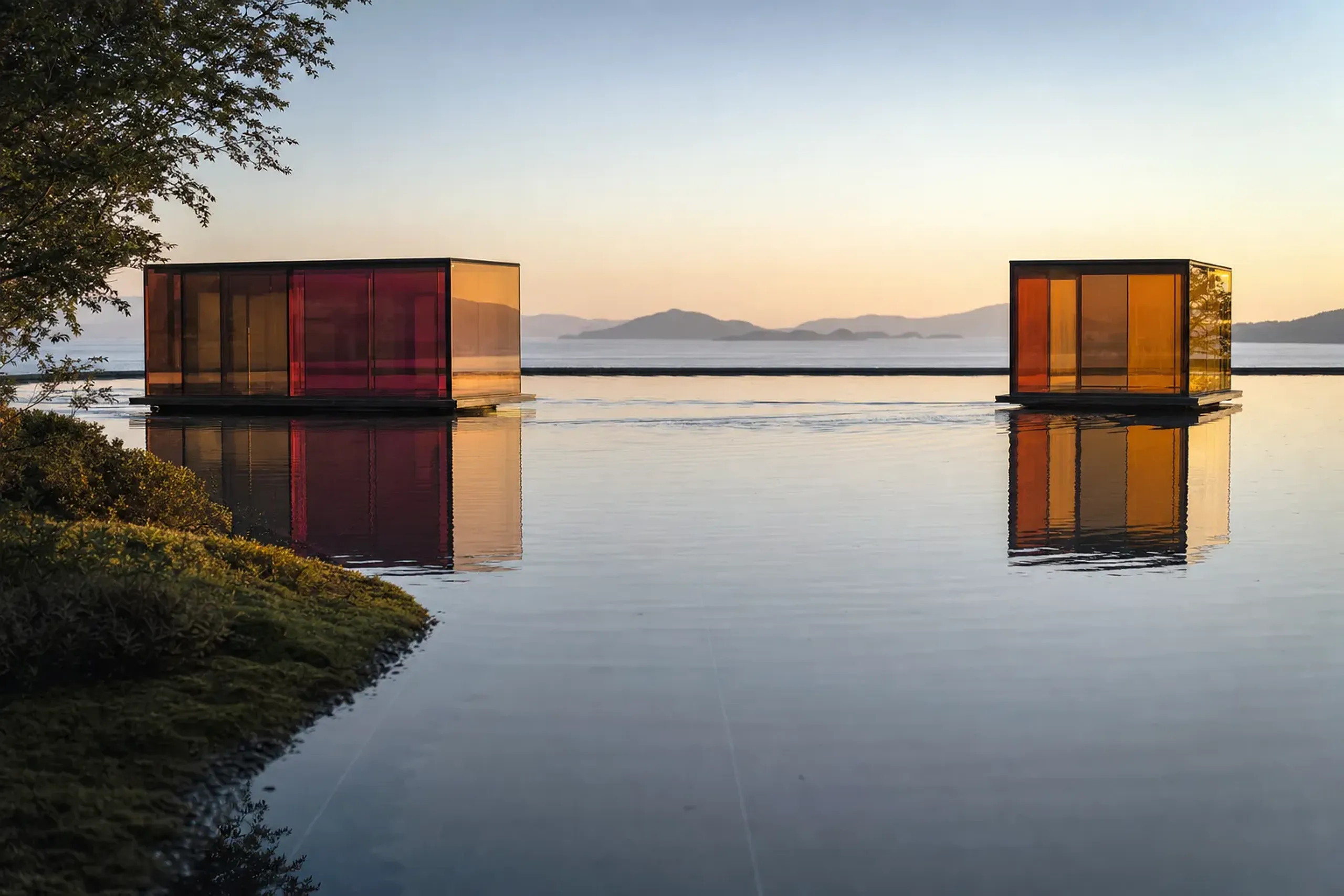
At night the coloured boxes are lit from within, and during some exhibition runs the museum extends its hours into the evening for that reason alone — a quieter, softer version of the place that few daytime visitors ever see.
Why a 190-metre building tries to disappear
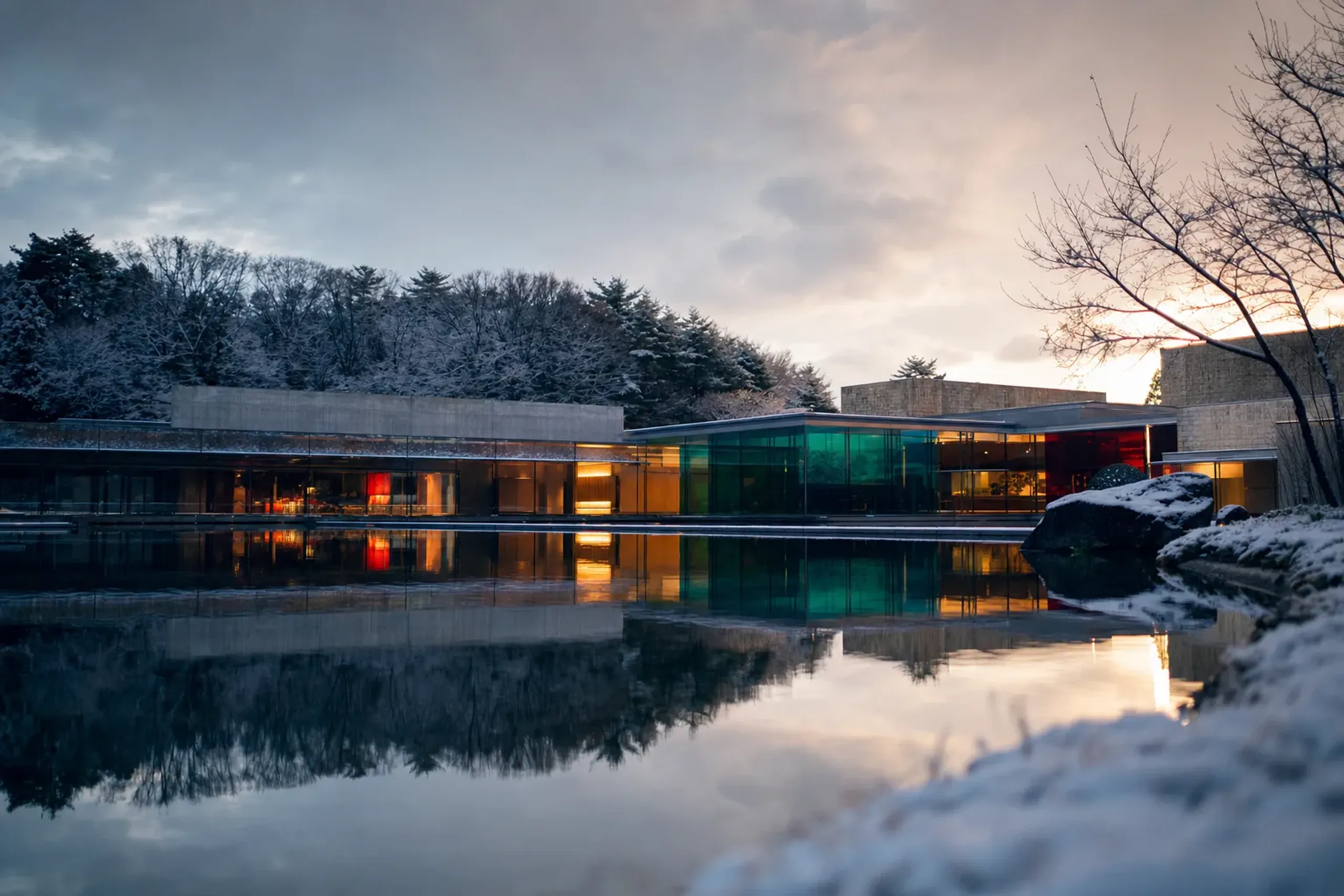
Three volumes stand parallel to the shoreline — an entrance wing, an exhibition wing and an administration wing — joined by covered walkways. Every external wall of all three, walkways included, is unified behind a single mirror-glass screen 190 metres long and 8.5 metres high. The reasoning is inverted from what you would expect of a landmark. The screen takes in the water basin, the coloured galleries, the garden and the sea, doubles them, and in doing so cancels the bulk of the architecture. You are meant to notice the Setouchi and not the building holding it.
The individual structures follow the same discipline. The entrance wing is an ellipse under an umbrella frame of laminated hinoki beams branching from two columns, carrying the reception desk, the café that faces the water basin, the shop and a multipurpose room. The exhibition wing is reinforced concrete, but post-tensioned beams open a clear span twenty-five metres square, and the ground around it is banked into a low pyramid so the volume barely reads as a building; walking up that bank is how you reach the terrace. The restaurant is essentially a roof set down in the landscape, its kitchen fittings held to counter height so that nothing interrupts the view but the extract hood. The graphic identity across the site is by Kenya Hara, down to the wayfinding markers — black discs on slender legs, sitting in the landscape like something that grew there.
The prize, and exactly what it was for
Precision matters here, because the shorthand circulates in several inaccurate forms. The Prix Versailles has been announced each year at UNESCO since 2015, judged by a jury of architects, philosophers and others across categories from airports to hotels. Within each category three awards are given: the Prix Versailles itself for the highest achievement, plus a Special Prize for an Interior and a Special Prize for an Exterior. 2024 was the prize’s tenth year, and the first in which a museums category existed at all.
In June 2024 seven museums worldwide were named to the list “Prix Versailles 2024: The World’s Most Beautiful Museums”, Simose among them. At the ceremony at UNESCO headquarters in Paris on 2 December 2024, Simose was given the Prix Versailles — the top award — in that category. Jérôme Gouadain, President of the World Prix Versailles Organization, remarked on the use of vibrant colour, rare in a museum setting, and on a quality of lightness, and said the seamless integration of interior and exterior had made a profound impression on the judges.
Where the collection came from
The collection is the reason to stay longer than you planned. The Shimose Collection was assembled over more than half a century by Yumiko Shimose, who inherited it from the founders Fukue Shimose and Shizuko Shimose and kept adding to it. It did not begin with paintings. It began with dolls — hina dolls, hina furnishings and gosho dolls from Kyoto, gathered as prayers for the healthy growth of children and for a peaceful world. Most came from Maruhei Ohki, the Kyoto doll house that has worked under the name Ohki Heizo for two hundred and fifty years, since the Edo period — the kind of shokunin lineage, handed down through generations, that quietly underpins so much of what is worth seeing in Japan.
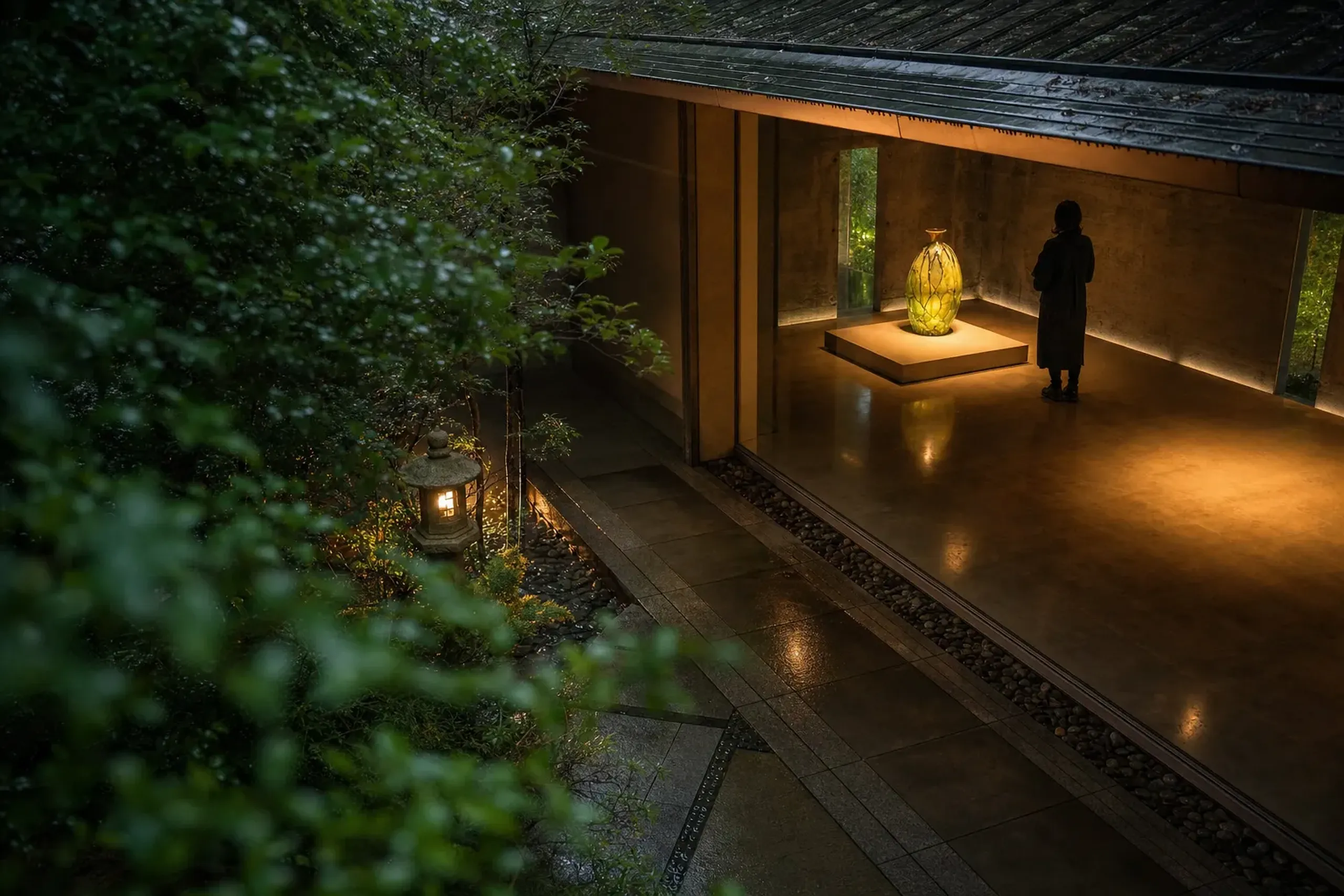
Dolls remain the largest single body of work in the collection, joined by figures by Goyo Hirata and Simon Yotsuya and ceramics by Rosanjin Kitaoji.
From there it widened in three directions. The Western decorative arts are centred on Émile Gallé — the museum’s Gallé holdings run to more than sixty works, from small glass vessels to full-size furniture — with Daum glass, Majorelle furniture, Meissen porcelain and Jumeau dolls alongside. The Western paintings run to Millet, Pissarro, Renoir, Rousseau and Matisse in oil, with prints by Munch, Picasso and Chagall. The Japanese modern holdings take in Taikan Yokoyama and Kaii Higashiyama in the nihonga line, and Yuzo Saeki and Ryohei Koiso in oils. It is one family’s eye rather than an institutional survey, which is what makes it legible in an afternoon.
The garden and the terrace, and what you see from them
Gallé was a botanist as well as a glassmaker, and the garden named for him is planted accordingly: chiefly with the flowers and plants that appear in his work, selected to survive the Setouchi climate. There is a seasonal reward in this — a matter of shun — for the visitor who comes when a given bloom is out: you can see a motif growing outdoors and then find it worked into glass a few minutes later.
Walk out of the exhibition wing and up the grassed bank and you arrive at the Seaview Terrace, where the sea opens out completely. Miyajima, Atatajima and Etajima lie in front of you — the scattered-island view the Setouchi is known for — with the eight coloured galleries below on their basin.
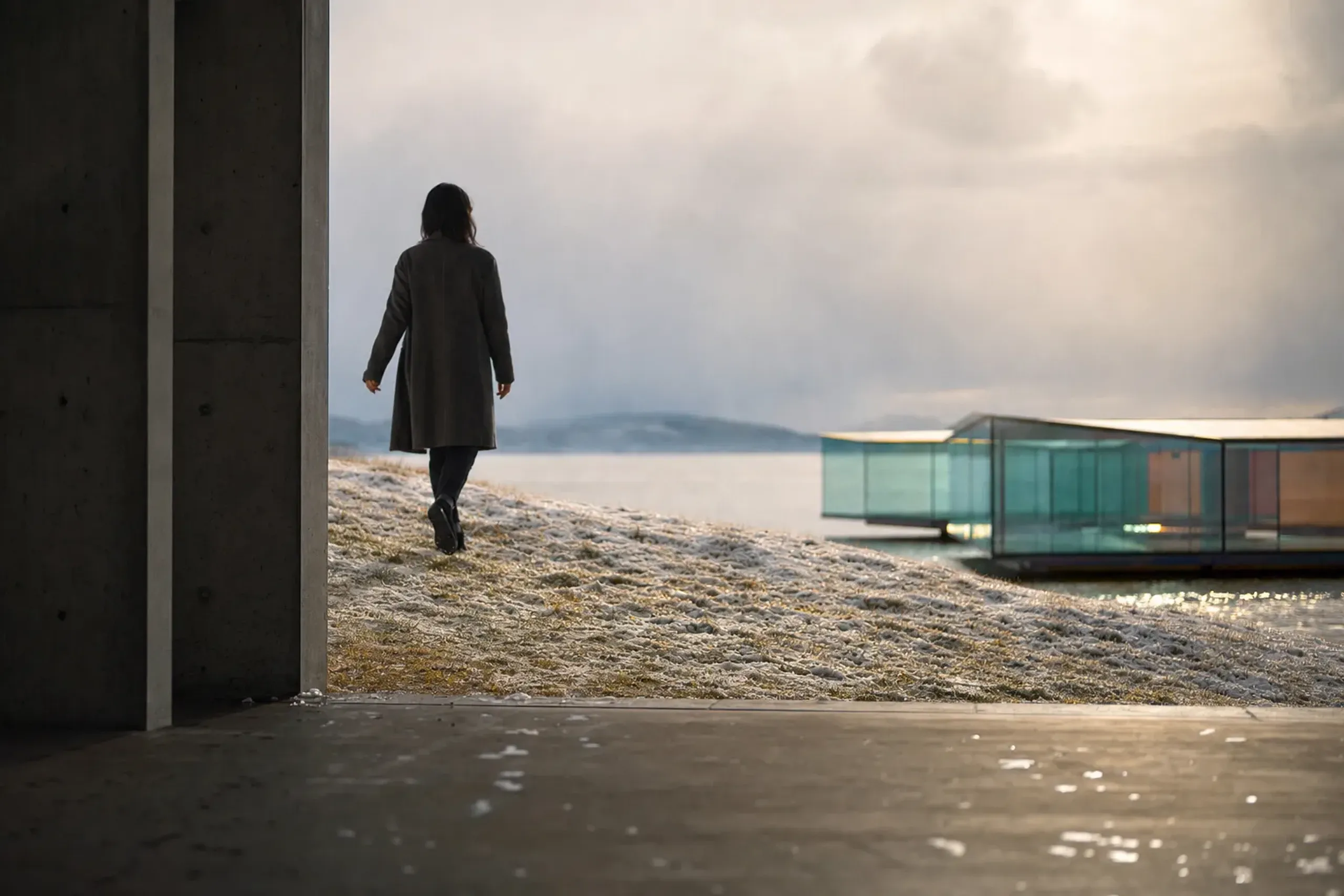
After dark the terrace also looks south to the lit petrochemical works of Otake, an unexpected and rather magnificent thing at the end of a museum visit. Both garden and terrace are included with admission.
Ten houses by the same architect, four of them rebuilt from his past
Five villas stand on the north of the site facing the water basin, five to the south among trees, with the restaurant and a herb garden between them. What makes them unusual is that four are not new designs. They are Shigeru Ban’s own earlier private houses, re-drawn as places to stay: the Wall-Less House, built on a Karuizawa slope in 1997; the House of Double-Roof, 1993; the Furniture House, 1995, its shelving doing the structural work; and the Paper House.
The Paper House was built at Lake Yamanaka in 1995. One hundred and ten tubes of recycled paper — 2.7 metres long, 28 centimetres across, 15 millimetres thick — are set in an S across a ten-metre-square floor; eighty of them form the larger arc, with living space inside it and a colonnade outside. This is the paper architecture that made Ban’s name, and here it is a building you can sleep in rather than a photograph you can look at. Two further designs are new for the site: the Cross Wall House, lifted clear of the ground on cross-laminated timber so no retaining wall was needed, with a hinoki bath on its third floor facing the sea; and a group built on Kielsteg, an Austrian stressed-skin timber panel used here as floor, as wall and, cut short and stacked, as louvre.
The restaurant is French, seats fifty, and has been led since June 2025 by Keisuke Fujiya, who trained in France before working in Sapporo. Guests must be thirteen or over. All ten villas can be taken on an exclusive basis, which is worth knowing if privacy is the point — to hold the entire garden of houses to a single party is the rarer, quieter form of luxury, and the kind of arrangement made by introduction rather than found on a booking page.
What to know before arranging a visit
The museum opens 9:30 to 17:00, with last admission at 16:30. It closes on Mondays — opening instead when the Monday is a public holiday — over the New Year, and during exhibition changeover periods, which can run to a fortnight and fall where you would not expect. Confirming the date is the first thing to do, not the last.
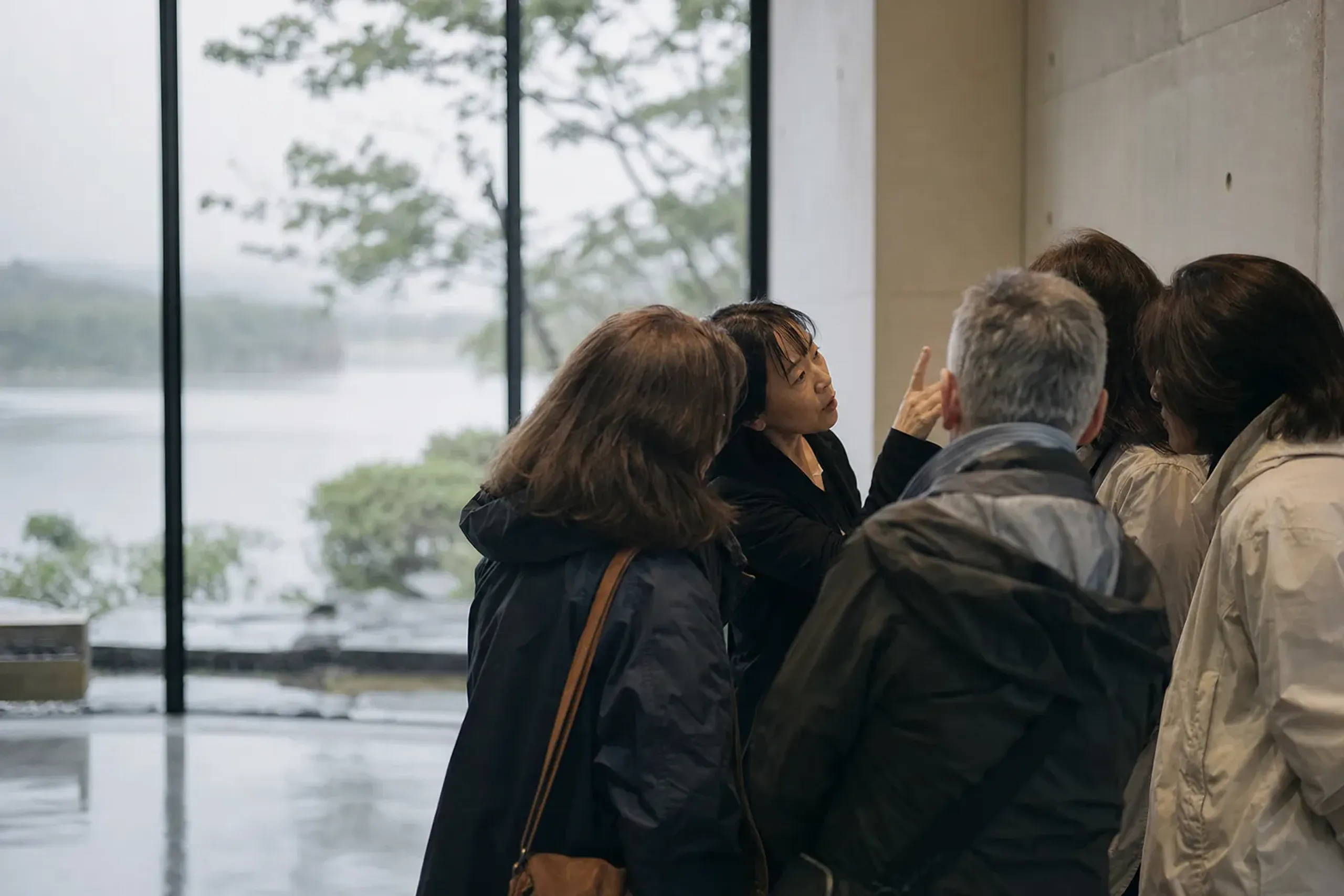
Two programmes are offered. Museum Guidance is a short orientation to the museum and the exhibition, five to ten minutes, free of charge. The Gallery Talk is the one to book: a curator walks the exhibition rooms with you and talks about the theme and the works, for roughly thirty minutes. Both are for parties of five or more and are arranged for the hour you request, but both are taken first come, first served, so the museum may need to move the time. The application goes in on a form two weeks before the visit; cancellation is accepted up to the day before, excluding closed days. The museum encourages booking early.
Both programmes run in Japanese — the museum told us this directly; its own published pages are silent on language — and interpretation is for the visiting party to bring. There is one provision worth knowing: an interpreter guide accompanying overseas visitors is admitted free, one per group, on production of a National Government Licensed Guide Interpreter or Regional Licensed Guide Interpreter registration certificate at the desk.
The audio guide is free with admission.
Cars come in to the forecourt in front of the entrance wing, where the station shuttle also sets down, so the walk to reception is short. A private car and chauffeur makes the difference between arriving composed and arriving flustered, particularly given the outlying location. From Hiroshima Station the run to Otake or Kuba station is about forty minutes; from the Otake interchange, five minutes by road. The museum’s own figures put Miyajima at ten minutes by ferry plus ten by train, or twenty by car; the Kintai Bridge at Iwakuni at twenty-five minutes by car; the Atomic Bomb Dome and Peace Memorial Park at thirty-five minutes, partly on toll road; and Iwakuni Kintaikyo Airport at twenty minutes.
One local note. When the museum ran a papermaking workshop it used Otake hand-made washi, made in this town since the Edo period, and pressed plants from Gallé’s garden into the sheets. That is the register of the place: a prize given in Paris, and a paper trade carried on quietly at the mouth of the river for four hundred years — precisely the sort of hidden Japan that no search engine will surface for you.
Simose rewards a half day, and more if the villas are taken. Because the curator’s talk needs a fortnight’s notice, because the closing days move with the exhibition calendar, and because everything on site is said in Japanese, a visit here is better set up in advance than walked into. A well-judged bespoke itinerary can fold Simose into a wider Setouchi journey without a single loose end. Japan Royal Service can confirm the day against the exhibition schedule, place the request for the gallery talk, arrange the interpreting, and bring the cars to the door. Should you wish to stay, the ten houses can be held together for your party alone.
Arrange your visit to Simose
The difference between seeing Simose and truly experiencing it lies in the details handled before you arrive — the exhibition confirmed, the gallery talk secured, the interpreting quietly arranged, the villas held in private. When you are ready to plan a visit built around your own dates and interests, contact us here, and we will shape the day, and the stay, around you.