In this guide
- 01What Tobe ware is, and why the rim is thick
- 02The town was a whetstone town first
- 03Why the white is not Arita's white
- 04Gosu: the blue that is black until it is fired
- 051953, and the year the town stopped making flower vases
- 06Baizan: the oldest kiln still working
- 07The valley of a hundred kilns
- 08How the day fits the port, and the brewery on the way back
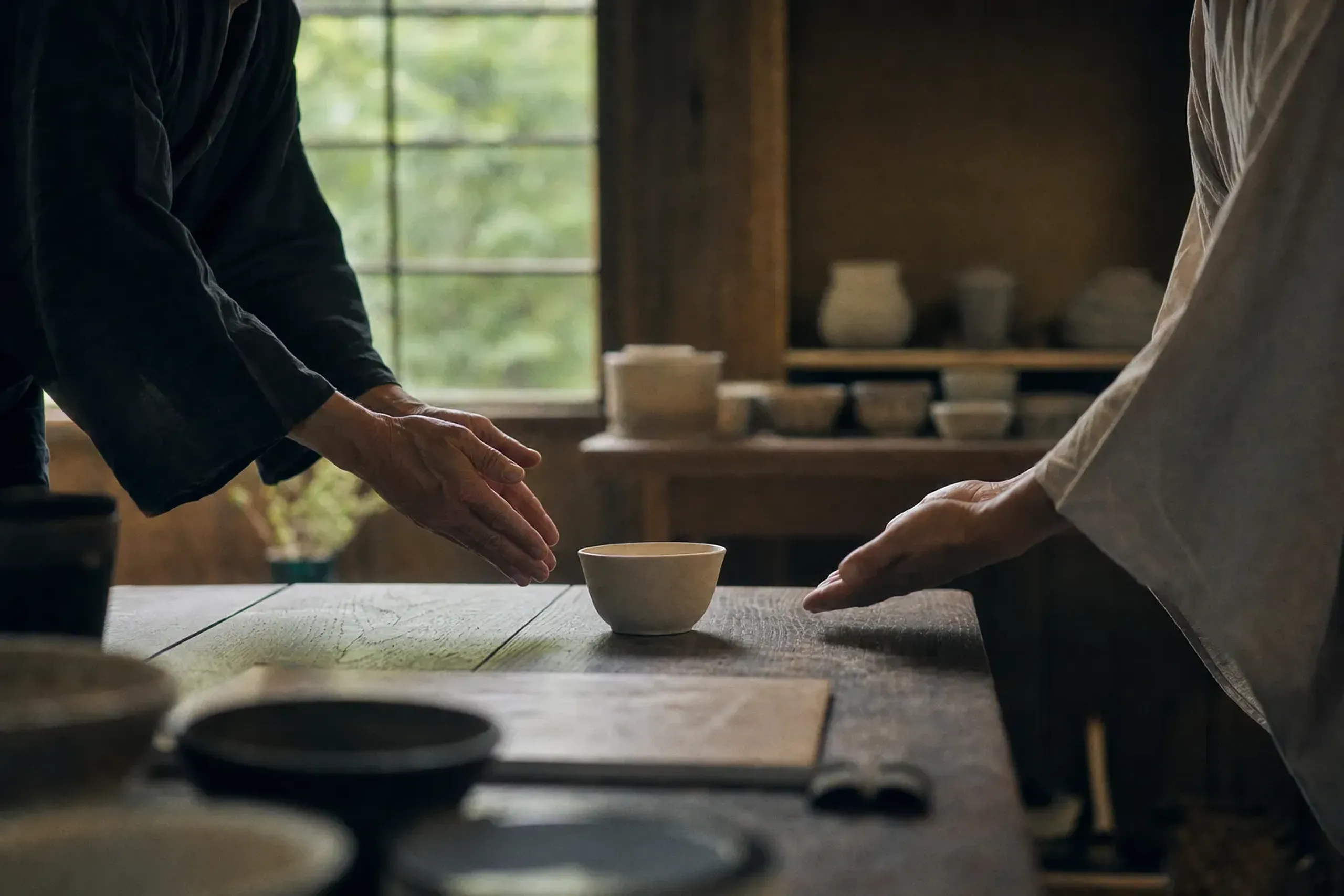
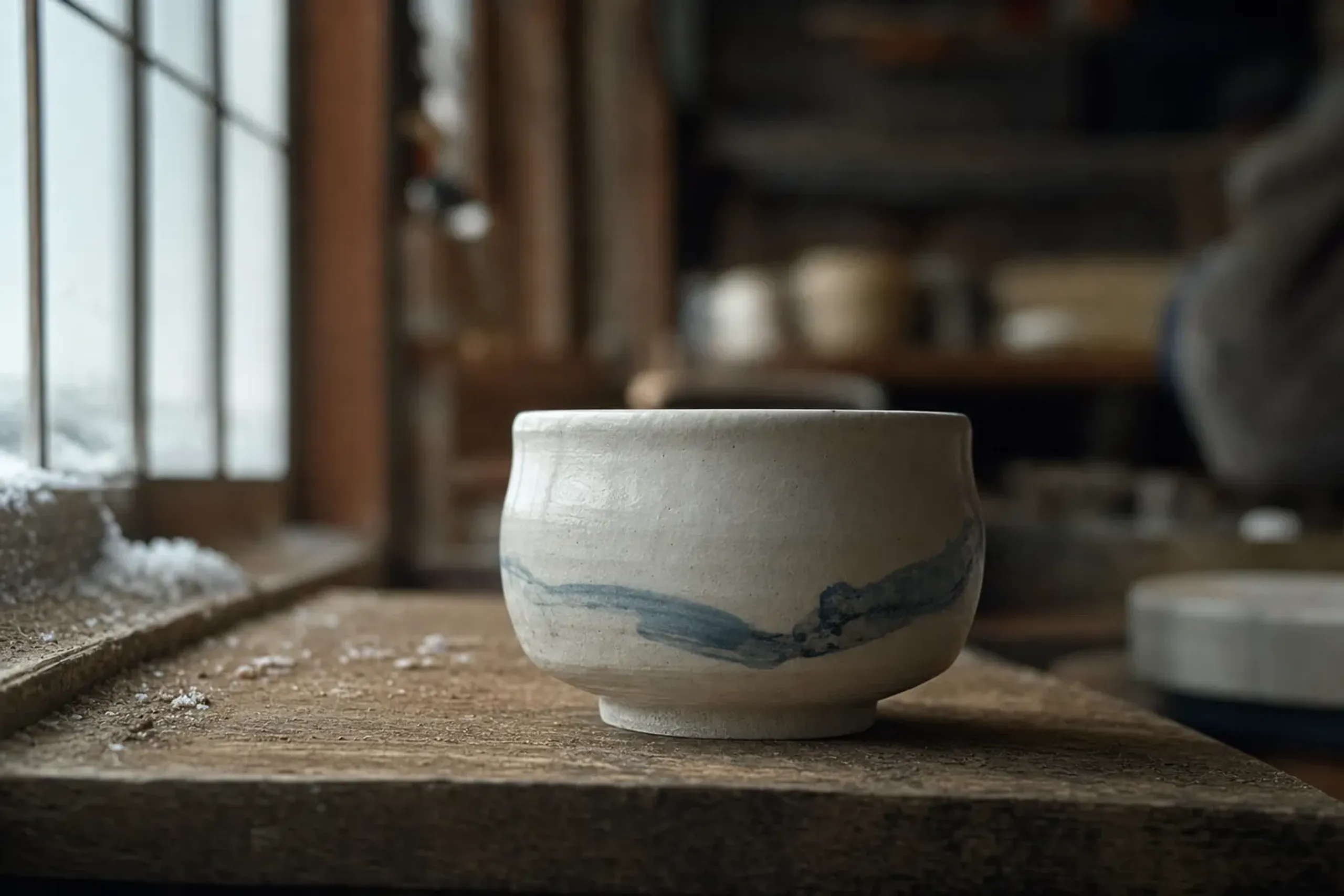
Lift a Tobe rice bowl off the shelf and the first thing the hand reports is not the pattern. It is the weight. The rim is thicker than a rim ought to be — you feel it as a blunt edge under the thumb, where Arita or Kyoto would have given you something closer to a blade. Turn it over and the foot is heavy too. Everything about the object says it expects to be picked up wet, stacked while hot, and handed to a child. This is porcelain made on the assumption that it will one day be dropped, and that assumption is the whole story of the valley it comes from.
Tobe is a small town in the hills a short drive inland from Matsuyama, and roughly a hundred kilns work there. What follows is what the porcelain actually is, why it is built the way it is, and one afternoon in 1953 that decided what the town would make for the next seventy years. The honest limit of this page is the same as it is for any craft: the weight of a bowl in the hand cannot be read, only held.
What Tobe ware is, and why the rim is thick
Ehime Prefecture, which lists Tobe ware as a prefectural Intangible Cultural Property, describes it in a single sentence worth quoting because it is unusually blunt for an official document: gosu painting dissolved into the skin of white porcelain, colour that sits in harmony with the whiteness of the body, and a somewhat thick, unadorned form and a hardness of material.
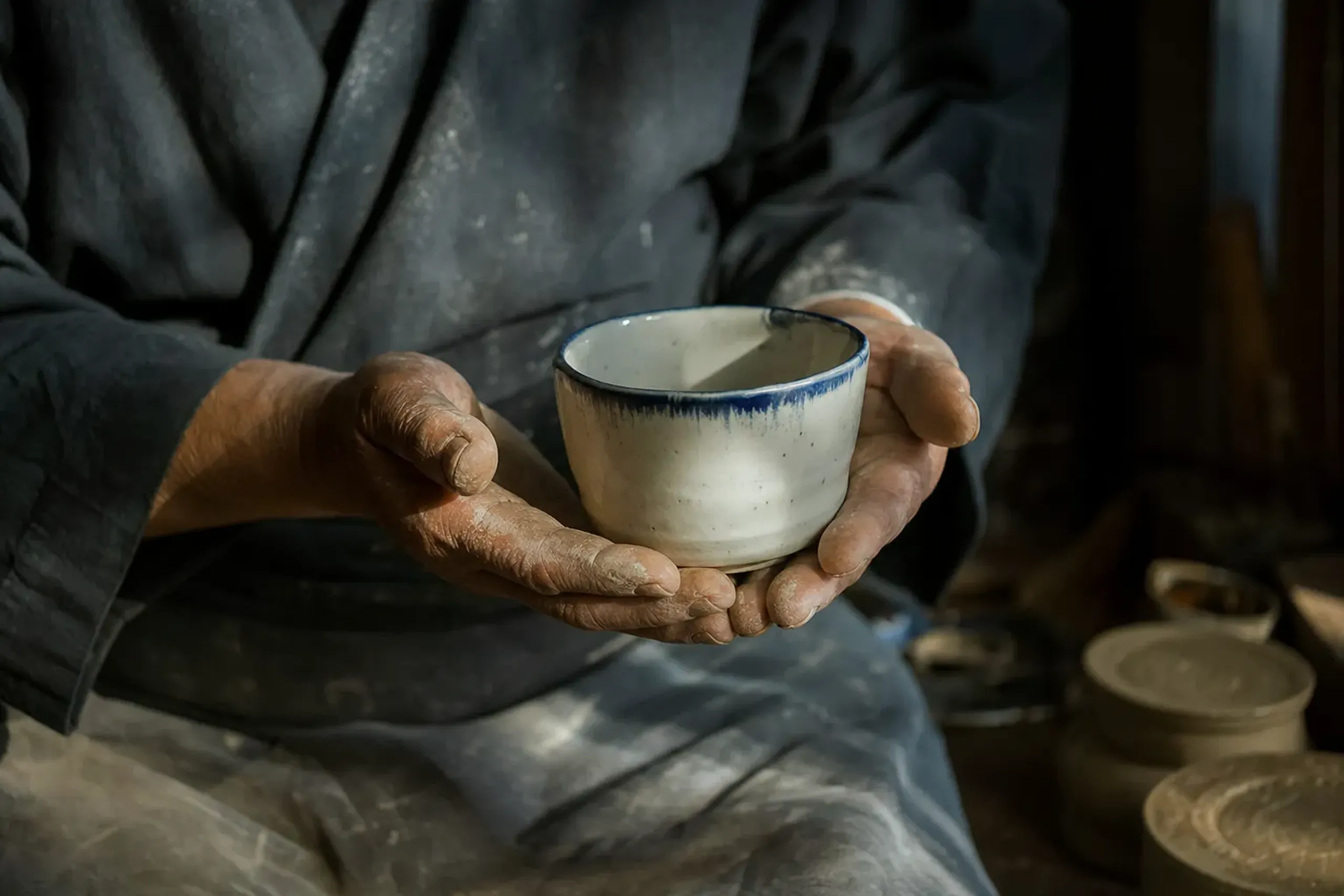
Not elegance. Not refinement. Thickness and hardness, named as the point.
The town's own description agrees and adds the reason: this is tableware. Not a display object that happens to be usable, but a working bowl that happens to be beautiful. The national designation covers four kinds — white porcelain, blue-and-white sometsuke, celadon, and tenmoku iron glaze — and the principal products named in the designation are eating and drinking vessels, flower vessels and figures, in that order.
The thickness is not a shortcut. On the wheel it is the hardest thing to hold. The town's own account of the process describes throwing as skilled work in which the potter keeps the wall an even thickness by the feel of the fingertips alone — and an even wall that is generously thick is harder to pull than a thin one, because there is more clay to keep true and more mass to keep centred. Then the piece is bisque-fired at 900 to 950°C for eight to ten hours, painted, glazed, and fired again at 1,300°C for fifteen to twenty-four hours. The second firing is where a thick wall either survives its own mass or does not.
The town was a whetstone town first
Read the name and the history is already there. The first character of Tobe is to, whetstone. Long before it made a single bowl, this was a place that cut sharpening stones out of the hillside, and the stone had a name that travelled: Iyo-to, the whetstone of Iyo.
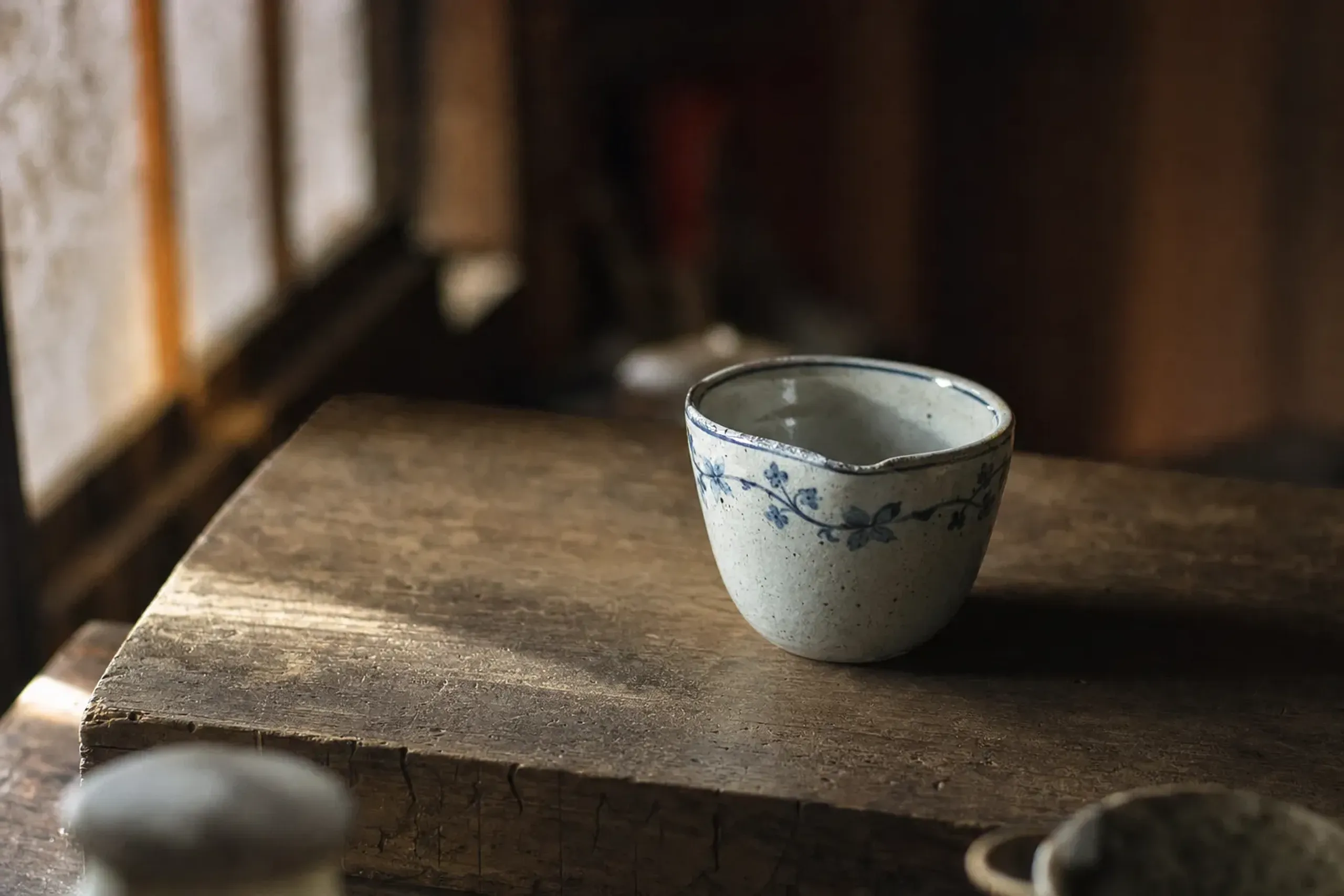
The trade association records that the documents of the Shōsōin — the eighth-century imperial repository at Nara — note Iyo whetstone among the materials used in the casting of a Kannon image. That is the earliest paper trail the town has, and it is about stone, not pottery.
Cutting whetstone leaves waste. Mountains of it. In the eighteenth century the Ōzu domain, looking for a way to mend its finances, took an interest in what that waste might be worth, because the same kind of stone was already being turned into porcelain elsewhere in Kyushu. In 1775 Katō Yasutoki, the ninth lord of Ōzu, ordered that porcelain be attempted in Tobe using the offcuts.
It did not work quickly. The man who carried it, Sugino Jōsuke, built a climbing kiln of four and a half chambers at a place in the village called Gohonmatsu, and failed repeatedly on the glaze before anything came out of it whole. The date the town keeps is 10 December 1777 — the first successful firing of porcelain, white ground with blue drawn on it. Two hundred and fifty years later the district still calls that the beginning.
Why the white is not Arita's white
Set a Tobe bowl beside an Arita one and the difference is immediate and slightly disconcerting: the Tobe white is warmer, softer, faintly grey where the Arita is close to blue-white. This is not a failing.
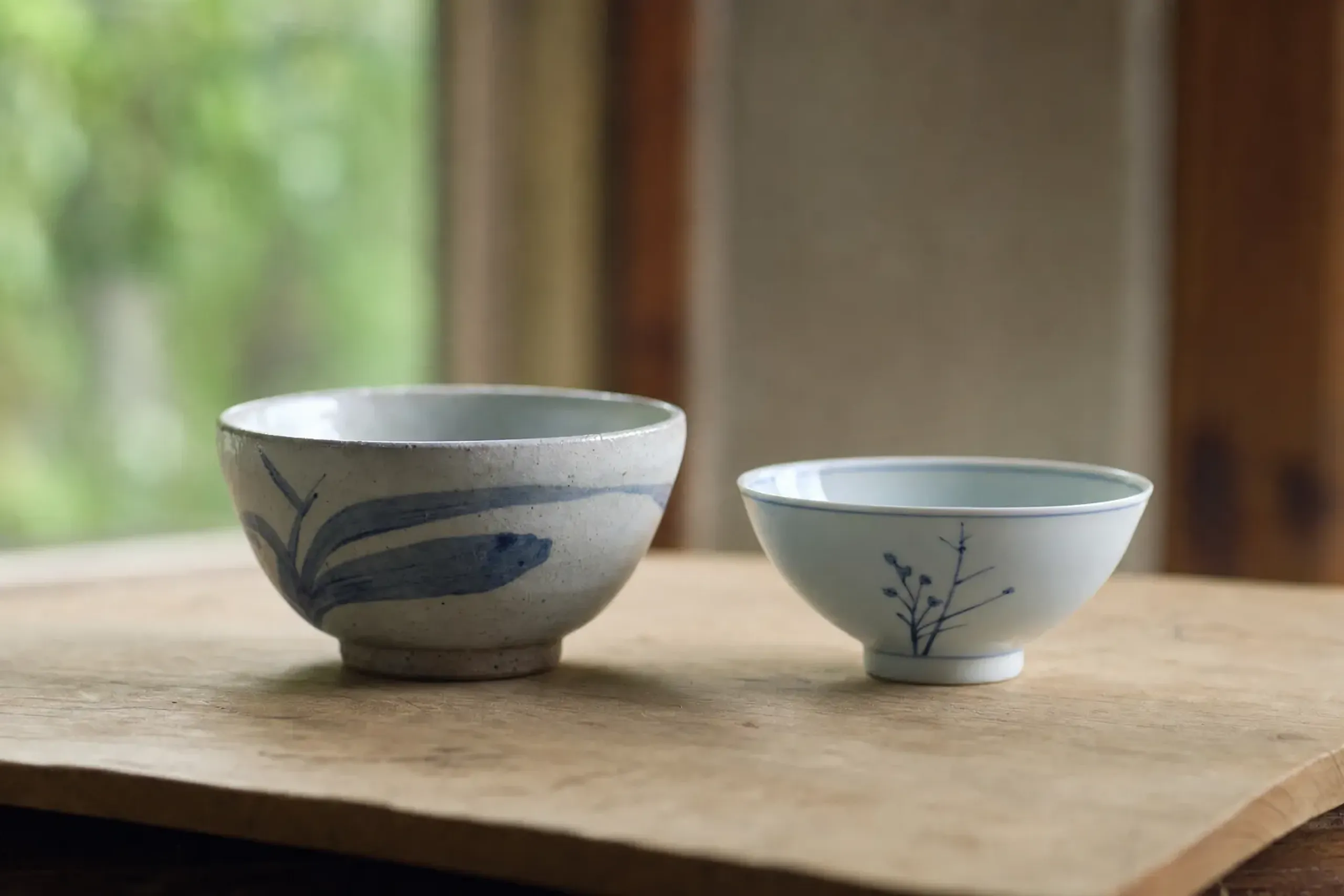
It is iron.
The porcelain stone under Tobe carries a high iron content, and iron in a porcelain body will always pull the white towards grey. The national craft body's description of the material is precise about the work this creates: the stone is pulverised in a ball mill for twenty-five to forty-five hours before it can be used at all, and the first stage of making Tobe ware is separating what can become clay from what cannot. Today the stone is a trachytic andesite from the Uebi ridge, quarried at six sites inside the town.
The town spent a century trying to make its white whiter. The turning point came in 1818, when Mukai Genji found the Kawanobori porcelain stone — and the prefectural record is candid about what that meant, describing the new body as having a beauty of brightness beyond comparison with the greyish material that came before. The pursuit did not stop there: by 1890 a Tobe maker had developed tankōji, a pale-yellow porcelain, and in 1893 it took a first prize at the world's fair in Chicago — a hill town in Shikoku, with a medal for the colour of its clay.
What survives from all that is the compromise the town settled on. The national designation describes the result as a body with warmth, carrying patterns drawn in blue with a bold stroke. Warmth is the polite word for iron. It is also, once you have eaten off it, the reason the blue looks the way it does — a cool line laid over a body that is not cold.
Gosu: the blue that is black until it is fired
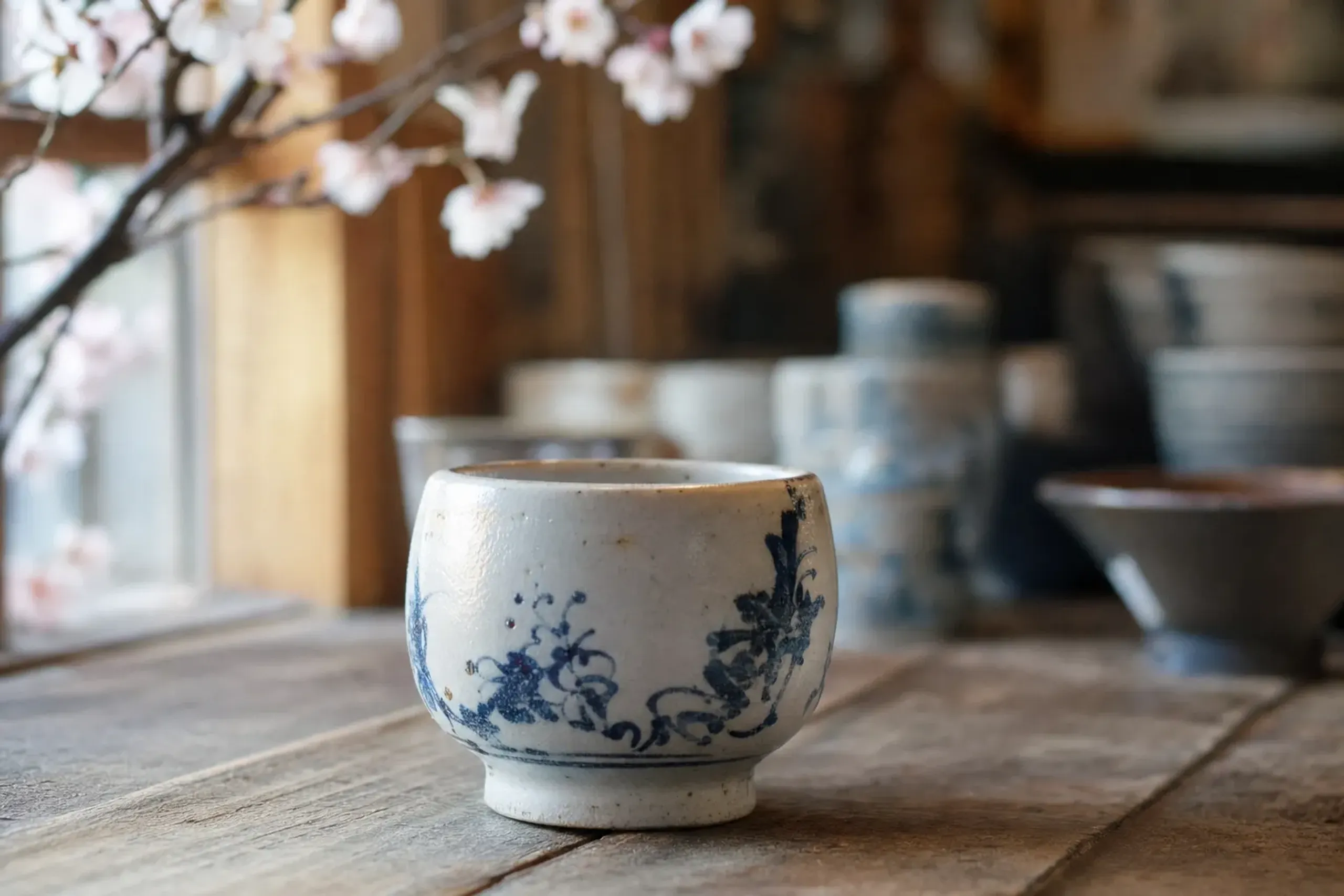
The pigment is gosu, and the thing to understand is that the painter never sees the colour. Gosu goes onto the bisque-fired body as a dull grey-black. It becomes blue only in the second firing, under the glaze, at 1,300°C. Everything about the brushwork — pressure, speed, where the stroke thins and where it pools — has to be judged in a colour that is not the colour.
Because it is applied under the glaze rather than over it, the drawing is sealed inside a layer of glass. It cannot be scrubbed off, cannot fade in a dishwasher, cannot wear away under a knife. That is the second half of the durability argument, and it is the less obvious half: a Tobe bowl is not merely hard to break, it is hard to spoil.
The strokes are drawn by hand, one at a time, and the older kilns have their own signatures. Baizan works in a manner called tsuketate ippitsu-gaki — laid down in a single loaded stroke, no correction, no going back over a line. Its recurring motifs have names as plain as the bowls: karakusa, the running arabesque; taiyō, the sun; nazuna, shepherd's purse, a roadside weed. A hundred years of a district's design vocabulary, and the flagship pattern is a weed.
1953, and the year the town stopped making flower vases
Here is the fact that reorders everything above.
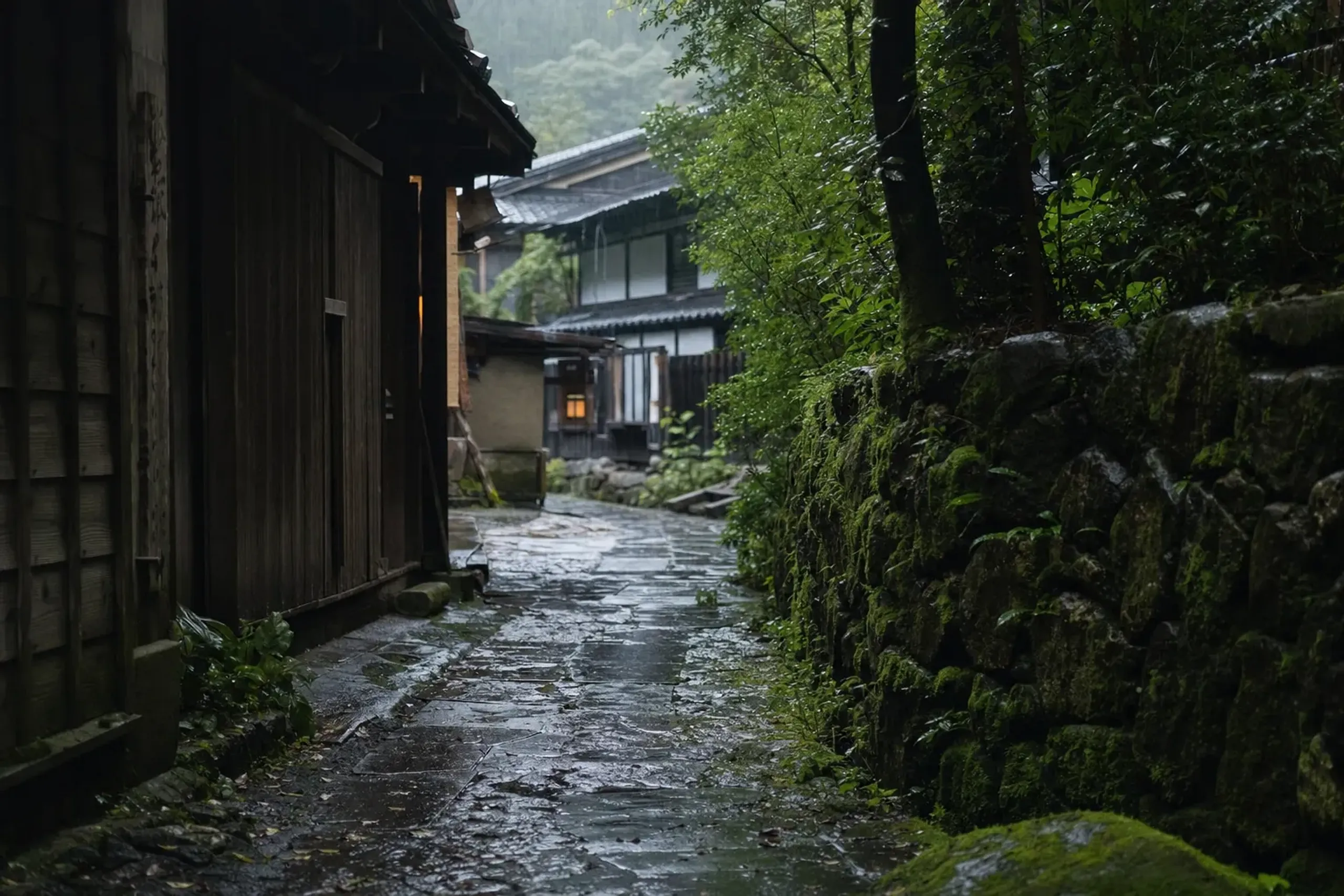
The Tobe ware you can buy today — the everyday bowls, the plates, the donburi — is a deliberate invention of the 1950s. Before and during the war, the prefectural record states plainly, the district's main output was vessels for flower arrangement: water basins, throw-in vases, compotes. A porcelain town making almost nothing to eat from.
On 23 May 1953 Yanagi Sōetsu, the philosopher who founded the mingei folk-craft movement, came to Tobe. He brought Bernard Leach with him. Yanagi looked at what the district was producing and said, in the words the prefecture preserves, that Japanese pottery had been mechanised into disorder in both form and pattern, that there was nothing sound being made — and that for a porcelain district to have no practical tableware made no sense at all.
It was not merely a rebuke. Through a school connection between Yanagi and the governor of Ehime, Hamada Shōji — later a Living National Treasure — was brought to Tobe to work with the kilns. Hamada's own verdict on where good work could still be done in Japan named two places, and Tobe in Shikoku was one of them. Tomimoto Kenkichi took an interest in the town's white porcelain and sent guidance on design. Within a few years the district had turned from flower vessels to rice bowls, donburi and plates, and to the principle Baizan still prints on its own materials: yō to bi, use and beauty, in that order.
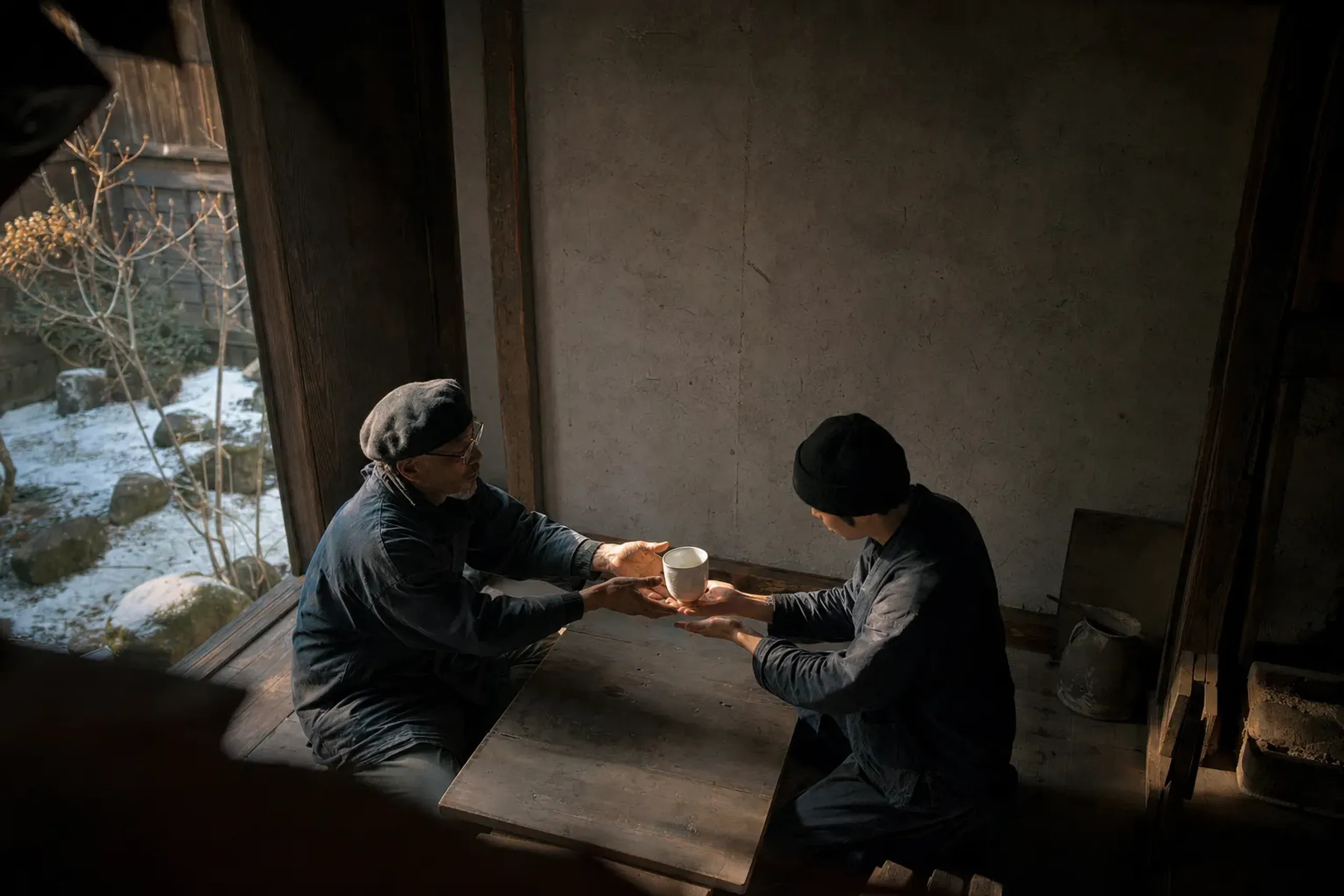
Recognition followed the change rather than preceding it. Tobe ware was designated a national Traditional Craft on 15 December 1976 — the sixth ceramic ware in Japan to receive the designation — and an Ehime Prefectural Intangible Cultural Property on 27 December 2005. The thick, plain, hard-wearing bowl was not what the town had always made. It was what the town chose to become, and then got certified for.
Baizan: the oldest kiln still working
Baizan-gama, the kiln of the Umeno Seitōsho company, opened in 1882 and is the oldest Tobe kiln still in operation — more than a hundred and forty years. The town credits the kiln's insistence on handwork as the thing the folk-craft leaders valued, and the kiln states its own concept in the same three words the movement left behind. It is also the one place in the district where the whole shape of the trade can be seen in a single yard.
The site holds a working factory floor, a historical collection of old Tobe ware, a large sales hall, and the Baizan great climbing kiln, built in 1887 and designated a cultural property by the town. That kiln no longer fires, and what remains is better than a working kiln for a visitor's purposes: you can walk into it. Standing inside the chambers, with the arch closing overhead and the floor still stepping up the slope, explains in a moment why a nineteenth-century pottery town needed a hillside.
On the factory floor the division of labour is visible and unhurried — the throwers, the finishers who sand the piece while it is still leather-hard, the painters laying gosu on white.
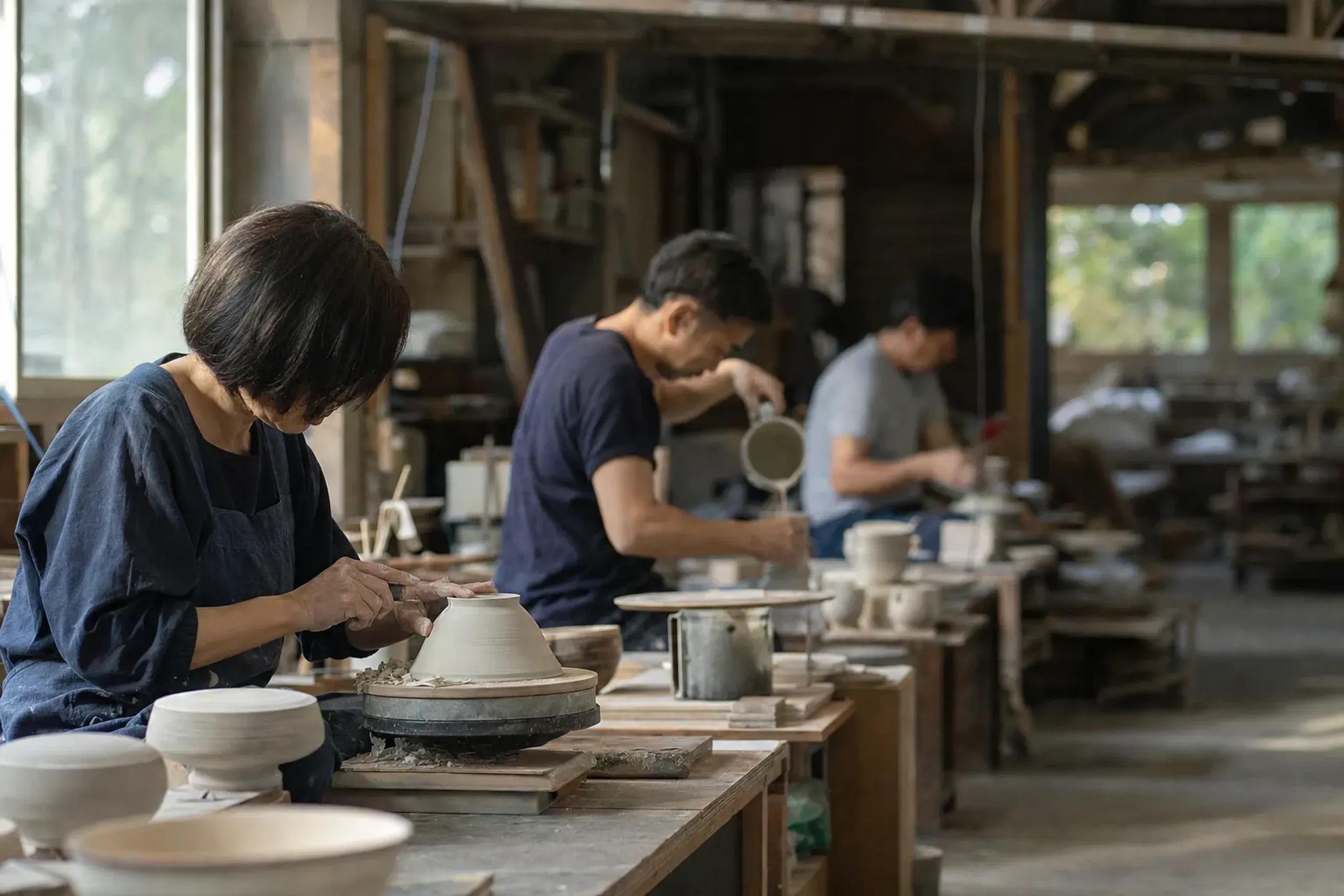
These are working people rather than a demonstration, and a visit is shaped around their rhythm.
The valley of a hundred kilns
Baizan is one kiln of roughly a hundred, and the range is wider than the postcard blue-and-white suggests. Celadon and tenmoku are inside the designation; the town's own line is that each of the hundred has developed a manner of its own. The Tobe-yaki Traditional Industry Hall, opened in 1989, shows and sells work from around eighty of the kilns under one roof and is the efficient way to find which two or three are worth an hour. It opens from nine to five and closes on Mondays.
One practical warning. Twice a year, in April and in autumn, the town holds the Tobe-yaki festival, with dozens of kilns selling directly across a park and the industry hall. It is a genuinely good event, and exactly what a private day is not: crowded, loud, and impossible to move through slowly. If quiet is the point, the festival weekends are the two weekends to avoid.
How the day fits the port, and the brewery on the way back
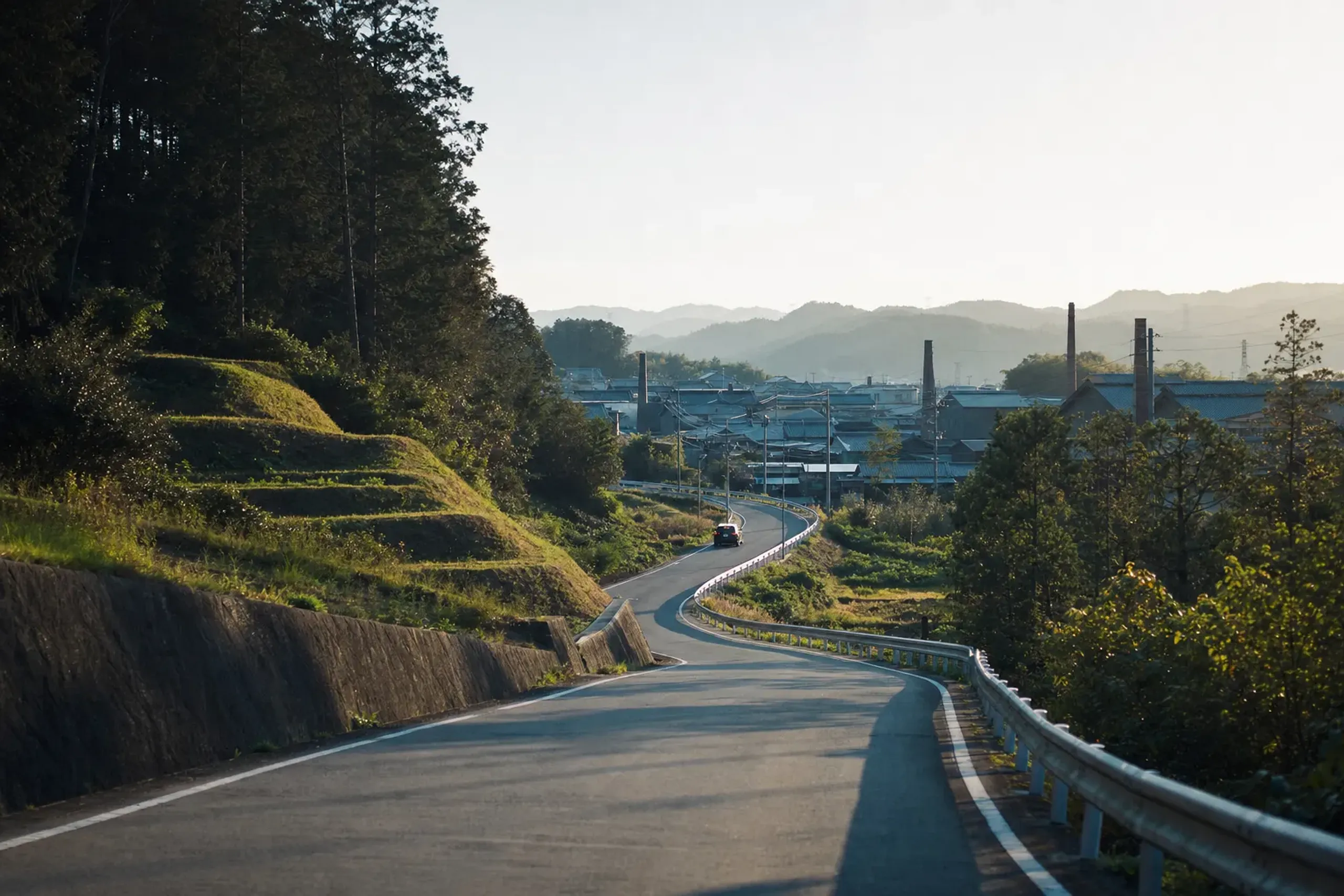
Tobe sits about twenty-five minutes by car from Dōgo, with the kilns a few minutes further on — which makes it a half-day rather than an expedition, and leaves the rest of the day intact. The ship lies at Matsuyama for days rather than hours, and that changes what is possible: a kiln can give you an afternoon instead of a demonstration, and nothing has to be cut short to fit a gangway.
If the pottery valley is the morning, one small thing sits naturally at the other end of it. Mizuguchi Shuzō is the only sake brewery in Dōgo, five minutes on foot from the Honkan, founded in 1895 — the year after the famous bathhouse itself was built. Its shop and main house, put up in 1917, is a National Registered Tangible Cultural Property. It brews the sake Nikitatsu from Dōgo groundwater, and also makes Dōgo Beer, a Dōgo gin built on Ehime botanicals, and a Dōgo rum. A visit to the brewhouse with a tasting across the range can be arranged, best placed between mid-morning and mid-afternoon; whether the owner or the head brewer is on the floor that day is not something anyone can promise in advance, and we would rather say so than imply otherwise.
Introductions of this kind are made in Japanese, with the people who own these places, and with an interpreter present because the conversation with a working craftsman is the entire point and does not happen in English. Photography inside a workshop is only ever with permission. To shape a morning in the kilns of Tobe, or to fold it into a wider itinerary from the Matsuyama berth, contact us here. We do not publish our clients, our itineraries, or our rates.