In this guide
- 01Why salt, and why here of all places
- 02What the money built, and what it destroyed
- 03The ships that took the salt away
- 04Fumeikaku, and the "little Kyoto" question
- 05A crane in a bamboo grove
- 06The brewery still working inside the district
- 07What is open, and what the rules are
- 08How to get there, and what the ground is like
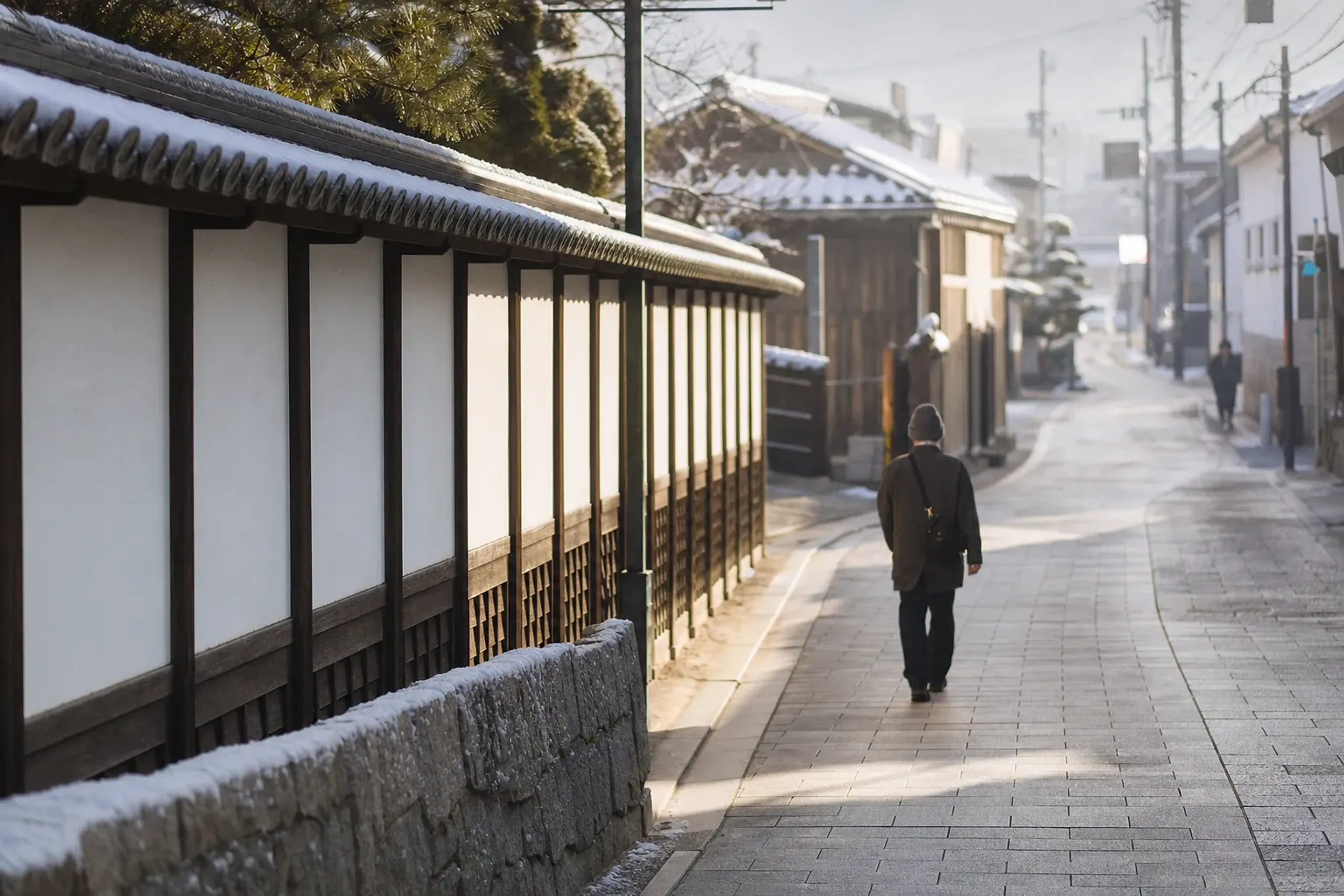
The Agency for Cultural Affairs keeps a register of the places where Japan has decided that a whole streetscape, not merely a single building, is worth protecting. Each entry carries a column headed shubetsu — type. Read down it and you find merchant towns, samurai quarters, post towns, port towns, mining towns, a weaving town. There are 129 districts in all, spread across 106 municipalities in 43 prefectures. Exactly one line reads seienmachi: salt-making town. It has said so since 16 December 1982, and it says it about five hectares of Hiroshima Prefecture called Takehara.
The second curiosity of that line is this: there has not been a working salt field here for roughly sixty-five years. The town's two official histories cannot even agree on the year the last one closed — the municipal booklet says 1959, the city's landscape plan says 1960 — but both agree it had run for more than three centuries. What the register protects, then, is not an industry at all. It is the shape a vanished industry left behind: the roofs it paid for, the temple hall on the hillside, and one family that moved from salt to sake to whisky without ever leaving the same street. For the traveller who values the Japan that Google cannot find, Takehara is a quiet argument for reading a place through what it once made.
Why salt, and why here of all places
Takehara backed into the trade after a failure. In the early Edo period the Hiroshima domain reclaimed part of Takehara Bay, at the mouth of the Kamo River, intending to make rice fields. The ground called Ōshingai was finished in 1647, came out too low and too salty to drain, and then sat useless. By the city's own account, the idea that rescued it came from a merchant of Akō, in Harima, who happened to be in Takehara buying firewood — firewood for the salt fields back home.
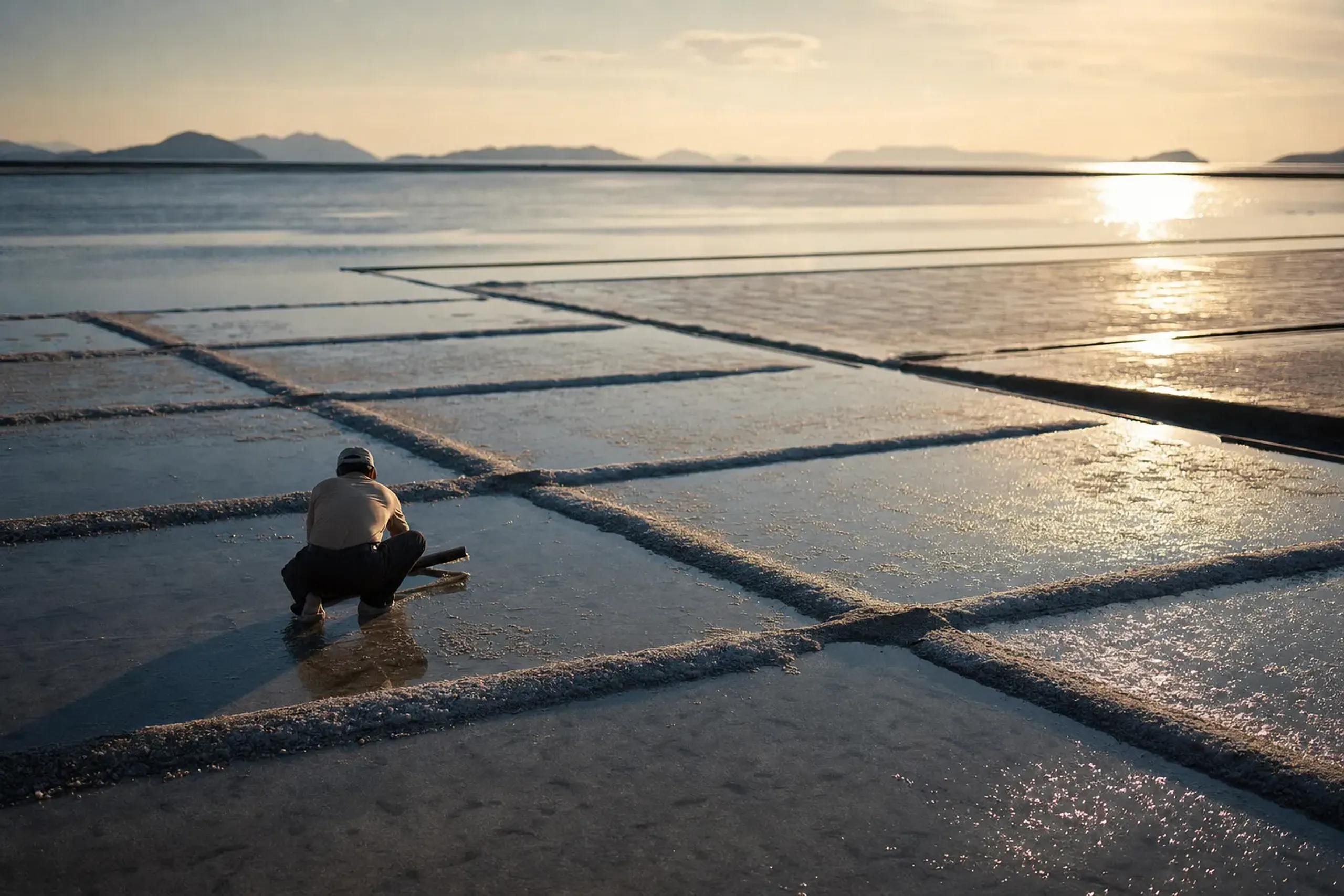
Around 1648 the local magistrate put the proposal to the domain, which brought in engineers from Akō. Salt technique was a closely guarded domain secret; the city explains its sharing as a family matter between the two lordly houses — the sort of quiet, personal transaction on which so much of old Japan turned.
What arrived was the irihama field, and it worked here for a reason Takehara had done nothing to earn. An irihama field lets the tide flood sand through channels at high water, then relies on sun and wind to concentrate the brine as the water drops, so it needs a large tidal range. Takehara sits where that range in the Inland Sea is greatest: the tide entering from the Kii Channel, east of Shikoku, meets the tide coming through the Kanmon Strait and the Bungo Channel from the west, and the two collide roughly here. By 1650 thirty-one pans were finished, and another sixty-seven followed — ninety-eight in all, about sixty hectares of engineered shoreline. By 1719, Takehara alone accounted for seventy-five per cent of the domain's salt tax revenue.
The work itself is worth knowing, because the houses are what it bought. Crews raked the flat from four in the morning, threw seawater across the sand through the day, then scraped the salt-crusted sand into ridges and washed the salt off it in sunken filter boxes set every fifteen metres down the field. Seawater is about three per cent salt; what drained into the jars below ran seventeen to eighteen.
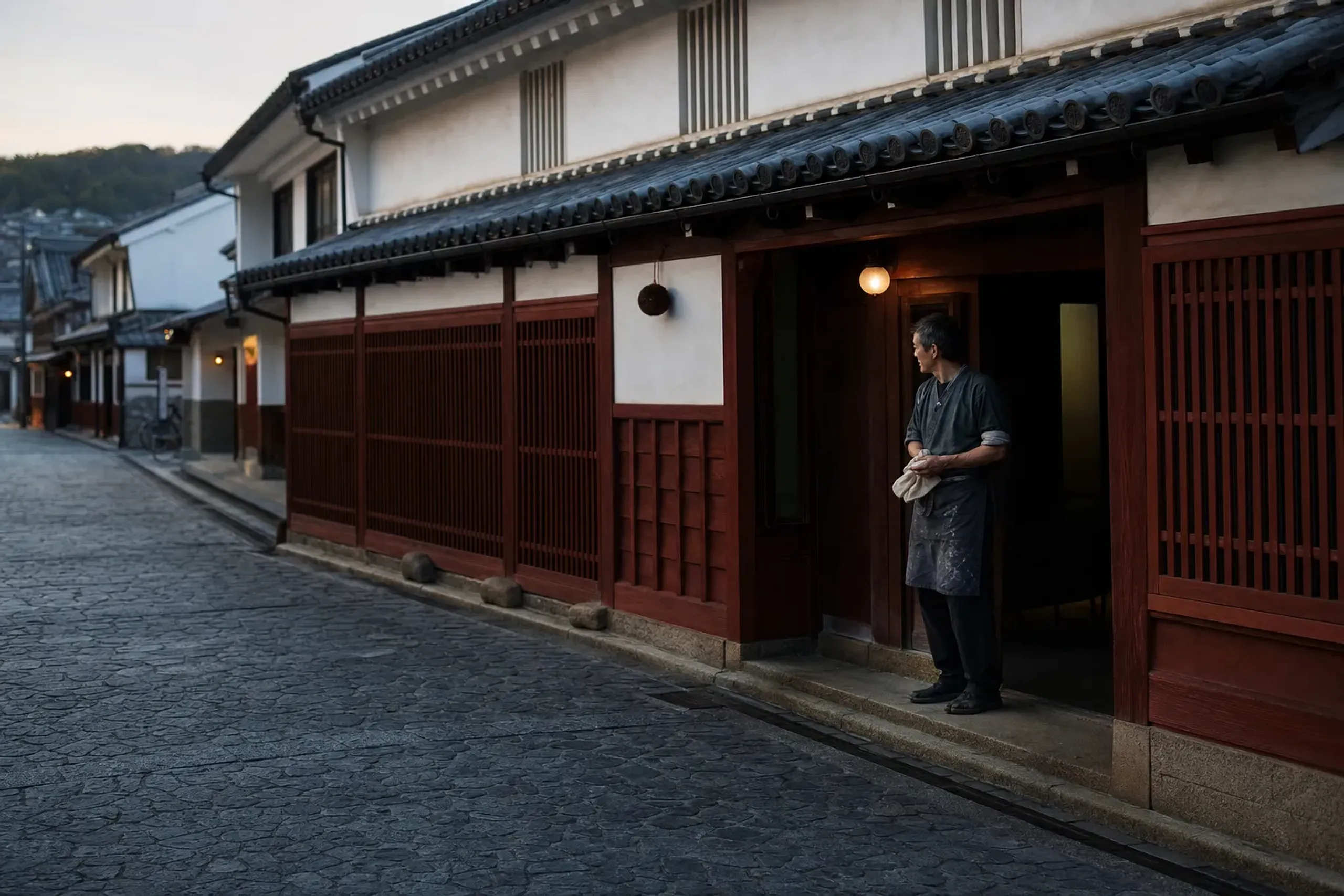
Emptying those boxes was heavy, wet work, and children helped with it. The rest was fire: the brine boiled down in flat pans over a furnace, with a pre-heating pan set higher so the waste heat off the smoke warmed the next batch. The pans were stone until iron arrived in the late 1890s.
What the money built, and what it destroyed
The town on the register is the balance sheet of that trade, losses included. By the Kyōhō era — 1716 to 1736 — the built-up area of today's district was essentially complete, and the town already supported sixteen sake breweries. Then the rest of the Inland Sea copied the technique; salt prices fell, firewood prices rose, and the eighteenth century was hard. The city's booklet gives the number without softening it: in the hundred years from the Kyōhō era to 1818, twenty-three of the town's forty established houses failed and their lines died out. The survivors scaled up and bought their neighbours' plots.
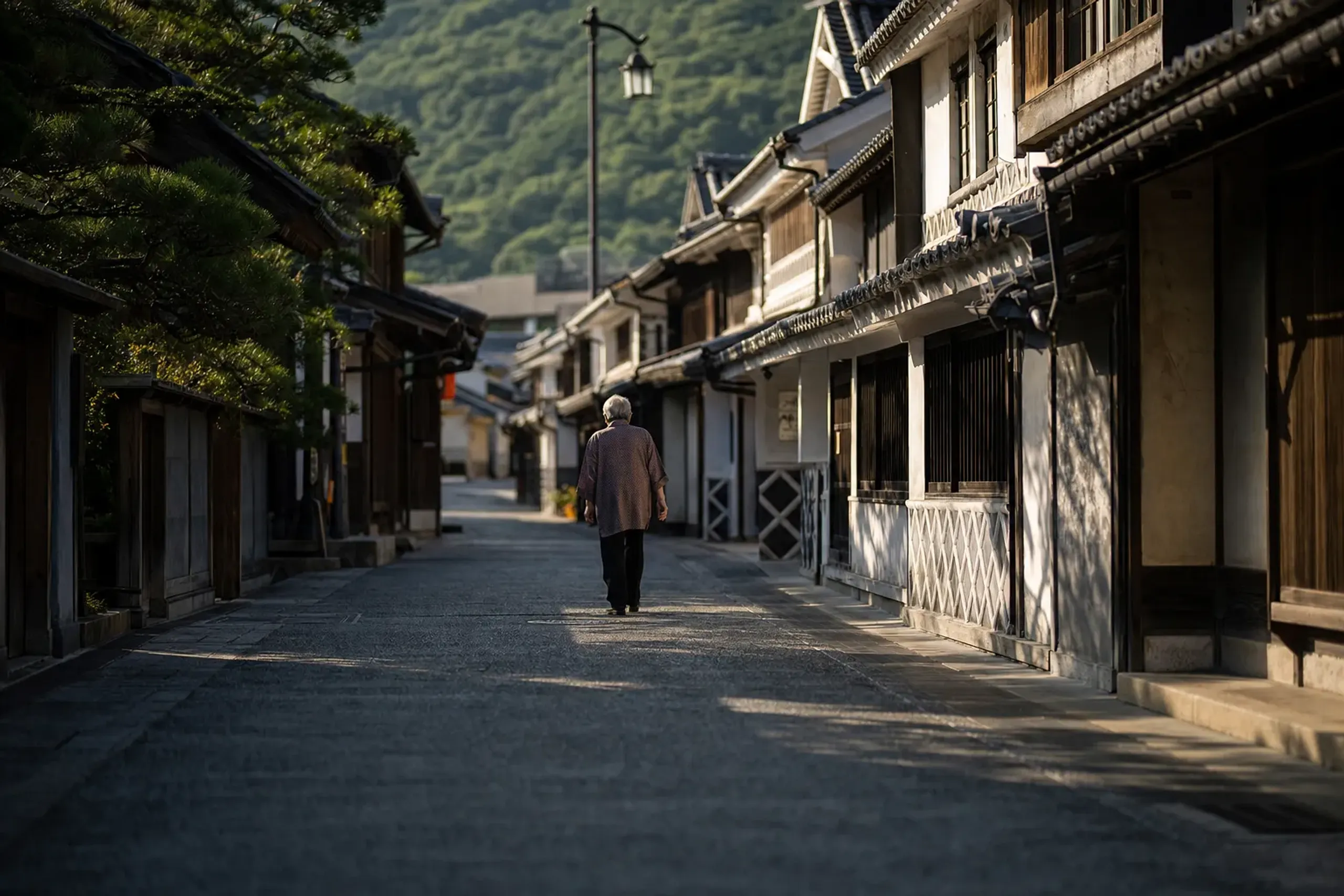
That is why the street looks heavy for a town this size. The roofs are hongawara, the two-piece pan-and-cover tiling normally reserved for temples, and the houses carry the trade in their biographies. The Matsusaka family arrived from Hiroshima in 1674 and dealt in exactly the two commodities a salt field consumes: firewood and coal. They ran pans, ships and a brewery, and their house was built in the Bunsei–Tenpō years and comprehensively rebuilt in 1879. The Kasai house, built in 1872, belonged to a hama-danna — "beach master", the local word for a salt-field proprietor.
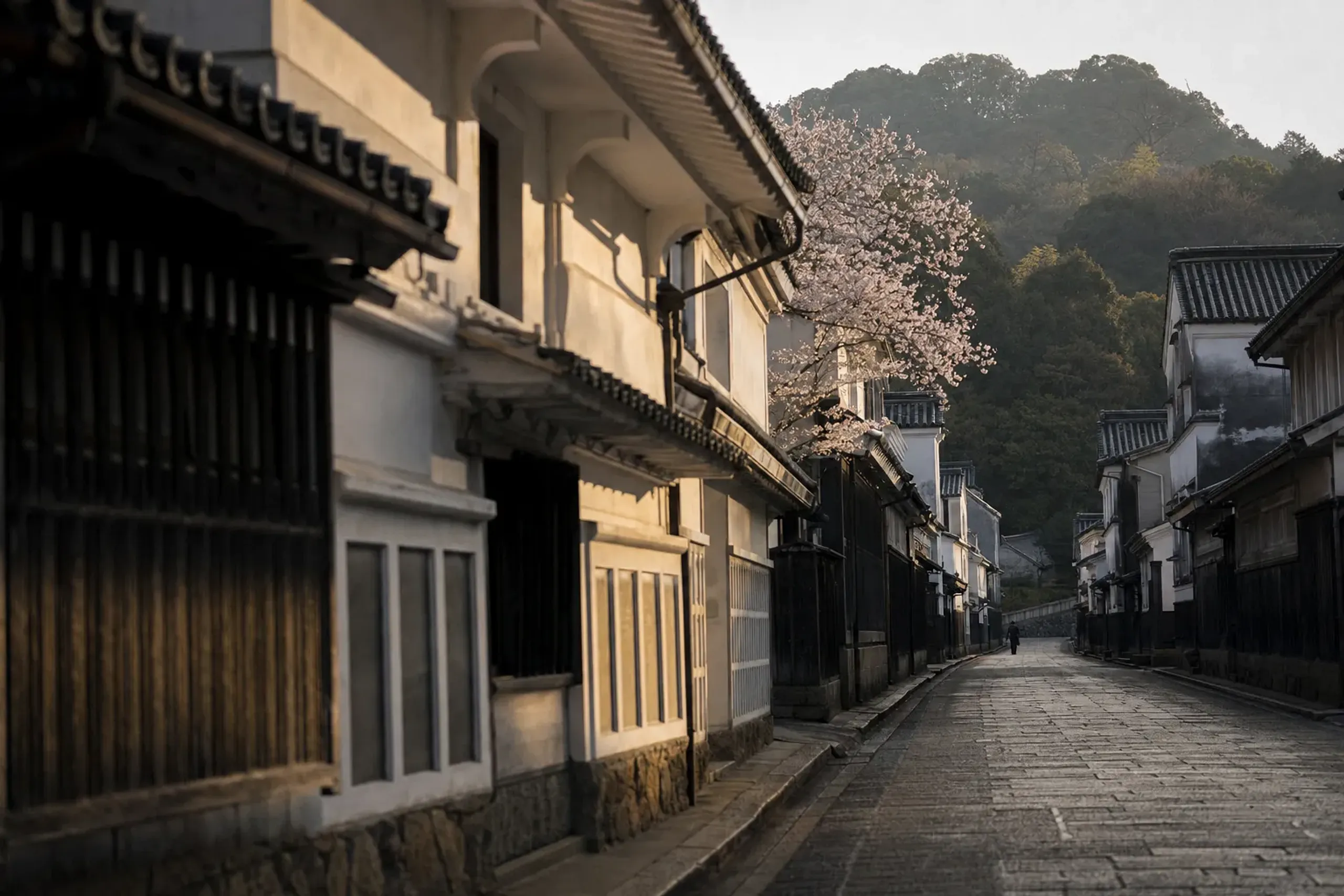
The Morikawa house is early Meiji, built on salt money and moved to its present site around 1916. The Yoshii house, whose main block dates from 1691, was the town's leading salt wholesaler — and it is not open. Nor are the town's two Important Cultural Properties, designated in 1988 and, tellingly, neither of them a salt house: Shunpūkan, built in 1781 by the physician and Confucian scholar Rai Shunpū, and Fukkokan next door, built by a branch of the same family in 1859.
The ships that took the salt away
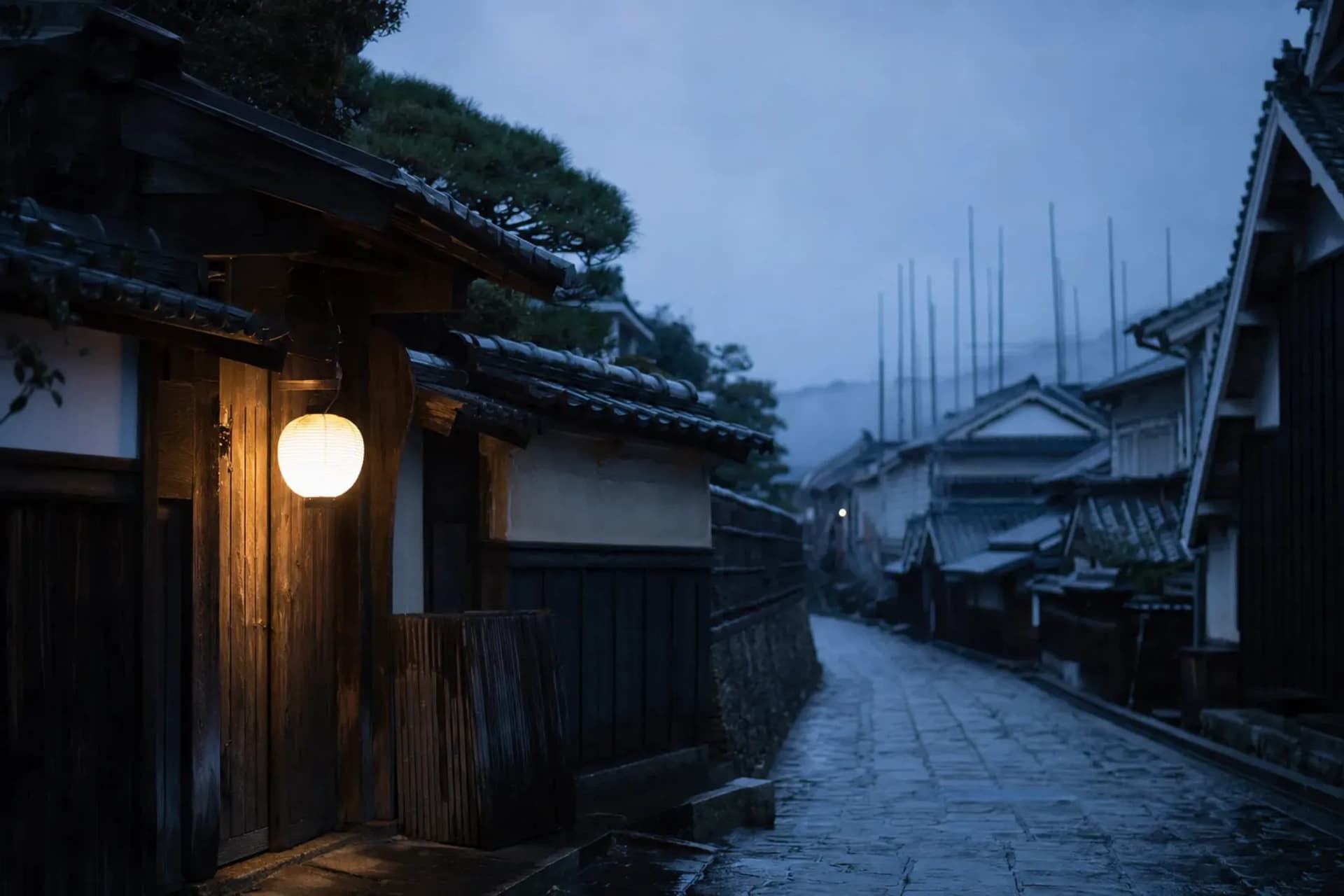
Salt is heavy and cheap, so the question is never how it was made but how it moved. From 1672, when Kawamura Zuiken opened the western sea route, Takehara became a port of call for the kitamaebune, the merchant ships that ran between Osaka and Hokkaidō by way of the Japan Sea. How far the town's reputation travelled is best measured in someone else's dialect: in Itoigawa, on the Japan Sea coast, the arrival of a salt cargo was announced as Takehara ga kita — Takehara has come — and to buy salt was to "buy a Takehara". In May 2019 Takehara was added to the serial Japan Heritage designation built around those ships. Walk toward the water and you pass the stone jōyatō lanterns that once served as the harbour lights.
Fumeikaku, and the "little Kyoto" question
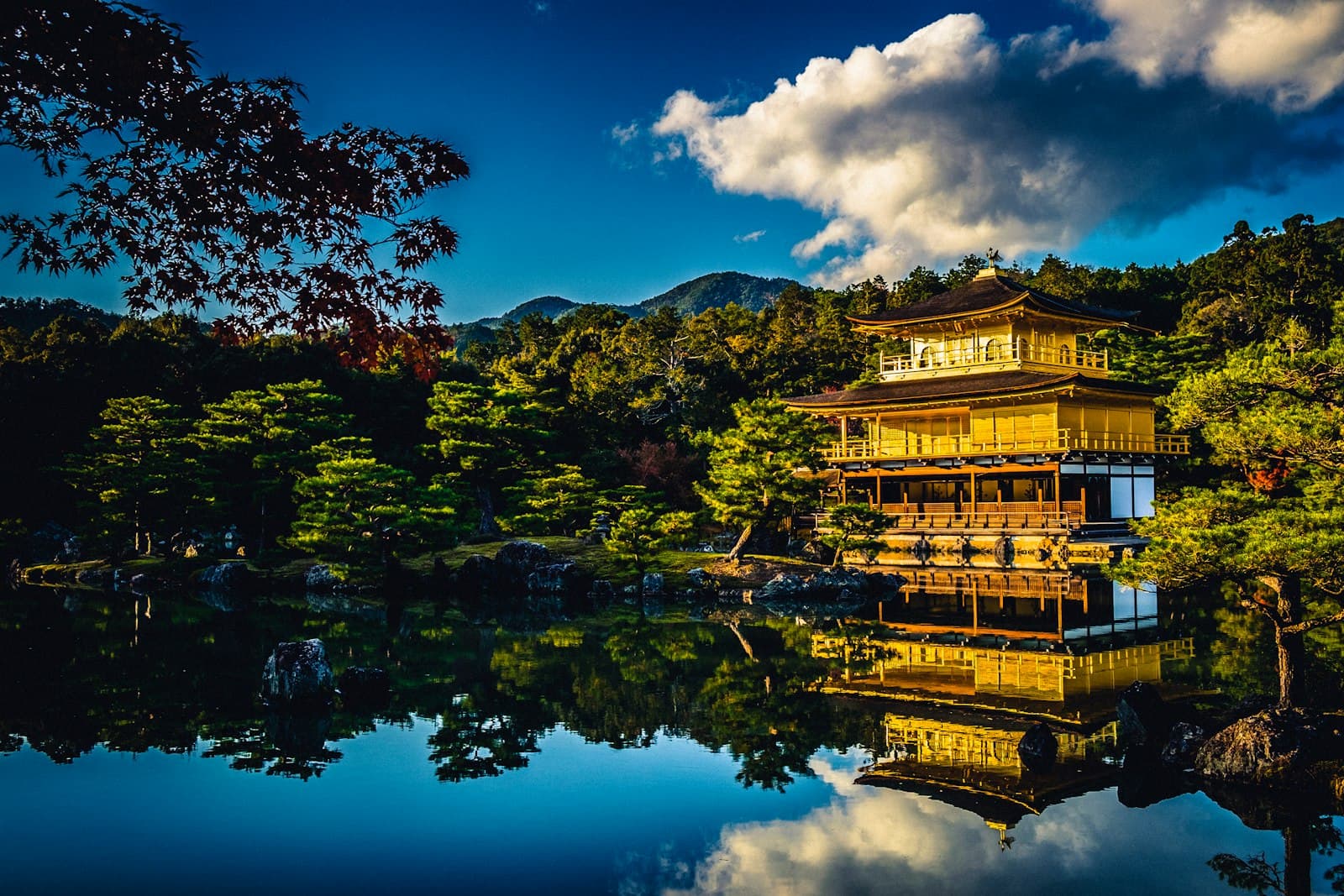
The temples sit on Terayama, the hill behind the merchant houses. The building everyone photographs is Fumeikaku, put up in 1758 on the high ground beside the main hall of Saihō-ji, its floor carried out over the slope on posts beneath a two-tiered pyramidal roof.
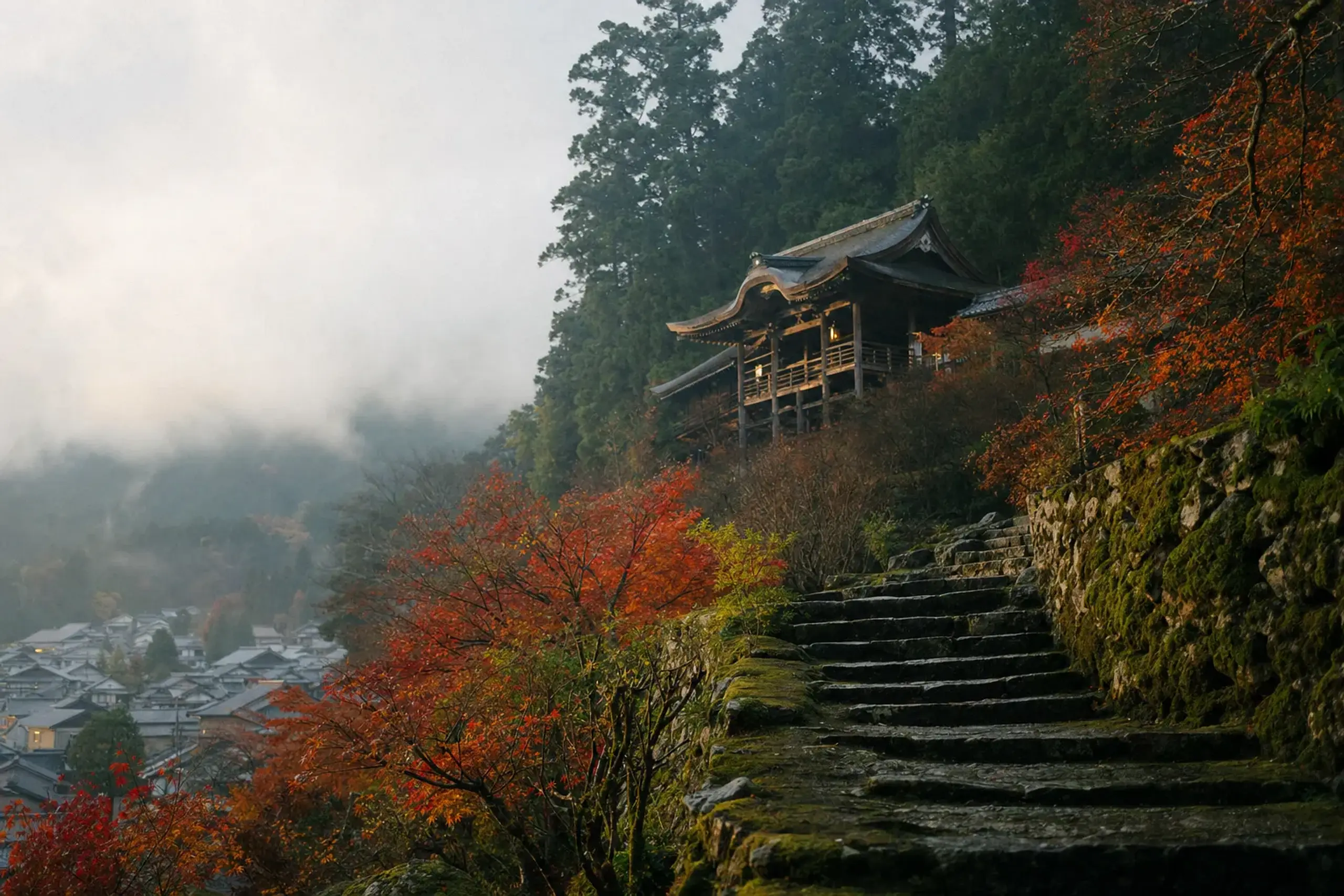
The city's description is unambiguous: it was modelled on the stage at Kiyomizu-dera in Kyoto. You can climb onto it; the view is roofs, in every combination of gable and hip the street can produce, with the Inland Sea behind. It is a study in wabi restraint — grey tile, weathered timber, the sea held at a distance — rather than anything gilded. Below it, Shōren-ji, once the school for the sons of the Takehara Kobayakawa, holds a bronze bell of Goryeo manufacture that has been an Important Cultural Property since April 1910 — the town's oldest designation by seventy years.
Takehara calls itself the "little Kyoto of Aki", and its tourism body says the view from Fumeikaku is the explanation. This is local usage, not a formal designation: Takehara does not appear on the published roster of the All Japan Kyoto Association, the body that formally recognises "little Kyoto" towns, and neither does anywhere else in Hiroshima Prefecture. But what the phrase points at is real — a Kiyomizu quotation on the hillside, temples stacked above a merchant grid, and a genuine intellectual pedigree. Salt money here bought education as reliably as it bought roof tile, and Rai San'yō, whose Nihon Gaishi shaped how the nineteenth century read its own history, was the son of this town's Rai Shunsui.
A crane in a bamboo grove
In the early 1600s, a family that had moved to Takehara from Wakayama found a crane nesting in the bamboo behind their house. A crane on a pine is the commonplace; a crane in bamboo, they decided, was a genuine omen, and they took the surname Taketsuru — bamboo-crane.
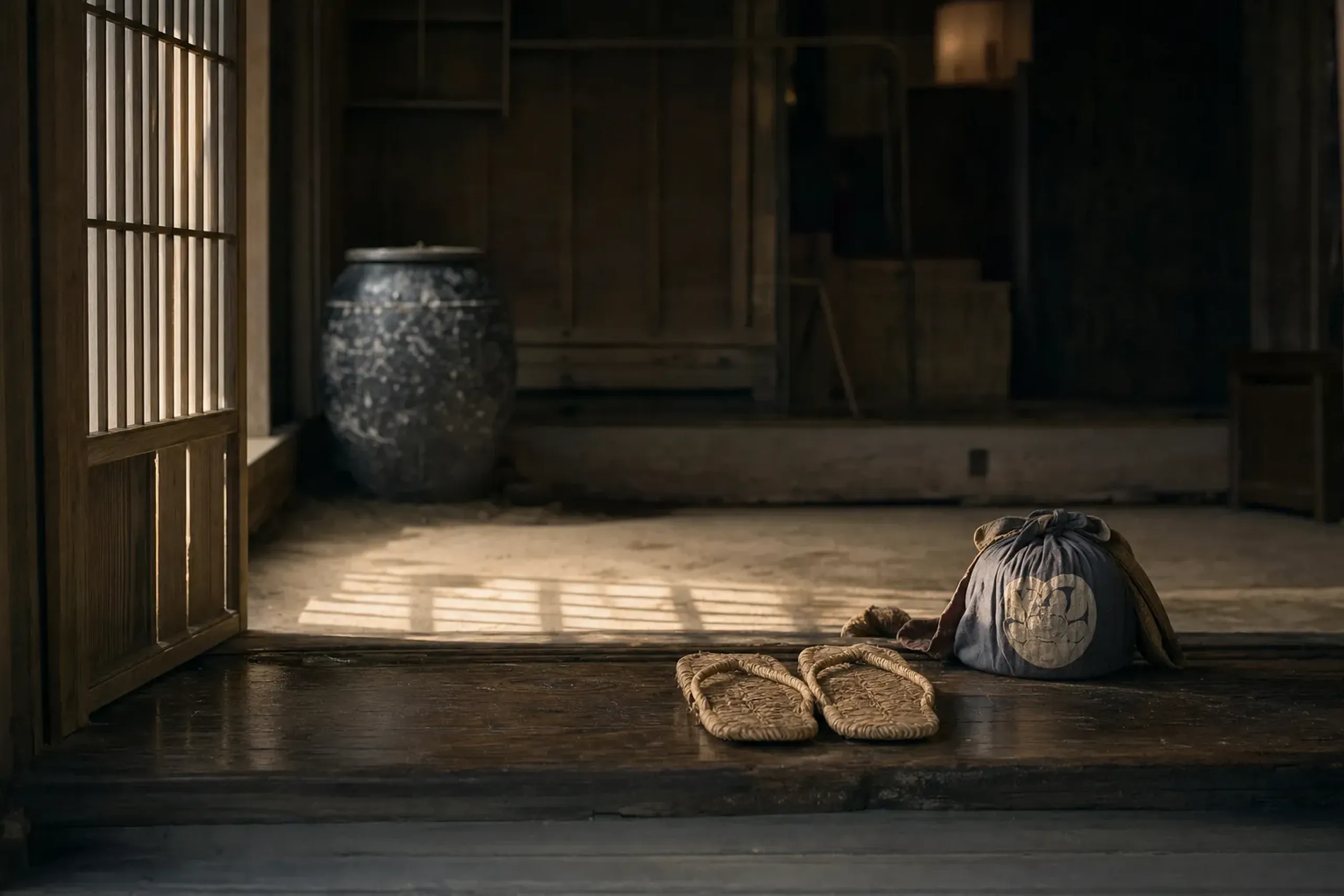
Around 1650, precisely as the first pans were being finished, they went into salt. In 1733 they added sake brewing, and it is 1733 the company still prints under its name today. In 1932 they sold the salt fields — in part to help fund the campaign to bring the railway, now the Kure Line, to the town — and sake became the main business.
Their own account of why the sake got good is the best part of the story. Takehara's brewers found after the Meiji Restoration that their product could not stand next to the Kansai heartland's, formed the first brewers' association in Hiroshima Prefecture in 1888, and spent more than twenty years closing the gap. The brewery's explanation for the speed is that most of those brewers also ran salt fields, and salt had already taught them, through competition with every other producing region on the Inland Sea, exactly what quality was worth. In a corner of the brewery a well draws water from 126 metres down, unusually high in chloride; the ground in front of it used to be sea.
Masataka Taketsuru was born into that house in 1894, the third son. He read brewing at the Osaka technical college, was drawn to Western spirits rather than sake, and joined Settsu Shuzō in 1916. In December 1918 the company sent him alone to Scotland, where he enrolled as an auditing student at the University of Glasgow. Finding the lectures useless, he talked his way into Longmorn in Speyside in April 1919 and learned malt whisky from the floor up — a shokunin's apprenticeship in a foreign language.
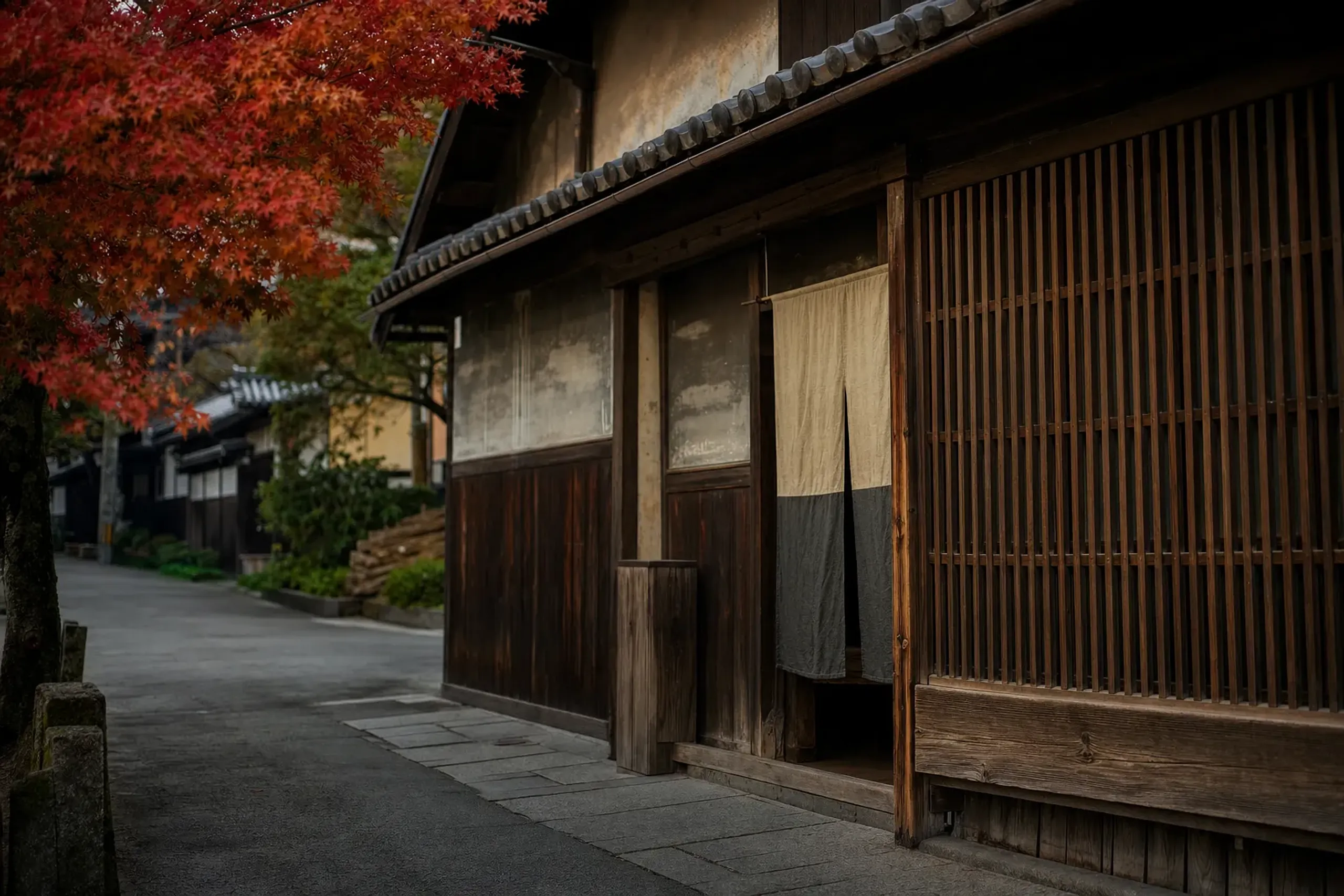
He married Jessie Roberta Cowan — Rita — at the Glasgow registry office on 8 January 1920 and brought her home that November.
The rest belongs elsewhere, but it begins here. He built Japan's first malt distillery at Yamazaki by November 1924, staffing it with sake brewers he brought from home in Hiroshima. He left in March 1934, completed Yoichi in Hokkaidō that October, and released his own first whisky in June 1940, naming it from the first syllables of the company: Nikka. The brewery that family founded still stands in Takehara. Whether it receives visitors we could not establish from any official source, and so we do not put it on an itinerary as though it does — a discipline we hold to precisely because our guests trust us to.
The brewery still working inside the district
Sake is still made in Takehara, not only remembered. Fujii Shuzō has stood at 3-4-14 Honmachi, inside the preservation district itself, since 1863, and its own chronology reads as a run of decisions to make less and to make it more slowly — a house committed, in the end, to restraint over volume. It took first place at the first national sake competition in 1907. It resumed junmai brewing and put its Ryūsei label back on sale in 1974, and added Yoru no Teiō — the night emperor — in 1982. In 1999 it stopped brewing honjōzō altogether and became an all-junmai house. In 2008 it went back to kimoto, the older and slower method in which the lactic acid is allowed to arrive of its own accord rather than being added, and in 2023 it converted the entire brewery to kimoto. The present head of the house took over in 2024.
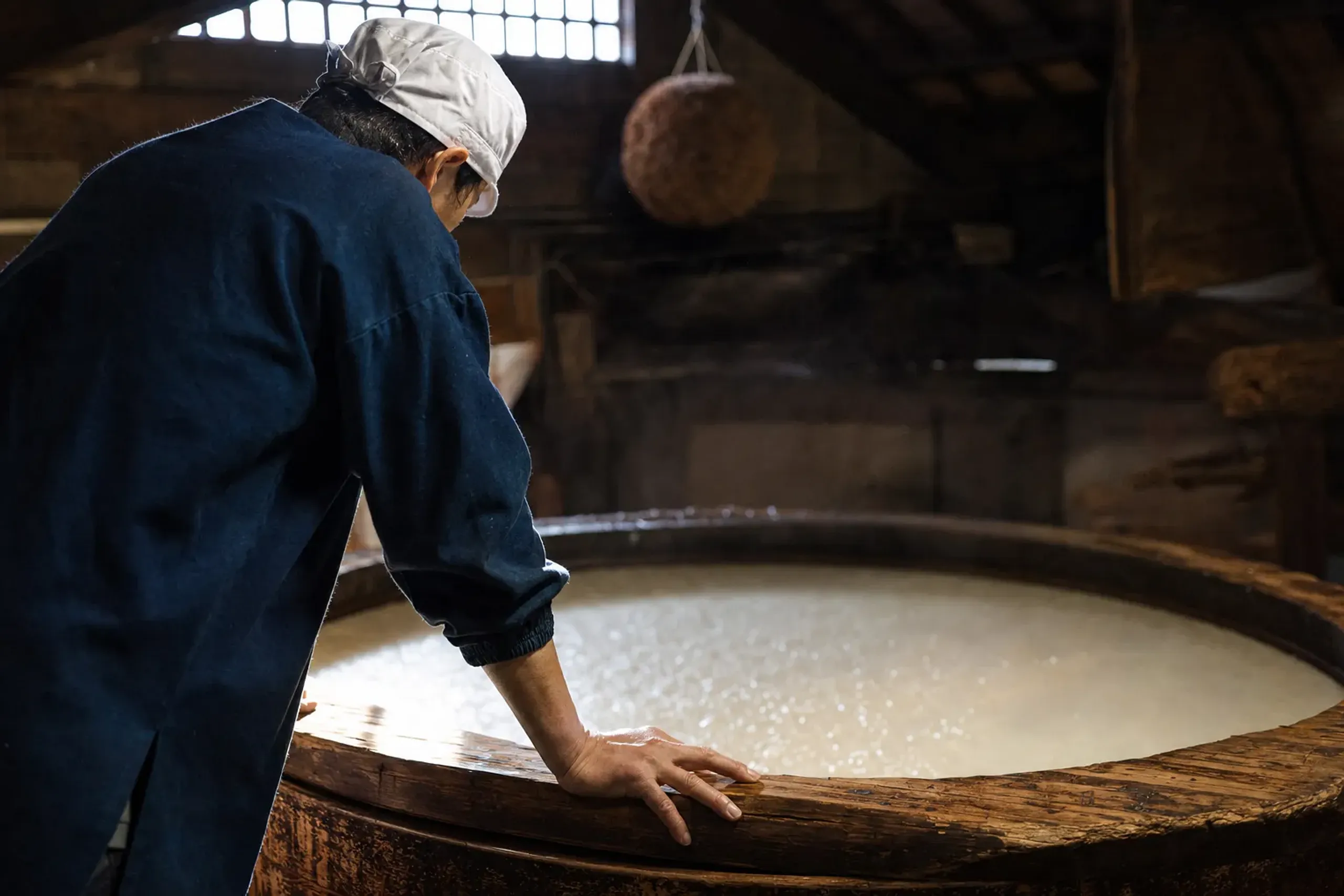
The International Wine Challenge was held in Hiroshima in 2026 and judged a record field of more than 1,700 entries. Ryūsei Kuro junmai daiginjō took a silver and Ryūsei Yuragi no Nagi a bronze. The brewery's own announcement of the result is the part worth reading. It notes that both are made with the yeast resident in the building and with nothing added, calls the result a surprise and a piece of hard-won confidence, and then says plainly that it did not reach gold. That candour is the register of the place — and it is precisely the reason to go.
A corner of the old brewery — late Edo, heavy beams, earth walls — has been given over to a small tasting room. It opens from eleven until four, closes on Mondays and on the following day when a Monday falls on a public holiday, and charges nothing, either to enter or to taste. Several sakes are poured, changed with the season, and a bottle you take to can be bought where you are standing. There are ten parking spaces, and the brewery asks anyone in a large vehicle to leave it at the Michi-no-Eki Takehara roadside station and walk in through the old streets instead — the lane up to the brewing hall is long, and was not laid for coaches. Takehara station is ten minutes away on foot and five by taxi; by road the brewery is twenty minutes from the Kōchi interchange of the Sanyō Expressway. For guests who prefer not to negotiate any of this, a discreet private car and chauffeur can wait outside the district while you walk the last quiet stretch on foot, as the town intends.
What is open, and what the rules are
Four historic houses are open to visitors — the Matsusaka house, the Morikawa house, the Mitsumoto house (the detached parlour of Fukkokan, whose storehouse now shows the ceramics of Imai Masayuki), and the municipal folk history museum, housed in a 1929 Western-style building on the site of the Edo-period town academy.
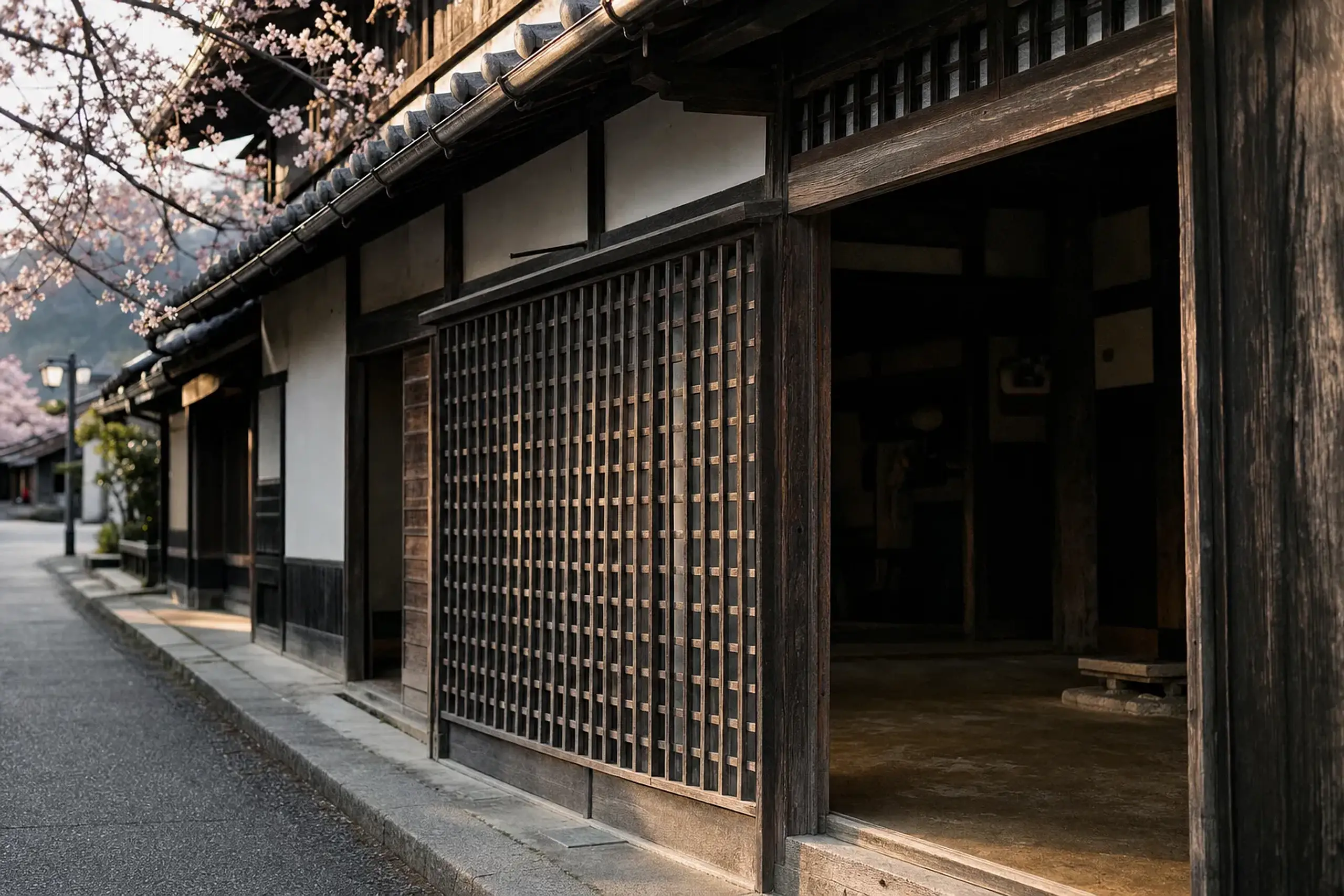
Closing days differ — the Matsusaka house shuts on Wednesdays, the Morikawa house only over the New Year — so the order in which you walk matters. Shunpūkan, Fukkokan and the Yoshii house are not open. The Kasai house is, free of charge, and doubles as a venue for town events.
The district is a legal regime, not a mood. Any change to the external appearance of any building inside it requires prior permission from the city and the board of education: new signage, an air-conditioning unit, a solar panel, even the felling of a tree — all need an application. Demolition of a designated traditional building is in principle not permitted; qualifying repairs are subsidised at eighty per cent of cost up to a ceiling. That is why the tiles and the grey plaster run continuously down the street, and why the town asks visitors to remember that these are private houses with people living in them. Moving through such a place with the right introductions, and with the discretion its residents deserve, is part of what makes the visit feel earned rather than merely arranged.
How to get there, and what the ground is like
The district is a ten- to fifteen-minute walk from Takehara station. Published figures put the town roughly an hour from central Hiroshima by road, seventy to eighty minutes by the Kaguya-hime express bus, and twenty-five to thirty minutes by taxi from Hiroshima Airport; from Mihara, on the Shinkansen, the Kure Line takes forty to fifty minutes.
Local guides can be booked through the association three days ahead. Tadanoumi, at the eastern edge of the same city, is where the boat leaves for Ōkunoshima — five minutes on foot from Tadanoumi station to the port and about fifteen minutes across, or roughly half an hour by car from Takehara station to the pier. The island is known for its free-roaming rabbits and the remains of a wartime installation, and is a separate day rather than an afternoon.
A word on the ground itself. The district climbs from the old waterline to the foot of Terayama, Saihō-ji is reached by a flight of stone steps, and Fumeikaku sits above that again. The one hotel inside the district states on its own facility sheet that it is not barrier-free — though that specific claim could not be re-checked as of our last pass (the page returned an error), so treat it as a starting point rather than a confirmed fact and reconfirm with the hotel directly before relying on it. Beyond that, neither the city nor the tourism association publishes an accessibility assessment of the streets, and we would rather say so plainly than guess on your behalf.
Takehara's population peaked at 36,895 in 1980 and had fallen to 28,644 by 2010; it has kept falling since. The preserved streets were not built for cars — Fujii Shuzō asks visitors to leave theirs at the roadside station car park — and the town repays a slow half-day and a guide who can read a roofline. Arranging that well, with the right houses open on the right day of the week, a grand-master sake brewer's welcome secured in advance, and a car waiting outside the district rather than trying to force its way in, takes real work beforehand. This is the quiet, invisible logistics on which a bespoke itinerary depends. Japan Royal Service is glad to do it — and to hold every detail of your visit in complete confidence. When you are ready to walk Takehara at its own unhurried pace, contact us here and we will build the day around you.