
In this guide
- 01Japanese Vegetable Tanning And Why Tochigi Leather Carries Its Name
- 02Shell Cordovan: What It Actually Is, And Why It Behaves Differently
- 03Saddle Stitch Versus Machine Lockstitch, And How Each Fails
- 04Edge Finishing: The Fastest Way To Judge A Maker's Hand
- 05What You Can Order, And How Lead Times Actually Work
- 06Asakusa And Kuramae: Where The Trade Lives
- 07Why Choose Japan Royal Service
- 08Common Questions
- 09Begin The Conversation
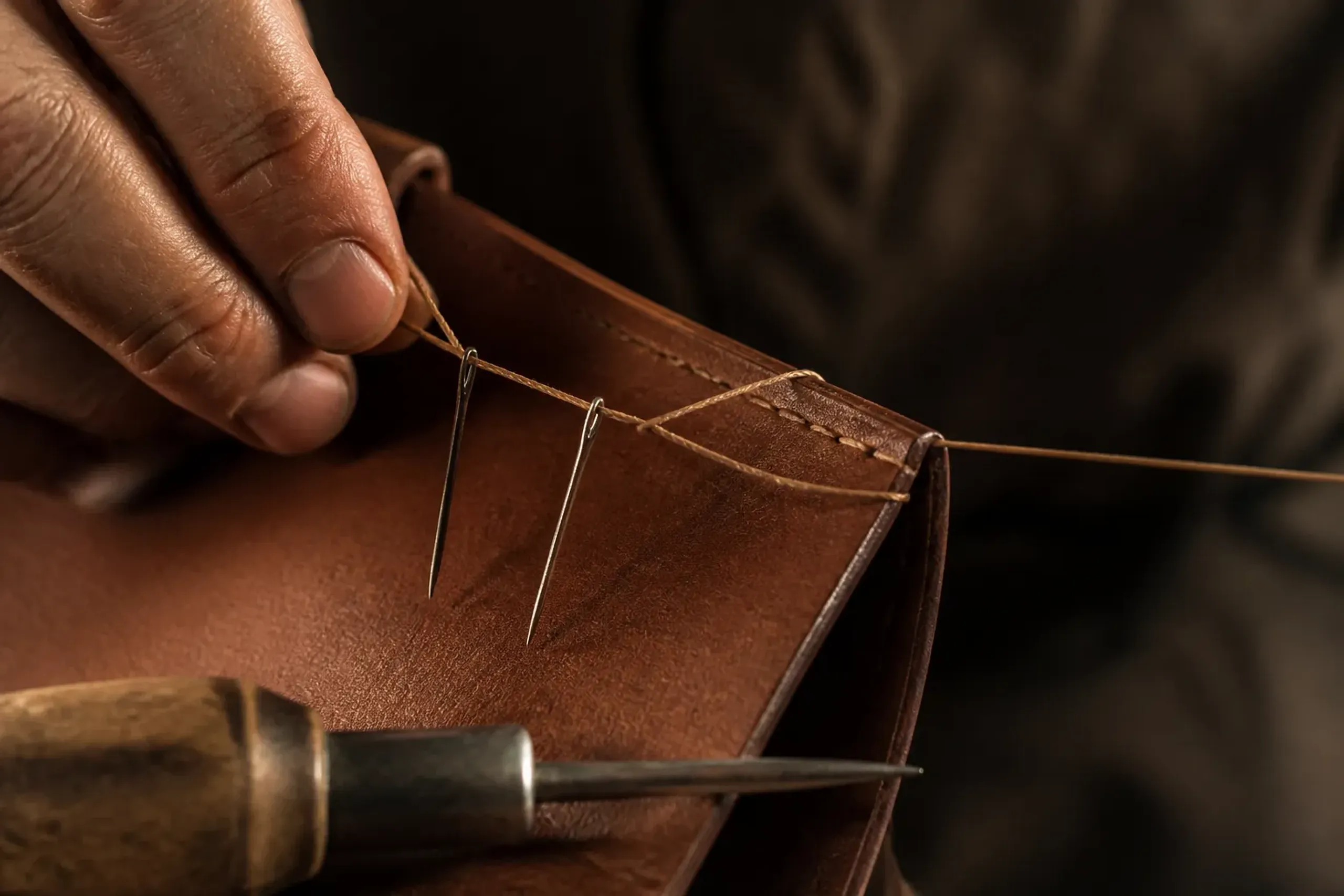
The needle goes in at an angle, both hands moving at once, one pushing thread from the front while the other catches it behind. The awl has already made the hole. The maker pulls each stitch to the same tension, over and over, down the spine of a briefcase gusset. Later comes the edge: a slick of gum, a burnisher warmed by friction, the raw grain compressed until it reads like a single sealed line rather than stacked layers of hide. Watch this for ten minutes and you understand what you are paying for.
This is a piece about materials and method: how Japanese bags, briefcases, wallets, watch straps and luggage are made, and how to tell good work from confident marketing. It is not about footwear. Shoes ask for a last, a fitting, and a multi-year commitment, and we covered that separately in our post on bespoke shoemaking in Japan — including the Tochigi and cordovan basics as they apply to shoes. Here we stay with goods you can order in months, carry daily, and judge with your hands.
Japanese Vegetable Tanning And Why Tochigi Leather Carries Its Name
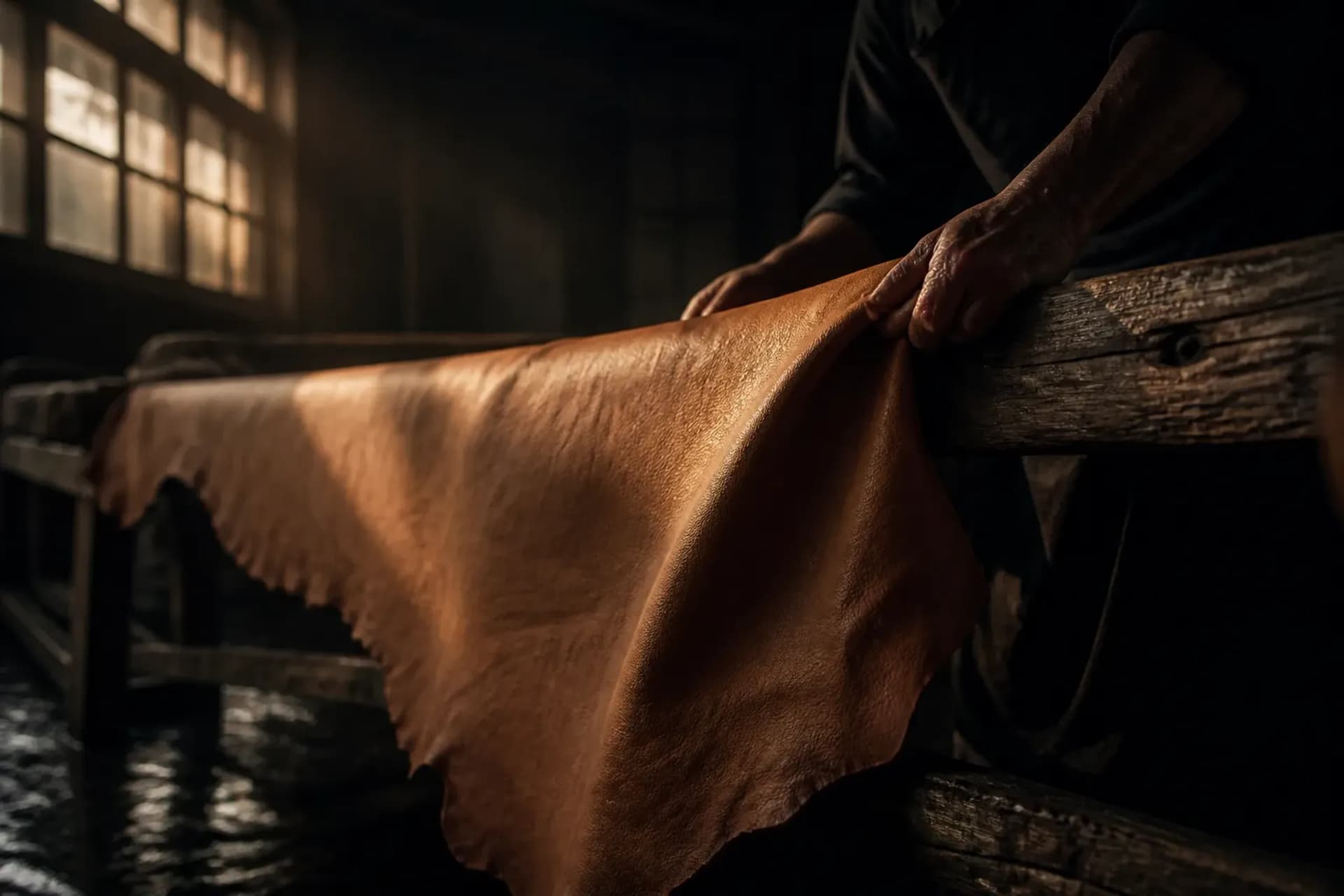
Start with the hide, because everything downstream depends on it. Most leather sold globally is chrome-tanned: fast, a day or two in the drum, soft and water-tolerant and cheap. Vegetable tanning is the old way. Tannins drawn from tree bark and plant matter slowly bond with the collagen in the hide, and slowly is the operative word.
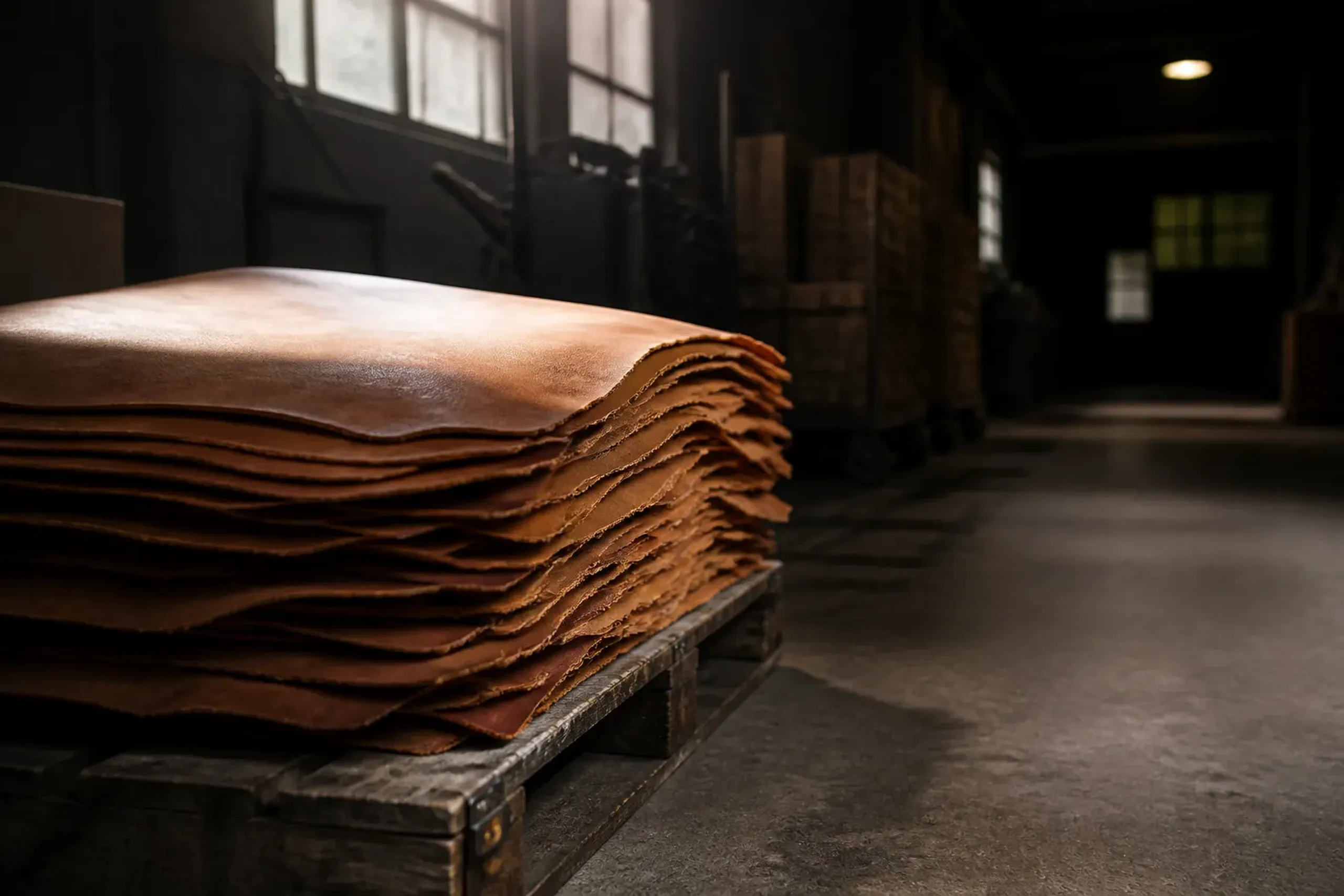
Tochigi Leather Co., Ltd. is a tannery in Tochigi City, Tochigi Prefecture, north of Tokyo. It was founded in 1937. The company works in the pit-tanning tradition — hides sit in a long series of tanning pits, moved through baths of increasing concentration over weeks rather than pushed through a rotating drum in hours. That patience is the whole point.
What you get is a firm, dense leather with a tight fiber structure and very little of the surface coating that hides a multitude of shortcuts. It takes a patina. Left in the sun it deepens; handled daily it darkens where fingers land and picks up a low sheen at the corners. Makers specify Tochigi not because the name sells — though by now it does — but because the material holds an edge, tools cleanly, and ages into something the owner recognizes as theirs.
Worth knowing: "Tochigi Leather" refers to leather from that specific tannery, not to any leather made in Tochigi Prefecture. When a maker lists it by name, they are naming a supplier, not a region. That distinction is the first authenticity check.
One caution about visiting. Tochigi Leather is an industrial tannery, not a showroom. Organized tannery visits have happened in the past — a bag-industry association ran a study tour in 2023, for example — but these are trade and community affairs, not public drop-in tours. Assume the working floor is closed to casual visitors and plan around the finished-goods end of the chain instead.
Shell Cordovan: What It Actually Is, And Why It Behaves Differently
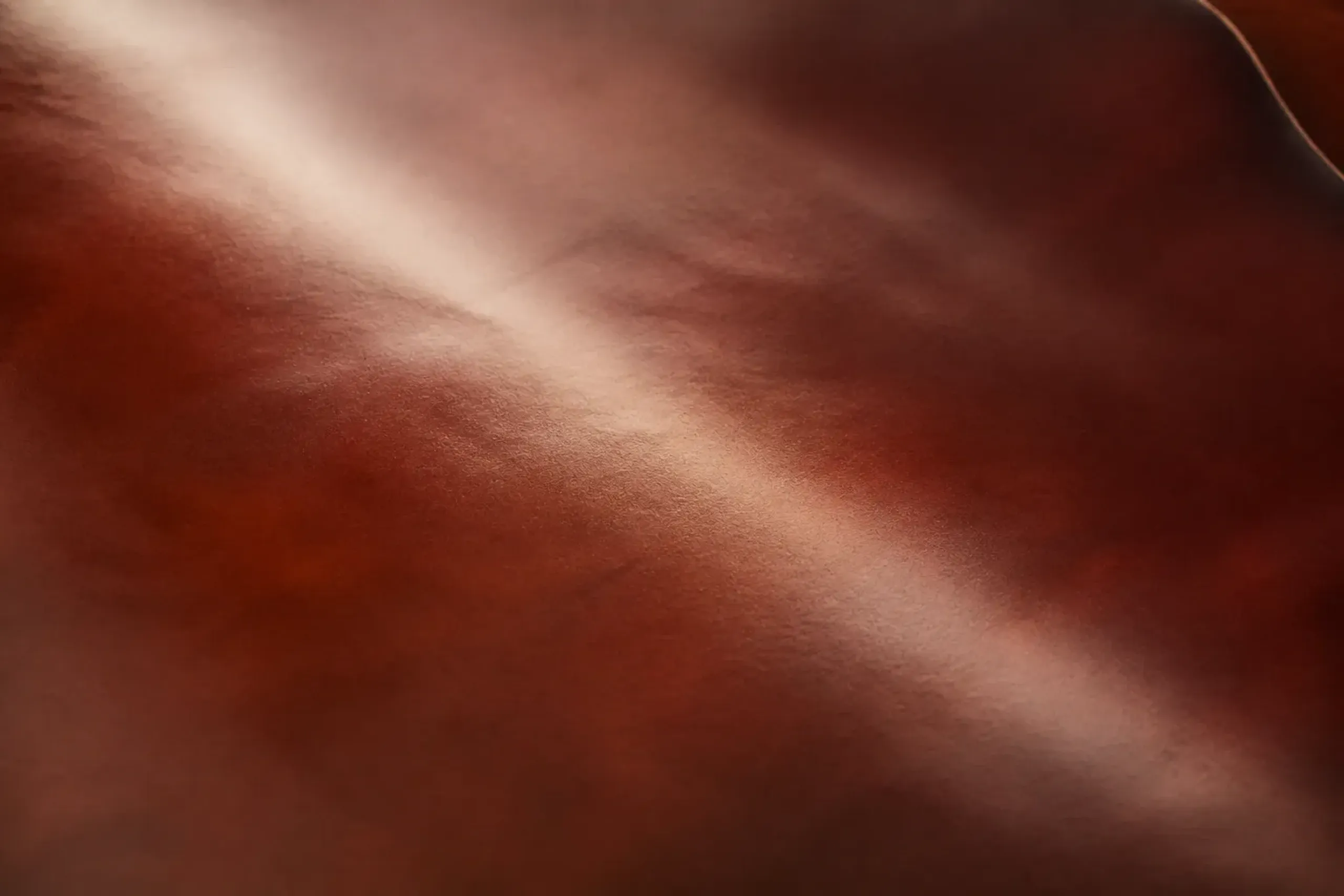
Cordovan gets talked about like a grade of luxury. It is really a location on the animal. Shell cordovan comes from a dense, flat layer of connective tissue under the hide on a horse's hindquarters — the "shell." There are two per horse, each modest in size, and only after the outer hide is split away and the shell is exposed, worked, and dyed can you see whether it is even usable. Much is not. That is most of the cost, before anyone talks about brand.
Structurally it is unlike calf. Calfskin has a grain surface with a visible pore structure and a fibrous corium beneath; it stretches, it stands up in creases, it takes a corrected finish easily. Shell has almost no directional grain and a fiber matrix so tightly packed that it behaves more like a solid than a skin.
How Cordovan Ages And Creases
This is the part people fall for. Calf creases into sharp folds. Shell cordovan rolls — instead of a crease line it develops soft, rounded waves where it flexes, because there is no loose grain to buckle. It does not scuff in the ordinary sense; a mark you would think ruined it can often be worked out with a bone folder and pressure, since you are moving fibers rather than removing a coating. The gloss deepens with wear. On a watch strap or a wallet, both of which flex constantly, that behavior is the entire appeal.
The Japanese Tanneries, Not Only The American Supply
Most readers know cordovan through the long-established American supply, and it deserves its reputation. Japan produces it too, at a level that competes directly. Shinki Hikaku Co., Ltd., founded in 1951 and based in Himeji, Hyogo Prefecture, is a horse-leather specialist whose cordovan turns up in a great deal of high-end Japanese leather goods. Leder Ogawa, established in 1971, describes itself as a cordovan finishing and dyeing house — the finishing stage being where a raw shell becomes the glossy, color-saturated material you recognize.
Why this matters when you shop: a wallet described only as "Japanese cordovan" is telling you very little. A wallet that names Shinki Hikaku, or names a finisher, is disclosing its supply chain. Disclosure is the tell. Vague provenance usually means there is nothing to disclose.
Saddle Stitch Versus Machine Lockstitch, And How Each Fails
Here is where a maker's hand shows or does not. Two methods dominate, and the honest way to compare them is not by how they look new but by how they die.
A machine lockstitch uses two threads — one above, one below — knotted together in the middle of the leather at every stitch. It is fast, even, and strong when intact. Its failure mode is the problem. Cut or abrade one thread and the lock unravels; because the two threads depend on each other, a single break can run, and a line of stitching opens up like a zipper.
Saddle stitch is done by hand with a single thread and two needles, one on each end, passing through every hole from both directions so the thread crosses over itself inside each hole. It is slow — a good gusset is an afternoon, not a minute. But each stitch is independent. Cut one and the two adjacent stitches hold; nothing runs. You can wear through a saddle-stitched seam for years and it degrades locally instead of catastrophically. This is why serious bag makers, who know their work will outlive several owners, stitch by hand where it counts.
The fast check: Look at the stitch line at an angle. Hand saddle stitching sits in a subtle diagonal, each stitch leaning the same way because the awl was angled by hand. Machine stitching sits dead straight and perfectly uniform. Neither is a flaw on its own — but a maker charging bespoke prices for machine work on the stress seams is charging for a thing they did not do.
Edge Finishing: The Fastest Way To Judge A Maker's Hand
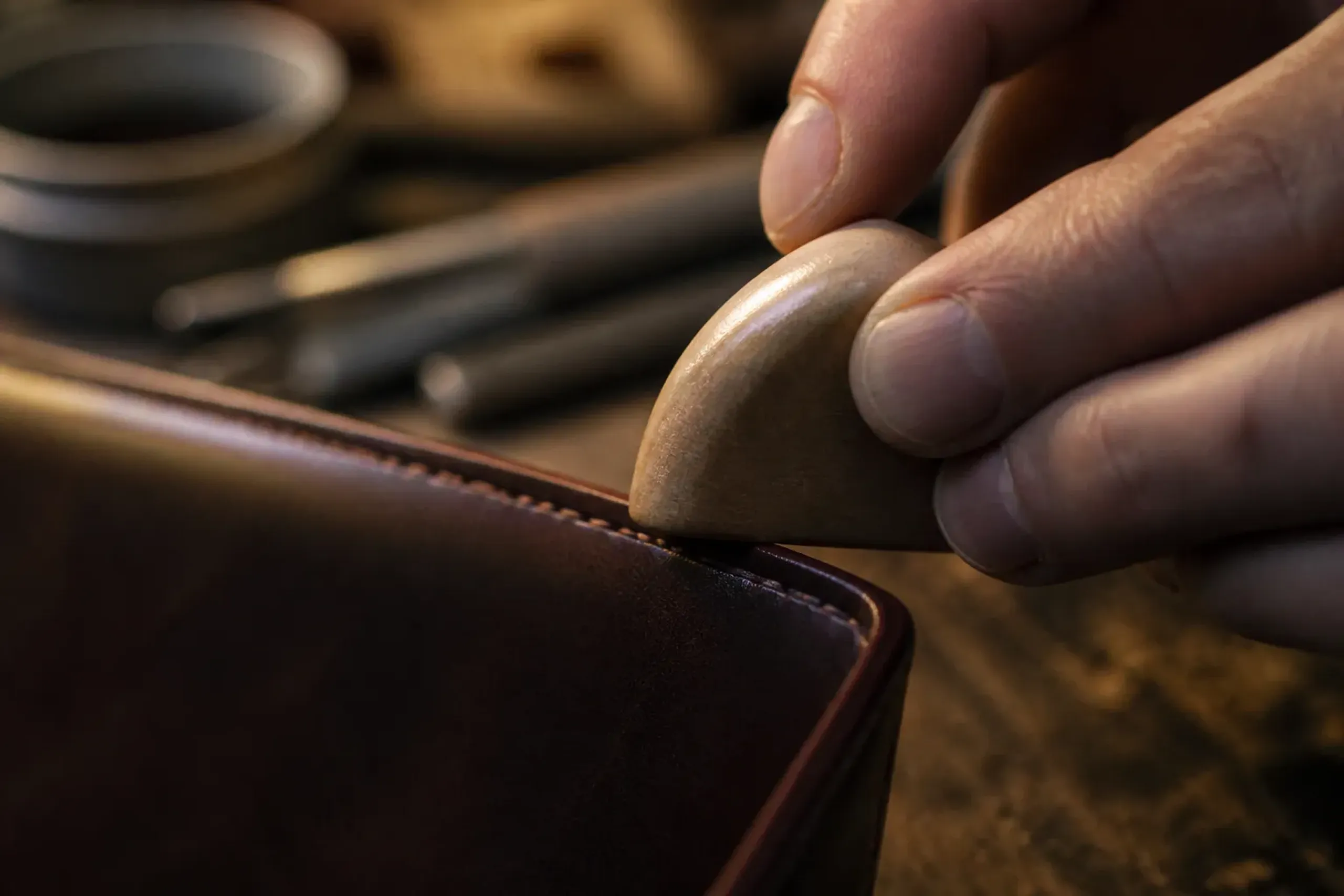
If you have thirty seconds and one thing to inspect, inspect the edges. A leather good is layers of hide stacked and glued; the cut edge is where those layers show. What a maker does with that raw edge tells you almost everything about the rest of the work, because it is slow, invisible in photographs, and impossible to fake at scale.
There are two honest approaches. A burnished (or slicked) edge is sanded flush, treated with gum or wax, and rubbed under heat and friction until the fibers compress into a smooth, rounded, sealed surface — often the same color as the leather or darker. A painted edge builds up thin coats of edge paint, sanding between each, into a clean rounded bead; European houses favor this, and done well it takes many passes.
What you are looking for either way: no fuzz, no gap where the layers meet, a rounded rather than flat-cut profile, and consistency along the whole run including the tight inside curves. Rushed edges show as a matte raw stripe, or a single thick coat of paint that has already started to crack, or fibers standing up under a loupe. On cheap goods the edge is simply left raw or given one careless swipe. Turn a wallet over and run a thumbnail along the edge. You will feel the answer before you see it.
What You Can Order, And How Lead Times Actually Work
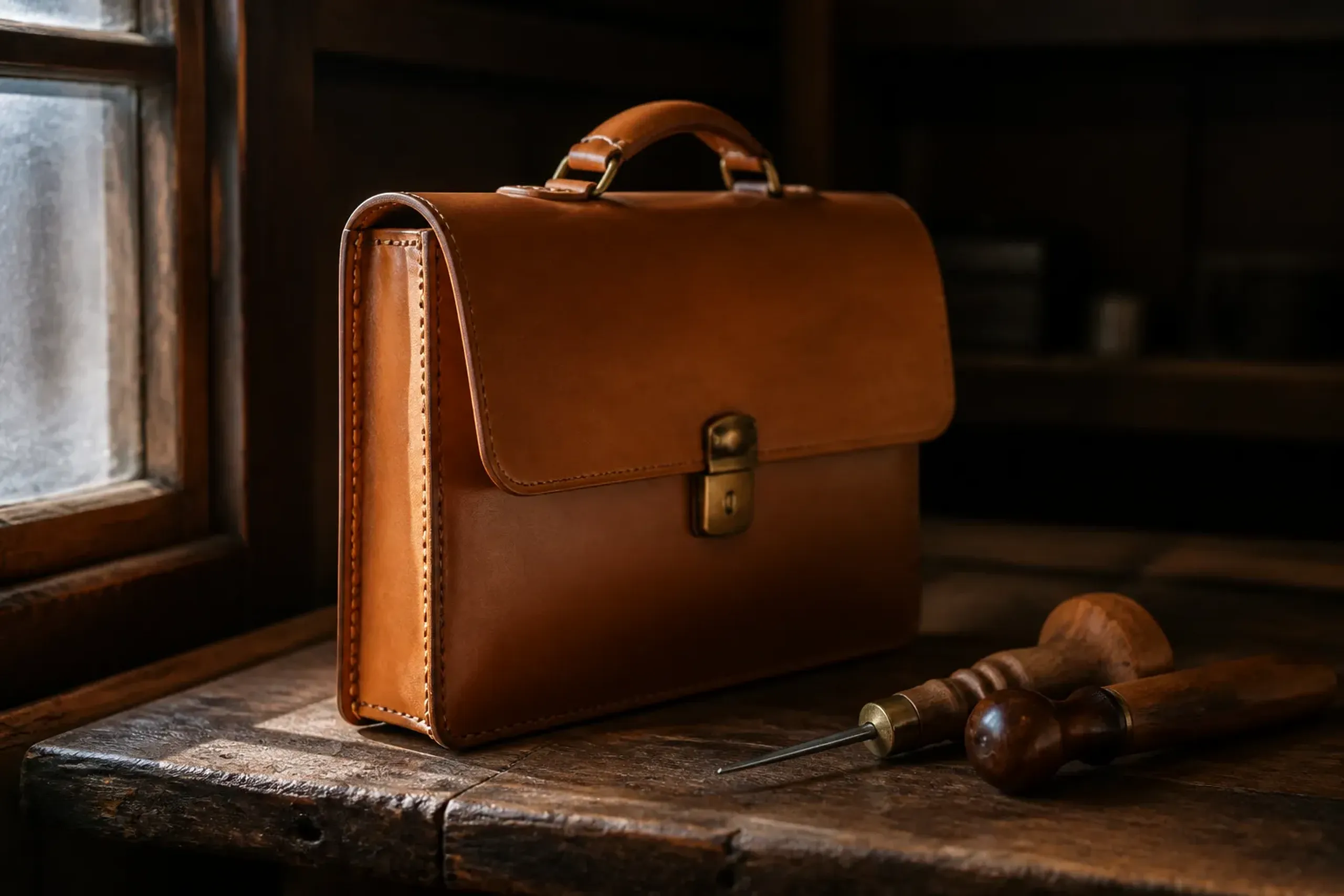
This is the practical difference from shoes, and it is the reason this post exists as its own piece. A bag or briefcase has no last to carve, no trial fitting, no return visit to check the fit of a mock-up. The maker takes your specification, sources the hide, and builds it. Months, not years.
| Item | Commitment level | Typical lead time |
|---|---|---|
| Watch strap | Low — one measurement | Weeks |
| Wallet, cardholder, small goods | Low to moderate | Several weeks to a few months |
| Briefcase, tote, bag | Moderate — specification and hide selection | Several months |
| Full luggage or matched set | High — queue plus build | Many months |
Lead time on custom leather goods is mostly a queue, not a construction problem. A busy maker's calendar, not the difficulty of your wallet, sets the wait. Order early. If you found the shoemaking timeline prohibitive — the fittings, the trans-Pacific return visits — this is the category built for you.
The Watch Strap As An Entry Point
If you want to test a maker before commissioning a bag, order a strap. It is a single measurement, a short lead time, and a modest sum, yet it exposes the whole skill set: hide selection, stitch tension, and — because a strap is almost all edge — the quality of the finishing. A maker who turns out a flawless cordovan strap will build you a flawless briefcase. One who leaves a fuzzy edge on a strap will do the same on the bag, only you will have waited months to learn it.
Asakusa And Kuramae: Where The Trade Lives
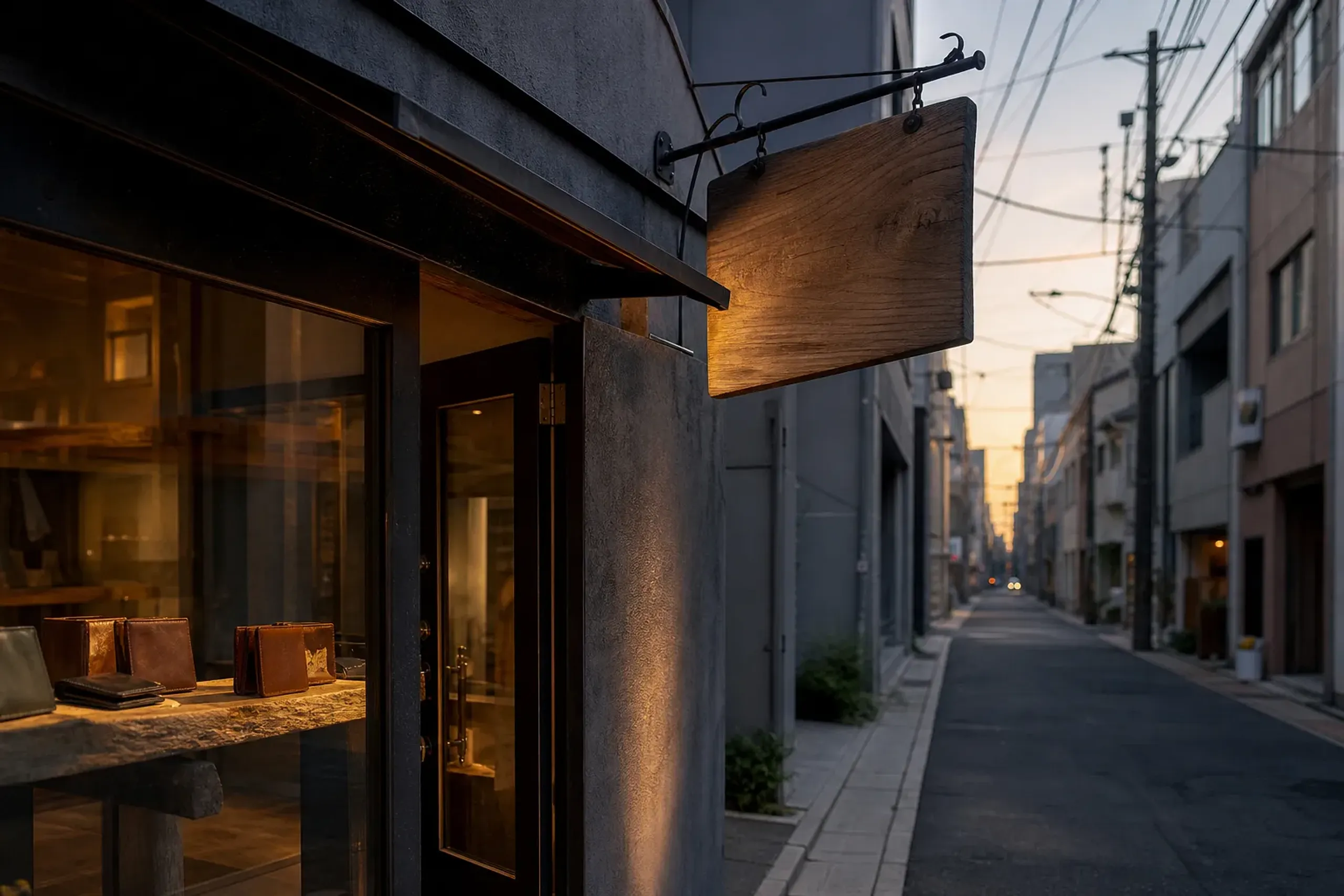
Leather in Tokyo has a geography, and it sits east of the tourist center in the low-lying wards near the Sumida River. Asakusa and neighboring Kuramae have been the city's leather and leather-goods district for generations — historically the tanning and hide trade, then the workshops that turned hide into product, and today a mix of long-running family operations and a newer wave of small studios that opened as Kuramae quietly became one of Tokyo's more interesting craft neighborhoods.
You will not find the tanneries here — those are in Tochigi and Himeji. What lives in Asakusa and Kuramae is the making and the selling: cutting tables, stitching benches, edge irons, and small storefronts where the person at the counter is often the person who built the thing on the shelf. Walking these streets is the closest an ordinary visitor gets to the trade, and it is worth an unhurried afternoon on foot rather than a checklist.
For those who want to feel the material rather than only buy it, hands-on options exist elsewhere in the country too — METI Kansai's official visit guides list a leather product-making experience at a workshop in Himeji, Hyogo, near the horse-leather tanneries. And for travelers timing a trip to the culture around it, 2026 offers real anchors: the Japan Leather Award 2026 program includes a retail order event at Isetan Tachikawa in April, Leathers Day TOKYO returns as a public leather-promotion event, and the Tokyo Leather Fair is scheduled for December 3–4, 2026, chiefly a trade fair but a clear read on where the material is heading.
Why Choose Japan Royal Service
The makers worth commissioning rarely advertise, often work in the language of the workshop rather than the showroom, and generally have no interest in walk-in traffic. That is the gap our team at Japan Royal Service closes. What we do is introduce, translate, and coordinate — quietly, and with full discretion about who you are and what you are commissioning.
In our experience the value is in the connective work: arranging appointments where appointments are not normally taken, interpreting a specification so nothing is lost between you and a maker's bench, routing you between an Asakusa workshop and a Himeji hands-on session on the same trip, and then handling the unglamorous aftercare — packing, shipping, and long-term care guidance for a piece meant to last decades. Our chauffeured transportation moves you between studios on your own schedule, and a tailor-made itinerary can fold a leather commission into a broader craft route. Readers building out a wider maker circuit often pair this with our writing on Kanazawa's kogei crafts.
Common Questions
Is Tochigi leather better than European vegetable-tanned leather?
Not better, different, and often comparable in quality at a lower price because there is no heritage-brand markup. Tochigi Leather is pit-tanned in the slow tradition and prized for its firmness and how it takes a patina. Many makers who could specify any leather in the world choose it on the merits.
What is the difference between shell cordovan and regular horse leather?
Shell cordovan is a specific dense layer from the horse's hindquarters, limited to two small shells per animal, with almost no grain and a distinctive rolling crease. Regular horsehide is the ordinary skin from elsewhere on the animal and behaves much like other hides. The scarcity and preparation of the shell explain the price gap.
How can I tell if a Japanese leather good is well made?
Check three things in order: the edges (smooth, sealed, no fuzz, rounded profile), the stitching (hand saddle stitch on stress seams sits at a slight diagonal and will not unravel from a single cut), and the disclosure (a maker who names the tannery is telling you what a vague "Japanese leather" label conceals).
How long does a custom leather bag take to make in Japan?
Usually several months, most of it queue rather than construction. Watch straps run weeks, small goods a few weeks to a few months, and full luggage many months. Unlike bespoke shoes there is no last or fitting stage, so no repeat visits are required — order early and it can be ready by your trip.
Can I visit the Tochigi Leather tannery?
Treat the working floor as closed to casual visitors. Organized trade and community tours have run in the past, but there is no reliable public drop-in access. Plan instead around Tokyo's leather-goods district in Asakusa and Kuramae, and reservation-based hands-on workshops such as the one listed in Himeji.
Begin The Conversation
If a commission — or simply a well-guided afternoon among the people who make these things — is on your mind, our concierge can advise on timing, routing, and introductions with full discretion. Reach our team privately via WhatsApp or LINE, or contact us here.