In this guide
- 01What wasanbon is, and the cane that almost nobody grows
- 02How it is made, and why the makers disagree about its own name
- 03Burnt oyster shells, a domain doctor, and the farmers nobody named
- 04What a kashi kigata is, and why it is cut from hundred-year cherry
- 05The room in Hanazono-chō, and what the hour actually involves
- 06Why this is not rakugan
- 07The ox-driven sheds still standing on the other side of town
- 08Plan your afternoon in Takamatsu
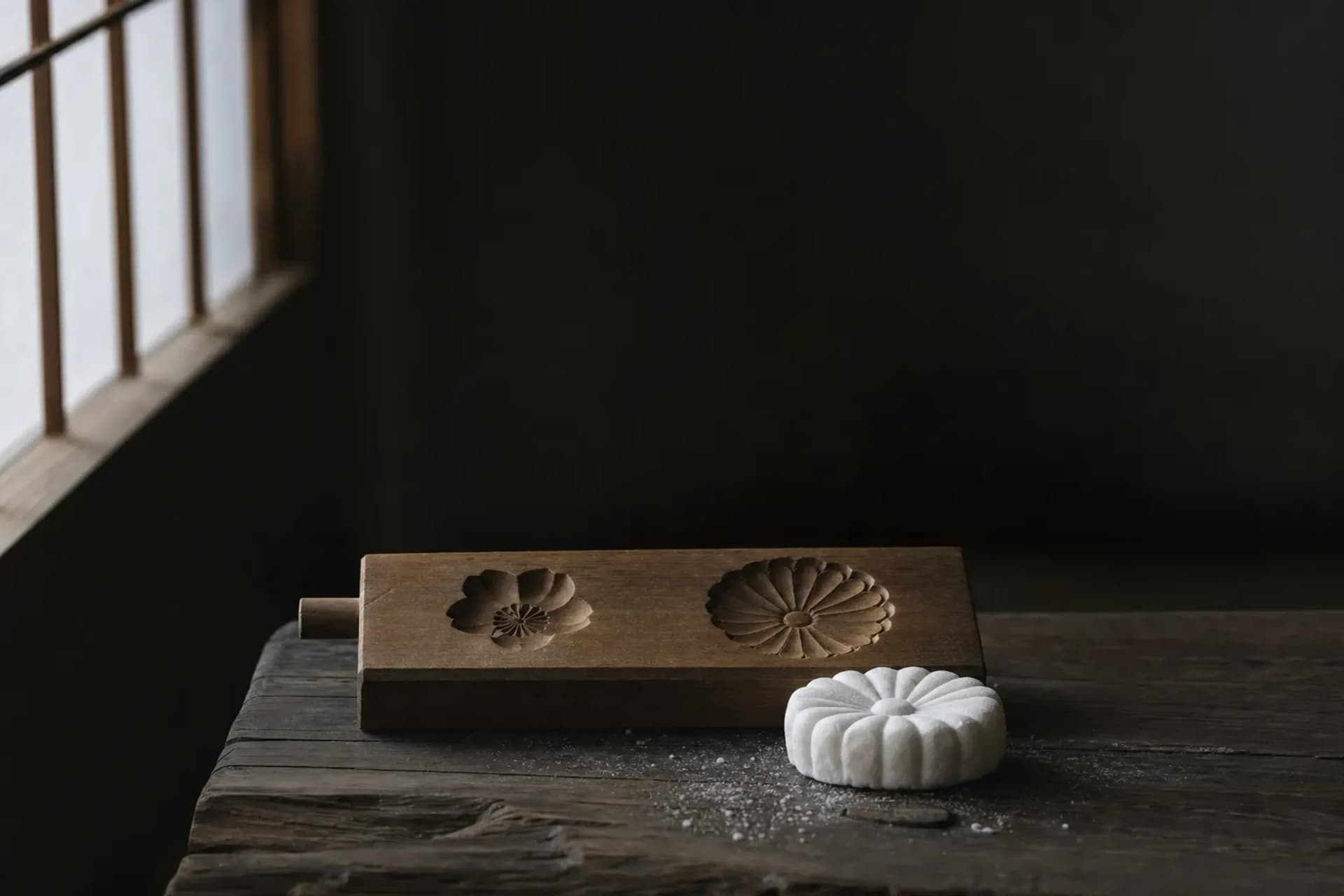
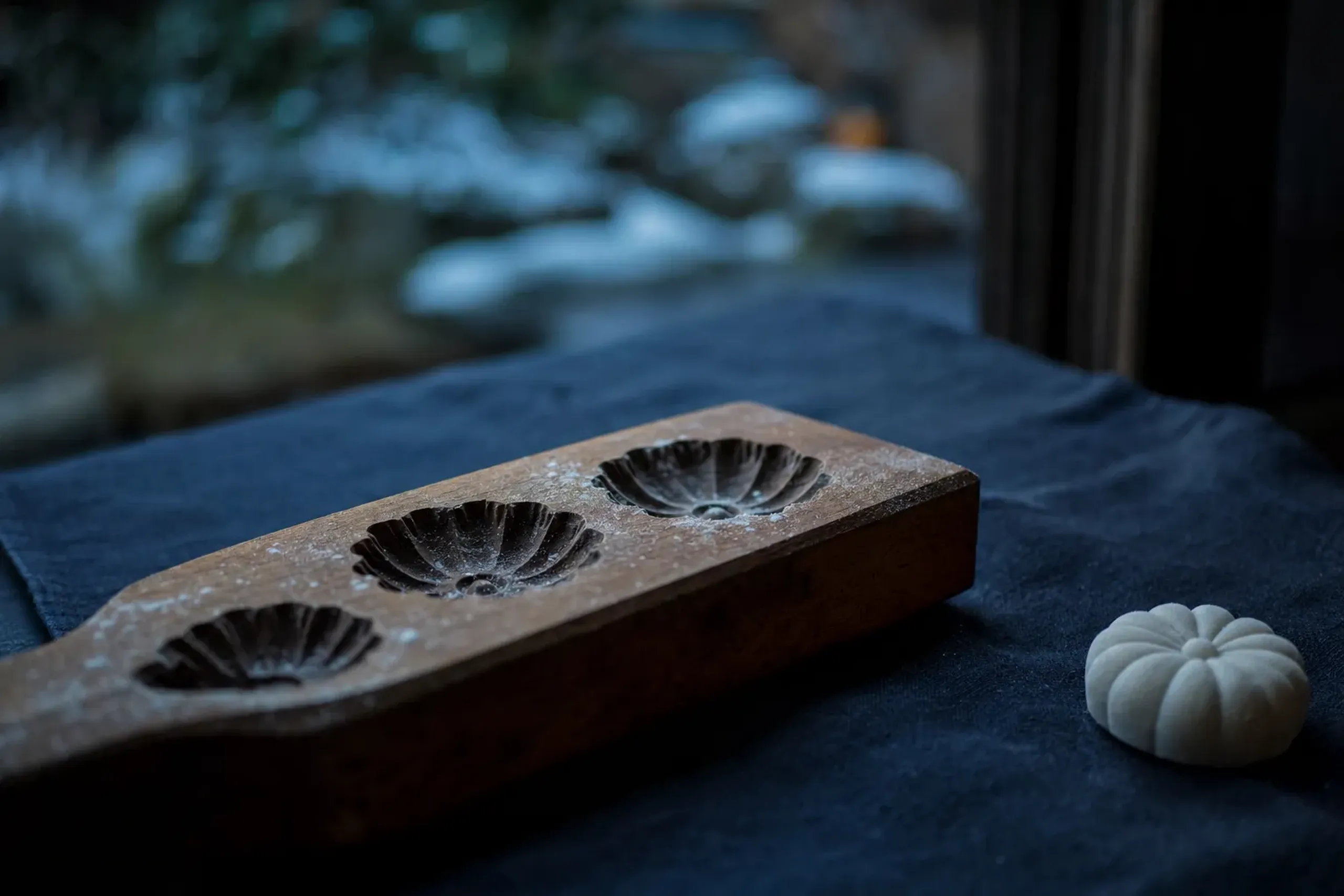
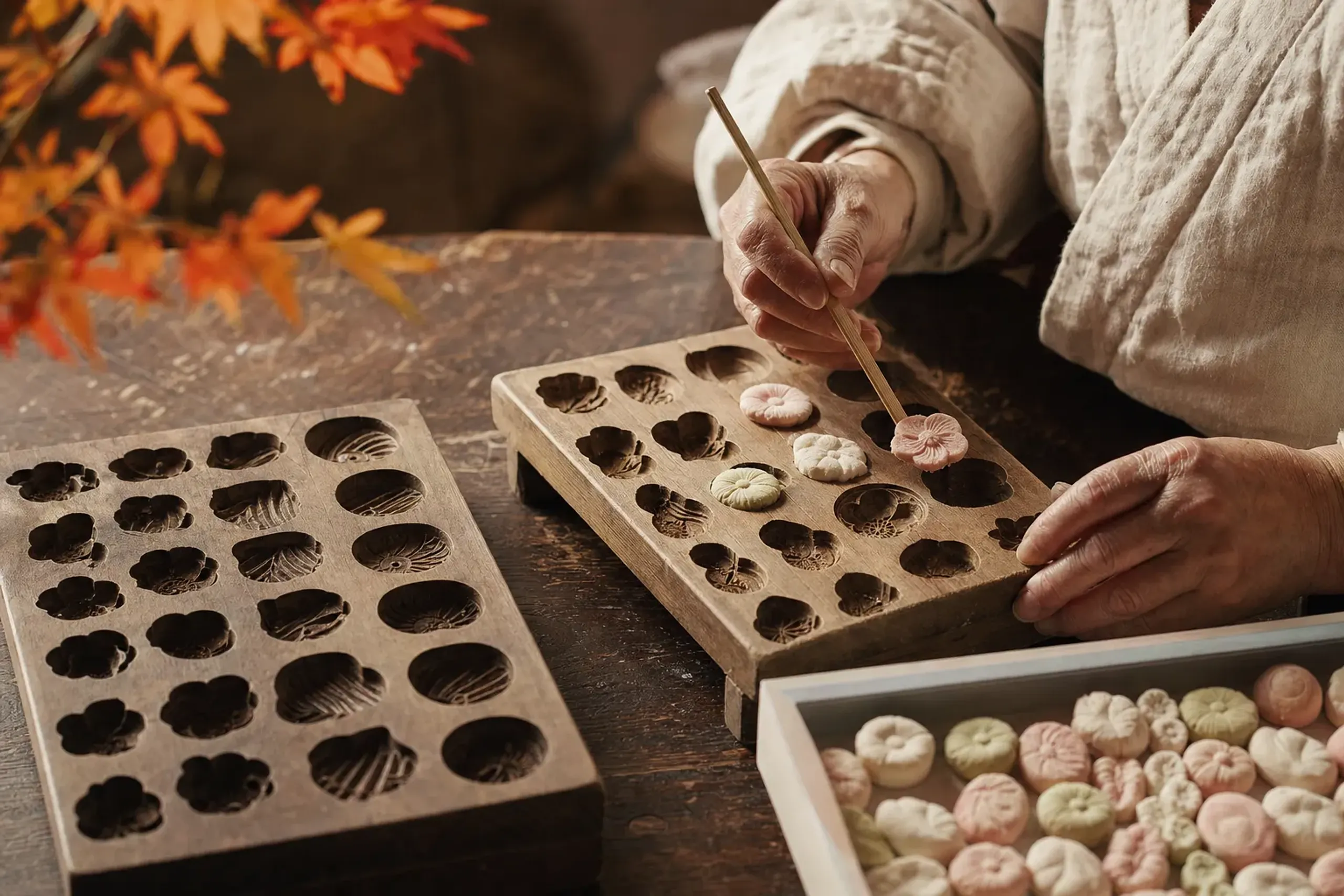
The hollows cut into the block of mountain cherry are all the wrong way round. A plum blossom is sunk into the wood instead of standing out of it; the veins of a maple leaf are raised where the finished sweet will carry a groove. A mould carver spends his working life cutting in reverse — left for right, hollow for relief — because everything he makes is the negative of something else. You understand this about four seconds after you press damp sugar into one of those hollows, scrape the surface flat and turn the block over: a plum blossom the size of a coin lands on the board with all five petals intact, holding a clean edge, made of nothing but sugar, a little water and a breath of colour.
This happens in a small room down a lane in Hanazono-chō, in the middle of Takamatsu, on the island of Shikoku. The room is called Mamehana. Next door is the workshop where the moulds themselves are cut, and the woman who runs the room is the carver's daughter. That arrangement — the tool made on one side of a wall and used on the other — is what separates this quiet hour from most craft demonstrations, where the object arrives from nowhere and you are invited to admire it. This is the Japan that Google cannot find: a room entered by introduction, not by search.
What wasanbon is, and the cane that almost nobody grows
Wasanbon is a sugar, not a sweet, and it is made in only two prefectures: Kagawa and Tokushima, at the eastern end of Shikoku. Tokushima Prefecture's own description is blunt about the reason — it is made from a single named variety of cane, chikutō, worked by traditional methods in eastern Shikoku and nowhere else.
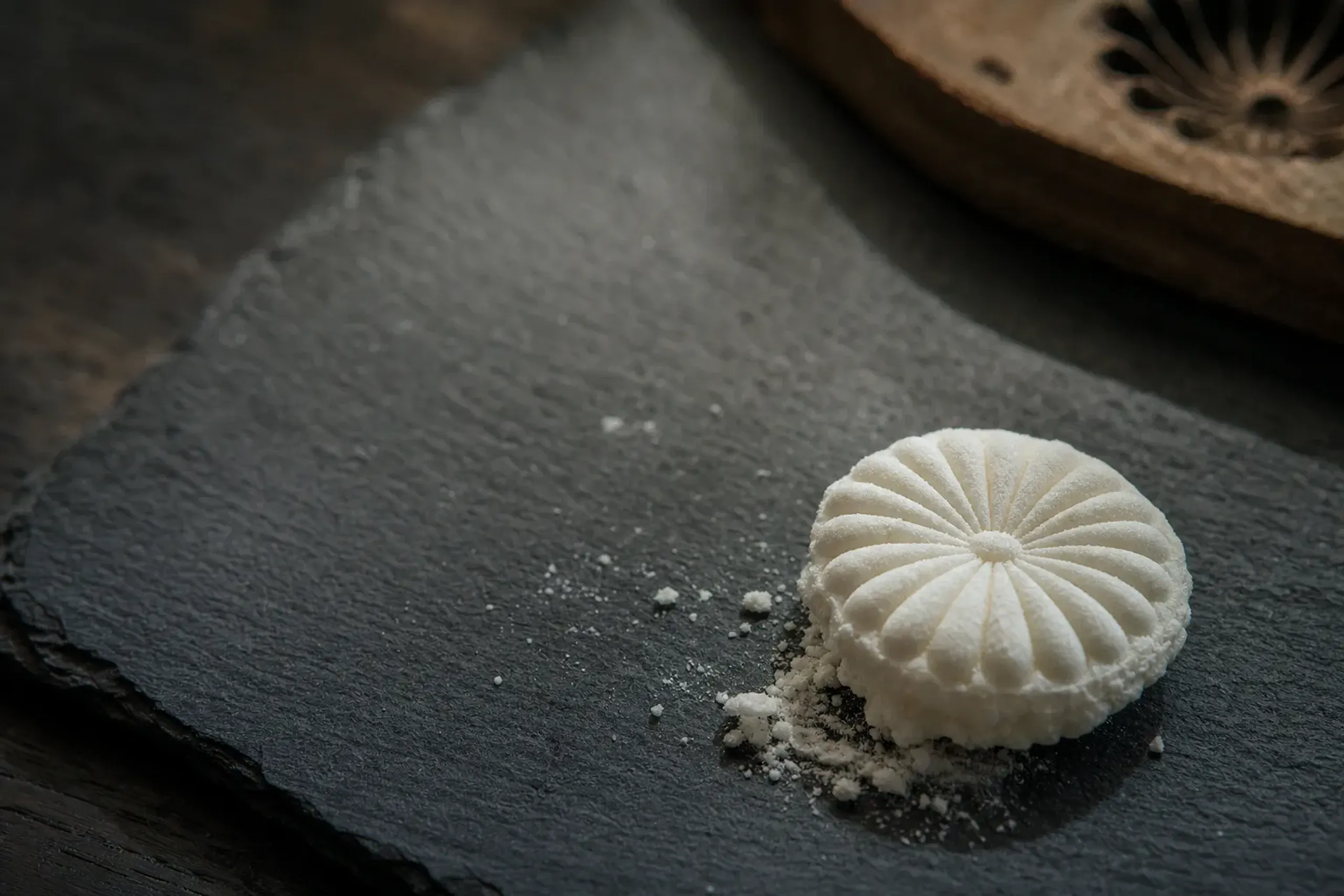
Chikutō is not the cane of tropical plantations. Baikōdō, one of the Kagawa makers, describes it as a thin, elongated cane that never flowers, so the plant puts everything into the stem — the origin of the aroma and savoury depth people notice in the sugar. It grows in a particular place: the sandy Izumi sandstone ground of eastern Kagawa, under a warm, dry climate.
The awkward fact underneath all this is yield. A report from Japan's Agriculture and Livestock Industries Corporation notes that chikutō gives up less extractable sugar than ordinary cane, which is why it was long treated as an unsuitable crop. It is cut once a year — the stalks come down from the end of November through December — and everything made that season comes from that single harvest. A cane harder to grow, harder to press and lower-yielding than the alternative has survived for one reason: what it becomes is better. This is the quiet logic of shun, the Japanese sense that the right thing comes only at the right moment, and that the wait is the point.
How it is made, and why the makers disagree about its own name
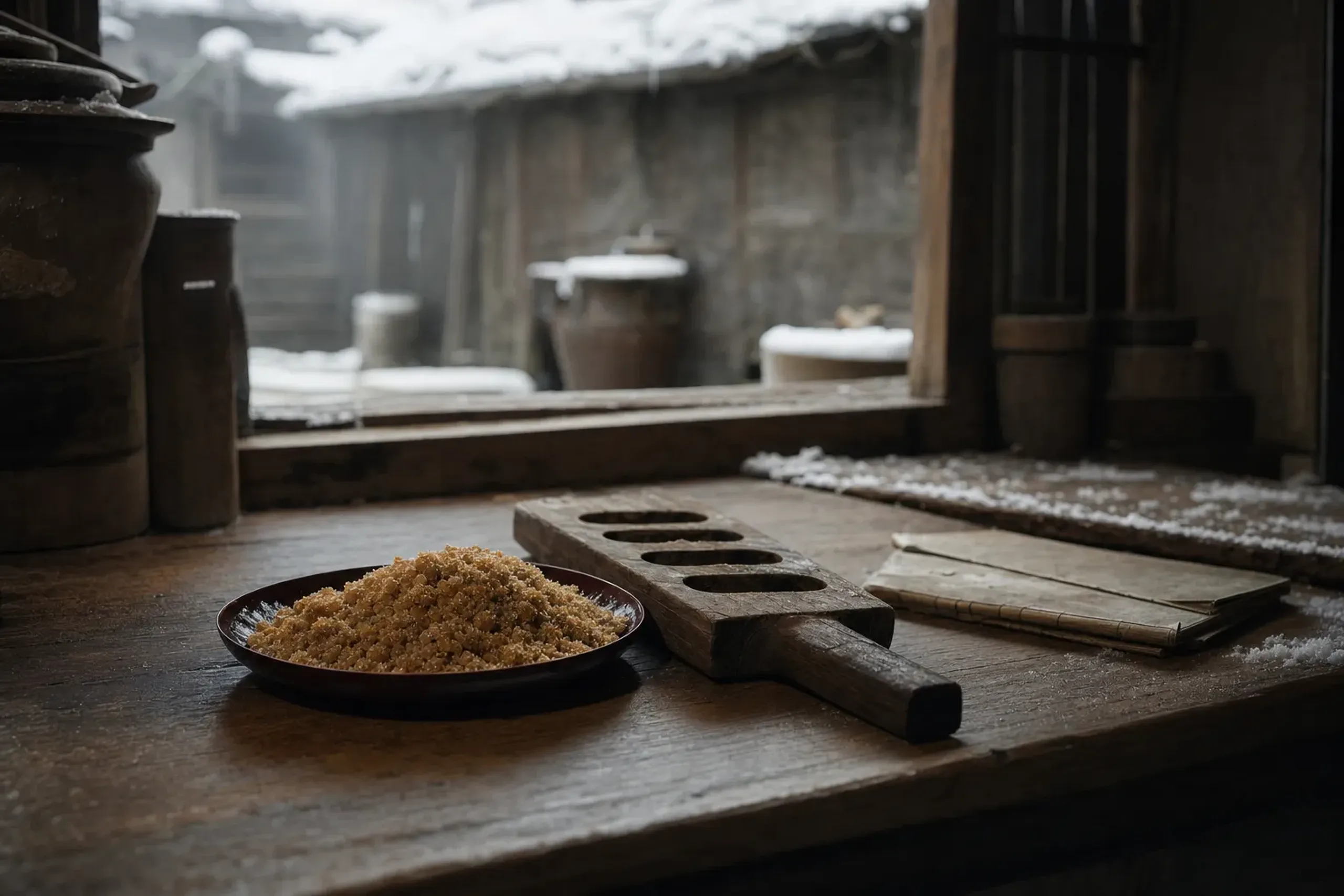
The cane is crushed and the juice skimmed by hand, filtered and boiled down. Cooled and stirred, it throws fine crystals and becomes shirashita-tō, a raw brown sugar that is the parent of everything that follows. From here the work is entirely about removing molasses without removing character.
Two operations do it, alternating. The first is the oshibune, the pressing boat: the sugar is wrapped in cloth, stacked and pressed under weights until the molasses runs out. The second is togi — literally whetting — in which a little water is added and the sugar is kneaded by hand on a flat surface, breaking the grain finer and driving out more molasses.
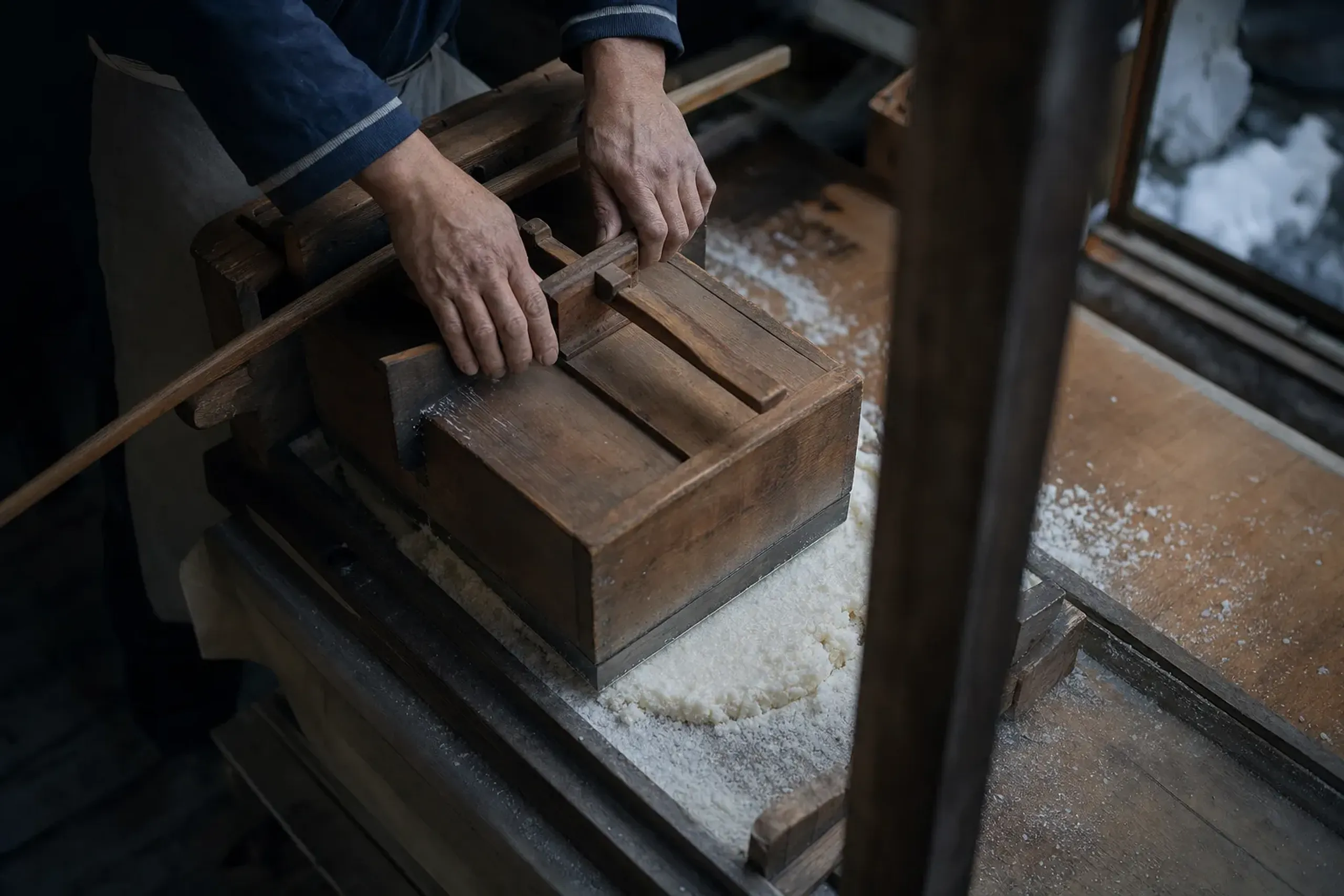
Then it is pressed again. Baikōdō puts roughly a week into each stage. Mitani Seitō, founded in 1804, names five grades of togi in sequence — arakake, tsuburi, dobu-togi, naka-togi, jō-togi — coarse through to fine, each a separate pass by the hand of a shokunin who has spent a lifetime learning to feel the grain change under the palm.
Now the interesting part. Wa-san-bon reads as "Japanese three trays", and no one agrees on what the three refers to. Baikōdō says the press-and-whet cycle was originally performed about three times, and the name records the count. Mitani Seitō says it comes from whetting for three days on the tray. Kagawa Prefecture's own account, published for schools, gives a third version — three whettings on the tray — and prefixes it with issetsu ni wa, "by one account".
That hedge is worth noticing. A prefectural government describing its own signature product declines to pick a version, and two of the oldest houses making the sugar tell it differently from each other. The name encodes the number three and the tray; the rest is contested. Anyone who gives you the definitive answer has stopped consulting the people who make it.
Burnt oyster shells, a domain doctor, and the farmers nobody named
In the middle of the Edo period, brown sugar reached Japan from the Ryūkyū and Amami islands through the Satsuma domain, and white sugar came in by trade with the Netherlands and China. Sugar made up a substantial share of imports and was, in the prefecture's words, one of the causes straining shogunate finances. The eighth shogun, Tokugawa Yoshimune, pushed for domestic production and called on the domains to try.
In Sanuki — the old name for Kagawa — serious research began in the 1760s under Matsudaira Yoritaka, fifth lord of the Takamatsu domain. Hiraga Gennai, the polymath from Shido on the Sanuki coast, served Yoritaka and helped compile the domain's natural-history albums; a drawing of sugarcane survives in the Shasei Gajō, a designated cultural property now held by the Kagawa Museum. Whether Gennai worked on sugar manufacture itself, the prefecture says only that it is possible. The research proper fell to the domain physician Ikeda Genjō, who worked at Ritsurin-sō — the garden now known as Ritsurin, still in Takamatsu — and could not get crystalline sugar.
The work passed to his student Mukaiyama Shūkei, a town doctor from Ōchi district, now Higashikagawa. By one account he was helped by a man from Satsuma named Seki Ryōsuke, from the region that already knew how. By the end of the 1780s Shūkei had crystalline sugar.
What solved it is the detail worth carrying away. Cane juice is faintly acidic, and boiling alone will not bring sugar out of it — you get syrup and nothing else. Add powdered ash from burnt oyster shells and the alkali neutralises the acid, and crystallisation follows. That is the breakthrough: a lime source off the Inland Sea shoreline, burnt and ground, stirred into a boiling pan by a country doctor.
Even then Shūkei had only reached shirashita-tō. Turning that into white sugar meant separating the molasses, and here the prefecture's account gives credit where craft histories usually invent a hero: it was solved by na mo naki nōmin-tachi, nameless farmers, through accumulated trial and adjustment. Press under weights, work the sugar on the tray, repeat, and it bleaches itself.
Sugar became one of the Sanuki sanpaku, the three whites, alongside salt and cotton — a reminder that this was never a boutique product. It was industrial policy, and it worked.
What a kashi kigata is, and why it is cut from hundred-year cherry
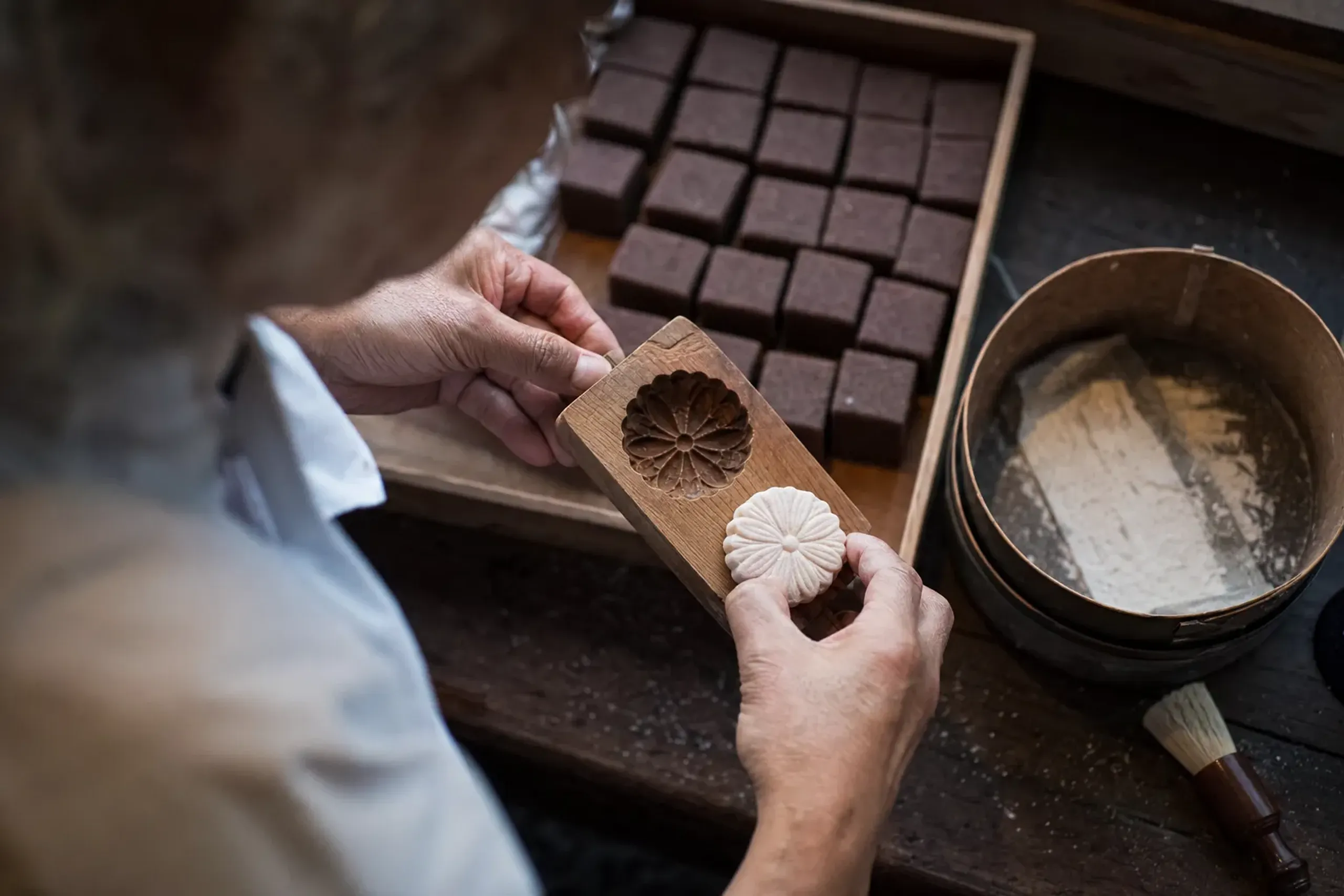
The mould is called a kashi kigata. Kagawa Prefecture lists it in its official register of traditional crafts and defines it precisely: a tool for making higashi, the dry confections, formed by packing materials such as wasanbon sugar or bean paste into a mould carved in reverse, left-to-right and relief-to-hollow. Because the shaping depends entirely on the carving, the register notes, the moulds themselves are prized as craft objects. Mould making in Kagawa began around 1897.
The wood is mountain cherry, yamazakura, and the workshop in Hanazono-chō specifies trees over a hundred years old. Old cherry has a close, even grain that resists splitting, which is what lets a carver take a chisel across the short grain of a chrysanthemum petal without the wood tearing out. The work is done with many chisels and gouges, cutting the design in reverse so the sweet comes out the right way round. There is a wabi austerity to the finished object: no gilding, no flourish, only the restraint of a single blossom held in pale sugar — beauty that asks nothing of you but attention.
The carver is Ichihara Yoshihiro, certified as a Kagawa traditional craftsman and a recipient of the Yellow Ribbon Medal, the national award for distinguished skill. One claim attached to his craft travels widely and needs care. His workshop's own account is that six or seven mould carvers remain in Japan and that he is the only one left in Shikoku; Mamehana says the same; the prefectural register calls them extremely rare nationwide but gives no figure.
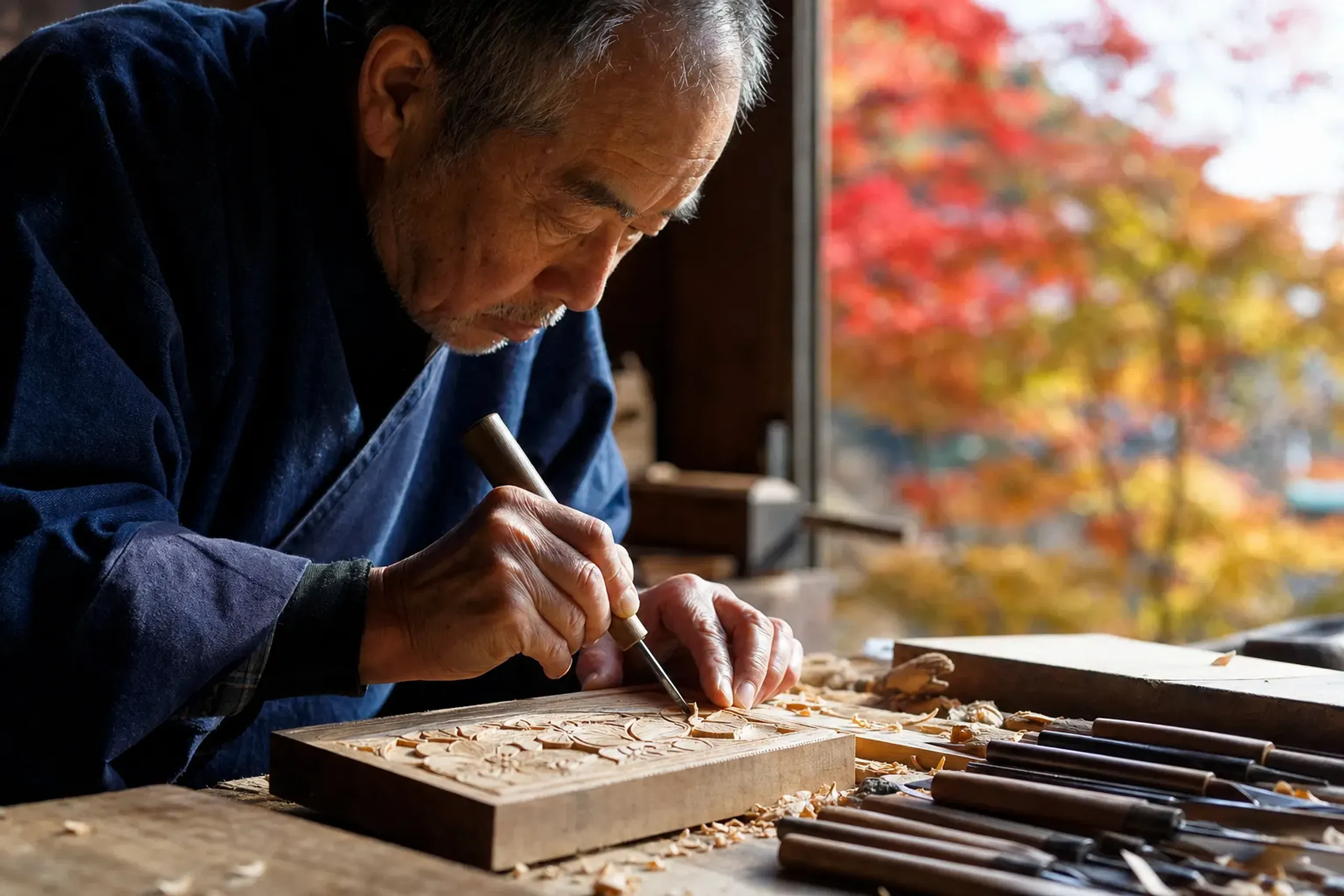
That is the trade's own count rather than an independent census, and no such census appears to exist — but it comes from the people best placed to know, and the practitioners believe they can name everyone still doing this. A private session in this workshop is, quite literally, time with one of a handful of hands still cutting these moulds anywhere.
The room in Hanazono-chō, and what the hour actually involves
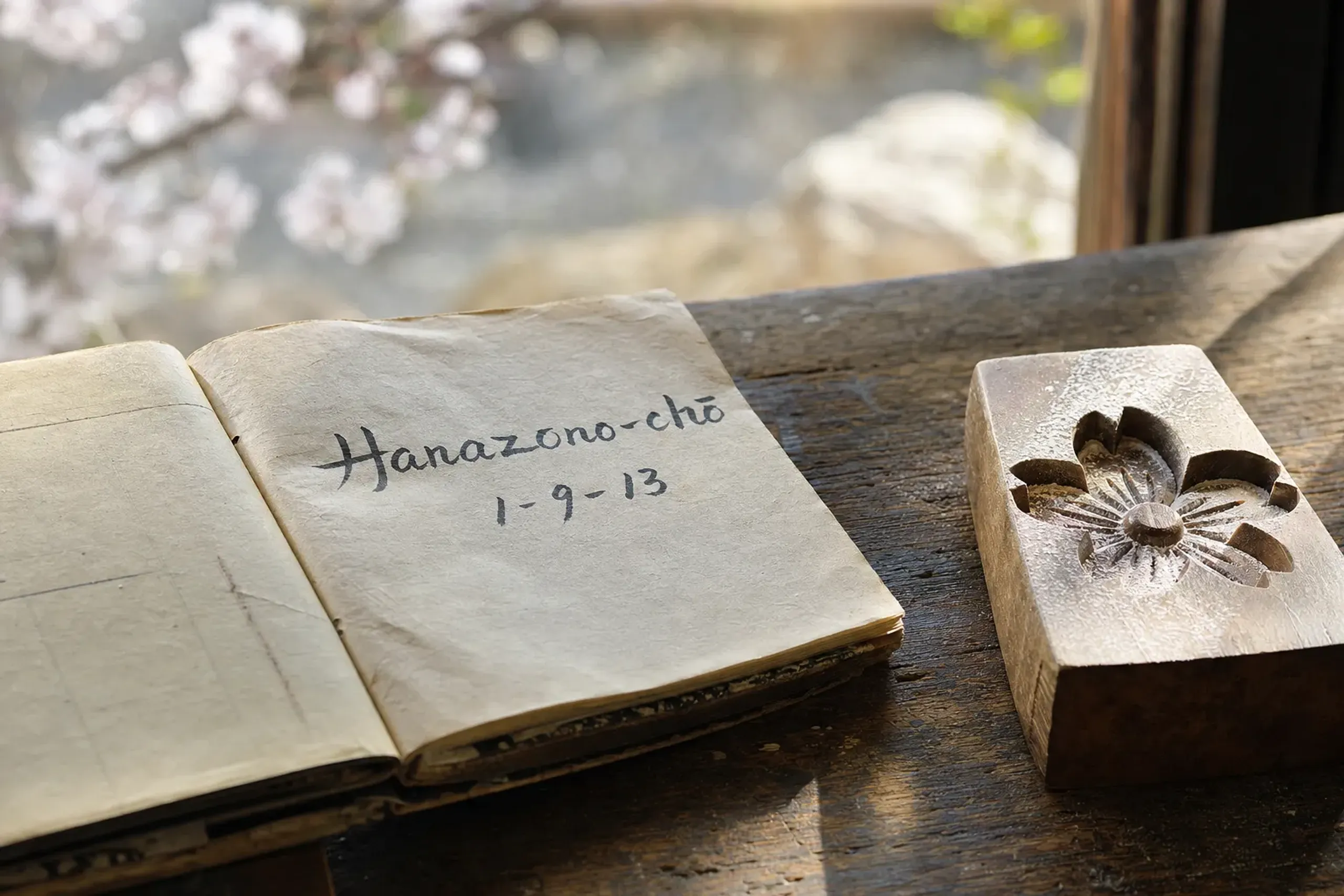
Mamehana was opened in July 2009 by Uehara Ayumi, born in Takamatsu in 1974, who grew up a mould carver's daughter but came to the moulds late and from the outside. Her own explanation is worth having, because it is not a heritage statement: she was struck that the moulds were beautiful and fine, and that you could make a dry confection simply by packing wasanbon in and turning it out — and she wanted to show that to as many people as possible.
The session runs about an hour to an hour and a half, by reservation. You colour plain wasanbon, sift it, press it into the moulds and release the shapes. Takamatsu's city tourism office puts the yield at twelve to fourteen pieces, boxed to take away. It closes with matcha and the sugar you just made, which is the only way to understand the fuss: the piece dissolves before you have decided how to eat it.
From the workshop's own pages: Hanazono-chō 1-9-13, Takamatsu; open ten to five; closed Thursdays; five minutes on foot from Hanazono station on the Kotoden Nagao line; parking for four cars at the mould workshop next door. Japanese and English are spoken. Nerikiri, the moulded fresh confection, can be done as well as or instead of wasanbon, and the workshop takes commissions for original moulds — a real option for a family crest, cut to your own device and kept for you. For guests who would rather not concern themselves with trains at all, a private car and chauffeur can hold the lane while you work.
Why this is not rakugan
Most visitors have met a moulded Japanese sugar sweet before and know it as rakugan. The distinction matters, and it is one of composition rather than shape.
Rakugan, as the Japanese encyclopedia Nipponica defines it, is made by milling grain — glutinous and non-glutinous rice, buckwheat, soy, azuki, barley, wheat — working the flour with sugar and starch syrup, pressing it into a mould and drying it in a warming oven. The flour is the body; the sugar binds and sweetens it.
What comes out of the mould at Mamehana has no flour in it, no starch syrup, no bean paste, and it never sees a drying oven. It is the sugar itself, dampened just enough to take a shape and released. Everything holding that plum blossom together is the fineness of the crystal. Which is why the sugar and the mould are not two subjects but one: a coarser sugar could not be asked to do this, and a mould cut by a less exact hand would not be worth asking.
The ox-driven sheds still standing on the other side of town
The last part of the story sits on the other side of the same city, and most visitors never learn it is there. In 1983 Japan's Agency for Cultural Affairs designated a collection — "Sugar Manufacturing Implements of Sanuki and Surrounding Regions, with Sugar Pressing Sheds and Kiln House" — as an Important Tangible Folk Cultural Property. It runs to 937 objects and three buildings: 101 implements for growing cane, 694 for making shirashita-tō, 61 for wasanbon, 81 others, two pressing sheds and one kiln house.
The registered address is Yashima-Naka-machi 91, Takamatsu, which is Shikoku Mura, the open-air museum of relocated buildings beneath Yashima.
The pressing sheds are round and built without pillars, and the museum explains why in one line: the engine for making sugar was an ox. The animal walked in circles hauling a beam that turned stone rollers, so the building had to be a circle to let it. The Miyazaki family shed dates from around 1865 and was moved from Hayashida in Sakaide. The Muguruma family kiln house is later, around the end of the nineteenth century, and came from Minato in Higashikagawa — the same district that produced Mukaiyama Shūkei. Inside it, cane juice was boiled down through three successive kettles into shirashita-tō, then refined onward into white sugar and into Sanuki wasanbon. The museum opens at half past nine and admits until half past four.
Assembling the day does take arranging. Mamehana works by reservation and closes on Thursdays; the mould workshop is a working business rather than an attraction; commissioned moulds and a private session need lead time; and the sugar houses in eastern Kagawa keep their own visiting seasons, which do not always overlap with the months when the sugar is actually being made. Our concierge can put the sequence together — the shed where the cane was crushed, the garden where a domain physician failed, and the room where the carver's daughter hands you a mould cut next door — as a single unhurried tailor-made itinerary, arranged in discretion and in an order that leaves time to sit down with the matcha at the end.
Plan your afternoon in Takamatsu
A morning among the ox-driven sheds, an hour at the carver's bench, and a bowl of matcha with sugar you shaped yourself is the kind of day that reveals a Japan most travellers pass straight through. If a private introduction to Mamehana, a commissioned mould bearing your own crest, or a wider Shikoku journey appeals, the specialists at Japan Royal Service will handle every arrangement with complete confidentiality. When you are ready to begin, contact us here and we will take it from there.