In this guide
- 01What Is Kumano Hanabi?
- 02The Sea Fireworks: The Boat, The Raft And The Cave
- 03Where To Watch, And The Rules
- 04The Coast, The Roads And The Evacuation Map
- 05What Happens If The Sea Is Rough?
- 06How Do I Get To Kumano From Nagoya?
- 07How The Japan Royal Service Concierge Team Plans The Evening
- 08Plan Your Night On The Kumano Coast
- 09Frequently Asked Questions
The light goes first from the pebbles. You arrive on the Shichirimihama coast in the late afternoon, and the stones under your feet are still warm from the day. The sea is flat, grey-blue, pushing up the shore in long, tired rolls. Nothing has happened yet. It will not happen for hours.
This is the honest shape of the evening: a long wait on a stony beach, a crowd settling in around you, the heat easing by slow degrees. Then, after dark, the whole coast changes. At Japan Royal Service we have watched enough fireworks nights across Japan to know which ones are worth the wait. Kumano Hanabi is one of them — and not for the reasons you might expect.
Because this is a fireworks night that happens on the water.
What Is Kumano Hanabi?
Kumano Hanabi is a fireworks festival held every 17 August on the Shichirimihama coast in Kumano City, Mie Prefecture, organised by Kumano City and the Kumano City Tourism Association. Its full name is the Kumano Ohanabi Taikai.
The date does not move for the calendar. It moves only for the sea. Every year, the seventeenth of August, evening. The event was cancelled from 2020 to 2022 during COVID-19 and has run again each year since 2023.
What makes it unlike a city river festival is where the shells go off. Some rise from the shore, yes. But the signature bursts happen out on the open water, and the finale lights up the rocks and sea caves of Onigajo, just down the coast.
The roots run deep. The Tourism Association traces the fireworks back an estimated 250 to 300 years, to Edo-period memorial fireworks lit at Obon, the midsummer season when families honour the dead.
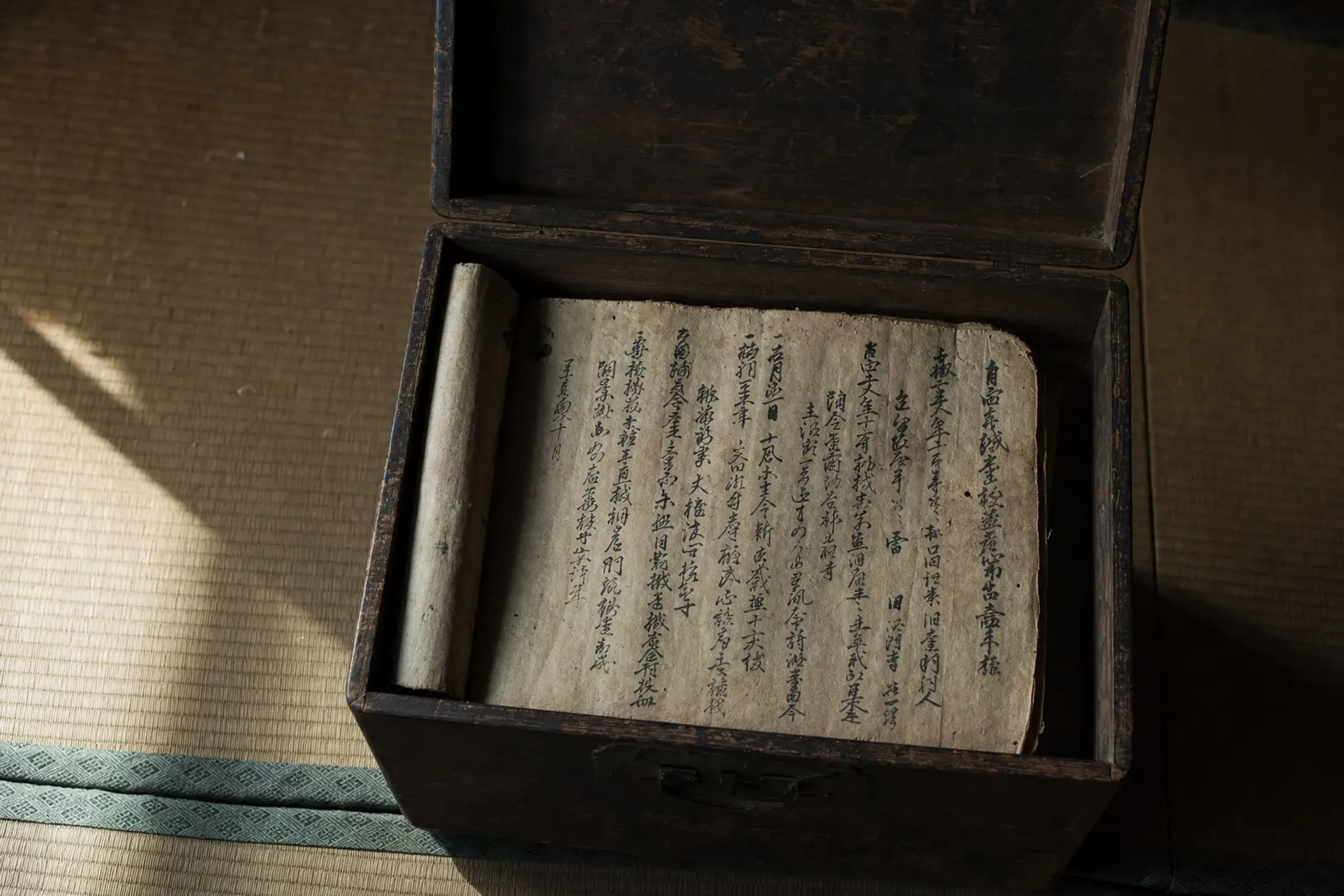
The records are unclear and there is no clean founding year. What is clear is the lineage: the Onigajo large set-piece debuted in 1932, the Tourism Association took over as organiser in 1955, the date was fixed at 17 August in 1963, and the three-shaku sea auto-burst was first performed in 1993. The following year, beach erosion forced launches from a barge offshore. The sea, as ever, has had a say in everything here.
The Sea Fireworks: The Boat, The Raft And The Cave
Here is what you came for. Three things set Kumano Hanabi apart, and all three involve the water.
The Sea Auto-Burst From A Speeding Boat
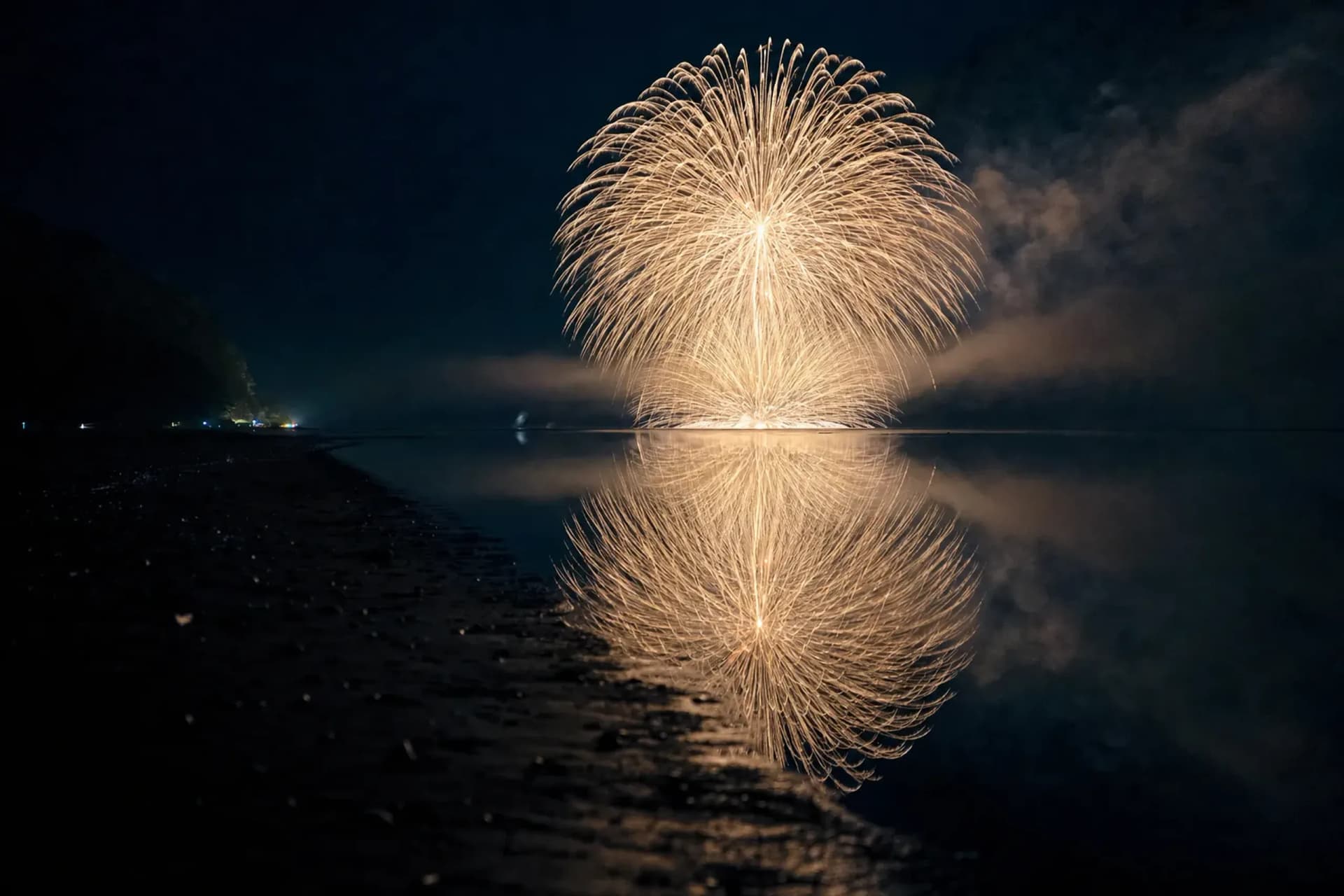
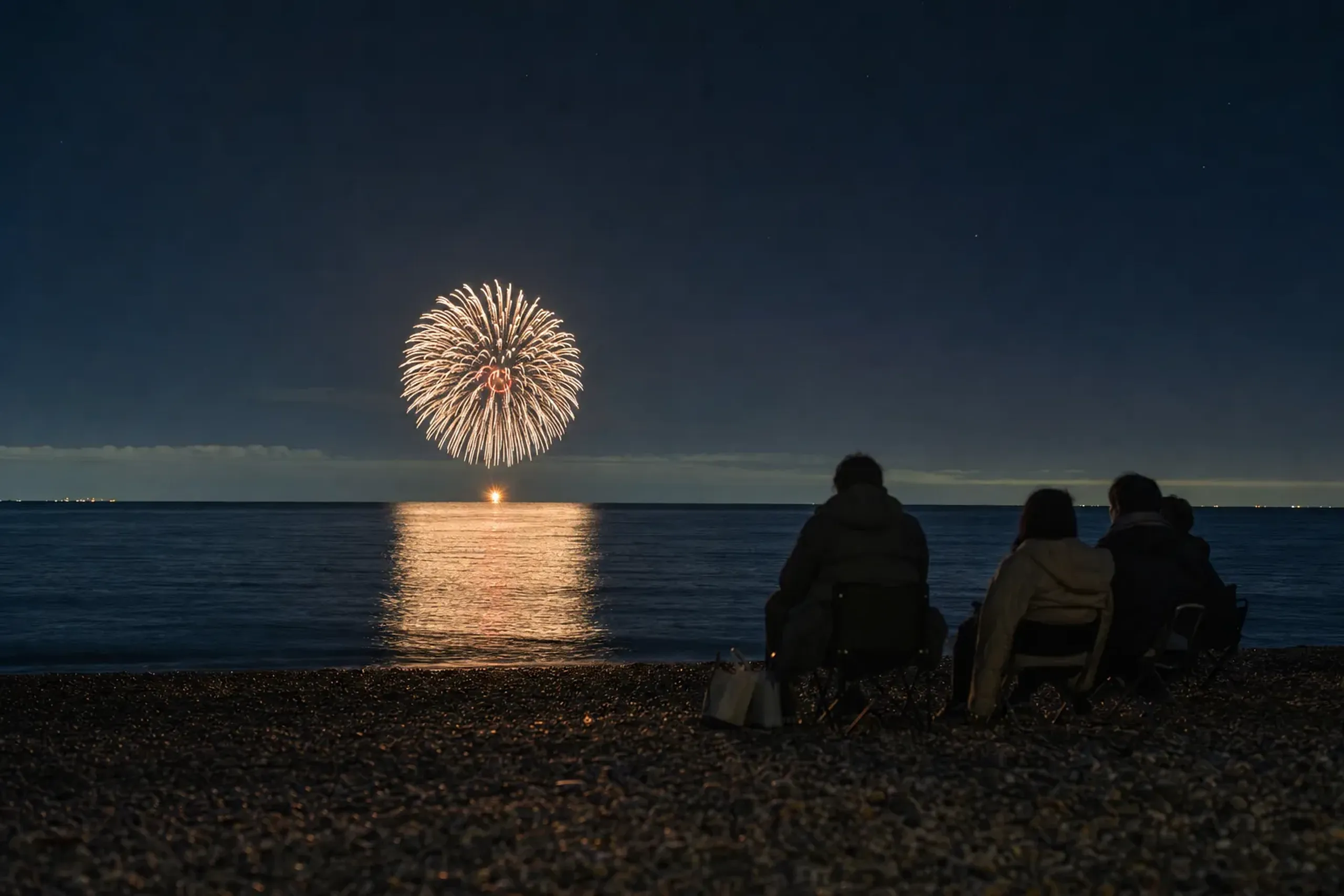
Watch the dark line of the horizon. A boat runs across it at full speed, and lit shells are thrown from the deck one after another. They open as semicircles on the surface of the sea — blooms of light that spread flat across the water rather than up into the sky. The effect is strange and lovely: half a circle of fire, reflected and doubled by the black water beneath it.
The Three-Shaku Shell On A Raft
The single largest burst of the night is the three-shaku sea auto-burst. A 250 kg shell is set on a steel raft roughly 400 metres offshore and detonated in place. The semicircle it throws spreads about 600 metres across the surface. You feel the pressure of it in your chest before your eyes catch up. It is low, wide, and enormous.
The Onigajo Finale
Then the finale.
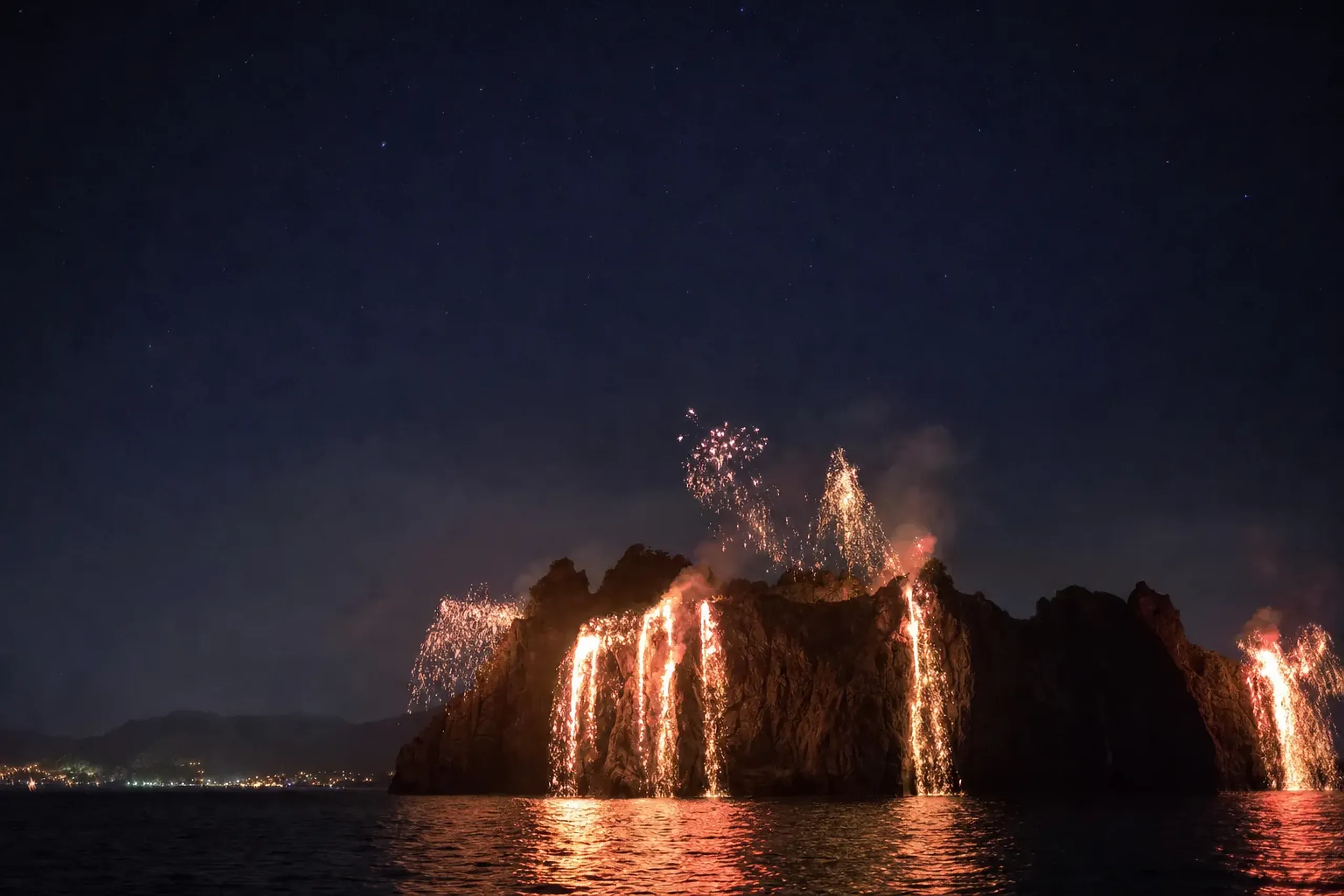
Fireworks are set directly into the rocks and caves of Onigajo, the dramatic cliff formation at the edge of the coast. The sound does not simply fade. It comes back. The rock walls catch the blasts and throw the echo at you — a low, rolling crack that arrives a beat after the light. For the 2026 programme the Tourism Association listed about 10,000 shells across the evening.
One of our coordinators who has stood on that beach put it plainly: you do not watch Kumano Hanabi so much as sit inside it.
Where To Watch, And The Rules
Most people watch from the Shichirimihama coast itself. It is a long public pebble beach, and the crowd spreads along it in both directions.
There are also sponsored seats, on the beach and the embankment, and lottery-allocated camera seats at the Shishiiwa viewpoint. The Tourism Association's FAQ advises applying early for these. They exist; that is all we will say. The beach itself is public, and our concierge team verifies seat status with the organiser on a client's behalf ahead of the visit rather than claiming to hold anything.
The rules matter, and a few are firm.
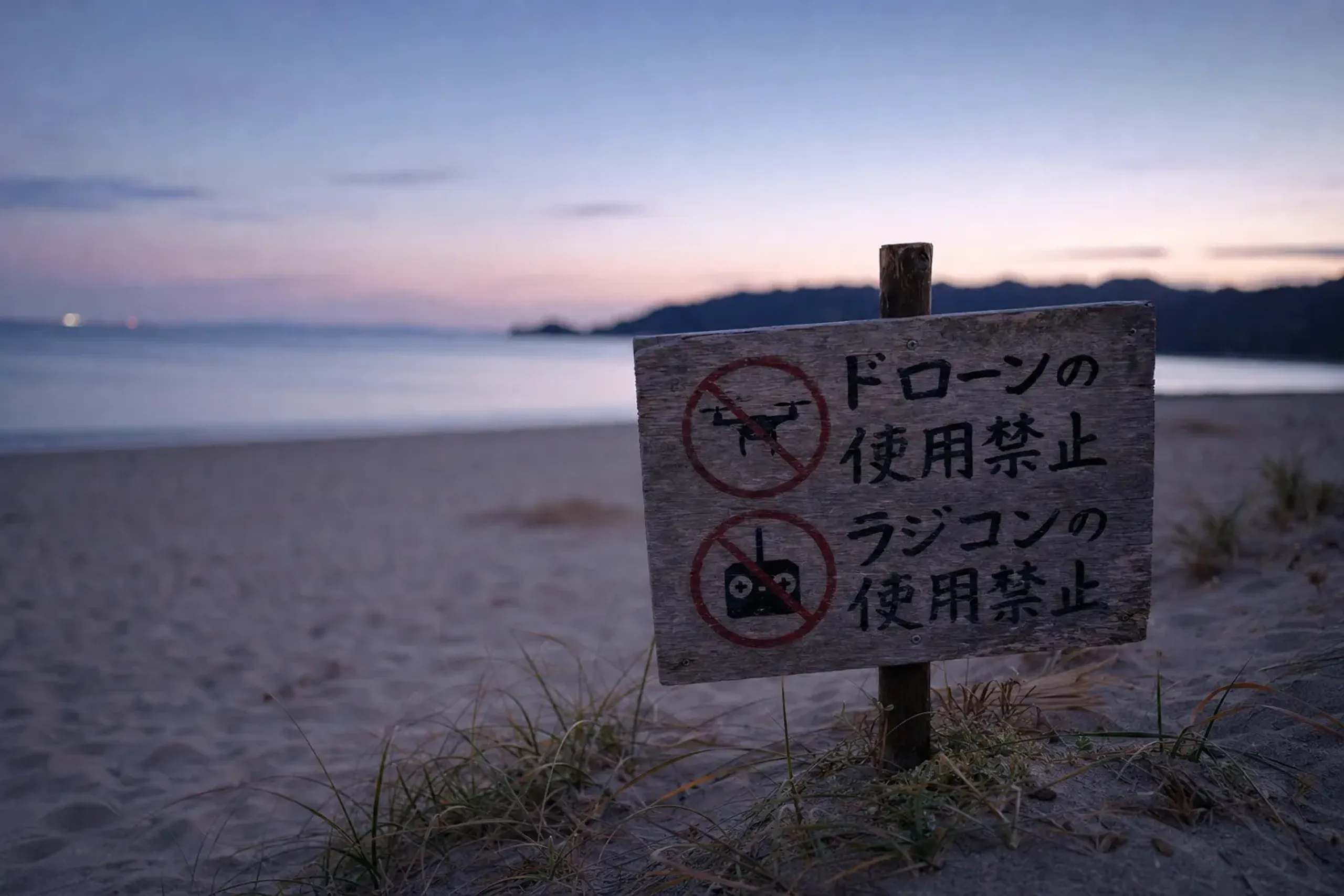
Key rule: Drones and radio-controlled craft are refused outright. You may not bring, fly, film with, or pass through the venue with them, including on the beach.
Beyond that: take your rubbish home. Stay out of the restricted zone, and boats must keep clear of the no-anchoring zone. No swimming at Shichirimihama. Do not claim spots in restricted areas or passages. Stakes and tape left on unattended spots may be removed after 19:00, so holding ground by leaving a mat down and wandering off is not a safe strategy here.
The Coast, The Roads And The Evacuation Map
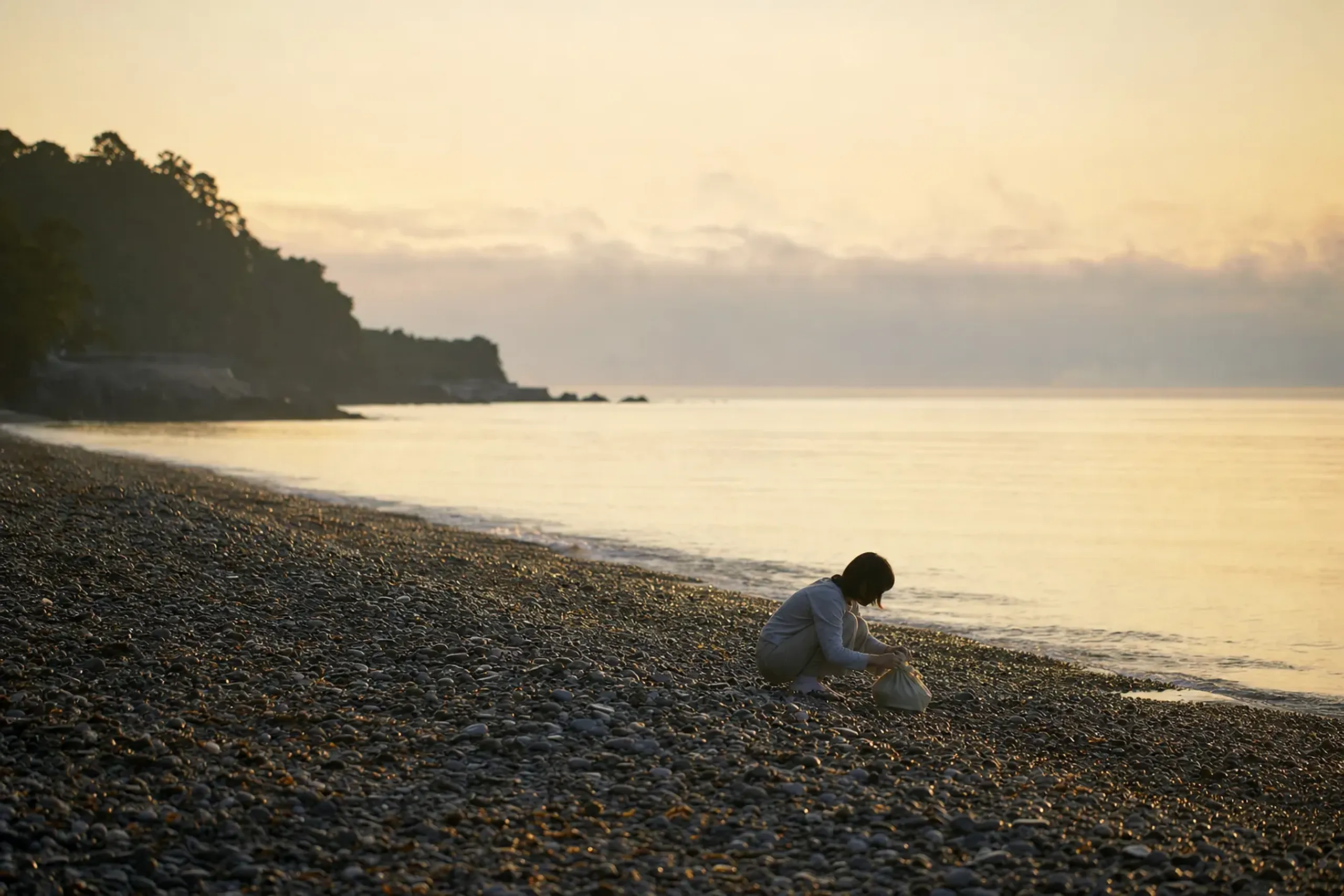
Shichirimihama is, by Kanko Mie's description, Japan's longest pebble coast, running roughly 22 kilometres. It sits within the Kumano Kodo Iseji World Heritage landscape, the old pilgrimage route that threads along the Kii Peninsula's eastern shore. Onigajo nearby is a nationally designated scenic spot and natural monument, with about a kilometre of walking path through its weathered rock. To stand here is to feel the quiet, moss-and-stone restraint of a coast that was sacred long before it was celebrated — the kind of hidden Japan that reveals itself only to those who know when, and where, to arrive.
It is a beautiful, exposed coast. It is also a tsunami-risk coast. The Tourism Association's venue page links an official evacuation map and a venue map, and we tell every guest the same thing: check the official evacuation and venue map on the Tourism Association site before the day, and know where you would go.
Roads are restricted on the day. For 2026, vehicles were planned to be banned in the urban area around the venue, and the southbound lanes of the Kumano-Owase Road between Owase-Kita IC and Kumano-Oodomari IC were restricted on 17 August. The exact hours live on an official map the public sources do not reproduce. Check the official traffic map before you travel. This single fact shapes the whole evening's timing.
What Happens If The Sea Is Rough?
Kumano Hanabi is postponed when the sea is too rough — usually from typhoon-driven high waves, not from ordinary rain.
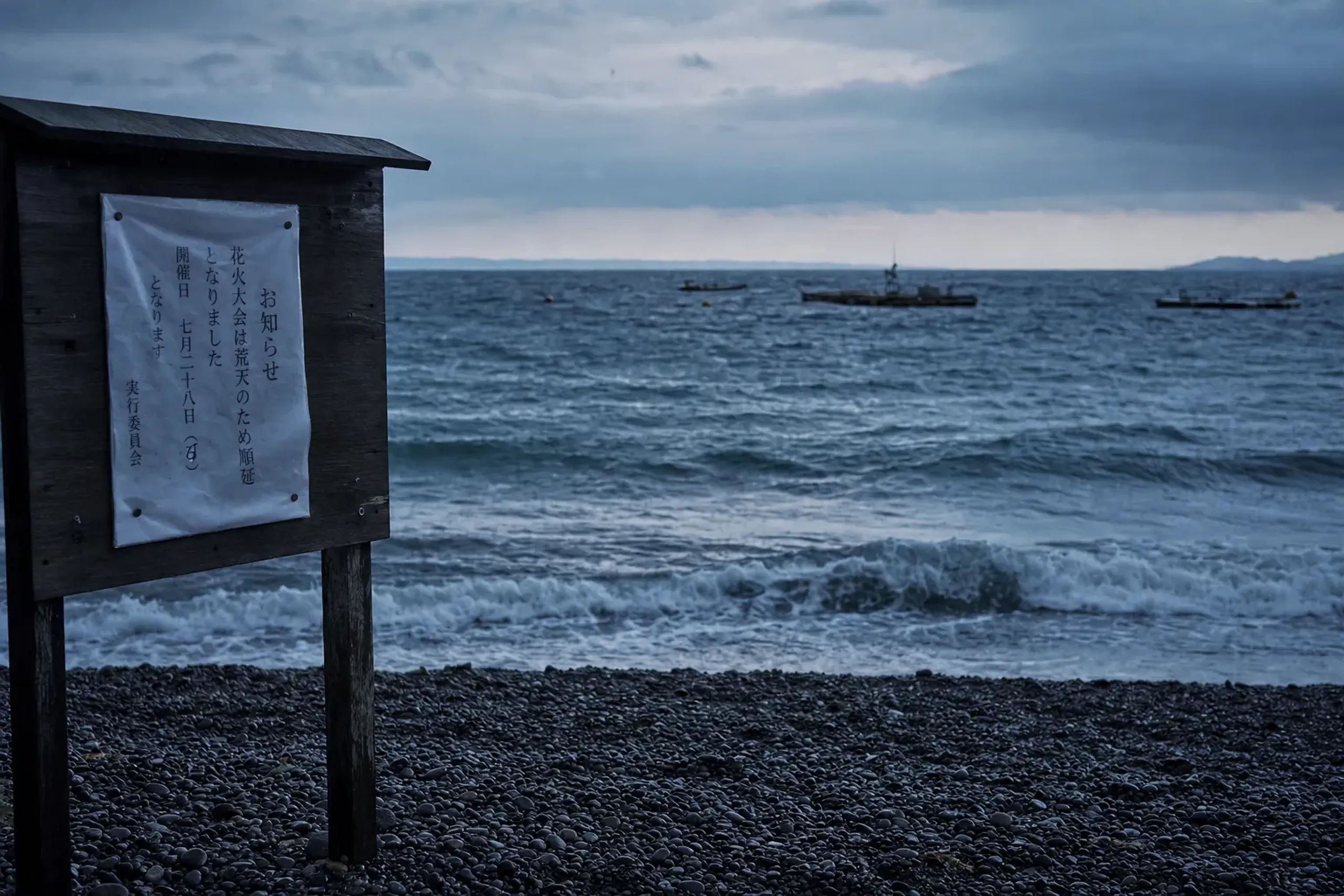
The final decision is posted by 6:00 a.m. on the day.
This is the part first-time visitors underestimate. Rain alone will not stop it. High waves will, because the shells are fired from boats and a raft on the open sea. So the thing to watch in the days before is not the rain forecast but the swell.
For the 2026 edition, had it been postponed, the backup dates were Friday 21, Monday 24 and Thursday 27 August. Treat those only as a 2026 fact; the backup dates differ from year to year, so they are not a rule you can plan a future trip around. The rule you can plan around is simpler: check before you travel, and expect the decision early that morning. Our concierge team confirms the postponement notice on a client's behalf as part of building the day.
How Do I Get To Kumano From Nagoya?
From Nagoya to Kumano-shi Station, a limited express takes roughly 3 to 4 hours. The Tourism Association gives about 3 hours; the special trains run for the 2026 event took between 3 hours 39 minutes and 4 hours 11 minutes.
JR Central ran a dedicated limited express, the "Kumano Taikaban-go", between Nagoya and Kumano-shi on 17 August 2026, with one extra return the following day, 18 August. It does not run if the event is postponed. Check the JR Central release each June for that year's details.
From Shin-Osaka, plan on about 3 hours via Nagoya, or take the Kuroshio limited express to Shingu, around 4 hours, then a local train of roughly 40 minutes.
Once you reach Kumano-shi Station, the beach is about a five-minute walk.
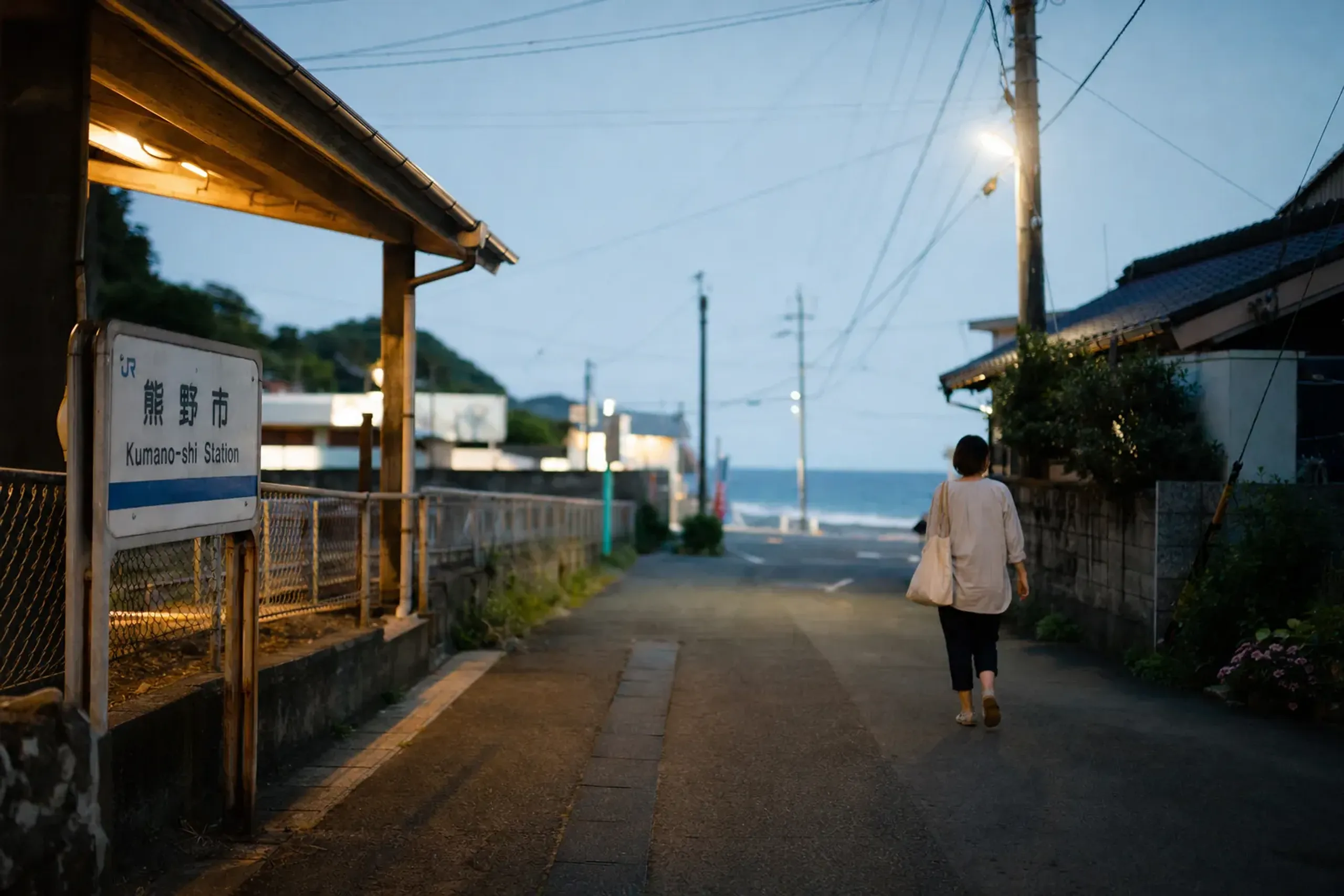
Onigajo is about five minutes by bus and then roughly ten minutes on foot. For the day itself, our team can arrange a private chauffeured transfer between your hotel or the station and the edge of the traffic-restricted zone, timed around the road closures. Beyond that line, you walk, like everyone else.
How The Japan Royal Service Concierge Team Plans The Evening
A fireworks night that starts around 19:00 and runs to roughly 21:00 does not sound like it needs much planning. On this coast, it does.
The whole day bends around four moving parts: the evening start, the 6:00 a.m. postponement notice, the rail and road restrictions, and the weather. Build the day badly and you spend it in a car that cannot move. Build it well and the wait itself becomes part of the pleasure. This is where the quiet, anticipatory care we are known for earns its keep — the comforts you did not think to ask for, arranged before you noticed they were missing.
Within the scope of this one event, here is what our team at Japan Royal Service handles, shaped by a tailor-made itinerary built around your pace:
- Planning. Our concierge builds the day around the evening start, with genuine rest on either side, factoring in the postponement notice, the rail and road restrictions, and the sea forecast.
- Guiding. An English-speaking cultural interpreter guide for the day, to explain the Obon origin of the fireworks, the Kumano coast, and the Kumano Kodo landscape around you. A guide, not a role in the event.
- Private transfer. A partner-fleet vehicle between your hotel or station and the edge of the restricted zone, timed to the road map. We do not own the fleet, and we do not combine the driver and guide into one role.
- Accommodation coordination. A hotel or ryokan in Kumano or along the surrounding coast, booked early, because rooms near a once-a-year sea fireworks night go first — and the finest small houses along this coast are the kind you reach only by introduction.
Ahead of the visit, our concierge team verifies on the client's behalf the date and the postponement notice, the special train and rail timetable, the traffic map, and the status of the sponsored seats and camera seats.
The beach is public, and we hold nothing on it. What we offer is a day built so that the hours before the first shell are comfortable, and the hours after the last one are not a stranded crawl through closed roads. Discretion runs through all of it: your plans, your movements, and your identity stay entirely your own.
Two other Kumano nights are worth a line. The Nachi Fire Festival over the border in Wakayama, and the Kumano Kodo pilgrimage walking that frames this whole coast, each have their own character; we cover them in their own guides. For a wider view of the season, our Tokyo summer festivals guide and the regional dances at Gujo Odori in Gifu and Owara Kaze no Bon in Toyama sit well either side of mid-August.
Plan Your Night On The Kumano Coast
Kumano Hanabi rewards those who understand its rhythm — the long afternoon, the single fixed date, the sea that decides everything.
If you would like that evening handled so the only thing left for you to do is watch the water catch fire, contact us here to begin shaping a private itinerary around the 17 August sea fireworks.
Frequently Asked Questions
When Is Kumano Hanabi Held Each Year?
Kumano Hanabi is held every 17 August on the Shichirimihama coast in Kumano City, Mie. The 2026 edition was held on 17 August. The date is fixed to the calendar and moves only if the sea is too rough.
What Time Does Kumano Hanabi Start And How Long Does It Last?
The fireworks start around 19:00 and run to roughly 21:00, about two hours. Spectators usually arrive on the Shichirimihama beach well before dark to settle in, so plan for a long afternoon and evening on the coast.
What Are The "Sea Fireworks" At Kumano?
They are shells fired on the water, not only from the beach. A boat running at full speed throws lit shells that open as semicircles on the sea; a three-shaku 250 kg shell detonates on a raft about 400 metres offshore; and the finale lights up the Onigajo rocks and caves.
What Happens If It Rains Or The Sea Is Rough On 17 August?
Rain alone rarely stops Kumano Hanabi; rough seas from typhoon swells do, because shells are fired from boats and a raft. The organiser posts the final decision by 6:00 a.m. on the day, so check before you travel.
Are Drones Allowed At Kumano Hanabi?
No. Drones and radio-controlled craft are refused. You may not bring, fly, film with, or pass through the venue with them, including on the beach itself.