In this guide
- 01A post town that turned into an industrial estate
- 02The four buildings that made this a national Historic Site — and the two you cannot enter
- 03Why Saijō is named alongside Nada and Fushimi
- 04Seven houses on one street, and what separates them
- 05What a day here actually asks of you
- 06October, and the two days that are not for learning
- 07What the Kamosu Tabi programme adds, and what we arrange around it
- 08A note on discretion
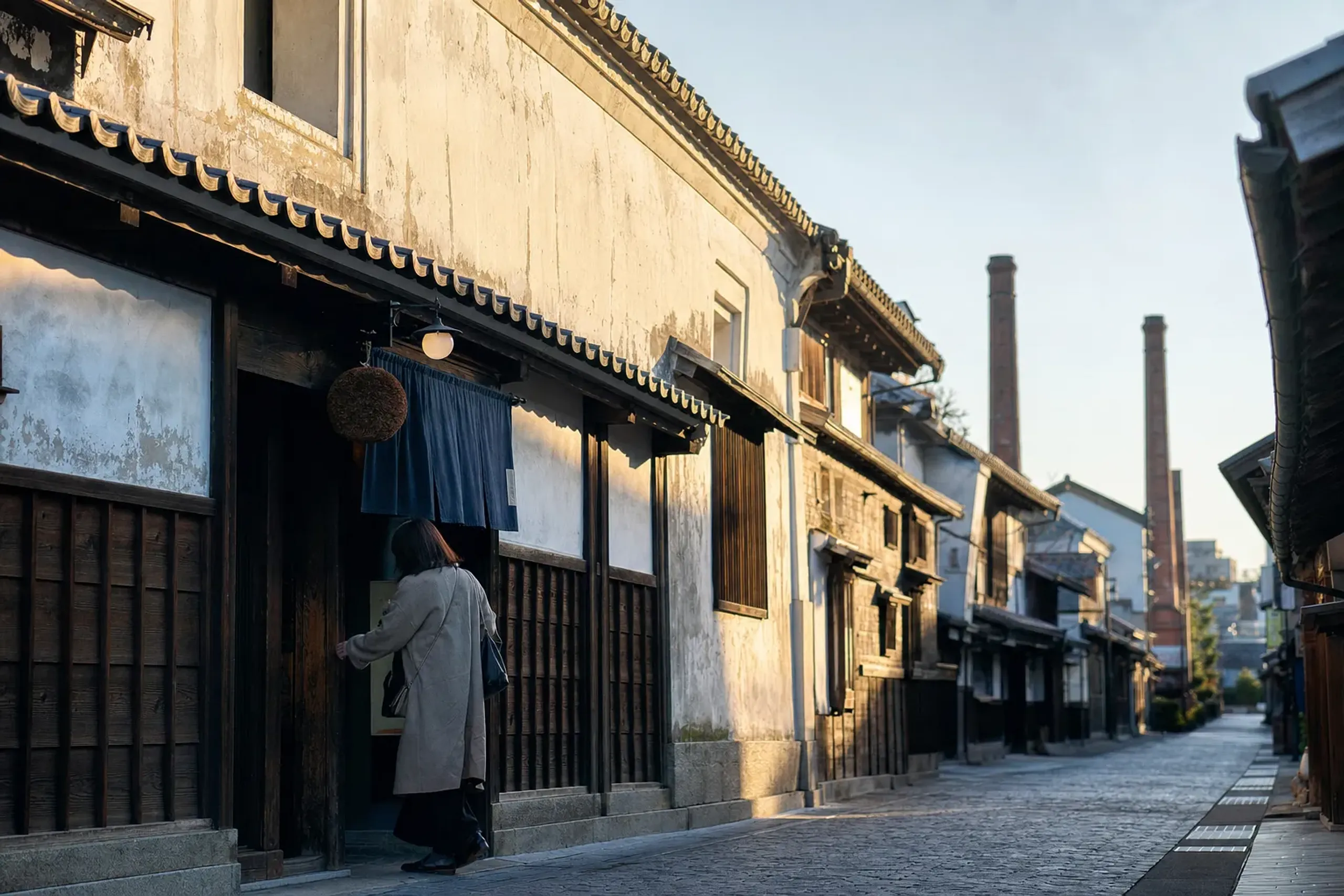
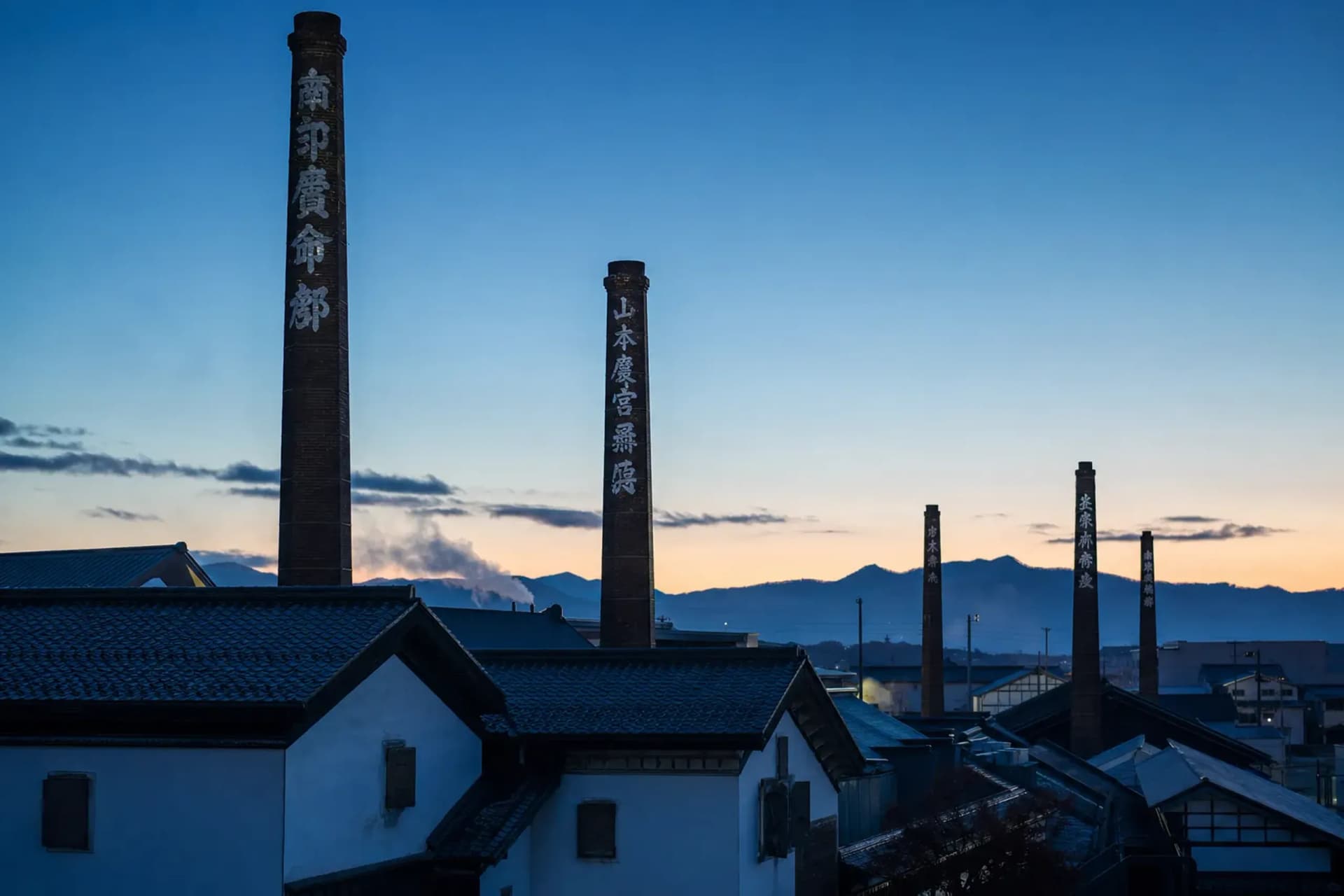
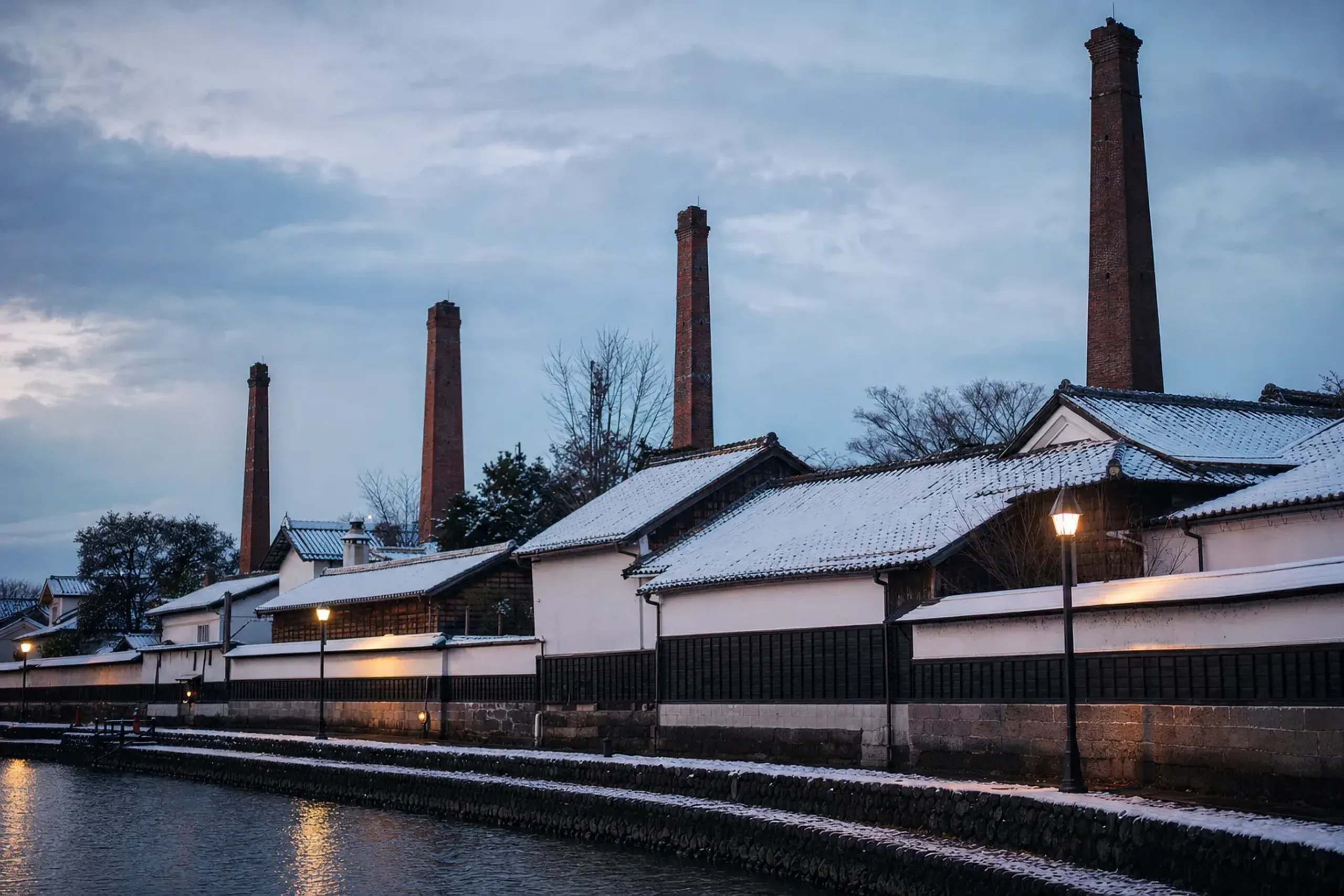
A red brick chimney rises above the roofline with a brand name written up its side. It is a working flue — in the city's designation records the chimney is listed beside the kamaba, the boiler house where the rice is steamed — but in Saijō it was also the signboard. The pattern runs: a small Western-style office at the front of the plot, the chimney behind it carrying the house name, and behind both the low white-plastered kura, black tiles set diamond-wise into the wall and pointed in raised lime. The town's tourism association calls this a Saijō company style rather than a general Japanese one, and seven brewing houses still stand this way on one street in front of a railway platform.
What is worth knowing about the street, though, is underneath it.
A post town that turned into an industrial estate
Before it brewed anything, Saijō was Yokkaichi — a post station on the Saikoku Kaidō, the old highway west along the Inland Sea, with the Hiroshima domain's largest honjin at its centre. The plots either side of the road were cut as post-town plots are cut everywhere: narrow at the street, long at the back. The main house faced the road; whatever else the family did happened behind it, down the strip.
In 1871 the new government abolished the sakekabu, the Edo-period brewing licence, and brewing became something a household could simply notify and begin. Merchants already on the highway did exactly that, building their kura behind the main house down the same narrow strip.
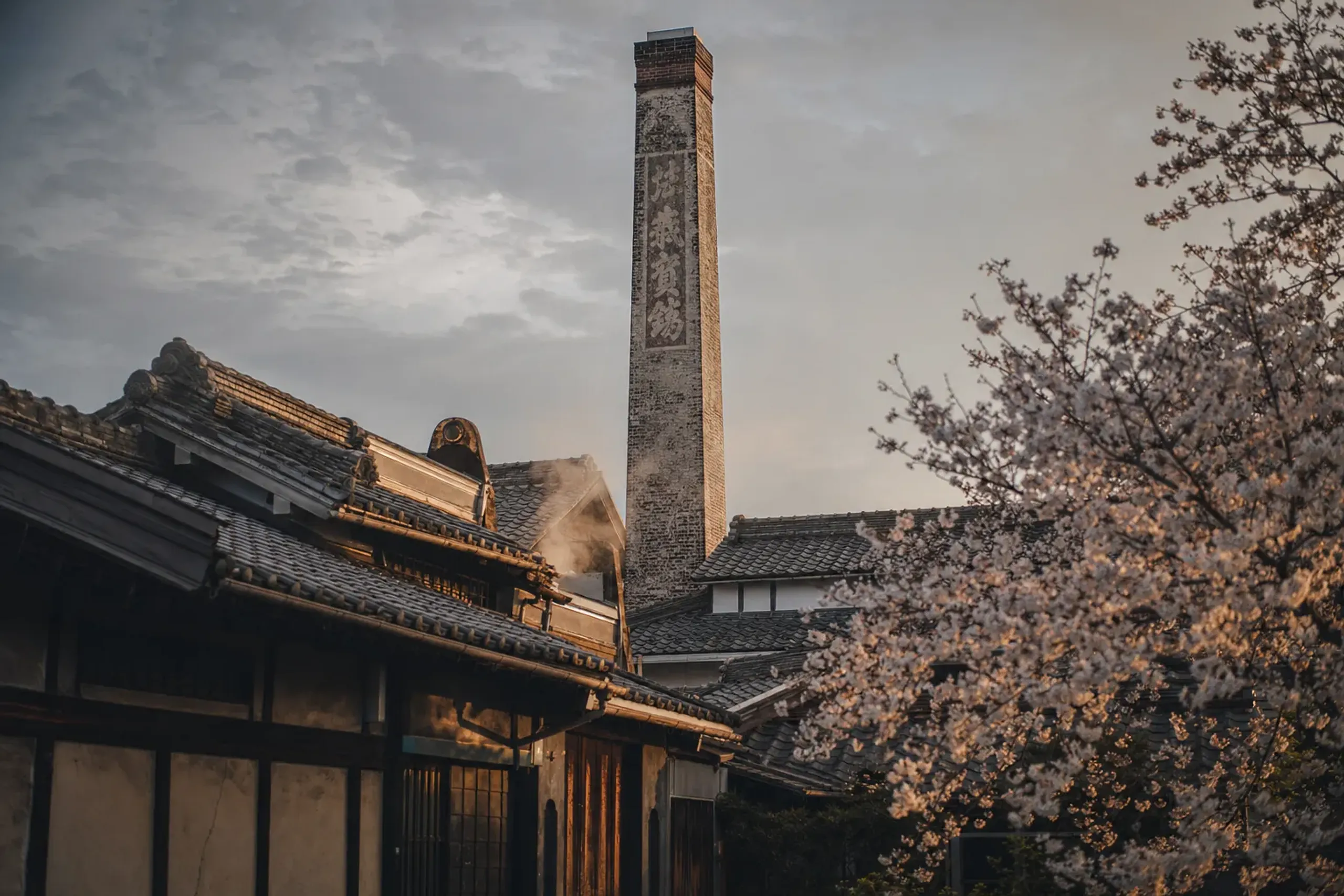
Then the railway came: the Sanyō Railway was driven through the prefecture in the 1890s, Saijō got a station, and the market stopped being men staying overnight at the inns. Through late Meiji and Taishō the kura outgrew the strips into the paddy behind, and those fields were merged into larger plots.
All of that is still legible on the ground, and it is the reason the city gives for protecting the district. In the city's own materials the value is placed on the jiwari, the division of the land, because you can read plot by plot a post town becoming what the city calls a cutting-edge industrial estate. The buildings are the evidence; the shape of the ground is the argument.
The four buildings that made this a national Historic Site — and the two you cannot enter
On 21 February 2024 the national government designated Saijō Sakaguragun, the Saijō brewery group, a Historic Site — the first time anywhere in the country, the city notes, that sake breweries have been designated one at all. Four places are covered, chosen to be read as one sequence rather than four monuments.
Hakubotan's Enpō-gura. The southern building holds a copy of a ridge tag dated 1675; the city calls it the oldest surviving brewing kura in Saijō and among the oldest anywhere, and a town drawing of 1862 already marks a kura on that spot. Not open to visitors.
Kamotsuru's Ichigō-gura. Raised in 1873 by the founder of what became Kamotsuru — the first kura built here in the modern era, in the same old configuration.
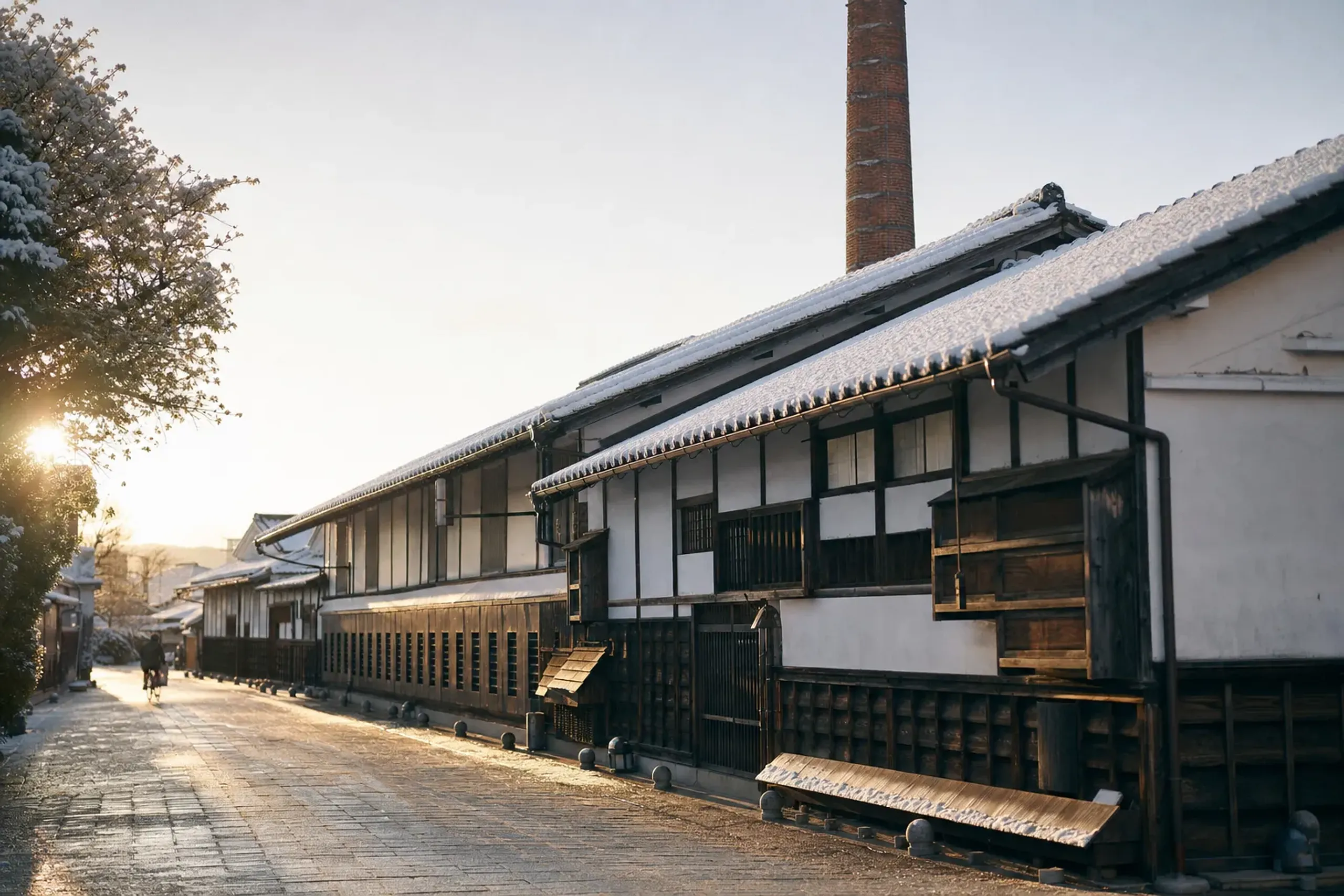
The main house is gone, its site now Saijō Honmachi History Plaza. The kura itself is open, converted into the brewery's exhibition and retail hall.
The former Hiroshima Prefectural Brewing Experiment Station. After the Finance Ministry founded the national brewing institute in 1904, prefectures built their own; Hiroshima built its here, completed 1929, because Saijō was by then the recognised centre of the prefecture's sake industry. It closed in 1975. The grounds now belong to Kamoizumi, and the 1929 main building is open as a sake café.
Fukubijin's Daikoku-gura. A working kura was normally a sengoku-gura — a thousand koku, roughly 180,000 litres, across one winter. Daikoku-gura was built to two thousand, the only kura in Saijō at that scale, put up in 1925 by a company floated by the town itself with the mayor as promoter. The city calls it the end point of Saijō brewery architecture. Not open to visitors.
Two open, two closed. Worth saying plainly: a national designation is not a national door.
Why Saijō is named alongside Nada and Fushimi
The basin sits at 250 to 300 metres, ringed by hills including Ryūōzan at about 549 metres, and the well water is chūkōsui, medium-hard. Inland winters here are genuinely cold, which is what a brewer wants. All of that helps. None of it is the reason. The reason is a man in a coastal town fourteen kilometres south-south-east, and a machine built in Saijō itself.
Miura Senzaburō was born in 1847 in Mitsu, now part of Higashihiroshima's Akitsu district, and began brewing in 1876 — one of the flood of entrants the 1871 deregulation produced.
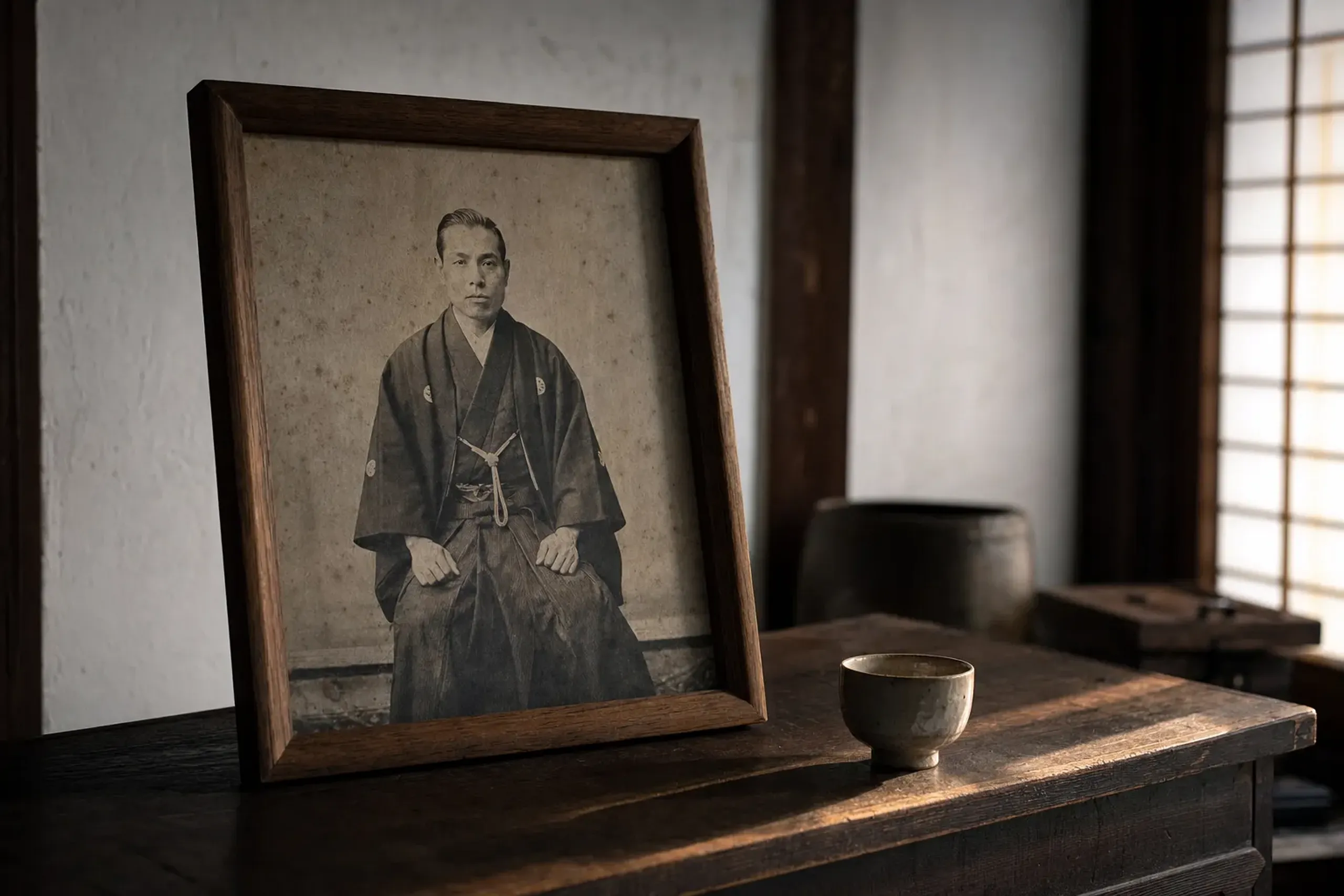
His sake spoiled, season after season. He went to Nada, worked a year there as a cellar hand, and established that Nada's advantage lay in its water: hard, mineral-rich, fermenting strongly. The water where he lived was soft, every well of it — and soft water ferments weakly and spoils.
He could not move Nada's water, so he stopped imitating Nada. He grew the kōji hard, brewed cold, and put thermometers, clocks, records and sanitation where instinct had been. His motto was hyakushi senkai: a hundred trials, a thousand improvements. In 1897 the method held; in 1898 he published it as Kaijōhō Jissenroku and gave it away to the brewers of his own prefecture.
Meanwhile in Saijō itself, Satake Riichi devised Japan's first powered rice-polishing machine in 1896, and in 1908 the vertical grinding polisher that made deep, consistent polishing practical — the machine that made ginjō possible. Kamotsuru installed one of the first powered mills in 1898. In the same years the Sanyō Railway reached Hiroshima from Mihara, and the sake could leave.
At the first national sake competition, in Tokyo in 1907, Hiroshima took first and second place, ahead of Nada and of Fushimi. What brewers elsewhere drew from that was not that Hiroshima had better water. It was that water was not destiny. That is what Saijō contributes to the trio, and why the shorthand here is onna-zake, fine-grained and mellow, against Nada's otoko-zake.
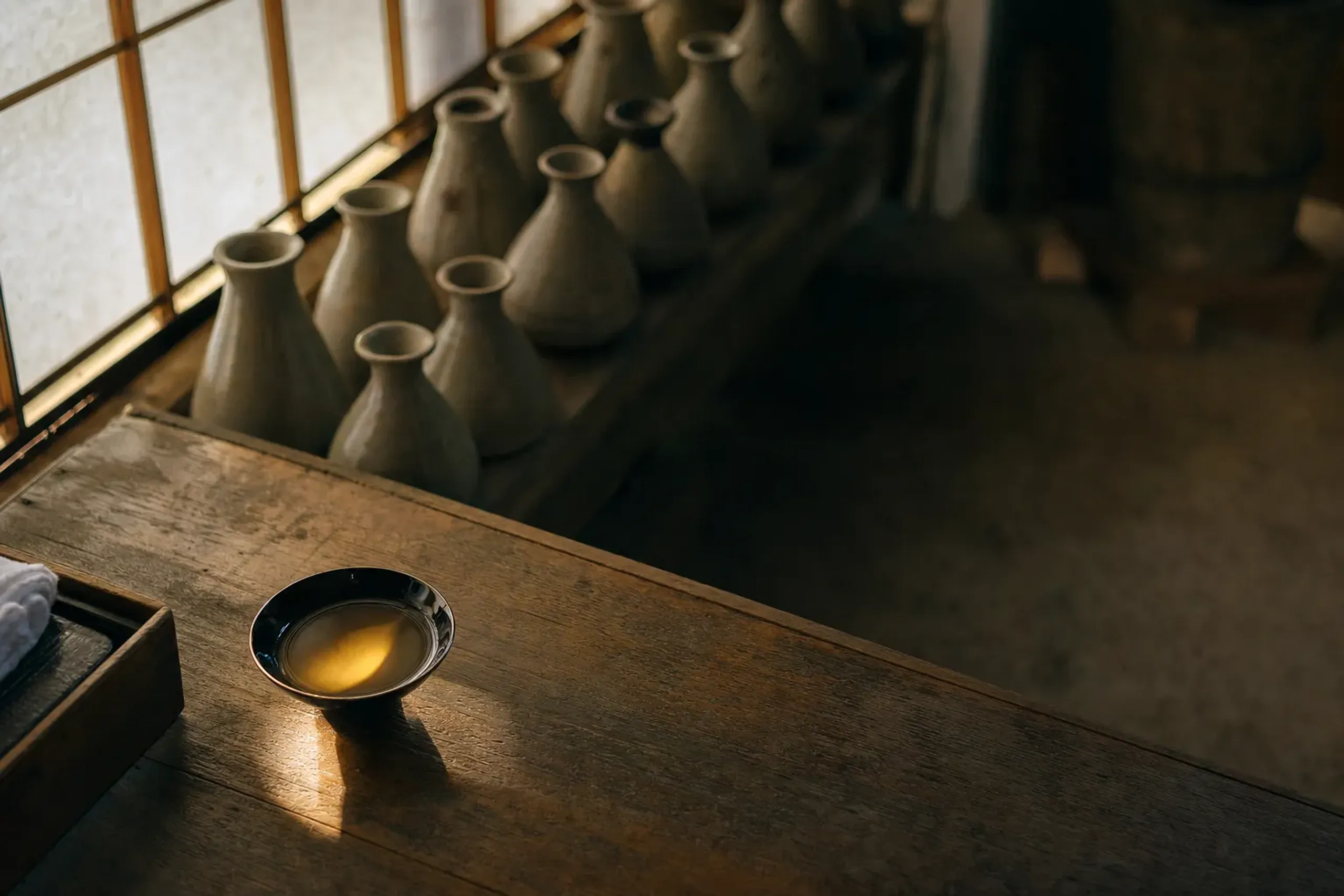
Seven houses on one street, and what separates them
Hakubotan, founded 1675, is the oldest, begun under the shop name Katoya by a descendant of the warlord Shima Sakon; the family counts Sakon as its first generation and the present head as the fifteenth. In the twelfth month of 1839 the Takatsukasa — one of the five regent houses — granted the brewery its name after their peony crest, the then Kanpaku brushing the naming plaque himself. The instruction that came with it, telling the family to brew with care, survives.
Kamotsuru named its sake in September 1873 and has been the technical pace-setter. Its gold-leaf bottling of 1958 is where most people outside Japan have met this street without knowing it: the leaf was square at first, became a cherry petal in 1974, cut one by one for the golden wedding of the Emperor and Empress Shōwa, and went onto the commercial bottling in that shape in 1997.
Kamoizumi, founded 1912, began brewing with rice and rice kōji alone around 1965 and released Honjikomi in 1972, a pioneer of the modern junmai movement; it still declines carbon filtration, so its sake is amber rather than water-clear. Fukubijin, set up in 1917 by a subscription of west-Japan brewers, served until around 1970 as something close to a technical college, the Saijō Sake Brewing School. Kirei, mid-Meiji, is the dry one on a street that is not otherwise dry; Saijōtsuru, 1904, draws from a Tenpō-era well; Sanyōtsuru, 1912, took its name from the pine avenue of the old Sanyō highway.
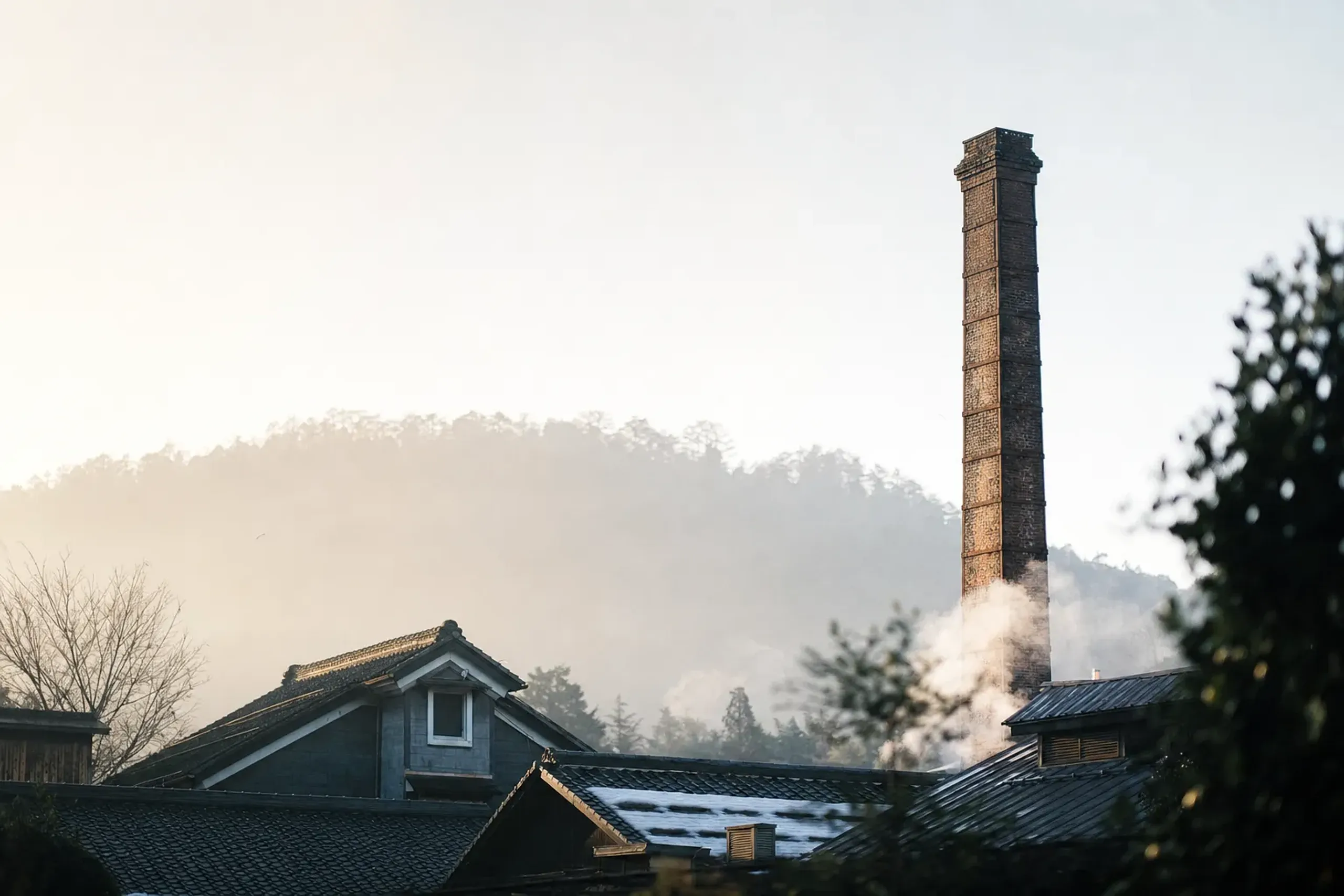
One rule binds them. The Saijō brewers' association runs its own certification: only sake meeting its criteria — among them one hundred per cent Hiroshima-grown brewers' rice — may be sold as SAIJO SAKE. Self-imposed, local, and more telling than a medal.
What a day here actually asks of you
Saijō is thirty-five minutes from Hiroshima Station by rail, direct, about thirty kilometres out; half an hour from central Hiroshima on the expressway; twenty-five minutes from Hiroshima Airport, which is closer to Saijō than the city is. The seven houses stand within ten minutes' walk of one another, the nearest three minutes from the station. Almost nothing here is a transport problem.
Almost all of it is an opening-hours problem. The houses keep their own hours and rules, and they change. Several take no cards at all; several that do take only cash at the tasting counter. One has kept its cellar tours suspended for years. Another runs a tour of the working brewing hall led by its own tōji, about an hour, by reservation, on irregular dates, with no tasting attached — exactly the tour worth having, and exactly the one you cannot turn up for.
Eat bishunabe, the meal brewery workers were fed during the season, each house making its own: garlic in the pot first, then chicken, gizzard, konnyaku and vegetables, seasoned with sake, salt and pepper and nothing else.
October, and the two days that are not for learning
Brewing runs through the cold months, and a kura in season smells of steamed rice from the street.
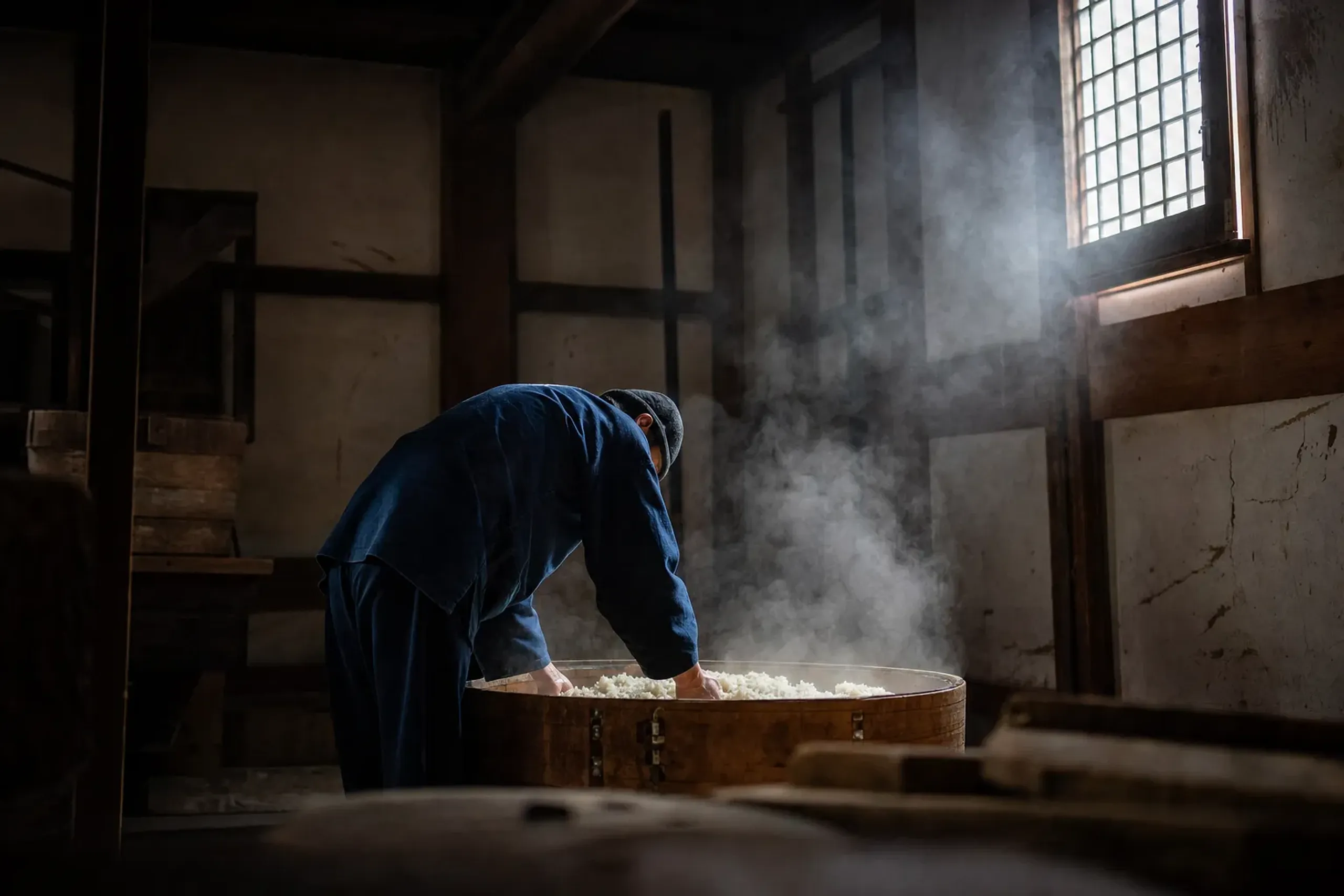
That is the argument for a winter call. October is a different proposition. Over the Saturday and Sunday of the October long weekend the town holds the Sake Matsuri, in Saijō Central Park and along the brewery street. Its core is the Sake Hiroba, where some eight hundred sake from across Japan are open for tasting in one place; the regional press has reported attendance well above two hundred thousand across the two days. It is a genuinely good festival, and the wrong two days to try to understand anything — a difference better chosen than discovered on arrival.
What the Kamosu Tabi programme adds, and what we arrange around it
A programme runs in Saijō as Sakedokoro Saijō Kamosu Tabi PREMIUM, operated by a local incorporated association and offered in Japanese and English. Its published description is specific: a visit inside a production brewery not normally opened to the public, an original sake bottle made through a calligraphy session, and a pairing of local cooking with the sake. It runs year round, meets at the north exit of Saijō Station, and is limited to guests of twenty and over, though minors may accompany.
The version we arrange takes in four of the houses across an afternoon. We should be straight about the provenance of that: the four-brewery shape is what the operator has told us, while the published listing describes the non-public brewery, the calligraphy bottle and the pairing without stating a number.
Better to flag the join than smooth it.
What it is for is the first item. Everything else on this street can be done well without help; being let into a room where sake is actually being made cannot.
Around it we arrange the day whole: the transfer from the ship, the houses in an order that suits the hours they keep, the introduction where dates allow, an interpreter, and lunch. The interpreter matters more than the car: the value of a brewing hall is what the tōji says while his hands are busy, and that does not survive being mimed. Where a house will part with something not on general sale we handle the purchase and onward shipping to your last address in Japan; unpasteurised sake does not want a warm cabin or a long wait on a quay, and our private transportation and logistics cover that door to door.
The afternoon sits inside a wider tailor-made itinerary. If the call at Hiroshima is a long one, the other half of the day is usually Miyajima on the right tide, and we have written separately on Saijō and ginjō.
A note on discretion
We are a Japanese company, working in Japanese, with the families who own these houses — arrangements made by someone the other side already knows. We do not publish our clients, our itineraries or our rates, and who visits and what they buy stays confidential.
If you would like an afternoon on this street arranged around the hours your ship gives you, contact us here.