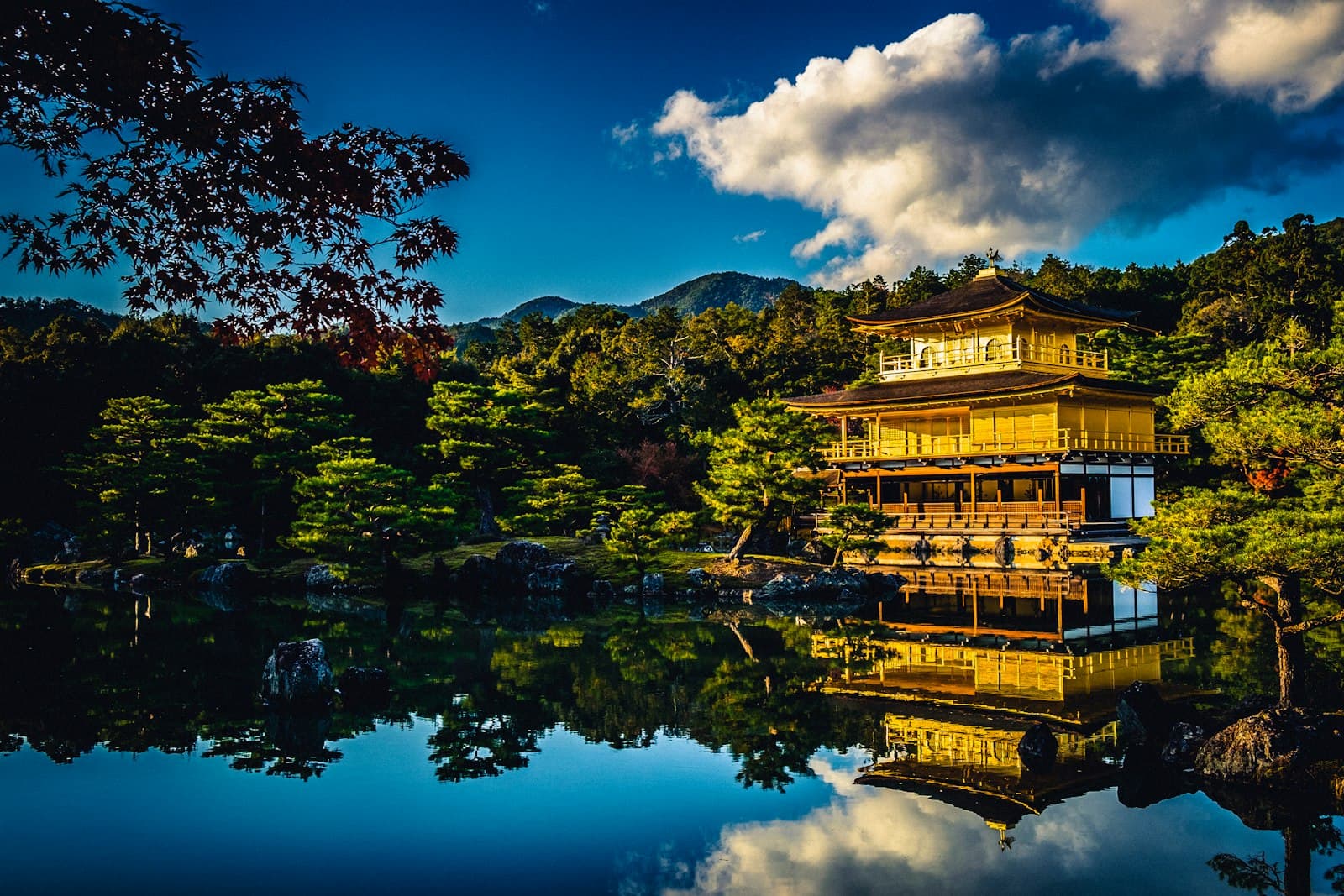
In this guide
- 01Why Does Fukuoka Not Bloom Before Tokyo Despite Being Further South?
- 02The Proof: Kagoshima Blooms After Tokyo
- 03When Does Fukuoka Bloom First, Then? In February
- 04Maizuru Park: Blossom Over a Castle, and Over Something Older
- 05Elsewhere In The Prefecture
- 06How Should I Time A Fukuoka Cherry Blossom Trip?
- 07What Japan Royal Service Arranges For A Fukuoka Spring
- 08Frequently Asked Questions
- 09Why Choose Japan Royal Service
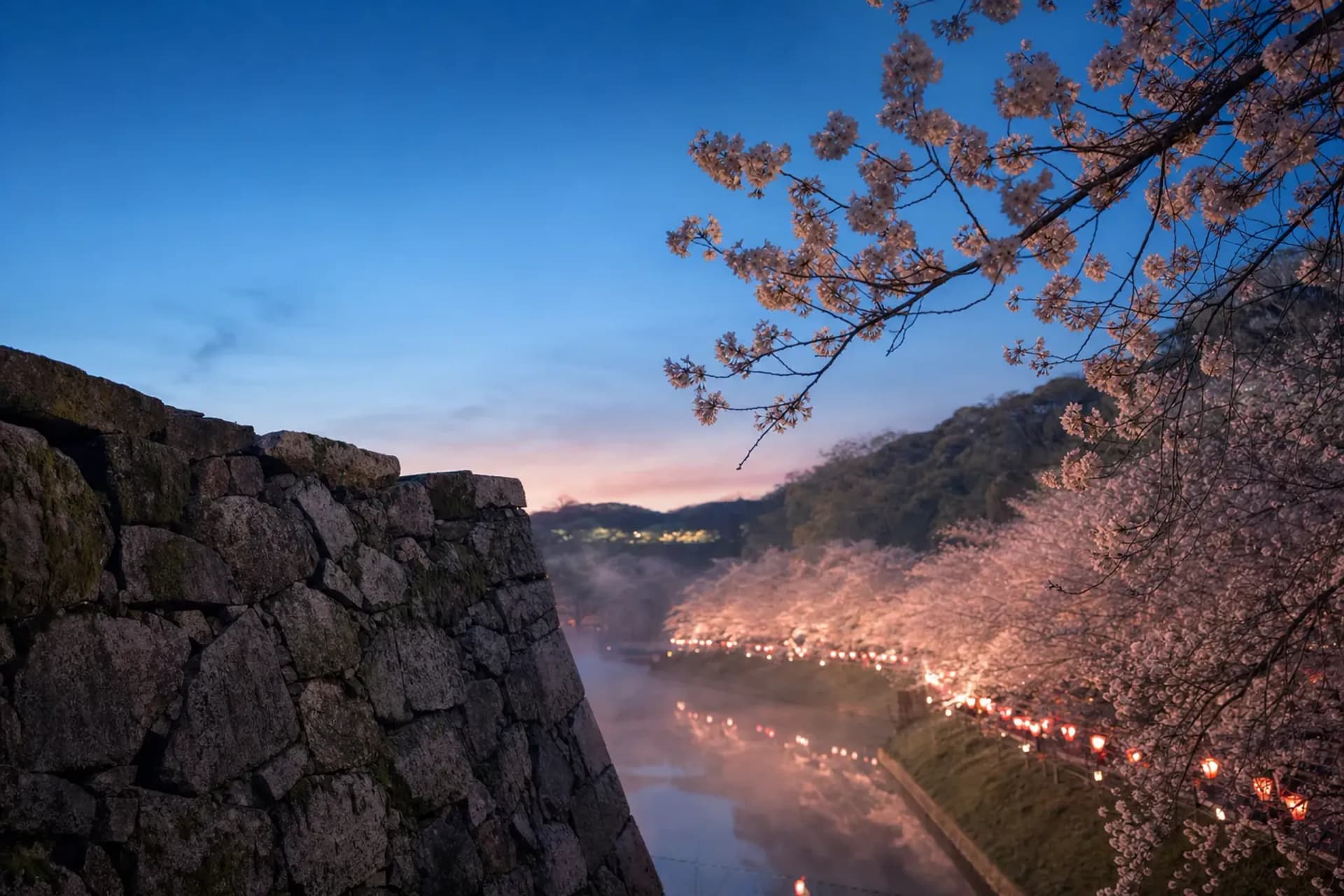
Come at dusk and walk the old stone ramparts of Maizuru Park. In late March the walls hold the last light, and a thousand Somei-Yoshino trees soften every hard edge of the ruins. Below your feet is a castle. Below that, older still, lies the ground of a Nara-period diplomatic hall. Blossom over both.
This is the season most visitors chase, and most of them chase it wrongly. The common assumption, and the one our team at Japan Royal Service corrects first, is this: Fukuoka is further south, so surely it flowers first, and one can follow the blossom neatly northward from Kyushu to Tokyo. It is a tidy story. It is also wrong, and the reason it is wrong is the most interesting thing about a Fukuoka spring.
Why Does Fukuoka Not Bloom Before Tokyo Despite Being Further South?
Fukuoka and Tokyo flower within a day or two of each other, because Somei-Yoshino cherry trees need a real spell of winter cold before spring warmth can trigger them. This is dormancy break, and it is the fact the whole season rests on.
Here is the mechanism, plainly. A Somei-Yoshino sets its buds in the previous summer, then goes dormant. To wake cleanly, it must first accumulate enough genuine cold through the winter. Only after that chilling requirement is satisfied does accumulated warmth push the buds toward opening. Cold first. Then heat. In that order.
So latitude alone does not decide the calendar. What decides it is whether a place gets cold enough, then warm enough, in the right sequence.
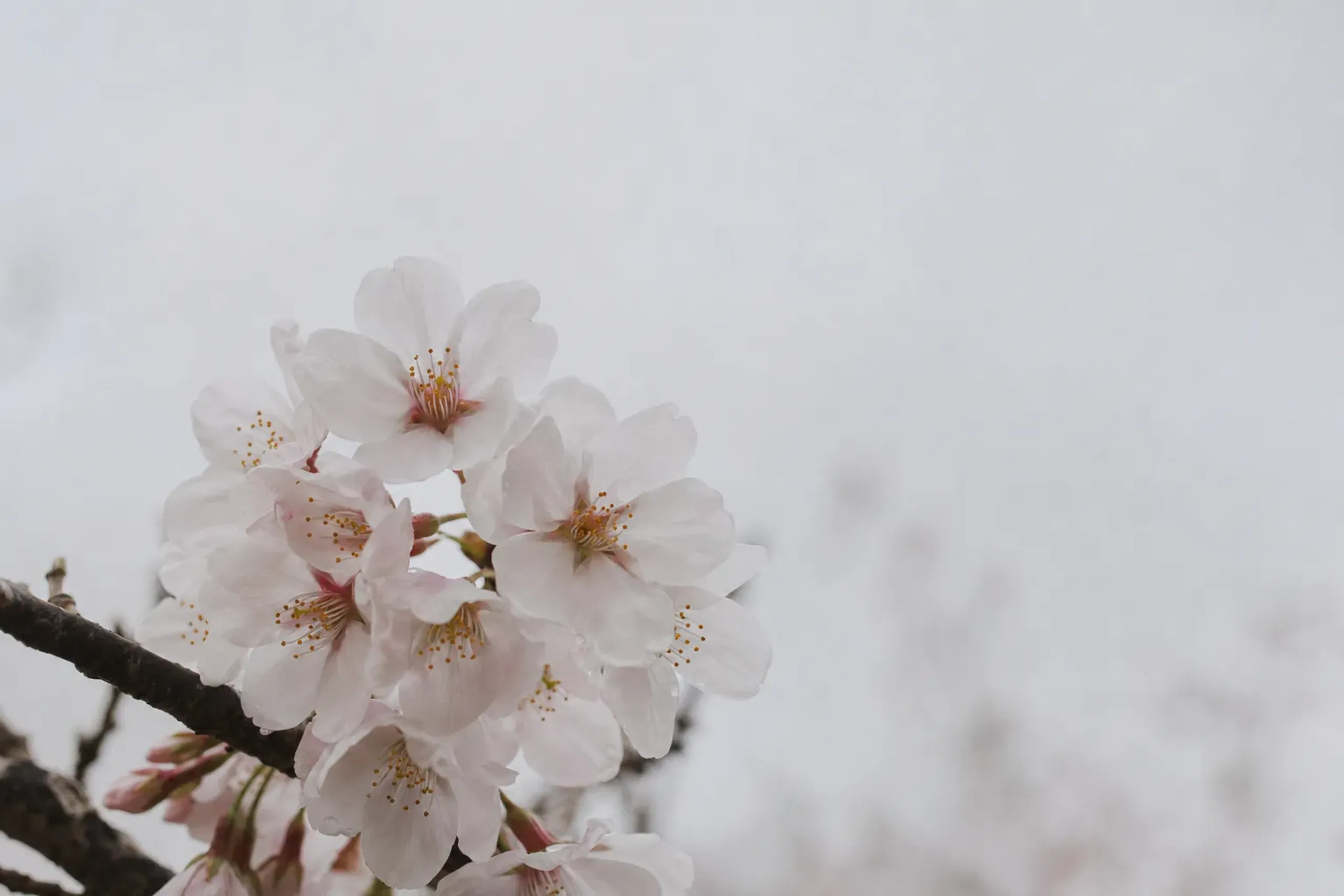
The Somei-Yoshino needs real winter cold before spring warmth — cold first, then heat.
Fukuoka's winters deliver that cold reliably. Its springs then warm quickly. The result is a bloom that arrives almost in step with Tokyo, roughly a thousand kilometres away.
Key fact: The Somei-Yoshino cherry needs a period of true winter cold to break dormancy. Without that chilling, warmth alone cannot trigger a clean bloom — which is why the far south is often late, not early.
The Proof: Kagoshima Blooms After Tokyo
Kagoshima — the southernmost major city on Japan's main islands — regularly flowers after Tokyo. Read that twice. The southernmost city is among the last to open.
Southern Kyushu's winters are often too mild for the chilling requirement to be met cleanly. The buds sit there, under-chilled, waiting for a cold that never quite comes hard enough. So the far south lags. Meanwhile Japan Weather Association forecasts have placed the earliest openings in Fukuoka and Tokyo together — the two ends of the country, side by side.
This is why the blossom "front" is not a line. Maps draw a smooth curve sweeping up from Kyushu, and it looks orderly and chase-able. It is neither. The front is a scatter of local conditions — elevation, coastal warmth, winter chill, urban heat — not a tide moving north.
It is exactly this that explains a common puzzle. If you have read our notes on Tokyo in blossom, Kyoto in late March, and Osaka Castle, you will have noticed those three cities open within days of one another rather than weeks apart.
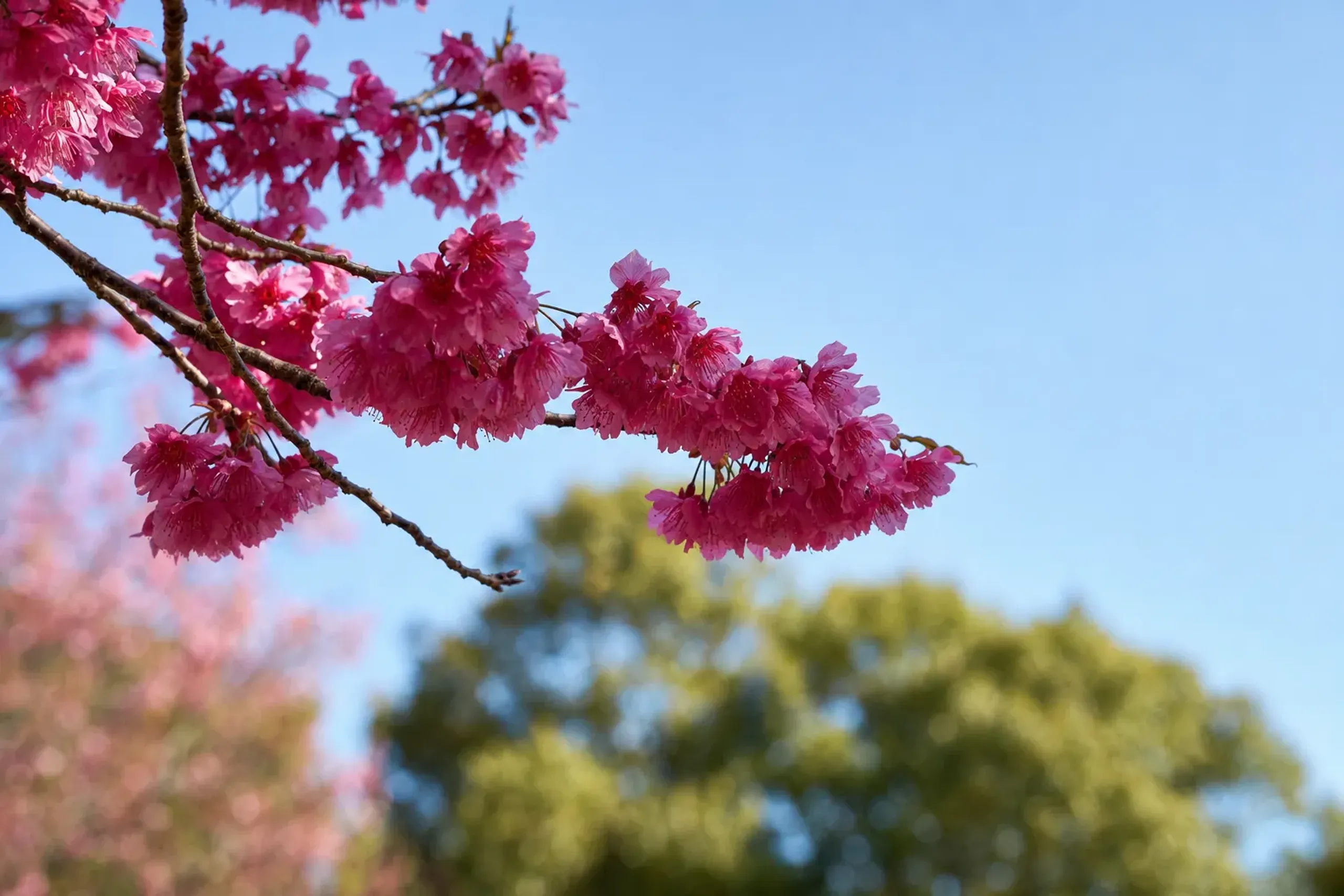
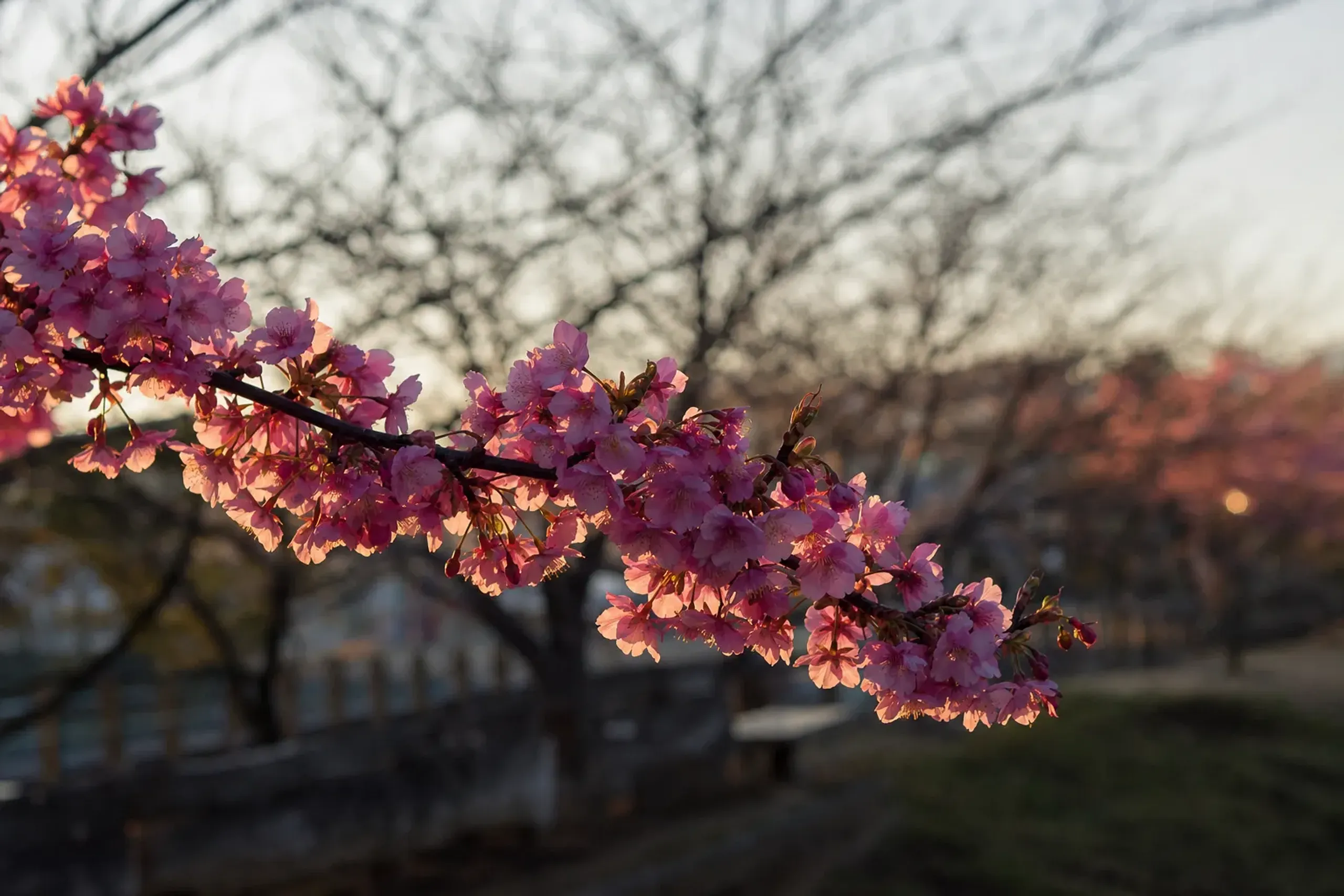
Kawazu-zakura opens around February — deeper pink, and it holds on the branch for weeks.
This is the piece that says why. You cannot ladder the season city by city. The window is narrow and it lands almost everywhere at once.
When Does Fukuoka Bloom First, Then? In February
Fukuoka does bloom early — just not Somei-Yoshino. A different, earlier variety called Kawazu-zakura flowers in Fukuoka Prefecture around February, roughly a month before anything else opens.
Kawazu-zakura is a deeper, warmer pink than the pale Somei-Yoshino. It holds on the branch far longer, so a single tree stays lovely for weeks rather than days. If someone tells you Fukuoka flowers first, this is the honest version of that claim — and it is a real one.
You will not find these early trees in the city centre. Two prefecture sites are worth the short drive:
- Amagi Park, in Asakura — outside Fukuoka city, to the southeast.
- The Shirano-e Botanical Garden, in Kitakyushu — a separate city to the northeast.
Both sit beyond the city limits, so plan them as a private drive rather than a stroll from your hotel. February timing shifts year to year; the early pink can arrive a fortnight early or late depending on the winter, so the window should always be checked close to travel.
The practical takeaway is unusually clean. Fukuoka blooms twice. Once in February with an early variety, and again in late March with everything else.
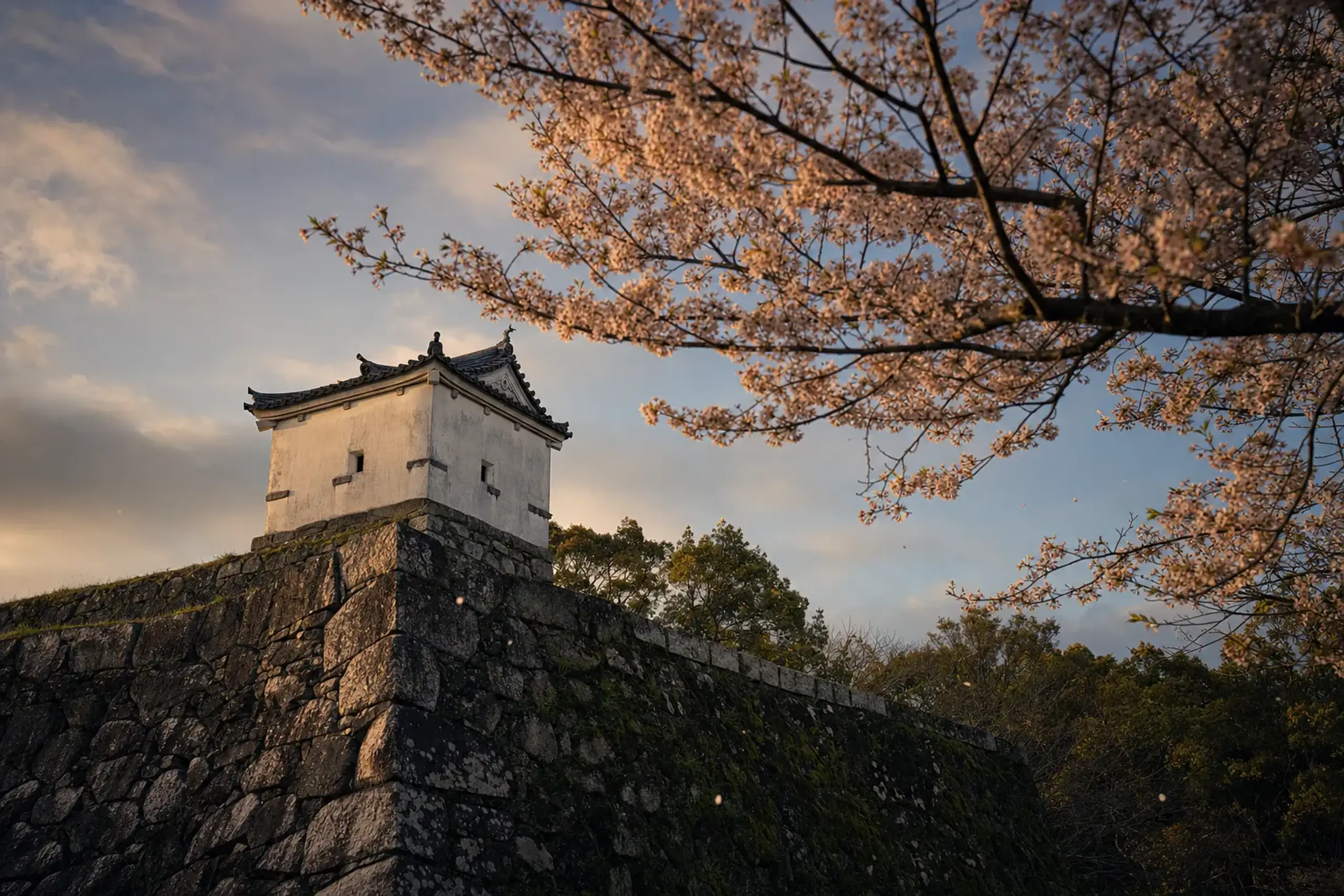
Maizuru Park: blossom over an Edo castle, and over the Nara-period Kōrokan beneath it.
For a client who simply cannot travel in April, that first bloom is a genuine proposition — and almost nobody writes it down.
Maizuru Park: Blossom Over a Castle, and Over Something Older
Maizuru Park holds around a thousand cherry trees on the grounds of the former Fukuoka Castle, right in Chūō-ku at the centre of the city. Typical viewing runs from late March into mid-April.
What makes this site quietly extraordinary is what lies underneath. Three eras are stacked here. The Edo-period castle you can trace in its stone walls and turrets. Before that stadium era — the site later held the Heiwadai athletic ground. And beneath all of it, the Kōrokan: the ancient reception hall where the imperial court once received foreign envoys, a diplomatic guesthouse from the Nara period.
So when the blossom opens across Maizuru, it opens over more than a castle. It opens over the place where Japan once welcomed the outside world, more than a thousand years ago. Stand on the ramparts at dusk with the petals catching the last light and the layering becomes almost physical — statecraft, then fortification, then flowers, all in one field of view.
The Fukuoka Castle Cherry Blossom Festival brings illumination across the park in the evenings, with lighting typically running into the night. Because the festival dates and the lighting hours shift each year, our concierge team confirms them against the current-year announcement before advising on an evening visit.
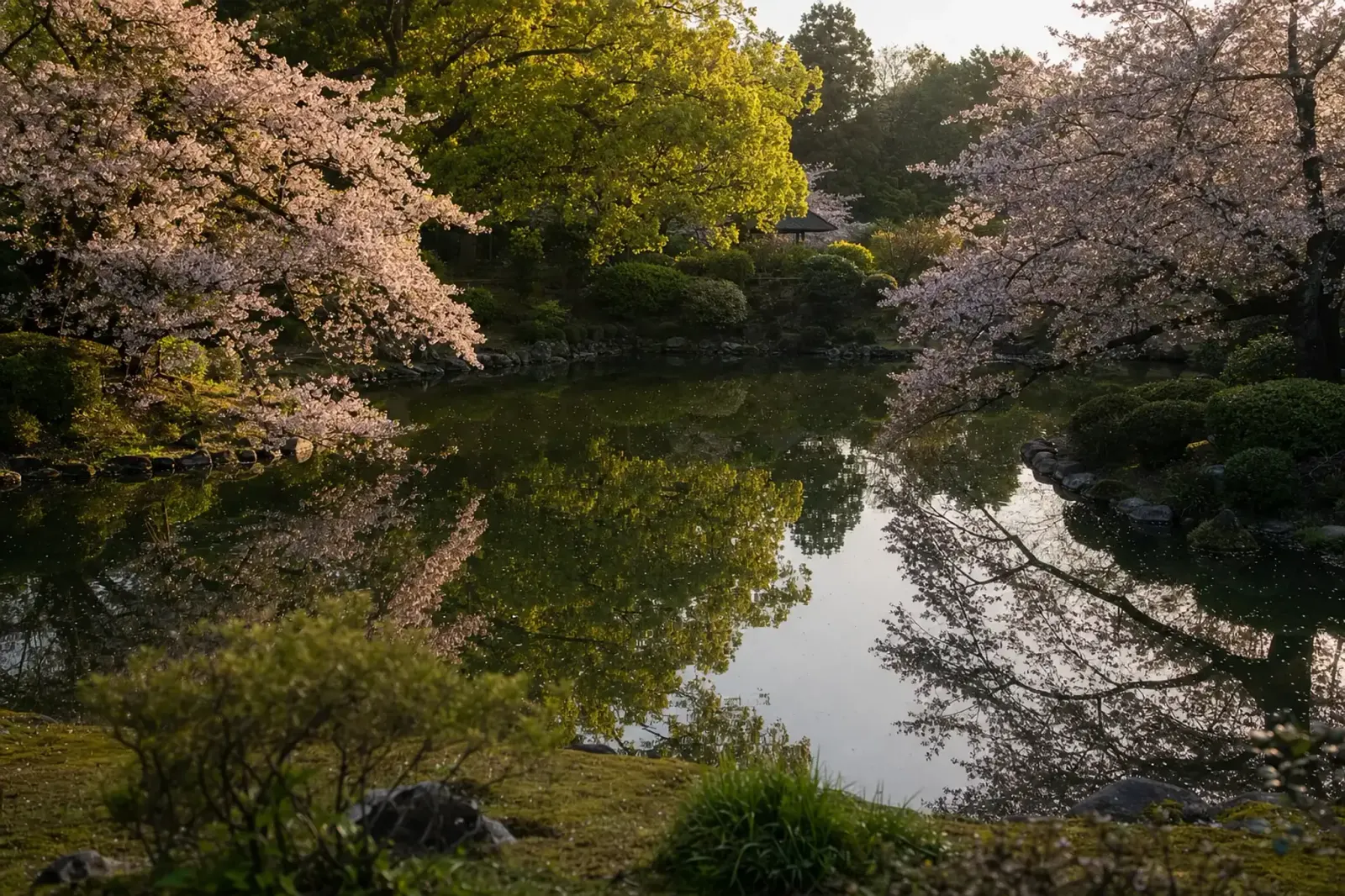
Amagi Park in Asakura — roughly four thousand trees ring a gourd-shaped pond.
Elsewhere In The Prefecture
Fukuoka Prefecture rewards a traveller willing to leave the city for an afternoon. Amagi Park in Asakura — the same park that carries the February kawazu — also holds a broader spring display. Around four thousand trees encircle a gourd-shaped pond, and a night illumination runs during the bloom on dates set each year. It dwarfs Maizuru in scale.
Two more sites rank highly with locals rather than tourists. The Dazaifu government office ruins — the old administrative seat of ancient Kyushu — draw crowds each spring and pair naturally with Dazaifu's celebrated plum season, which runs into mid-March. Nomiyama Kannon-ji and Katsumori Park round out the list for anyone who wants blossom away from a camera queue.
One note on geography, because Fukuoka's position matters. Hakata is the shinkansen terminus and the gateway to Kyushu. A blossom visit here does not close at the city limits — it opens onto Dazaifu, Yufuin, and Nagasaki, and it is the natural staging city before boarding Kyushu's luxury rail. That reach is part of why we favour Fukuoka as a spring base and not merely a stop.
How Should I Time A Fukuoka Cherry Blossom Trip?
Book the frame in advance, but confirm the exact days two to three weeks out. Bloom forecasts begin publishing in February, and they revise as the winter's cold and spring's warmth resolve — so lock hotels and transport early, then fine-tune the hanami days late.
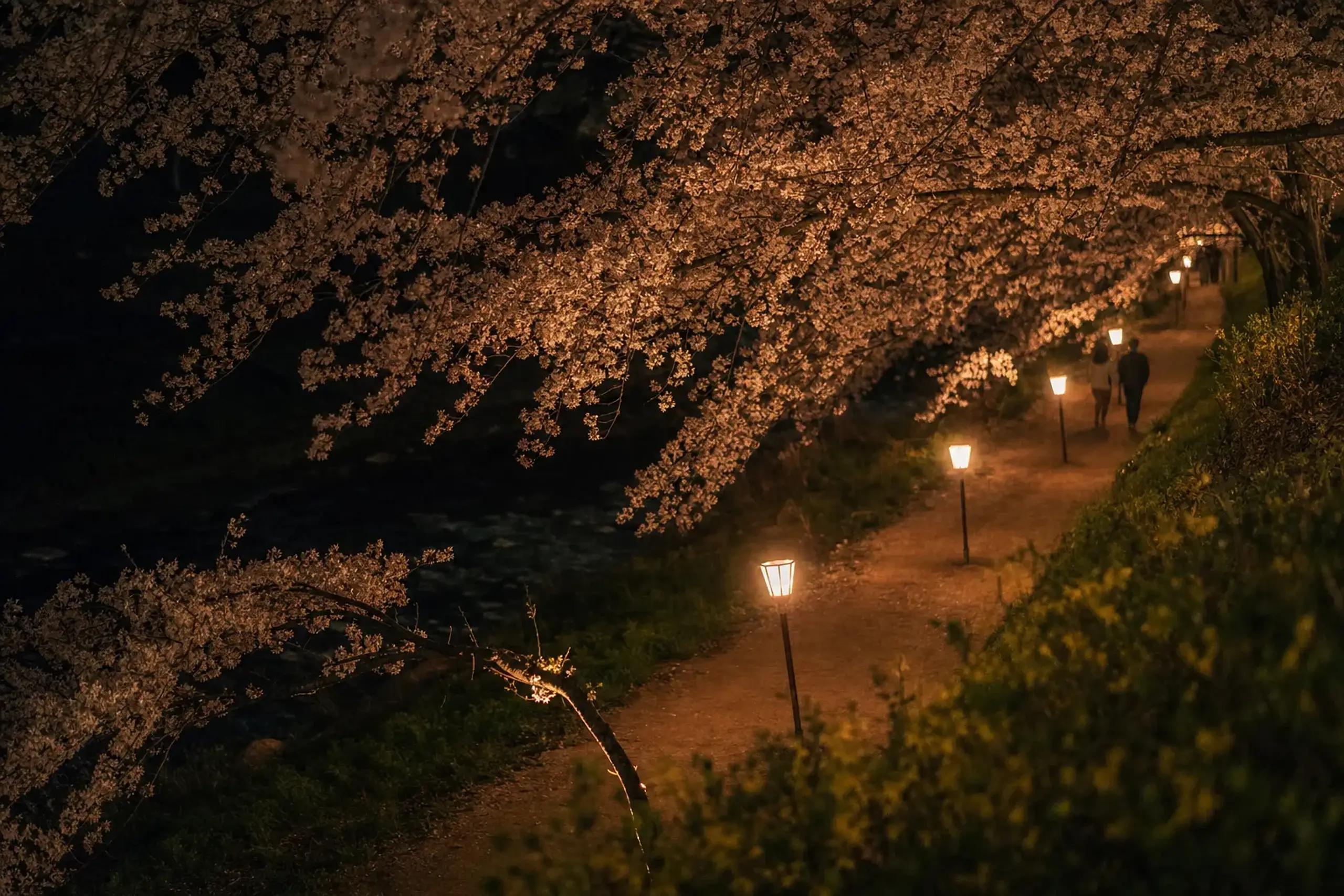
Late-March evenings, when illumination stacks with the Flower Show and sake festival.
We plan spring travel in ranges, never fixed dates. For late-March Somei-Yoshino, aim broadly at the final week of March into early April and hold a buffer of a day or two on either side. For the February kawazu, watch the prefecture's early-variety reports and keep the itinerary flexible enough to move a drive forward or back.
Late March can also stack with other reasons to be in Fukuoka. The Fukuoka Flower Show at the Fukuoka City Botanical Garden and a Kyushu Spring Sake Festival collaboration in the Hakata area have both been held in late March; their dates are set each year, and the JRS concierge team confirms them directly with the guest at time of arrangement. A traveller optimising for blossom can land squarely inside both — a quiet argument for the late-March window over the April rush.
What Japan Royal Service Arranges For A Fukuoka Spring
Our value in a Fukuoka spring is precision — reading the forecast correctly, moving you to the right park at the right hour, and keeping the whole thing unhurried.
In practice, that means a private chauffeured vehicle for the prefecture's scattered sites — Amagi in Asakura, Shirano-e in Kitakyushu — so the February and late-March blooms both stay within easy reach without a rental car or a train timetable. It means an early, quiet arrival at Maizuru before the festival crowds thicken. And it means a tailor-made itinerary that uses Fukuoka as a gateway, extending toward Dazaifu, Yufuin, or the coast rather than stopping at the city.
For those staying overnight, we advise on refined city accommodation and, where a client wishes, on stays that suit a quiet spring rhythm. Every recommendation is shaped to how you actually like to travel.
Frequently Asked Questions
Does Fukuoka's cherry blossom bloom before Tokyo's because it is further south?
No. Fukuoka and Tokyo flower within a day or two of each other. Somei-Yoshino cherries need genuine winter cold to break dormancy before warmth triggers bloom, so latitude alone does not make the far south earlier.
Why does Kagoshima bloom later than Tokyo when it is the southernmost city?
Southern Kyushu's winters are often too mild to satisfy the cherry's chilling requirement cleanly, so the buds wake late. Kagoshima regularly flowers after Tokyo, which is the clearest proof the blossom front is not a simple line moving north.
When can I see early cherry blossoms in Fukuoka Prefecture?
Around February, roughly a month before the main bloom. The early Kawazu-zakura variety flowers at Amagi Park in Asakura and the Shirano-e Botanical Garden in Kitakyushu — both outside Fukuoka city. Exact timing shifts yearly and should be checked close to travel.
What are the dates for the Fukuoka Castle Cherry Blossom Festival at Maizuru Park?
The festival is held during the late-March to early-April bloom, with evening illumination across the park. Because dates and lighting hours change each year, the JRS concierge team confirms them directly with the guest at time of arrangement.
Can I follow the cherry blossom season from Kyushu north to Tokyo?
Not the way the maps imply. Fukuoka, Kyoto, Osaka, and Tokyo open within days of one another, not weeks, so the season cannot be chased city by city. Timing one region well matters more than trying to ladder several.
Why Choose Japan Royal Service
A Fukuoka spring is easy to misread and easy to miss. The window is narrow, the forecast moves, and the best trees are scattered across a prefecture rather than gathered in one park. Japan Royal Service exists to make that precision effortless — to read the season correctly and move you between the February and late-March blooms.
We are a Tokyo-headquartered concierge that arranges vehicles from partner companies with English-speaking drivers, and we can advise on timing risk honestly and adjust an itinerary two weeks out without friction. No brochure blossom trip. A season met on your terms, quietly.
To begin planning, contact our team here.