In this guide
- 01What "One Of Japan's Three Great Night Cherry Blossoms" Actually Means
- 02The Festival: Dates, Lanterns, And Why The Window Moves Every Year
- 03The Turret, Doubled On The Moat
- 04Sakura Road: Castle, Blossom, Mountain In One Frame
- 05Beside the memorial tower stands a reference tree, the kanjuboku, used locally to declare the season's bloom. During the festival a storytelling performance is staged beside it, in the same manner as the standard trees used in Tokyo and Osaka. If you want that mechanism explained, our Osaka Castle blossom guide walks through it.
- 06How Do You Avoid The Worst Crowds At Takada Castle Cherry Blossom Festival?
- 07How Do You Get To Takada Castle Site Park?
- 08Niigata, The Prefecture Most Blossom Travellers Skip
- 09Frequently Asked Questions
- 10Why Choose Japan Royal Service
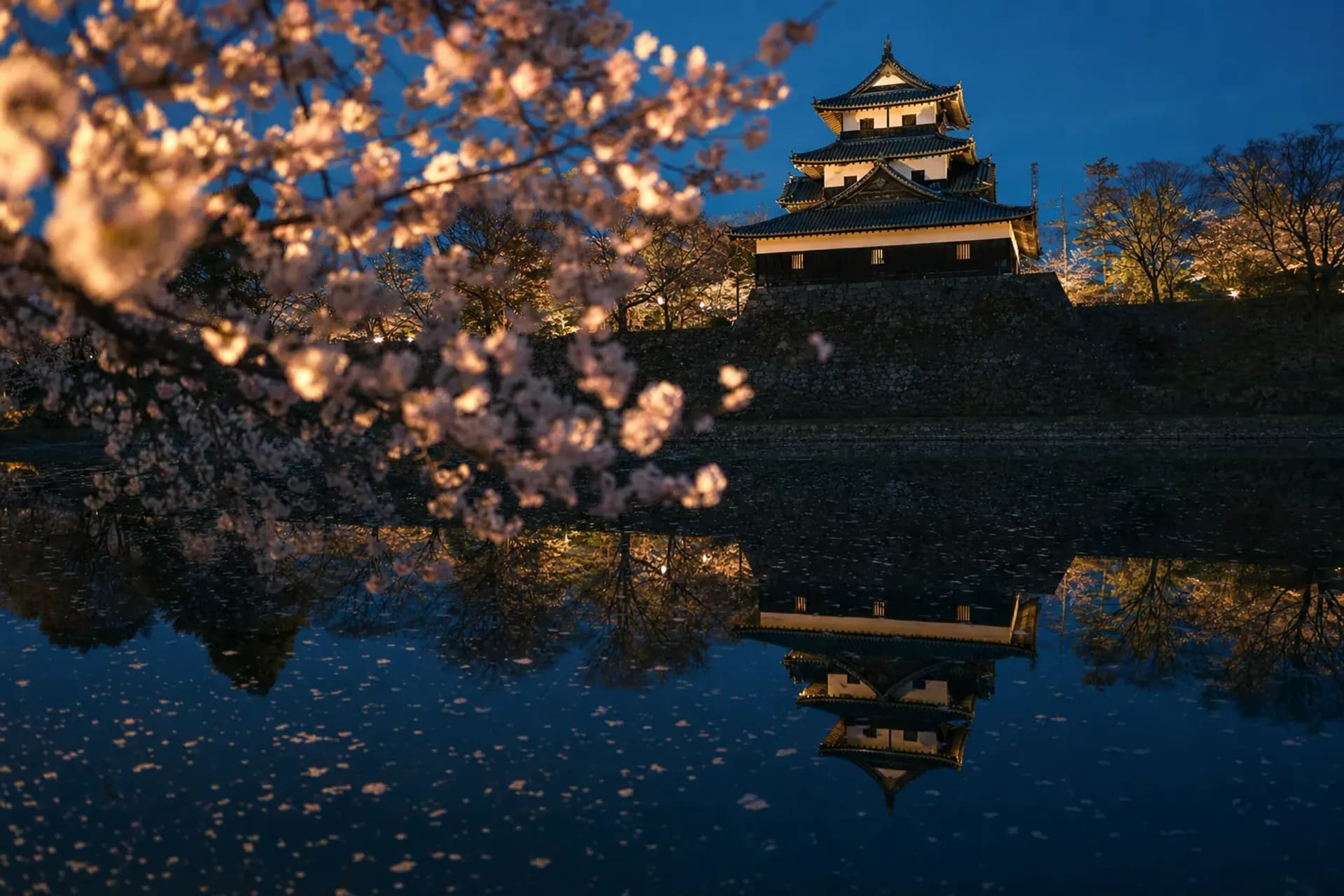
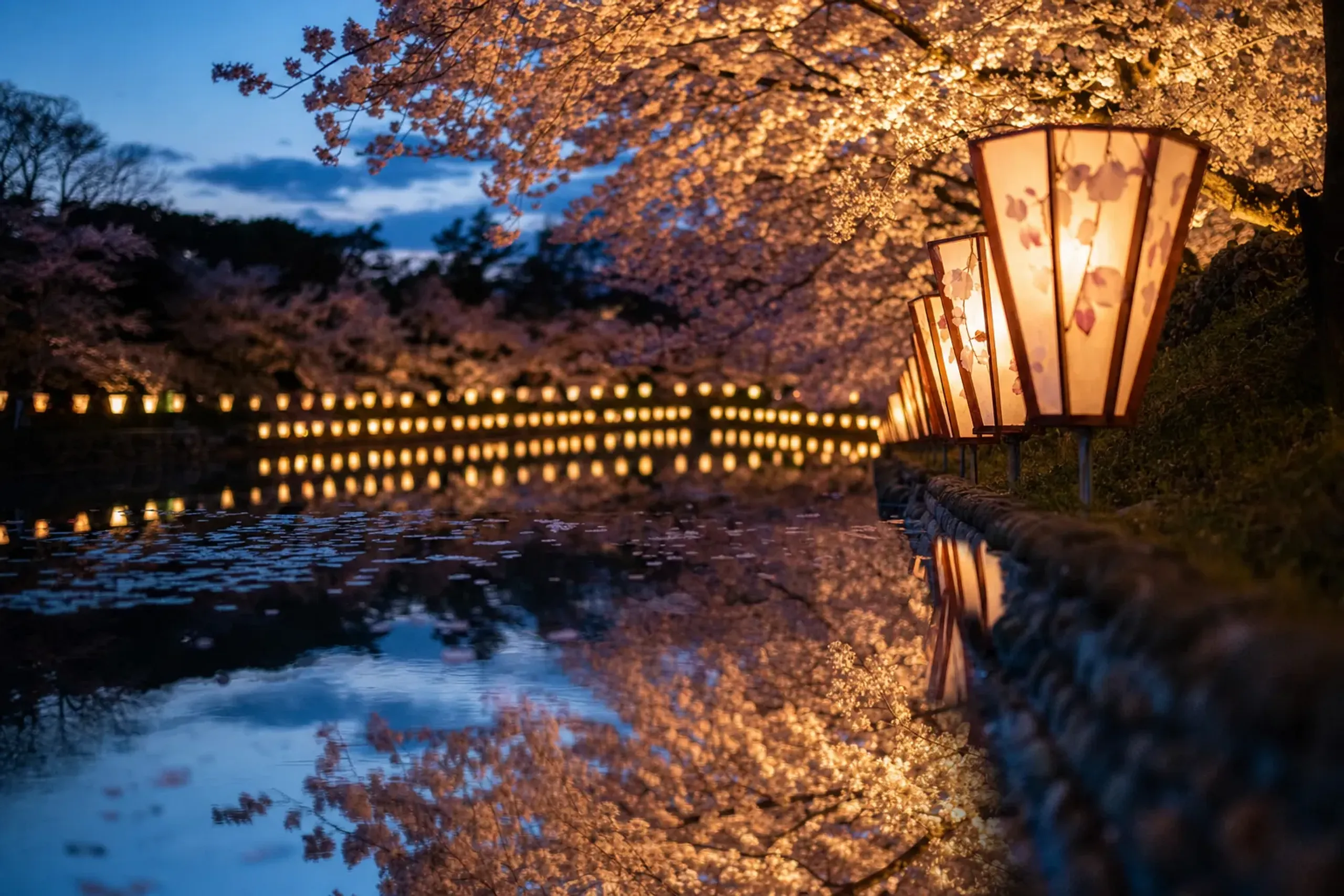
The moat is still. Not glass-still, but close enough that the water holds a second sky. Above it, three thousand paper lanterns burn low against the dark, and four thousand cherry trees lean out over the surface, heavy with bloom. Then you look down. Every lantern is there again, softened. Every branch. The three-story turret at the park's centre, lit from within, stands twice — once in the air and once on the water, joined at the waterline where the reflection begins.
This is Takada Castle Site Park in Jōetsu, Niigata, on a night in early April. Our team at Japan Royal Service sends travellers here for one reason above all others, and it is not the ranking. It is what the moat does to everything above it.
What "One Of Japan's Three Great Night Cherry Blossoms" Actually Means
Takada is named, alongside Ueno Onshi Park in Tokyo and Hirosaki Castle Park in Aomori, as one of Japan's Three Great Night Cherry Blossoms. That is the phrase you will see on every listing. But the phrase is a claim. The reflection is the reason.
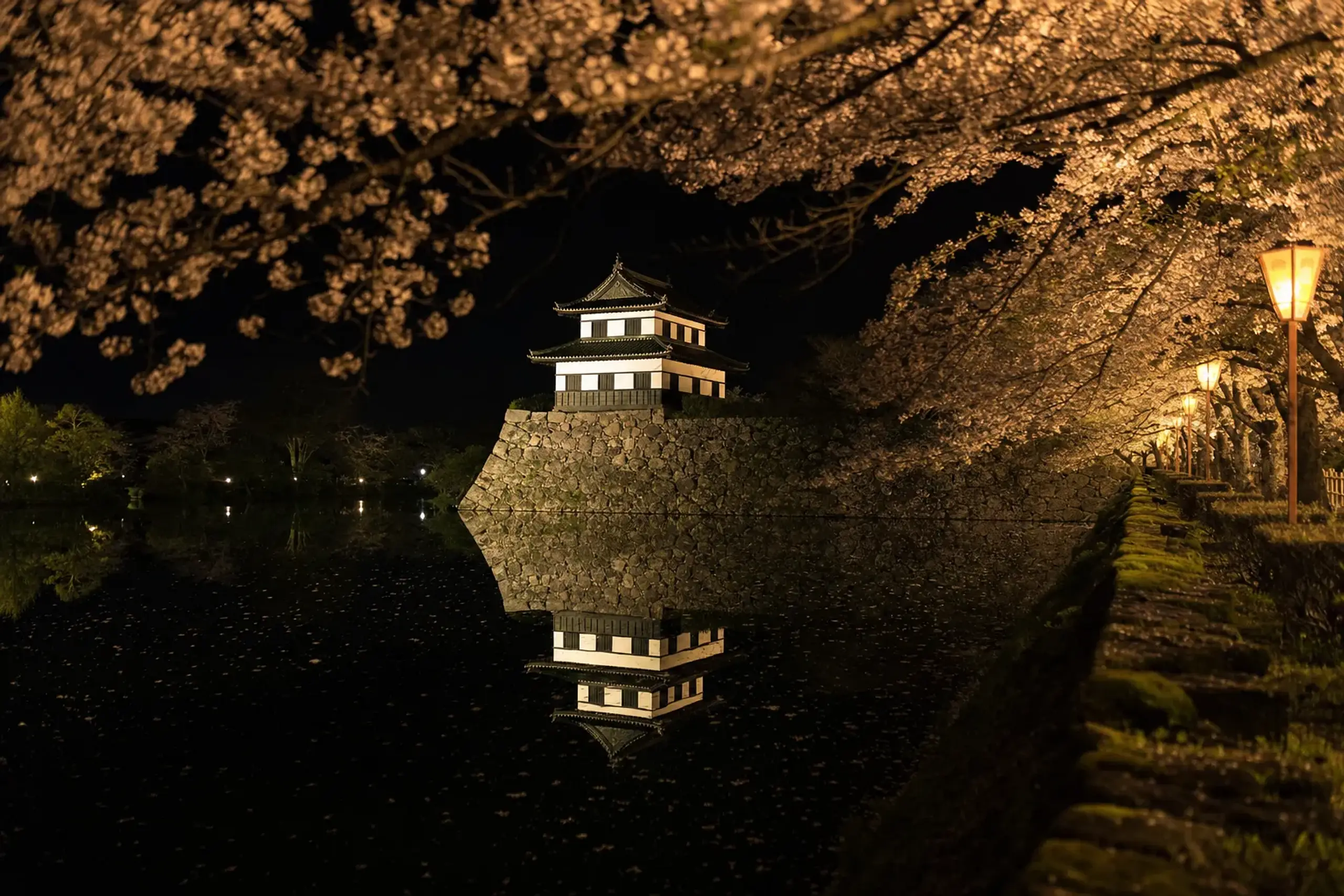
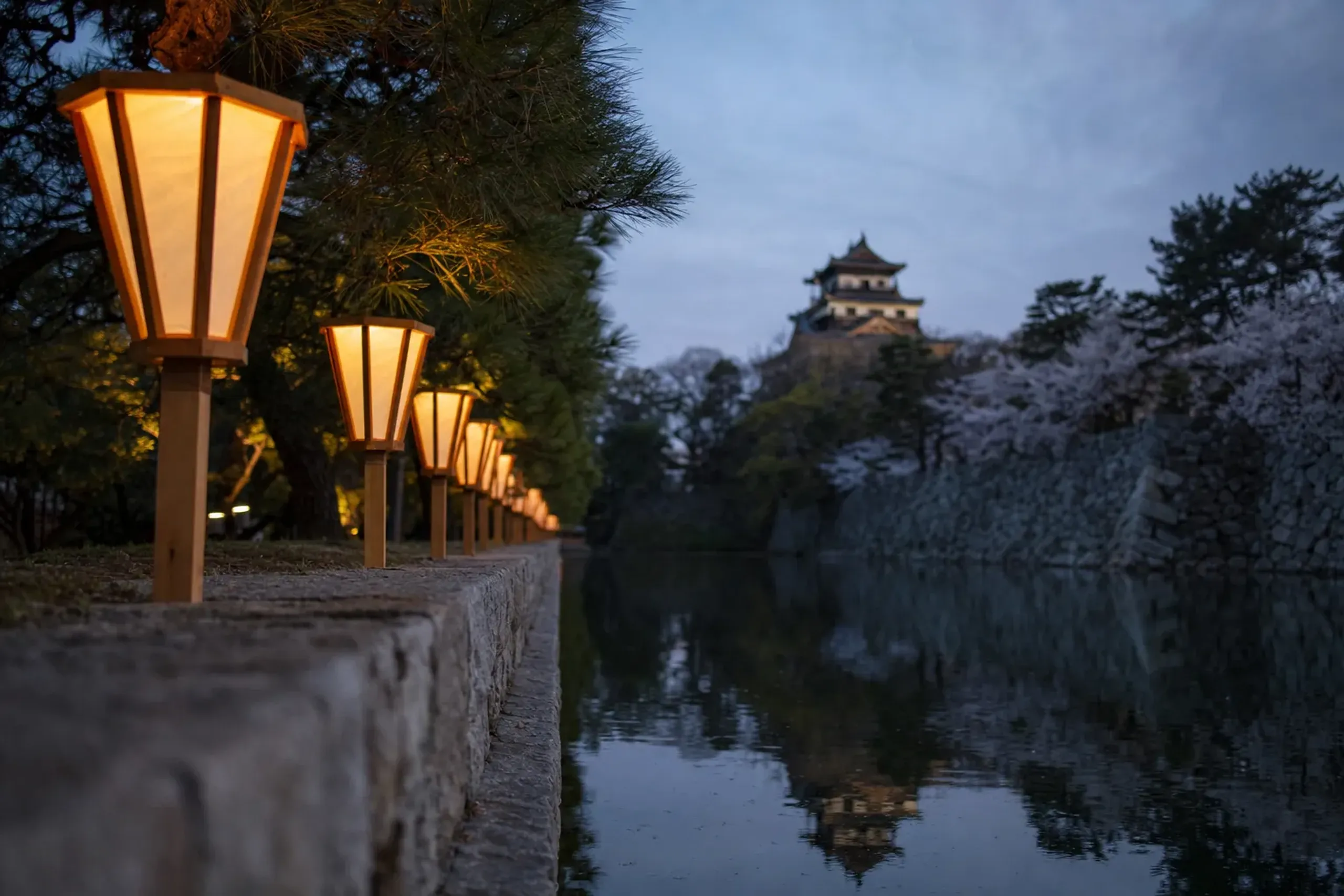
Consider the mechanism plainly. Roughly 4,000 cherry trees fill the park and the ground around it. About 3,000 bonbori lanterns line the paths and the water's edge. The reconstructed turret is illuminated. And the old castle moat sits beneath all of it, wide and calm, doubling the whole scene. This is not blossom lit at night. It is blossom built to be seen twice — once overhead, once below.
We have taken guests to Ueno, which we covered in our Tokyo blossom guide as daytime public infrastructure. Ueno earns its place among the three on scale and history. Takada earns it on water. If you have already seen night blossom in a great park and found yourself wanting something quieter and stranger, this is that thing.
The Festival: Dates, Lanterns, And Why The Window Moves Every Year
The Takada Castle Site Park Kanō-kai runs for roughly two to three weeks in early April, but the exact dates shift annually — the 2026 edition, the 101st, is scheduled for 3–19 April. The window is not fixed.
Here is the proof it is real. The 100th festival ran 28 March to 13 April in 2025. The 101st runs 3 to 19 April in 2026. That is a shift of nearly a week. Organisers set the dates each year to capture three weekends around the expected peak, based on recent bloom patterns. This is scheduling logic, not marketing language.
Key fact: Festival dates at Takada are set fresh each year to include three weekends near peak bloom. Confirm the current year's window before committing to travel — a 2025 date will not match 2026.
On ordinary festival nights the illumination and lantern lighting run from 18:00 to 21:00. During peak bloom the lights stay on until 22:00. The opening evening usually carries fireworks synchronised to music — worth planning for if you want the loud version of the night, though most of our guests prefer the quiet ones that follow.
Several smaller illuminated features run inside the festival window on their own sub-schedules: the cherry blossom nursery garden, the reference bloom-tree storytelling display, and the Gimyō River night blossom nearby. The Gimyō River stretch in particular sometimes opens on a slightly earlier and shorter window than the main festival. Do not assume they overlap perfectly. Our concierge confirms each sub-event's dates for the year in question.
Admission to the park is free. The Sanjū Yagura turret carries a small separate fee for its interior. Takada is a public municipal park, not a gated venue — the luxury here is in the timing and the access, not the ticket.
The Turret, Doubled On The Moat
At the centre of the park stands the Sanjū Yagura — a three-story turret, roughly 15 metres tall. It was rebuilt in 1993, based on historical records and excavation, to restore the appearance the structure held before the castle was pulled down. The park itself occupies the site of Takada Castle, built for Matsudaira Tadateru, the sixth son of Tokugawa Ieyasu. That is the whole of the history you need.
What matters at night is what the turret becomes. Lit from inside and out, it throws a long column of colour onto the moat. Wind moves the water and the reflection breaks into ribbons, then knits itself back together when the surface settles. Stand at the right point on the bank and you cannot easily tell where the turret ends and its reflection begins.
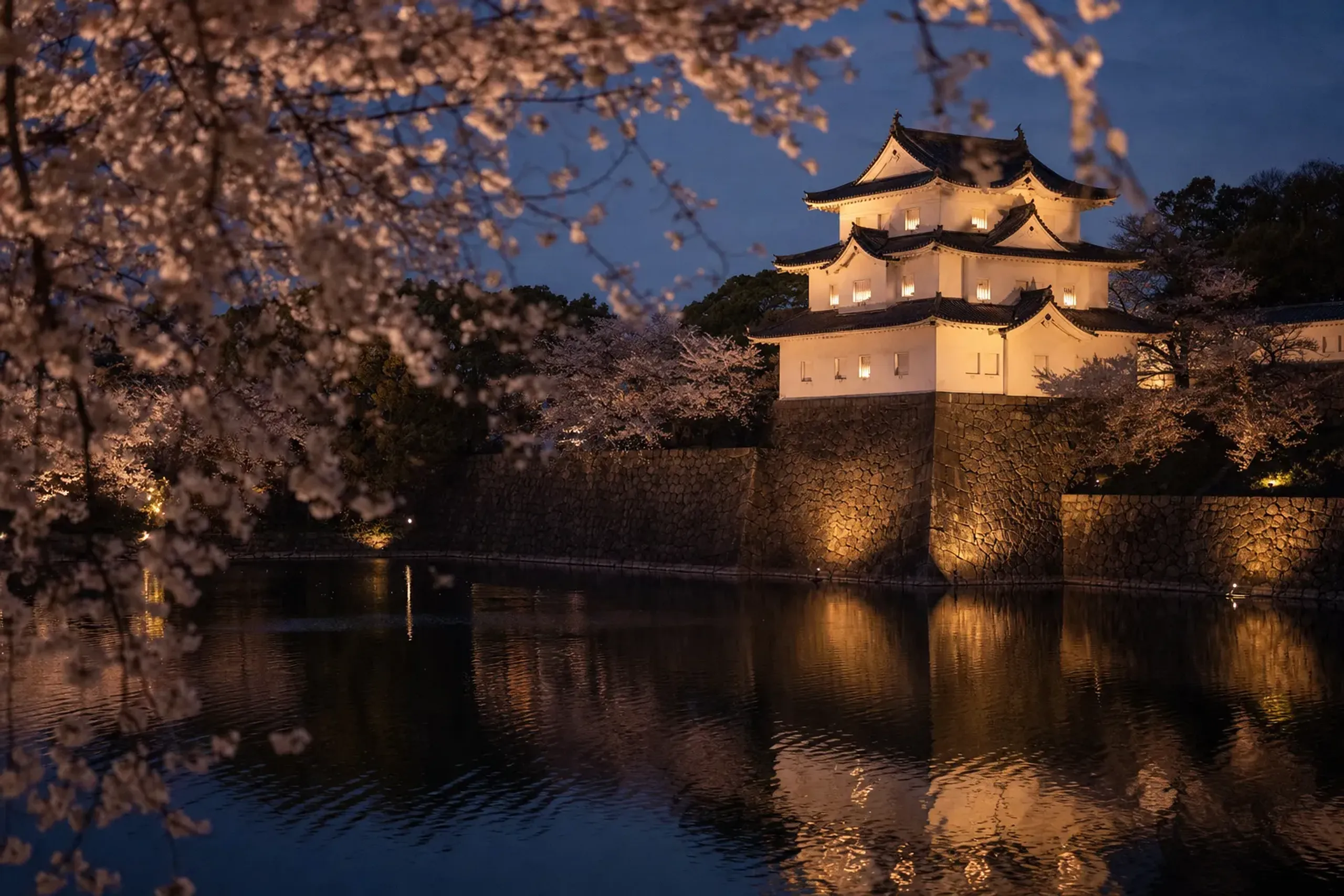
People go quiet here. It is that kind of sight.
Sakura Road: Castle, Blossom, Mountain In One Frame
Sakura Road is the single best image the park offers. It is a tunnel of cherry trees along the park's paths, arching overhead until the branches nearly touch. Walk it at the right hour and you get three distinct layers stacked in one view.
The turret. The moat reflection beneath it. And on a clear day, snow-capped Mount Myōkō rising in the background behind the whole scene. Castle, blossom, mountain — three layers, one frame. You will not find this composition in Kyoto or Tokyo. It belongs to the Sea of Japan side, where the mountains still hold their snow while the trees below open into bloom.
Blossom overhead, blossom mirrored underfoot, a mountain behind. If you care about the photograph — or simply about standing inside something that does not exist elsewhere — this is why you come.
Beside the memorial tower stands a reference tree, the kanjuboku, used locally to declare the season's bloom. During the festival a storytelling performance is staged beside it, in the same manner as the standard trees used in Tokyo and Osaka. If you want that mechanism explained, our Osaka Castle blossom guide walks through it.
How Do You Avoid The Worst Crowds At Takada Castle Cherry Blossom Festival?
Arrive in mid-afternoon, see the daytime grounds, and be in place as dusk turns to lantern-light. The worst congestion falls in the dusk-to-dark window on peak weekends, when everyone arrives at once for the illumination.
This is not a vague caution. The bottleneck at Takada is formally documented. Jōetsu City, the local Chamber of Commerce, the Tourism Convention Association, and a national river and roads office jointly run a named initiative — the Takada Castle Site Park Kanō-kai Traffic Congestion Countermeasures Project. It partners with a parking-space-sharing platform to crowdsource private parking from nearby individuals and businesses, precisely because official temporary capacity falls short and illegal roadside parking recurs every year.
Eight designated temporary parking areas operate during the festival, alongside general parking and the shared-space platform. Free shuttle buses run from Jōetsu City Hall on weekends and from the Jōetsu Sports Park, and locals describe them as the comparatively smooth way in.
The precise answer, then, is a timing answer. Come mid-afternoon. Walk the grounds while the light is still high and the food stalls are unhurried. Take a seat, or a slow lap of the moat, as the sky drops toward blue. Be standing at the water when the lanterns come up and the turret catches fire on the surface. You will have seen the full day-to-night transition and missed the crush entirely. Arranged transport is how you execute that timing reliably — arriving and leaving on your own clock rather than the crowd's.
How Do You Get To Takada Castle Site Park?
Takada Station on the Echigo Tokimeki Railway is about a 15-minute walk from the park. From the Hokuriku Shinkansen, alight at Jōetsu-Myōkō Station, connect to the Echigo Tokimeki Railway's Myōkō Haneuma Line to Takada Station, then walk.
By road, the park sits about 10 minutes from Jōetsu-Takada IC on the Hokushinetsu expressway, or about 15 minutes from Jōetsu IC on the Hokuriku expressway. That said, driving directly to the venue on a peak weekend puts you inside the exact congestion the traffic project exists to manage. This is where a chauffeured arrival earns its keep. Our private transportation lets you time the run for mid-afternoon and step out at the edge of the walkable zone, rather than circling for a space that does not exist.
Niigata, The Prefecture Most Blossom Travellers Skip
Niigata sees far fewer international visitors during blossom season than Kyoto, Tokyo, or Osaka. That is worth saying plainly, and worth saying only once. It is not undiscovered — the festival draws large domestic crowds — but it is off the international Golden Route, and that changes the texture of a night here. Fewer foreign voices, more room at the water's edge, a blossom event that still runs to a community rhythm rather than a tourist one. For a traveller building a follow-the-blossom itinerary, Takada is a strategic and quieter stop between the major hubs.
Frequently Asked Questions
When Is The Takada Castle Cherry Blossom Festival In 2026?
The 101st Takada Castle Site Park Kanō-kai is scheduled for 3–19 April 2026. Dates shift each year to capture three weekends near peak bloom, so always confirm the current year's window before booking travel.
What Time Does The Night Illumination Start At Takada?
Illumination and lantern lighting run from 18:00 to 21:00 on ordinary festival nights, extending to 22:00 during peak bloom. Arrive in mid-afternoon and stay through dusk to see the full day-to-night transition without the peak-weekend crush.
Why Is Takada Considered One Of Japan's Three Great Night Cherry Blossoms?
Because of the moat. Roughly 3,000 lanterns and 4,000 illuminated cherry trees sit on still water and are doubled by reflection, alongside the lit three-story turret. It is joined in the ranking by Ueno Onshi Park in Tokyo and Hirosaki Castle Park in Aomori.
Is Takada Castle Cherry Blossom In Niigata The Same As Takada In Nara?
No. This festival is at Takada Castle Site Park in Jōetsu, Niigata Prefecture, on the Sea of Japan side. It is unrelated to the Takada Senbonzakura in Yamatotakada, Nara. Confirm the prefecture when planning to avoid routing to the wrong place.
Can You Reach Takada By Shinkansen?
Yes. Take the Hokuriku Shinkansen to Jōetsu-Myōkō Station, connect to the Echigo Tokimeki Railway's Myōkō Haneuma Line to Takada Station, then walk about 15 minutes to the park.
Why Choose Japan Royal Service
What we arrange at Takada is straightforward: guiding, transfers, and accommodation. We do not oversell it. The park is public and free to enter, and the real value lies in getting the timing right and the movement quiet.
In our experience, the difference between a memorable night and a frustrating one at Takada is entirely logistical. Arriving before the dusk surge. Standing at the best point on the moat as the lanterns rise. Leaving without joining the queue back to the station. Our concierge builds Takada into a broader tailor-made itinerary — following the blossom front from an earlier bloom in Tokyo north to Niigata, as we describe in our Kansai and Kyoto planning notes — so a single festival night sits inside a coherent trip rather than a scramble. Discretion runs through all of it. Where you stay and how you move remains yours alone.
To plan a night at Takada, or to weave it into a spring journey across Japan, reach our team privately via WhatsApp or LINE, or contact us here. We will build the timing around the water.